Hardin County / Grades 9 to 12
Radcliff Online High School
Some students are needed at three o’clock every afternoon, and no amount of planning moves that. A parent on rotating shifts, a deployment, a grandparent who cannot be left alone, younger children who have to be collected. This is an online high school where the coursework happens in the hours that are actually open.
- Grades 9 to 12
- Accredited
- Self-paced
- No fixed class times
- Start any month
- Certified teachers
Or call (888) 242-4262 on a weekday and ask for admissions.
Read This First
What Is Radcliff Online High School?
One thing to be clear about before anything else: nothing here changes what is happening at home. We change when the coursework happens, and that is the whole of the offer. A family that needs help with the situation itself needs something other than a school.
Radcliff Online High School is an accredited online high school diploma program for grades 9 to 12, taught by certified teachers, with no fixed class times and no register. Families in Hardin County come to it when a student is reliably unavailable during part of the day and reliably available at some other part of it. The admissions process asks for a grade level. It does not ask why.
- There is no attendance register to fall behind on, which for this student is usually the first thing that was going wrong.
- Progress is measured by self-paced coursework completed and marked, not by hours sat in a room.
- The diploma is accredited and records nothing about the hours a student kept.
- All 24 required credits still have to be earned. The timing moves and the requirement does not.
- Start dates are monthly, so nothing waits for a term to turn over. High School of America admits in every month.
Three Reasons a High School Day Stops Fitting
They arrive differently and they end up in the same place, which is a student missing the last period twice a week and an attendance record that no longer describes anything true about them.
| What changed | What it does to the school day |
|---|---|
| A parent’s hours moved | Rotating or night shifts mean somebody has to be home at a fixed time. In a one-car household it often also means the school run stops working. |
| Somebody at home needs looking after | An illness, a recovery, an elderly relative. The need is not dramatic and it is not temporary, and it lands on whoever is available at three. |
| A parent is away | A deployment or a job that takes somebody out of the house for months. The oldest child absorbs the gap, usually without anybody deciding that they would. |
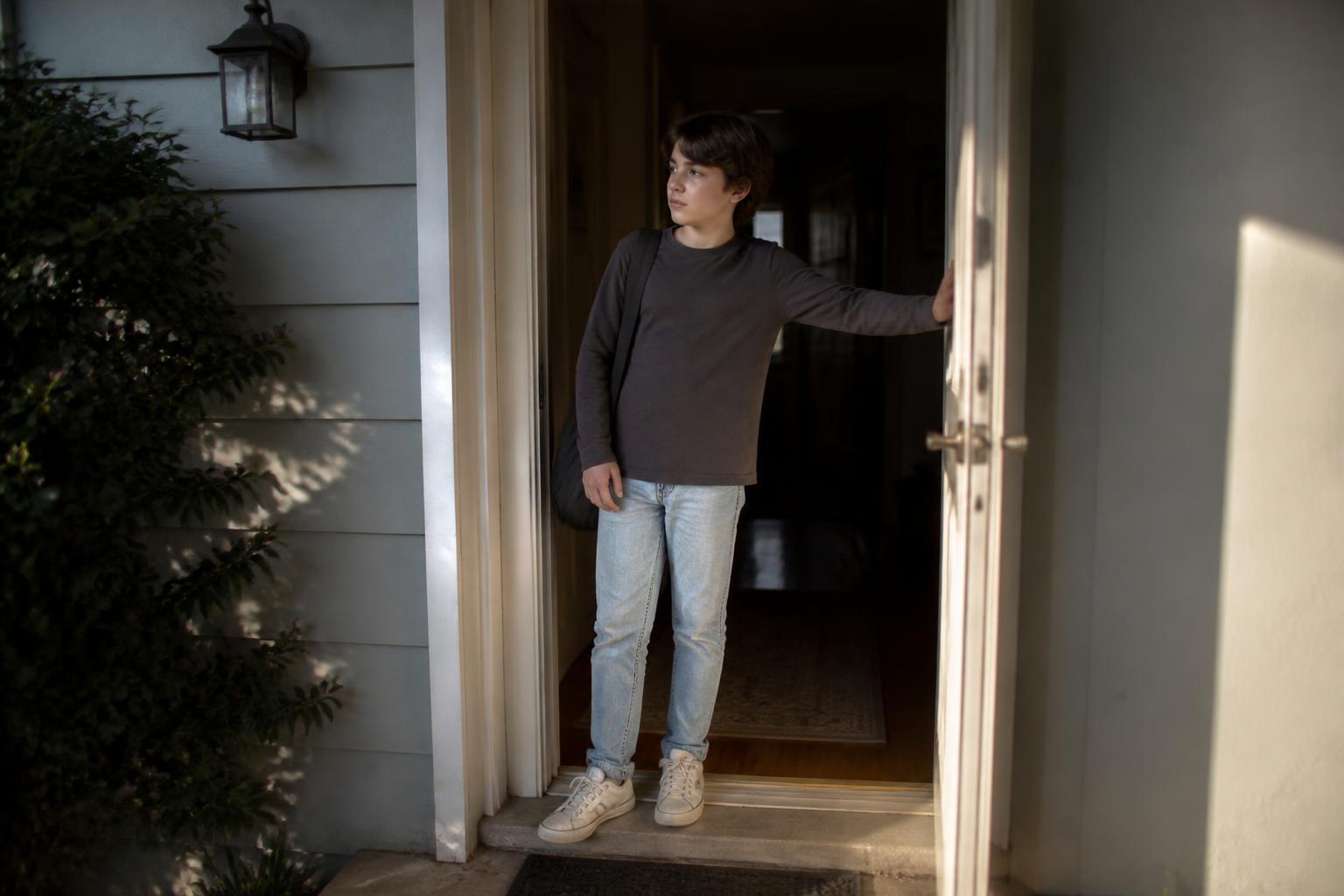
When Staying at the District High School Is Better
In three situations it clearly is, and they are worth ruling out deliberately rather than assuming. None of what follows is a reason to move a student.
- 1
The building is the one place that is theirs. For a student who carries the house, school is sometimes the only part of the day with no responsibility in it. Taking that away to solve a timetable problem is a bad trade and it is not always obvious from outside.
- 2
Nobody has asked the school yet. Counseling offices deal with this more often than families expect and can sometimes rebuild a schedule around an open last period. Ask before concluding there is nothing.
- 3
It is genuinely temporary. A recovery with an end date, a deployment with a return date. Six weeks of disruption is a problem for credit recovery to mop up, not a reason to change schools.
What follows assumes the situation is ongoing, the school has been asked, and the afternoons are genuinely not available.
Which Online High School Courses a Year Contains
The same subjects as any other high school year, and nothing about this page changes the content of them. A ninth grade year is English 1 alongside Algebra 1, with Biology for the science requirement and World History for the social studies one. Tenth moves on to English 2 and Geometry, with Chemistry and an elective such as Art History and Criticism filling out the year.
The courses are the courses. Nobody gets a shorter reading list because their afternoons are spoken for, and a diploma that worked that way would not be worth carrying into an admissions office.
Eleventh is English 3 with Algebra 2, Physics and United States History, and twelfth carries U.S. Government, Pre-Calculus for students continuing with mathematics, and whatever remains outstanding. The full high school course list holds considerably more than the spine, and a counselor builds the actual year from what a transcript says is already done rather than from the grade a student happens to be in.
Laid out by year, that is 9th grade online, then 10th grade online, 11th grade online and 12th grade online. A self-paced student frequently sits across two of those at once, finishing a course left half-done last year while starting this year’s, which is a thing a timetable cannot do and a private online high school can.
How Credits Get Earned Around an Afternoon
By moving the work to the hours that are reliably empty, which for most of these students is early morning and late evening rather than the middle of the day. That sounds obvious and it is the entire mechanism. A fixed timetable spends a student’s most available hours on travel and registration and then asks for homework during the hours that are already spoken for.
- The empty hours
- Usually six to eight in the morning and eight to ten at night. Shorter blocks than a school day but almost never interrupted.
- The contested hours
- Three until seven. Collections, meals, somebody else’s appointments. Nothing should be scheduled here, and a plan that quietly assumes it will fail in the second week.
- The slack
- At least one day a week with nothing planned on it. A week with no slack breaks the first time something at home overruns, and then the student concludes the arrangement does not work.
What the afternoons look like, and nothing more than that. A counselor building a schedule needs to know which hours are unavailable. They do not need the reason and will not ask for it.
What Usually Goes Wrong in Month One
Most arrangements that fail do not fail because the student could not do the work. They fail in the second or third week, when something at home overran on a Tuesday and the plan had nothing in it that could absorb a lost evening. By Friday the student is behind, and being behind is what makes people conclude the whole thing was a mistake.
- One day a week with nothing planned on it, kept empty on purpose rather than filled the moment it looks wasteful.
- The heavier subjects early in the week, while there is still room to recover a lost evening.
- Reading last, because reading survives being done at a bad hour and written work does not.
A week built to survive that has two properties. It has one unplanned day in it, and it front-loads the heavier subjects rather than saving them for the end. Science and mathematics move first, while the week still has room to recover, and reading goes last because reading can be done badly-timed and still count. Families who draw the week that way tend to still be running the same plan in March. Families who fill every open hour in September usually are not.
Enrolling in Online High School From Radcliff
It starts with a transcript and not with a decision, which is the part most families get the wrong way round. The document establishes what is already earned against the 24 credits, and until it has been read, every estimate of how long anything will take is arithmetic performed on a guess.
The sequence is short. The current school issues the transcript on request and a family does not have to explain why they want it. A counselor reads it and returns a written breakdown of what is met and what is outstanding, before any payment. Courses then open on an agreed date rather than at a term boundary, and transferring credits is a records job that happens in the background. A student does not withdraw from the district school until there is a confirmed start date, because withdrawing early creates a gap in enrollment for no reason at all.

Tuition, and What Changes When Circumstances Do
Tuition does not move with a student’s circumstances, and the current figures live on the tuition page rather than here, where they would go stale. What does move is how many courses remain, and a student arriving with credits already banked is not paying for a full year of them. The savings page covers how that is worked out.
Circumstances at home change, sometimes quickly, and the enrollment does not have to change with them. A student whose afternoons open up can take on more; one whose situation gets heavier can slow a course rather than drop it. What the diploma records is the credits completed, not the rate at which they were completed, and that is precisely what a fixed school year could never accommodate.
No school fixes what is happening in a house. What a school can do is stop being one more thing that has to be managed around it.
Radcliff sits in Hardin County next to Fort Knox, and local information is with the City of Radcliff. The district is Hardin County Schools, and state rules on enrollment and withdrawal sit with the Kentucky Department of Education, which a family weighing a change of school should check rather than taking ours for it. Families relocating on orders will want the Elizabethtown page, which covers what a move does to a record. Other cities are on the Kentucky hub and the younger grades are covered by the K-12 program. North and south of Hardin County: Louisville, Bowling Green and Jeffersontown.
Graduation, the Diploma and What Comes After
The diploma is issued by us, it is accredited, and it records that the requirements were met. It does not record the hours a student kept or why they kept them. A transcript shows courses, terms and grades, which is what every transcript shows.
| Stays with the district | Comes with the student |
|---|---|
| School teams, band and theatre | The accredited transcript a college admissions office or an employer reads. |
| Anything run out of the building itself | The diploma, which records that the requirements were met and nothing about the hours. |
| Nothing else | The credits already earned, which belong to the student rather than to a school. |
Students carrying on locally often go to Campbellsville University or one of the regional campuses, and an accredited transcript is where that conversation starts.
- Accredited
- The school has been reviewed against an external standard, which is what makes the record readable to a registrar who has never heard of us.
- The transcript
- Courses, terms and grades. It is the working document, and it is what a receiving school asks for.
- The diploma
- The statement that the 24 credits were met. It is issued once, at the end, and says nothing about the schedule that produced it.
What Hardin County Families Ask About Enrollment
These five come up on nearly every first call, and the answers are the same whoever is asking.
Does the school need to know what is happening at home?
No. A counselor may ask which hours of the day are unavailable, because a schedule cannot be built without that. The reason is not recorded anywhere and nobody will ask for it.
Is a student who cannot attend during the day considered truant here?
There is no attendance register to be marked absent from. Progress is measured by coursework completed and marked, which is why this arrangement suits a student whose availability is irregular but real.
Can the student go back to the district school later?
Yes. Credits earned here sit on an accredited transcript and transfer like credits from anywhere else. The receiving school decides how they apply to its own requirements, exactly as it would for any transfer student.
Is this the same as homeschooling?
No, and the difference matters here more than usual. A parent is not teaching and is not responsible for the curriculum or the records, which is the whole point in a household where the adults are already stretched. Families wanting the younger grades want the K-12 program for Radcliff instead.
What if the situation at home resolves?
Then the schedule gets rebuilt with more hours in it, or the student transfers back. Neither is difficult and neither needs deciding now. Choosing this is not a door that locks.
Start a Radcliff Enrollment
A grade level is the whole of what the form asks for. If a student is needed at home, ask the district school what it can do first, because sometimes it can do quite a lot. If that has been asked and the answer was no, a counselor here will read the transcript and tell you what the year actually needs.
Or call (888) 242-4262 on a weekday between 9:30 and 5:30 Eastern.