

12th Grade Online Classes
Let me tell you something about 12th grade online classes: senior year is where course progress, transcript planning, and post-graduation plans converge into a finish line. I love a finish line.
I’ve watched every kind of senior cross mine. The student closing out graduation credits while college applications pile up. The athlete finalizing recruitment between tournaments. The transfer who landed late and needs a clean runway to June. The teen eyeing the military, a trade, a gap year, or a dual-enrollment seat that already has them halfway into college reading.
Online senior year, done right, doesn’t fight any of that. It bends around it. Coursework moves at the student’s pace with advisors and academic specialists on call. The transcript stays current. The graduation map is visible. Credits earned, credits left, courses queued. Parents can stop guessing how the year ends.
Want to see exactly what your 12th grader needs to finish? That’s a counselor conversation, and the Eagle has one ready.
- Talk to the Eagle now: call (888) 242-4262
- Schedule a call: pick a time that works
- Start enrollment: begin today, send the transcript after
Why Senior Year Matters
Senior year is the year the record closes. Transcripts get final, credits get counted, and the file a college, employer, or recruiter actually reads is the one your student finishes building between August and May.
Three things have to be true for a 12th grade year to land.
One, the credit math has to work. Final transcripts go out after graduation, and colleges request mid-year reports along the way. The courses on the schedule in September are the courses being judged in March. A senior who needs the required credits and is sitting at 18 in August has a real plan to build, not a vague one.
Two, the rigor has to match the plan. Admissions readers look at senior year for Pre-Calculus or Calculus, a fourth science like Physics, a fourth year of English, and whatever AP or dual enrollment a student can carry honestly. Honest is the operative word. A loaded transcript a student didn’t actually finish reads worse than a focused one they did.
Three, the calendar has to cooperate. The Common Application opens in August. FAFSA opens in October. Athletic recruiting peaks early. Online senior year gives a 12th grader room to manage all of it without falling behind on coursework.
For seniors heading toward work, the military, or a trade, the logic holds. Senior year is the bridge. Finishing it cleanly is what opens the next door.
Six Seniors. One Program That Bends to the Calendar.
Senior year does not look the same for every student. The program flexes around the work. The work itself stays accredited.
The Finisher. You are close. A few requirements left, a transcript that already tells most of the story. Move at your own pace, knock out what is missing, hold your timeline. Upload the transcript, get a clean credit map, finish what you started.
The College-Bound Senior. Applications, recommendation requests, FAFSA, scholarship deadlines. Course load matters — so do the hours you need for essays. Coursework runs on your schedule so the application work gets the attention it deserves.
The Athlete. Showcases, signing windows, training blocks, travel weeks. Log in from a hotel after a tournament. Submit assignments before practice. Recruiting is a job in the back half of senior year. Treat it like one, and let your classes follow you instead of the other way around.
The Performing Artist. Conservatory auditions, portfolio deadlines, callbacks, industry meetings. The craft demands rehearsal hours a traditional bell schedule cannot give back. Build coursework around the audition calendar, not against it.
The Late-Arrival Transfer. You moved. The new school will not slot you in cleanly. You started senior year somewhere else and need to land it. Enroll now. Send the transcript when you have it. Get a precise plan to finish the year on a tight runway.
The Next-Step Senior. Gap year. Trade school. Military. A job already lined up. Finish strong, finish clean, walk into what comes next with nothing unfinished behind you.
Ready to map your senior year? Call (888) 242-4262.
The Senior-Year Course Stack
Senior year has a job to do. Finish the core sequence. Build a transcript that tells a clean story. Leave room for the work that points where the student is actually going. The course list below is built around that job.
Core Subjects
English IV. The capstone of the four-year English sequence. Advanced literature, college-level essay structure, and a research project that holds up on a transcript. The reading load is real, the writing gets workshopped with a advisor, and the final portfolio is something a senior can point to in an application.
Pre-Calculus. For seniors who finished Algebra 2 in 11th grade, Pre-Calculus closes the math sequence and opens the door to Calculus. Functions, trigonometry, analytic geometry, sequences. The problem-solving that shows up on placement tests. The math course that signals readiness without overcommitting the schedule.
Physics. A lab science with the math to back it up. Mechanics, energy, waves, electricity. Seniors who already cleared Biology and Chemistry use Physics to round out a four-credit science transcript. What selective programs in engineering, nursing, and the sciences look for.
U.S. Government. The 12th-grade social studies anchor in most states, and the one our seniors take in the fall semester. Constitutional structure, civic participation, policy, the federal-versus-state framework. Paired with Economics in the spring, it completes the social studies sequence.
Advanced and Elective Options
Three things shape the elective half of senior year. One, where the student is going. Two, what the transcript still needs. Three, what the student actually wants to learn before graduating.
Accelerated seniors continue into Calculus after finishing Pre-Calculus early. Students aiming at humanities or pre-law strengthen the writing side with Art History and Criticism. Independent capstone projects, foreign-language continuation, and Economics for the second-semester social studies credit all live in this slot. Transfer seniors who arrive missing fine-arts, health, or elective credits can usually clear them in a single semester and stay on a normal graduation timeline.
Every senior’s path is different. A counselor reviews the transcript, names the gaps, and builds the schedule from there. Call (888) 242-4262 to start that conversation.
How Online Senior Year Works
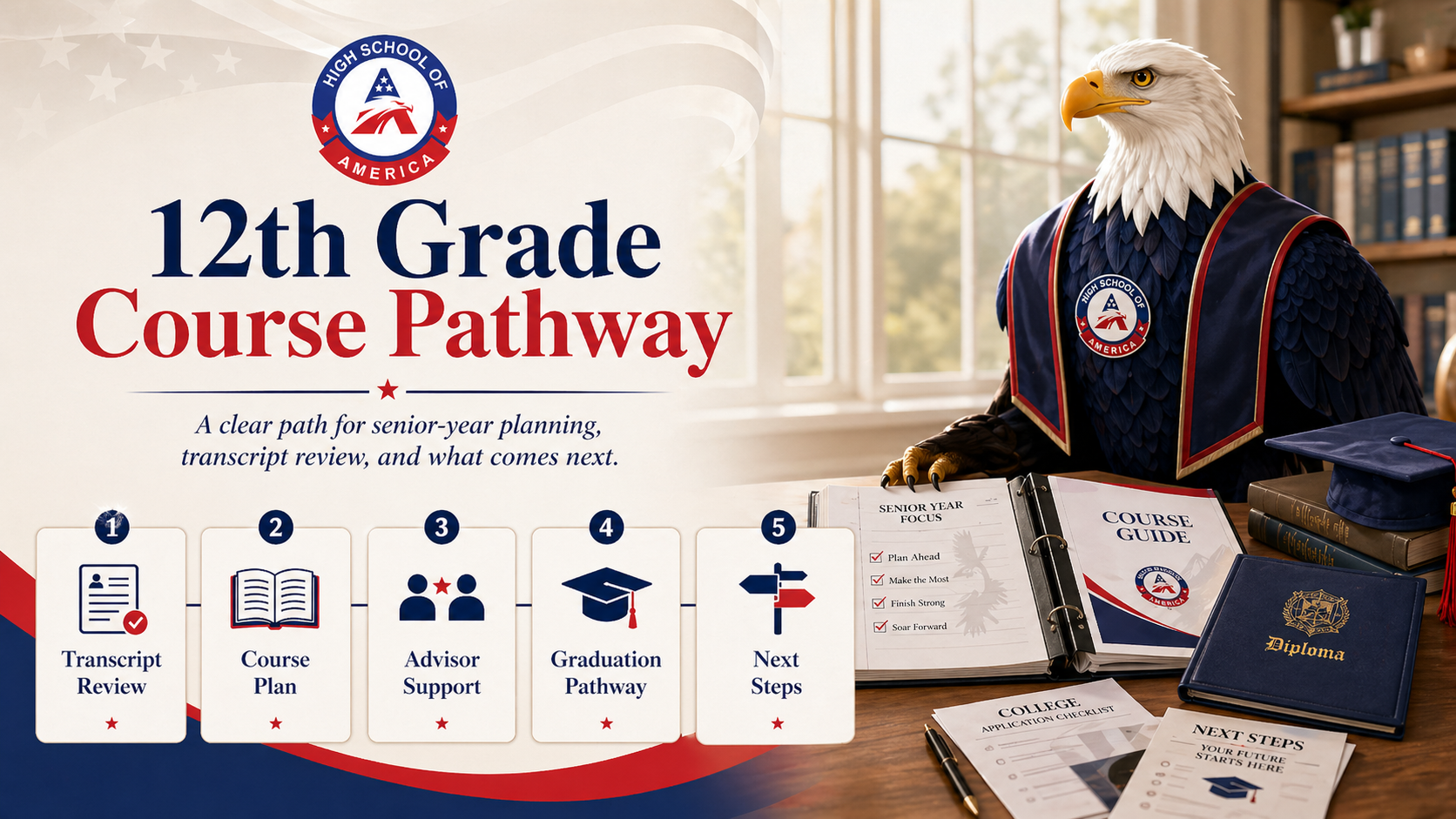
Six phases, fall through spring. Each one has a job. Parents see every checkpoint on the same dashboard the counselor uses.
1. Transcript review of grades 9-11. Before a senior opens a single assignment, the registrar pulls the transcript and runs a course audit. What’s complete. What’s missing. Whether prior credits transferred cleanly. Common Application schools want a full record from grade nine forward, so the audit is thorough on purpose. Families without a transcript in hand can still enroll. Text it, email support@highschoolofamerica.org, or upload it during enrollment. The official evaluation follows.
2. Senior course plan. The counselor builds the final-year schedule around what’s left and where the student is heading. Senior English. Government and Economics. The math or science still pending. Financial literacy if the destination state requires it. Electives that match a college major or a career pivot.
3. Self-paced weekly schedule. Coursework opens online. The student sets the rhythm; the teacher sets the pacing benchmarks. Travel athletes work around tournaments. A senior working two evenings a week can put in two hours of English after dinner. The pace is the student’s. The deadlines aren’t.
4. Counselor check-ins. Heavier in fall around early action and early decision deadlines. Heavier again in spring as acceptance letters land and post-graduation plans firm up. Parents see what the counselor sees: grades, assignments, pacing, teacher comments.
5. Mid-year transcript pull. Around January, applications often request an updated transcript. The registrar generates and sends it directly.
6. Final transcript and what comes next. Coursework completes, the credential is issued, and planning shifts to college, military, trade, or work. The file stays available for verifications long after senior year ends.
The Senior-Year Audit
Before a senior registers for a single course, our counselors pull the 9-11 transcript apart line by line. English sequence intact? Lab science complete? US History on the books? Government and Economics still owed for senior year? The audit names what is finished and what is left, and the senior plan is built around that gap. Not a generic course list. Families upload the transcript during enrollment, text it, or email it to support@highschoolofamerica.org. Students can begin coursework while the official credit evaluation is finalized.
From there, the plan takes shape around the destination. College-bound seniors work backward from the Common Application, which opens August 1, and the FAFSA, which opens in October. Counselors schedule the mid-year transcript send into the winter and the final transcript into June, so admissions offices receive what they need on the timeline they expect. Military-bound students plan around ASVAB windows. Trade-school applicants align coursework with summer or fall start dates. Gap-year students can request a transcript hold and reactivate sends later.
None of this guarantees an admission decision or a scholarship. What it does ensure is that the paperwork behind a senior never becomes the reason a door closes. Call (888) 242-4262 to start the senior-year transcript review with a counselor at High School of America.

Inside the Senior Portal
The portal organizes 12th grade online classes into weekly modules. Each module opens with the week’s objectives, then sequences video lessons, structured reading, practice work, and a quiz that returns feedback within the same session. Senior science courses, including Physics, run virtual labs through the browser; simulation tools record data the way a bench notebook would. Discussion threads sit inside each course for Q&A with instructors and peers.
The portal runs on any device a senior already owns: a laptop, a Chromebook, an iPad, a phone in a hotel room between college visits. Coursework saves to the cloud. A quiz started on a kitchen counter can be finished at an airport gate.
The senior view layers on three panels weighted to the final year. A graduation-progress tracker shows credits earned and credits remaining. A college-application calendar overlay marks application deadlines against module due dates. A transcript status panel displays what registrars and admissions offices currently see.
For seniors visiting campuses, traveling for sport or performance, or holding a part-time job, the technology removes the daily commute and keeps the graduation timeline visible inside the same screen where the coursework lives.
Senior year visibility, without hovering
A senior is finalizing college applications, work hours, scholarship essays, and the last credits between now and the finish line. Parents need confirmation, not surveillance.
The parent dashboard shows real-time grades, course progress, and assignment status across every class. The trajectory is visible at a glance: which courses are on pace, which are running tight, and what’s left between this week and graduation.
Progress updates land on a regular cadence. Pacing conversations happen early, not in a panic. If a course slips. Or a senior is juggling heavier outside hours. The academic team reaches out before it becomes a graduation question.
Transcript and credit review is the conversation parents actually want this year. Our team walks through credits earned, credits remaining, and the timeline to finish. That clarity matters: per NACAC’s State of College Admission, the high school transcript ranks among the top factors in admission decisions at four-year institutions. Military enlistment requires the same documentation. Our records are built for that handoff.
Direct access to the counseling team is a phone call away at (888) 242-4262. Senior-year questions don’t wait on a portal ticket.

Preparing for What Comes After Senior Year
Let me tell you what I love about senior spring. The hard work is on the transcript. The coursework is logged, the grades are real, and the path forward belongs to your kid.
Four-year college? I send sealed transcripts wherever the Common App points. Community college or dual-enrollment continuation? Same drill, faster turnaround. Trade school, apprenticeship, a job a senior already loves? The accredited credential travels. Military or a gap year with intention? Recruiters and program coordinators get what they need, in the format they need it.
The same counseling team that walked your senior through 12th grade online classes walks them through the final stretch. Transcript review. Final credit audit. Send-outs to the destination of their choosing.
I don’t promise admission anywhere. Nobody honest does. What I promise is this. When after-high-school arrives, the paperwork is clean, the credential is real, and the next door is yours to walk through.
Call High School of America at (888) 242-4262 when you’re ready.
Senior Year, Answered Plainly
Ten years of seniors have come through this program. The questions repeat. Straight answers below.
What is online 12th grade through this program?
Senior year completed through our accredited K-12 online home school. Coursework, transcripts, and graduation planning live in one place. Students log in, work through courses at their own pace, and finish on a timeline that fits their life rather than a bell schedule.
Is the program accredited?
Yes. High School of America is a nationally accredited K-12 online home school. The accreditation covers every grade, senior year included. Colleges, universities, employers, and the U.S. Military recognize accredited transcripts.
Can a senior transfer in mid-year to finish 12th grade online?
Yes. Year-round enrollment is one of the reasons families come to us. October, January, March. Whenever the timing makes sense. The transcript from the previous school comes in, our team evaluates credits, and the remaining path is mapped from there.
What if we don’t have the transcript yet?
A student can enroll without it. We get them started in coursework, and the official credit evaluation happens once the transcript arrives. Text a photo, email support@highschoolofamerica.org, or upload during enrollment. Whichever is easiest.
How does self-paced actually work for a senior?
No daily Zoom block. No fixed period schedule. Assignments and deadlines live inside each course, but the student decides when in the day to work. advisors and academic specialists respond within 24 hours. A senior balancing a job, a sport, or college applications puts the heavier work where it actually fits.
How much does online senior year cost?
Tuition depends on credits remaining, which is why we don’t post one number. A senior who needs six credits and a senior who needs twelve don’t pay the same. Call (888) 242-4262 and the enrollment team will walk through the breakdown and payment plan options.
Can a senior finish high school online in less than a year?
Flexible pacing is real. The honest answer is that it depends on credits remaining and the student’s work rate. Some seniors arrive with most of the path done and move quickly. Others need the full year. We don’t put a finish date in writing until we see the transcript.
Will colleges accept the transcript?
Accredited transcripts are recognized by colleges and universities nationwide. Individual admission decisions still belong to each institution. Their GPA, test, and essay requirements. The Common Application accepts our transcripts, school profile, and counselor documentation in the standard format admissions offices expect.
Can a senior take dual enrollment alongside 12th grade courses?
Many do. Seniors enroll in community college or four-year institution courses while finishing high school requirements with us. The college sets its own admission and tuition rules. Our team keeps the high school side on track while dual enrollment runs on its own schedule.
What courses are typical for senior year?
Most seniors are finishing English 4, Government, Economics, a final math (often Pre-Calculus or a senior-level option), and any remaining electives or science. Personal finance is increasingly part of the senior plan. The exact list depends on what’s already done. A counselor builds the specific schedule once the transcript is in.
When do the Common Application and FAFSA open?
The Common Application opens August 1 for the following fall’s admission cycle. FAFSA traditionally opens October 1. The 2024-25 cycle ran on a delayed schedule, so families should confirm the current year’s date on studentaid.gov. Senior fall is the window for both.
How does the program prepare a student for what comes after?
Coursework, transcripts, and pacing are the visible part. Underneath that, seniors get counselor support on college applications, Common App documentation, military enlistment paperwork, and workforce planning. The path forward looks different for every student. The accredited record opens the doors; the student walks through.
How does a family get started?
Call (888) 242-4262, schedule a counselor call, or begin enrollment online. Send the transcript by text or email when it’s ready. A senior can be in coursework within days.
Start 12th Grade Online
Ready to map your senior year? Our counseling team pulls your transcript, marks what’s already done, and builds the rest of senior year around what’s actually left. The English credit, the math you still need, the elective slot you’ve been saving. Year-round enrollment means your start date is the week you decide, not next August.