
10th Grade Online Classes
Sophomore year is where the transcript starts to mean something. Freshman credits are on the books, and the next nine months decide whether 11th grade arrives with momentum or with a pile of catch-up.
This is the year a lot of families come to us. A swimmer hits a travel-heavy season and the attendance office stops being patient. A young actor books a role that pulls her out of the building three weeks at a stretch. A family relocates in November and the new district shrugs at half a semester of half-finished credits. A student who’s ready for Geometry or Algebra 2 sits in a classroom that won’t bend the schedule. Sophomore year online gives every one of those students a single calendar that actually fits.
When a student transfers in, an advisor reads the transcript, maps the credits already earned, and lays out the courses still ahead before graduation. The work is self-paced. advisors and academic specialists are on the other end of every course. The plan is built around your student, not the other way around.
The next step is a short conversation with a High School of America counselor.
- Call (888) 242-4262
- Schedule a counselor appointment
- Start enrollment online
Why Sophomore Year Matters
Sophomore year is when the transcript stops being a first impression and starts becoming a record. Tenth grade GPA counts. It sits on the same transcript colleges read, and it compounds with the freshman year already behind your student.
This is also where the course tree branches. Math splits into Geometry or Algebra 2 depending on placement. Science moves from Biology toward Chemistry. A foreign-language sequence locks into year two, the year that starts to count for admissions. PSAT prep usually enters the picture. None of it is dramatic on its own. Together it’s the year a plan either tightens or drifts.
That’s the honest case for taking 10th grade online classes seriously as a structural choice, not a fallback. A self-paced, accredited program lets a sophomore carry a real course load around training schedules, performance calendars, medical appointments, a move mid-semester. The work still gets done. The transcript still tells the right story.
Who Online 10th Grade Works For
The sophomore class on our rosters is not one type of student. Six patterns repeat.
The mid-year transfer. Sophomores arriving from public, private, or charter campuses, often after a fit issue or a move. Transcripts are reviewed at intake; credits earned at accredited schools come with the student.
The competitive athlete. Club-sport and travel athletes in their second varsity season. Training blocks, tournament weekends, and recovery days set the calendar. Coursework is self-paced and runs around them.
The performing-arts student. Audition tours, regional productions, and conservatory prep create weeks a fixed bell schedule cannot hold. Online 10th grade lets rehearsal and academics share the same day.
The continuing homeschooler. Families who taught the elementary and middle years at home and now want accredited credit on the high school transcript. advisors and academic specialists carry the academic load; parents shift back to support.
The accelerated learner. Students ready for Geometry or honors-level science earlier than a campus calendar permits. Pacing is set by mastery, not by a building’s master schedule.
The family in transition. A medical diagnosis, a military relocation, a caregiving season, a safety concern. The reasons differ. The need is the same: a stable accredited K-12 program that travels with the student and does not restart every time the address does.
Different starting points, one program. Call (888) 242-4262 to talk through which path fits your sophomore.
 English II, Geometry, Chemistry or Biology, and World History plus electives.” width=”1200″ height=”858″ loading=”lazy” decoding=”async”/>
Sophomore Year, Built Differently
Most schools hand a tenth grader a six-period schedule and a hall pass. We hand them the keys. Log in when the brain’s on. Move through Geometry the morning of a meet. Knock out a World History reading at 9pm because that’s when the house finally goes quiet. The course list below is real college-prep work. The pacing is yours.
Core Subjects
English II picks up where freshman lit left off. World literature, rhetorical analysis, longer essays, independent argument. By spring, sophomores are writing the kind of paper that holds up in eleventh-grade AP and dual-enrollment classrooms.
Geometry is the standard sophomore math: proofs, transformations, trig foundations, coordinate work. Students who took Algebra I in eighth grade skip ahead to Algebra II and start lining up Pre-Calculus for junior year.
Chemistry is the typical sophomore science once Biology is behind them. Atomic structure, stoichiometry, reactions, lab analysis. Came in without Biology? Take Biology here and slide Chemistry to eleventh. The sequence bends to the student, not the other way around.
World History zooms out. Ancient civilizations through the modern era, with real attention to source analysis and writing. It’s the on-ramp to U.S. History as a junior and Government as a senior.
Electives
Here’s where sophomore year stops being a checklist. Art History and Criticism trains the eye and the argument at once, and reads beautifully on a transcript next to the cores. Spanish I or II keeps the language requirement moving for college admissions. Computer Literacy covers what every junior research paper, internship application, and AP class already assumes a student knows.
Athletes use electives to round out a transcript without burning a school day. Performers slot them around audition seasons. Transfer students backfill exactly what their last school skipped. The full catalog runs deeper than this list, and a counselor at High School of America maps the right four or five to each sophomore. Call (888) 242-4262 to build the schedule.
How Online Sophomore Year Works
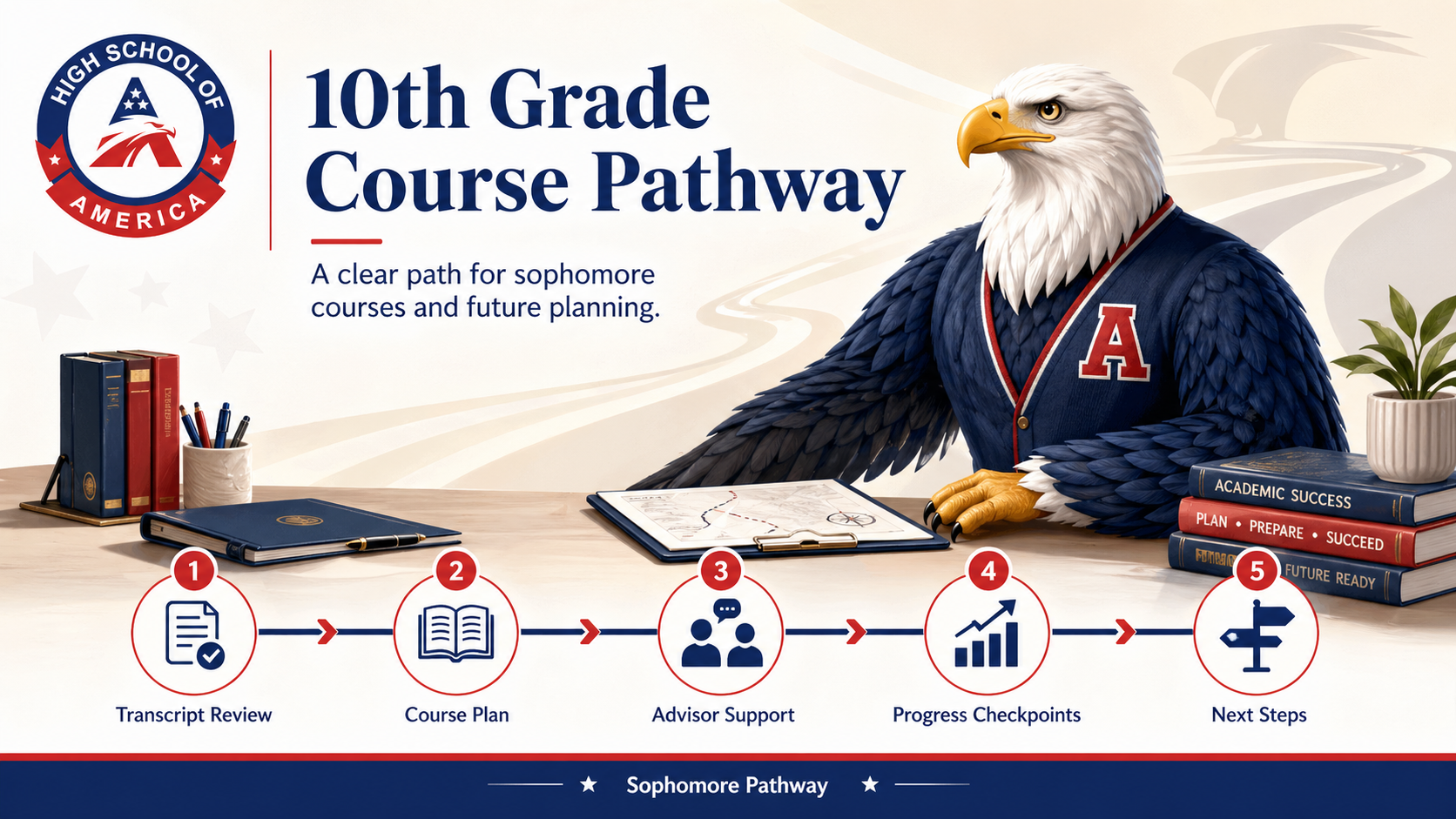
Sophomore year at High School of America moves through a fixed sequence. Each step has a function. Parents see the work at every stage.
Step 1: Freshman transcript review. Families submit the prior transcript by text, by email to support@highschoolofamerica.org, or through the enrollment upload. The registrar reads the record and confirms which courses carry forward. Students can begin coursework before the transcript arrives. The official credit map is finalized once it lands.
Step 2: A course plan built on prior credits and sophomore goals. Tenth grade is where the math and science sequences branch. Geometry typically follows Algebra 1. Chemistry typically follows Biology. The plan also sets English 2, a social studies course, and electives aligned to the student’s direction.
Step 3: A self-paced weekly schedule with pacing benchmarks. Coursework is online and asynchronous. Each course carries weekly benchmarks so a student knows what a productive week looks like. Athletes shift study blocks around training. Working students log hours in the evening. The schedule bends. The standards do not.
Step 4: Teacher response and progress tracking. advisors and academic specialists respond within 24 hours. The parent dashboard reports grades and assignment status in real time.
Step 5: PSAT prep where it fits. Many sophomores sit for the PSAT in October. Coursework covers the reading, writing, and math content the test draws from.
Step 6: End-of-year transcript review. Before 11th grade begins, the counselor confirms credits earned and sets the junior-year course list.
How a Sophomore’s File Gets Read
Since 2008, our counseling team has read transcripts from every kind of school a sophomore might be leaving: public, private, charter, parent-led homeschool, and international programs whose records arrive in two languages. The review is not a formality. A counselor walks the freshman year line by line, maps which courses translate cleanly into our K-12 framework, and flags what needs a closer look. A half-credit elective, a course graded on a different scale, a Biology class that ended at semester.
For families arriving mid-year, that read happens fast. Students can begin coursework before the transcript is finalized; the official credit evaluation runs in parallel. Transcripts can be texted as a photo, emailed to support@highschoolofamerica.org, or uploaded during enrollment. Whichever is easiest for the family is the right one.
From there, the sophomore plan is built backward from where the student is heading. Tenth grade typically lands a student near the one-third mark of the accredited K-12 program, but the real number is the one on the transcript. The counselor identifies any gaps from ninth grade, sets the sequence for sophomore year, and walks the family through what the next two and a half years look like on paper. One conversation, one plan, in writing.
The Portal
One login. Any device. The family laptop is fine. A Chromebook works. So does a tablet on the kitchen table while dinner gets made.
Courses run on weekly modules. Each module opens with a video lesson, moves into structured reading, then practice work, then a quiz with feedback that tells the student what they missed and why. Sophomore science, Chemistry or Biology. Runs virtual labs inside the same environment. No driving to a co-op. No shipping kits.
The pacing dashboard is the part parents actually use. Where the student is in every course, what’s due, what’s graded, how the term is tracking against the course calendar. The sophomore sees the same view. That’s intentional. Tenth grade is when students start owning their own week.
Discussion threads sit inside each course. Messages get answered. Work gets returned.
Log in from a hotel, a kitchen, a tournament lobby, a grandparent’s house two time zones over. The 10th grade online classes don’t care where the desk is. The work is the work.
Visibility without hovering
Sophomore year is when a student starts owning the work. The job at home shifts with it. You stop checking every assignment and start checking the shape of the week.
The parent dashboard is built for that shift. Grades update in real time. Assignment status, course pacing, and time-on-task sit on one screen, so a Sunday-night glance tells you whether your tenth grader is on track or drifting. No calls to a front office. No Friday progress slip in the mail.
When a student stalls, our team reaches out before it becomes a hole: a pacing conversation, a check-in with the student, a note home when extra support is warranted. Families can email support@highschoolofamerica.org or call (888) 242-4262 to talk with a counselor about transcript questions, credit review, or how the path to graduation is mapping out.
Sophomores get room to drive. Parents get the instrument panel. That is what online sophomore year is supposed to feel like, and it is how families track 10th grade without standing over a shoulder.
The Bridge to Junior Year
May of sophomore year has a particular feeling. The hardest sciences are behind. A student who started Geometry in the fall is ready for Algebra II. A student who finished Algebra II is staring down Pre-Calculus. Chemistry wraps up. Physics waits on the next page.
This is when the same counseling team that opened your sophomore file pulls the transcript out and reads it forward instead of backward. What got finished. Where the pacing held. Where the student found a stride. Then the conversation turns to junior year online. The heaviest college-prep stretch on any high school path, and the year standardized testing starts setting its own rhythm against the school calendar.
The plan for 11th grade gets built one student at a time. Math sequence, science sequence, English, history, electives that earn their place on a transcript. We map it together, and the full course catalog is open before any decision gets made. The same counselor stays. The plan just grows up with the student.
10th Grade Online FAQs
What is 10th grade online?
Sophomore-year coursework delivered through a fully online platform. Students log in from anywhere, work through accredited courses at their own pace, and progress when they demonstrate mastery. The standard load covers English 2, a math course (typically Geometry or Algebra 2), a lab science, social studies, and electives.
What is 10th grade online?
Sophomore-year coursework delivered through a fully online platform. Students log in from anywhere, work through accredited courses at their own pace, and progress when they demonstrate mastery. The standard load covers English 2, a math course (typically Geometry or Algebra 2), a lab science, social studies, and electives.
Is online 10th grade accredited?
Yes. The K-12 program is nationally accredited. Coursework, transcripts, and the credential are recognized by colleges, universities, employers, and the military. Accredited credits also travel if a student transfers back to a brick-and-mortar school later.
Can my sophomore transfer credits in?
Yes. The registrar reviews the official transcript from the prior accredited school and maps which 9th-grade and partial 10th-grade credits apply. A student can enroll before the transcript arrives. Once it is received by text, email, or upload, the team finalizes the path.
How is the program self-paced?
No fixed class meeting times. A sophomore opens the course, completes lessons and assessments, and moves to the next unit when ready. Faster mastery means faster progression. A heavier week. A meet, a tournament, a flare-up. Slows the pace without penalty. advisors and academic specialists respond to questions within 24 hours.
How much does online 10th grade cost?
Tuition depends on how many credits a student still needs. Because every transferring sophomore arrives with a different credit balance, the enrollment team builds a quote from the transcript review. Payment plans are available. Call (888) 242-4262 to talk through options with a counselor.
Is online 10th grade good for athletes?
It is one of the most common reasons sophomores enroll. Training blocks, travel meets, and recovery weeks fit around coursework. A student can study on a plane, in a hotel, or between sessions. Parents and coaches track progress through the parent dashboard.
Can homeschoolers continue into online 10th grade?
Yes. Families who homeschooled through 9th grade or earlier often shift into the program at the sophomore level for the accredited transcript and advisor support. Prior homeschool work is reviewed at enrollment, and credits are awarded where documentation supports them.
What courses do sophomores typically take?
A standard 10th-grade load: English 2, a math course, a lab science, a social studies course (often World History), a world language or elective, and physical education or health. Honors options are available in the core subjects.
Should my 10th grader take Geometry or Algebra 2?
It depends on what they finished in 9th grade. Students who completed Algebra 1 typically take Geometry in 10th. Students who finished Geometry in 9th, common on accelerated math tracks, move into Algebra 2. The counselor confirms placement during the transcript review.
Should they take Biology or Chemistry?
Most sophomores take Biology if they did not complete it in 9th grade. Students who finished Biology as freshmen typically move into Chemistry. Physics generally waits until 11th or 12th. Placement follows the student’s completed science sequence, not a fixed grade-level rule.
How does online 10th grade prepare for the PSAT?
The PSAT is administered in the fall of sophomore and junior year. English 2 and the assigned math course cover the reading, writing, and math content the test draws from. Families register through a local high school or testing site, since the PSAT is administered in person.
How does online 10th grade prepare for college?
Through the transcript that builds across sophomore, junior, and senior year. Sophomore courses establish the GPA pattern admissions officers read first. Honors options, a strong English and math sequence, and steady pacing through a lab science give a rising junior the foundation to add regional accrediting commission coursework later.
How do families get started?
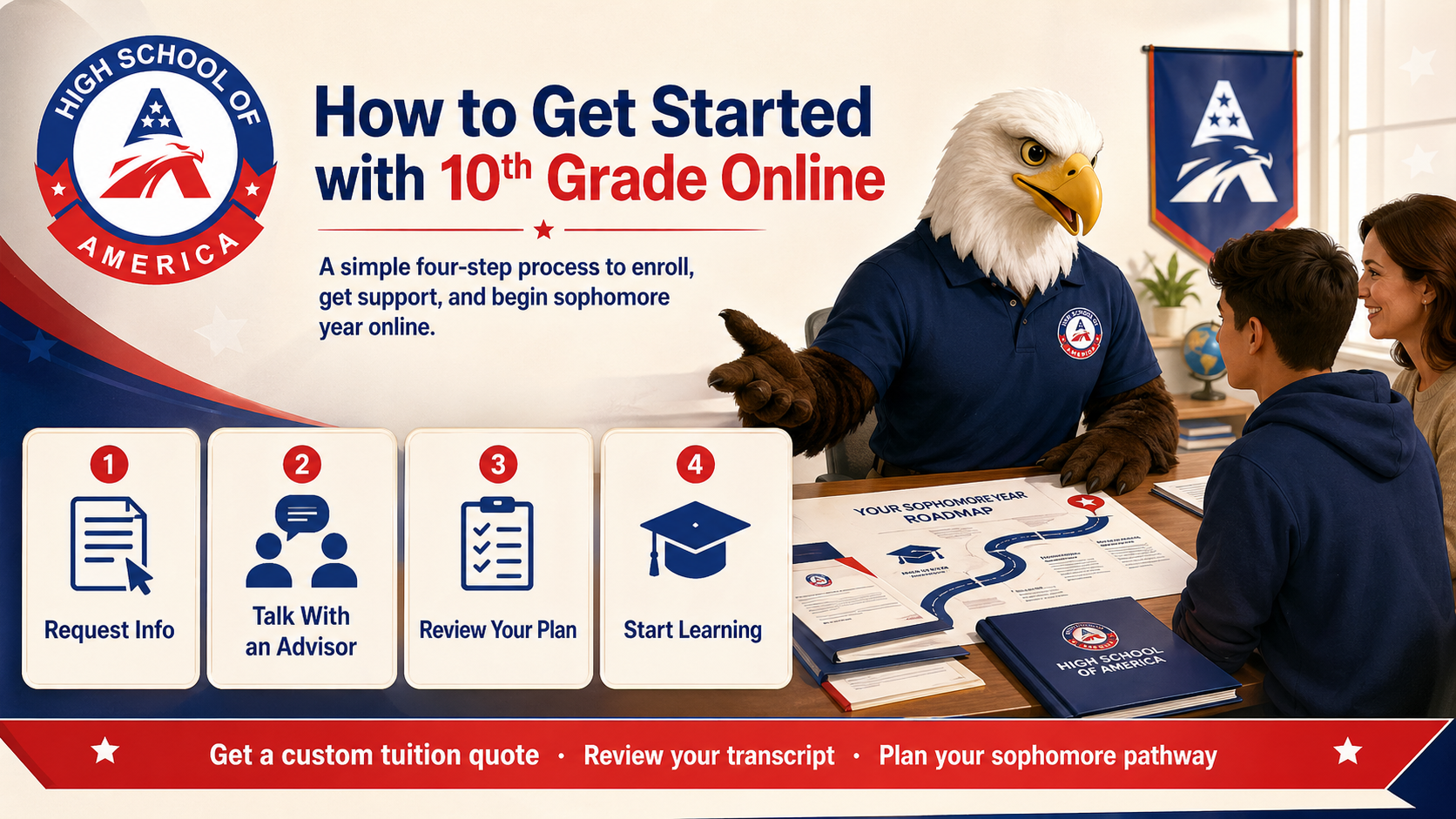
Call (888) 242-4262 or request enrollment information online. The team gathers student information, discusses the sophomore’s situation, reviews the transcript when available, and outlines the path. Enrollment at High School of America is open year-round, so a 10th grader can start any month.
Start 10th Grade Online
Here’s what the next hour can look like. You call (888) 242-4262 around 2:15, and a counselor picks up on the second ring. You walk through where your sophomore is right now. Credits already on the transcript, the courses still owed, what the rest of the year should look like. If the transcript isn’t on the desk, you snap a photo and email it to support@highschoolofamerica.org after dinner. By the next morning, the team has the course plan built around what’s actually done. Enrollment opens. Your student logs in and starts the first lesson.