
AP and Honors Pressure:
When College Prep
Becomes a Crisis
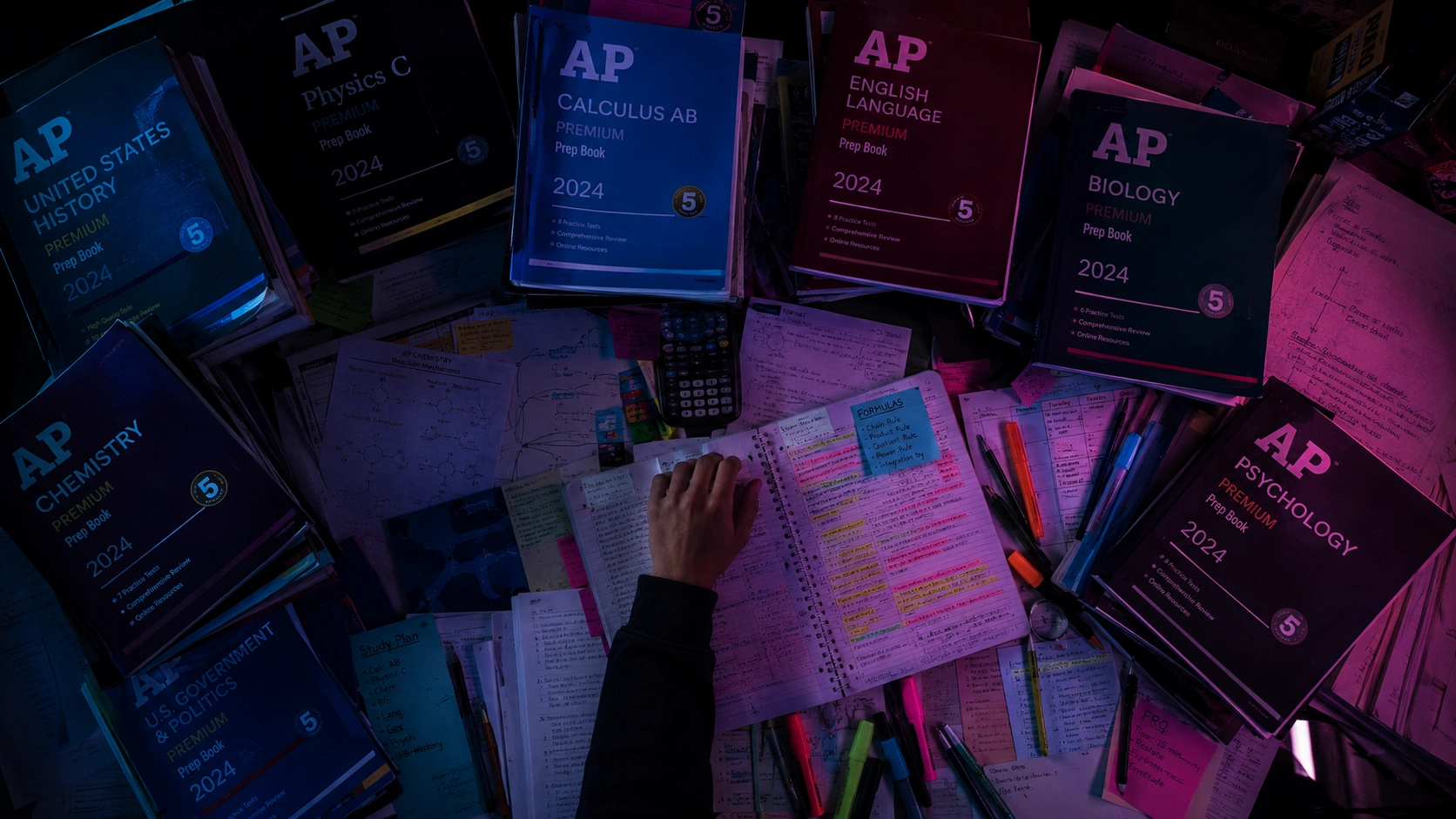
AP pressure public schools face today has turned a tool designed for genuinely advanced students into an arms race that most participants cannot win and nearly everyone is forced to enter.
AP pressure public schools generate is one of the most consequential and least discussed crises in American education. This article covers the data, the damage, and what families across the country are choosing instead.
TL;DR: What You Need to Know
- 71% of AP students take these courses for college admissions strategy or GPA, not because they are genuinely interested in the subject at a college level.
- The national AP exam pass rate is only 58% overall, with many subjects below 50%. Four in ten students who pay $98 and prepare for months fail the test.
- Only 23% of AP credits earned are actually accepted and applied at the college the student ends up attending.
- Students taking 5 or more AP courses simultaneously average fewer than 6.5 hours of sleep per night, well below the recommended minimum.
- The entire AP arms race was created by the competitive public school environment itself. Individual students cannot opt out without appearing less academically serious, regardless of their actual intelligence or potential.

What AP Pressure Public Schools Create Looks Like From the Inside
AP pressure public schools across America face today did not begin as a student problem. Instead, it started as a college admissions problem, grew into a school culture problem, and finally became a mental health crisis. Individual students had no part in creating it. Moreover, understanding this origin matters because willpower, time management, and stress coaching cannot fix a structural problem.
In 1955, the College Board created Advanced Placement courses for genuinely exceptional students who had exhausted their school's standard curriculum and were ready for college-level work. The program was designed to be selective. Taking one or two AP courses in areas of deep personal interest was the intended use case, and it worked well in that context for decades.
The transformation happened gradually as college admissions grew more competitive. First, schools started advertising AP availability as a sign of institutional quality. Then, admissions officers began treating AP course counts as a proxy for academic seriousness. As a result, students who took more AP courses appeared more competitive than those who took fewer, regardless of genuine readiness or interest. The incentive structure took shape, and the arms race began.
What the Arms Race Looks Like in 2026
By 2026, the situation in competitive public schools has reached an extreme that the program's creators could not have predicted. Students in high-ranking suburban districts routinely take five, six, and seven AP courses simultaneously in their junior year. They select courses not based on intellectual passion but on weighted GPA calculations, exam pass rate statistics, and whether the course appears on the published lists of what selective colleges want to see. The result is not a population of intellectually ambitious students preparing for college. It is a population of exhausted teenagers performing a very specific kind of academic theater. The admissions system briefly rewards this theater. Ultimately, however, it demands something entirely different.
Furthermore, very few parents know that the data on this strategy is devastating. The arms race now produces students who are more tired, more anxious, less curious, and less prepared for genuine college-level work than graduates from the same schools twenty years ago. Nobody in the system intended this outcome. However, it is simply what happens when structural incentives operate without supervision long enough.
AP Pressure Public Schools: What the Courses Promise vs. What They Deliver
Earn college credit and skip introductory courses, saving tuition money and time.
Only 23% of AP credits earned are accepted at the college the student actually attends. Many require a 4 or 5, not a 3. Many do not count toward major requirements.
Demonstrate academic rigor and intellectual seriousness to selective college admissions offices.
68% of admissions officers say AP courses are now expected baseline at selective schools, not a differentiating factor. Having them does not get you in. Not having them can keep you out.
Prepare students for college-level thinking and the demands of university coursework.
AP courses teach to a standardized exam, not to college thinking. The skills developed are test optimization skills, not the independent intellectual inquiry university professors expect.
Allow students to explore college-level subjects in areas they are passionate about.
71% of AP students take courses for the weighted GPA boost, not passion. Students in high-pressure schools often take 6 to 8 AP courses, systematically avoiding the ones they actually care about if those courses have lower pass rates.
The AP Pass Rate Nobody Shows Parents Before Enrollment
The College Board publishes AP exam pass rates publicly, but this data is rarely shared with families before students commit to a course load. The national pass rate of 58 percent means that nearly half of all students who take an AP course, spend months preparing, and pay $98 per exam will receive a failing score. The variation by subject is even more striking.
Students in high-pressure schools take AP courses regardless of their genuine preparation or interest in the subject, which drives pass rates down. Students from under-resourced schools pass at significantly lower rates across all subjects, revealing the deep inequity in who actually benefits from the AP system as structured.
AP Pressure Public Schools Generate Damage That Outlasts High School
The effects of carrying an extreme AP load extend well beyond the high school years. In fact, the behavior patterns and beliefs students develop under sustained AP pressure follow them into college and beyond. The following is what the research documents about what actually happens to students inside the AP arms race.
Burnout Before Senior Year
Students who peak their AP load in 11th grade consistently report entering 12th grade already exhausted and disengaged. The cognitive and emotional reserves required to produce genuinely strong college applications have been spent on AP exam preparation. Senior year, which should be the culmination of a high school education, becomes a performance to endure.
Sleep Debt with Lasting Cognitive Effects
Adolescents who chronically sleep fewer than 7 hours per night during the critical developmental window of 14 to 18 show measurable differences in working memory and emotional regulation that persist into early adulthood. The sleep deprivation associated with a 5 to 7 AP course load is not just a temporary inconvenience. It is occurring during a period when the brain requires sleep to consolidate learning and develop executive function.
Loss of Intellectual Identity
Students who spend three years taking AP courses in subjects they are not genuinely interested in arrive at college without a clear sense of what they actually want to study or why. They have optimized for the appearance of intellectual ambition rather than developing genuine curiosity. College advisors and professors consistently report this as one of the most significant challenges facing first-year students from high-pressure AP environments.
Inability to Handle Unstructured Intellectual Work
AP courses teach to a standardized exam. The skills they develop are: identifying what the rubric wants, producing it efficiently, and moving on. College coursework increasingly demands the opposite: genuine inquiry, tolerance for ambiguity, and sustained engagement with difficult ideas without a clear right answer. Students trained entirely in AP environments are often poorly prepared for this transition.
Financial Waste at Scale
At $98 per exam in 2026, a student taking 6 AP exams per year for two years spends $1,176 in exam fees alone, not counting tutoring, prep books, or courses. If 42% of those exams yield failing scores, and only 23% of passing scores will be accepted at the college attended, the financial return on AP investment is poor for most families. The costs are real. The benefits are frequently not.
The Equity Trap
Well-resourced families can afford tutoring, prep courses, and test retakes. By contrast, under-resourced families cannot. The AP arms race systematically advantages students who already have advantages. In under-resourced public schools, AP courses are offered with less support, taught by less experienced teachers, and passed at lower rates. The same tool that appears to democratize college access actually amplifies existing inequalities when deployed at scale in a competitive admissions environment.
Select the number of AP courses your child is taking this school year to see estimated weekly impact.
A student who takes two AP courses they genuinely care about and masters them is better prepared for college than one who takes eight for the weighted GPA and learns to perform all of them adequately.

AP Pressure Public Schools and Grade Inflation: A Compounding Problem
AP pressure does not operate in isolation. It interacts with and amplifies the broader grade inflation problem documented elsewhere in this series. When a student takes a standard course and receives an A, that grade is already inflated relative to what an A represented twenty years ago. When the same student takes an AP course and receives an A, the weighted GPA calculation adds a full point to the benefit, creating an incentive structure that strongly favors AP participation regardless of whether the student is actually prepared for college-level work. Data from the National Center for Education Statistics consistently shows this pattern across public school districts.
How Weighted GPA Punishes Intellectual Honesty
Consequently, a student who takes six AP courses and earns Bs in all of them may have a lower weighted GPA than a student who takes three AP courses, earns As in all of them, and earns As in three standard courses. The system punishes genuine engagement with difficult material and rewards strategic course selection. Students learn this quickly. They respond rationally.
Colleges have responded by creating systems to evaluate course rigor contextually, accounting for what was available at a student's specific school. This adds a layer of opacity to the admissions process that many students and families find deeply confusing: the same transcript that makes a student look well-prepared at one school makes them look over-extended at another. The rules keep changing because the arms race keeps escalating, and no one has an incentive to stop it.
AP Pressure Public Schools vs. What Advanced Learning Without Arms Race Looks Like
The alternative to AP pressure is not less academic challenge. It is academic challenge organized around the student's actual interests and readiness rather than around a competitive signaling system. Accredited online high schools like High School of America are structured around the idea that genuine depth in a few areas of true passion is both more educationally sound and more compelling to selective colleges than strategic breadth in eight subjects chosen for weighted GPA points.
What Healthy Advanced Learning Actually Looks Like
At HSOA, students pursue advanced coursework without the context that makes it destructive. There is no class rank. There is no peer visibility of course loads. There is no social pressure to take more than a student can genuinely engage with. A student who takes one rigorous course in a subject they are passionate about and produces real work in it is not penalized relative to a peer who is taking six AP courses strategically.
- Course selection driven by weighted GPA strategy and peer competition
- Students take subjects they are not interested in to remain competitive
- $98 per exam regardless of preparation level or pass likelihood
- Sleep deprivation normalized as the price of academic ambition
- AP content taught to the exam format, not to genuine understanding
- Students arrive at college exhausted and without intellectual identity
- Advanced coursework chosen based on genuine interest and readiness
- No peer comparison of course loads or competitive signaling environment
- No high-stakes external exams with failure rates built into the structure
- Flexible schedule enables genuine depth without sleep sacrifice
- Content mastery measured through coursework, not a single test day
- Students arrive at college with real intellectual depth and energy
Your Child Can Earn a Rigorous Diploma Without the Arms Race
A common concern about leaving the AP system: will a non-AP transcript look less rigorous to colleges? The honest answer is that admissions offices evaluate rigor in context. A student at HSOA who has pursued genuine depth in their areas of interest, produced real work, and developed intellectual independence is not at a disadvantage compared to a student who took eight AP courses strategically. In many cases they are at an advantage, because they have something specific and authentic to show for their high school years.
Four-year universities across the country, including highly selective institutions, have accepted HSOA graduates. The transcript reflects what a student has actually mastered, not what a weighted GPA calculation suggested they should take. That difference matters, both for admissions and for what happens after the student arrives on campus.
If your child is showing signs of AP and honors pressure, including sleep deprivation, anxiety about course selection, or taking courses they hate because they need the GPA points, there is a different way. Enrollment at HSOA is open year-round.

What Families Who Left AP Pressure Behind Say
Thousands of families have already left the AP arms race behind. Here is what they report after making the switch to a learning environment built around genuine interest rather than competitive course loading.
My son was taking seven AP courses in 11th grade and sleeping four hours a night. He was not learning anything. He was surviving. Switching to HSOA was the first time in two years he said he actually understood the material in a class rather than just knowing what the exam wanted.
My daughter took AP Environmental Science because it had a high pass rate, not because she cared about it. She failed the exam anyway after months of prep. At HSOA she spent that same time going deep on the subjects she actually loves. The difference in her engagement was immediate and obvious.
We spent over $800 on AP exams in junior year. My son passed two of them. The credits were not accepted at the college he wanted to attend because of their transfer policy. HSOA cost less and produced work that actually reflected what he knew rather than whether he had a good day in May.
Our daughter was choosing AP courses the way some people pick stocks, purely for the weighted GPA return. She had no idea what she actually wanted to study. A year at HSOA changed that entirely. She arrived at college knowing exactly what she was interested in and why, which no amount of AP courses had given her.
Frequently Asked Questions
AP and honors pressure refers to the expectation in competitive public school environments that students must take as many Advanced Placement and honors courses as possible to remain competitive for college admissions. Specifically, this pressure is largely structural: as more students take AP courses, any student who takes fewer is perceived as less academically serious regardless of their actual learning or interests. As a result, students take 5, 6, 7, or even 8 AP courses not because they are genuinely interested but because the system rewards the appearance of rigor.
The American Association of Guidance Counselors recommends no more than 4 to 5 AP courses total across all four years of high school for most students. Similarly, the College Board itself states that students should take AP courses only in subjects they find genuinely interesting and are prepared to handle at a college level. In reality, however, competitive public schools look dramatically different: many 11th graders are taking 5 to 8 AP courses simultaneously, far exceeding any guideline and creating genuine mental health risks. Therefore, one or two well-chosen AP courses in areas of genuine passion are far more valuable than 8 strategically selected for GPA points.
AP courses were originally a differentiator in college admissions. However, grade inflation and the arms race have eroded that advantage significantly. Today, at selective institutions, a full slate of AP courses is now expected rather than impressive. Furthermore, admissions officers are trained to identify students who took AP courses for GPA inflation versus genuine intellectual engagement. Consequently, a student with 3 to 4 genuinely selected AP courses is typically viewed more favorably than one with 8 strategically chosen courses.
The national AP exam pass rate (score of 3 or higher) is approximately 58 percent. This means roughly 4 in 10 students who take an AP course, pay $98 per exam, and spend months preparing do not receive a passing score. Pass rates vary dramatically by subject: AP Calculus BC has a pass rate above 80 percent while subjects like AP Environmental Science and AP World History hover around 48 to 50 percent. Students in under-resourced schools pass at significantly lower rates than those in affluent districts.
While many colleges accept AP exam scores for credit or placement, the percentage of AP credits that students actually use at their specific college is far lower than most families realize. In fact, a 2023 analysis found that colleges accept and apply only about 23 percent of AP credits earned. Many selective universities accept AP scores only for placement, not credit. Others require a score of 4 or 5 rather than 3. Additionally, many students find their AP credits do not count toward their chosen major's requirements.
Students taking 5 or more AP courses simultaneously show significantly elevated rates of anxiety, sleep deprivation, and burnout. Notably, research from Stanford found that students in high-AP-load environments averaged fewer than 6.5 hours of sleep per night, well below the 8 to 10 hours recommended for adolescents. Moreover, the high-stakes nature of AP exams compounds the pressure: a single bad test day after months of preparation can derail a student's GPA strategy, creating a constant state of performance anxiety tied to a system the student cannot fully control.
Honors courses sit between standard and AP courses in difficulty level and exist in most public school systems. The pressure dynamic is similar: students feel compelled to take all available honors courses to protect their class rank and appear academically competitive, even when they are not genuinely ready for or interested in the subject. Unlike AP courses, honors courses do not carry college credit potential, which means the only benefit is the weighted GPA boost. This creates an environment where students take honors courses purely for the number, not because the coursework serves their learning or future goals.
Accredited online high schools like High School of America operate outside the AP arms race entirely. HSOA students pursue advanced coursework based on genuine interest and academic readiness rather than competitive positioning. There is no class rank, no peer comparison of course loads, and no social pressure to take more than a student can genuinely engage with. Advanced coursework at HSOA is designed to challenge students intellectually and build real depth in areas they care about. Graduates earn a fully accredited diploma without having subjected themselves to a course load designed for college admissions strategy rather than actual learning.
Your Child Deserves to Learn, Not Just Perform
High School of America is a fully accredited online high school where advanced coursework is chosen for depth, not competitive positioning. No AP arms race. No $98 exam fees. Just genuine learning and a real diploma.