
Your Child Takes 0 Standardized Tests Before Graduation
American students are tested more heavily than those in any other developed nation, and the research shows it is not making them smarter. Here is the full picture.
TL;DR: What You Need to Know
- The average American K–12 student takes 112 mandatory standardized tests before graduation, more than students in any other developed country.
- During the peak testing years (grades 3–8), students face 20 to 25 distinct standardized assessments in a single school year.
- Research consistently shows this level of testing narrows the curriculum, raises anxiety, and does not improve learning outcomes.
- More than 4 full school days per year are spent simply taking tests, not counting weeks of test prep that displace real instruction.
- Accredited online K-12 programs operate entirely outside the public school standardized testing framework.
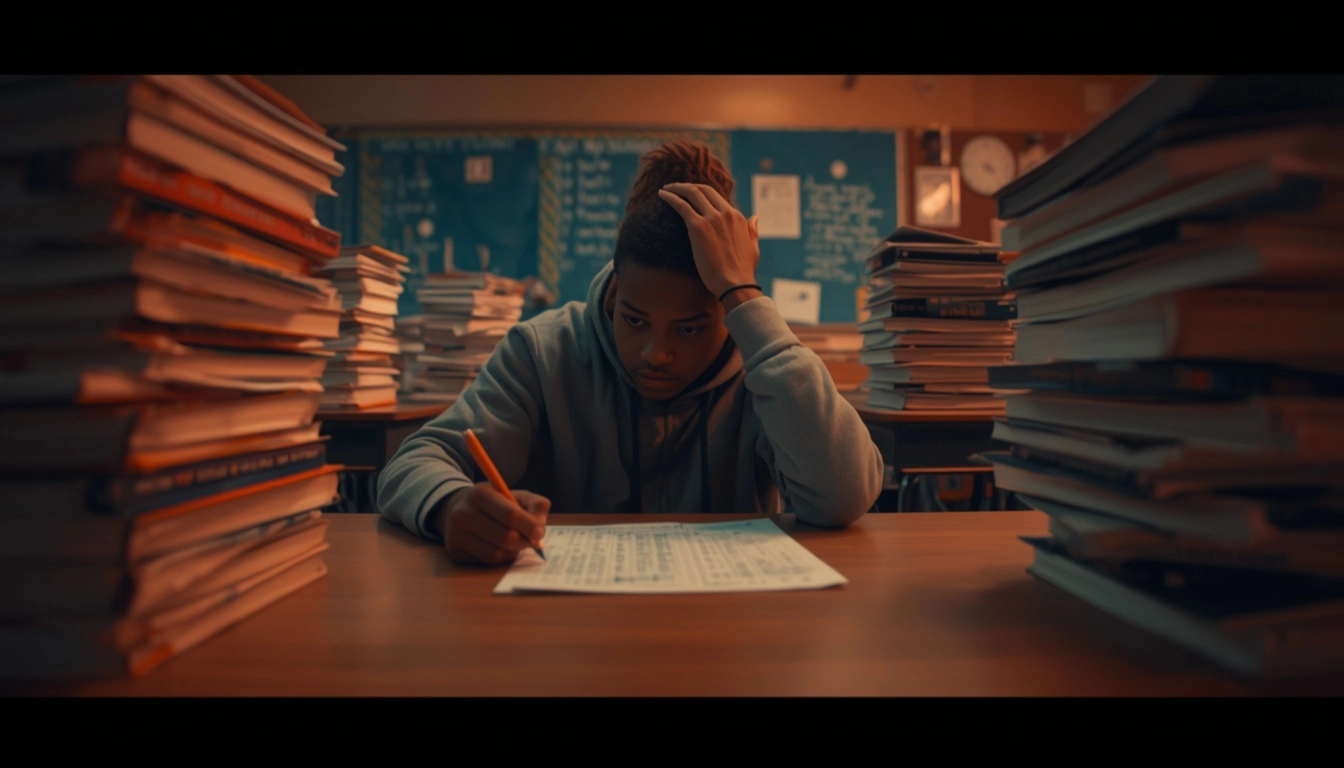
What Standardized Testing Overload Actually Looks Like From the Inside
When most parents hear "standardized testing," they picture the SAT or ACT, the college entrance exams taken once or twice in junior year. That picture is wrong by a factor of roughly five.
The testing landscape your child navigates every year is a layered system of federal mandates, state requirements, district benchmarks, and college-readiness exams, all stacked on top of each other with very little coordination about their cumulative impact on students. What follows is a look at each layer.
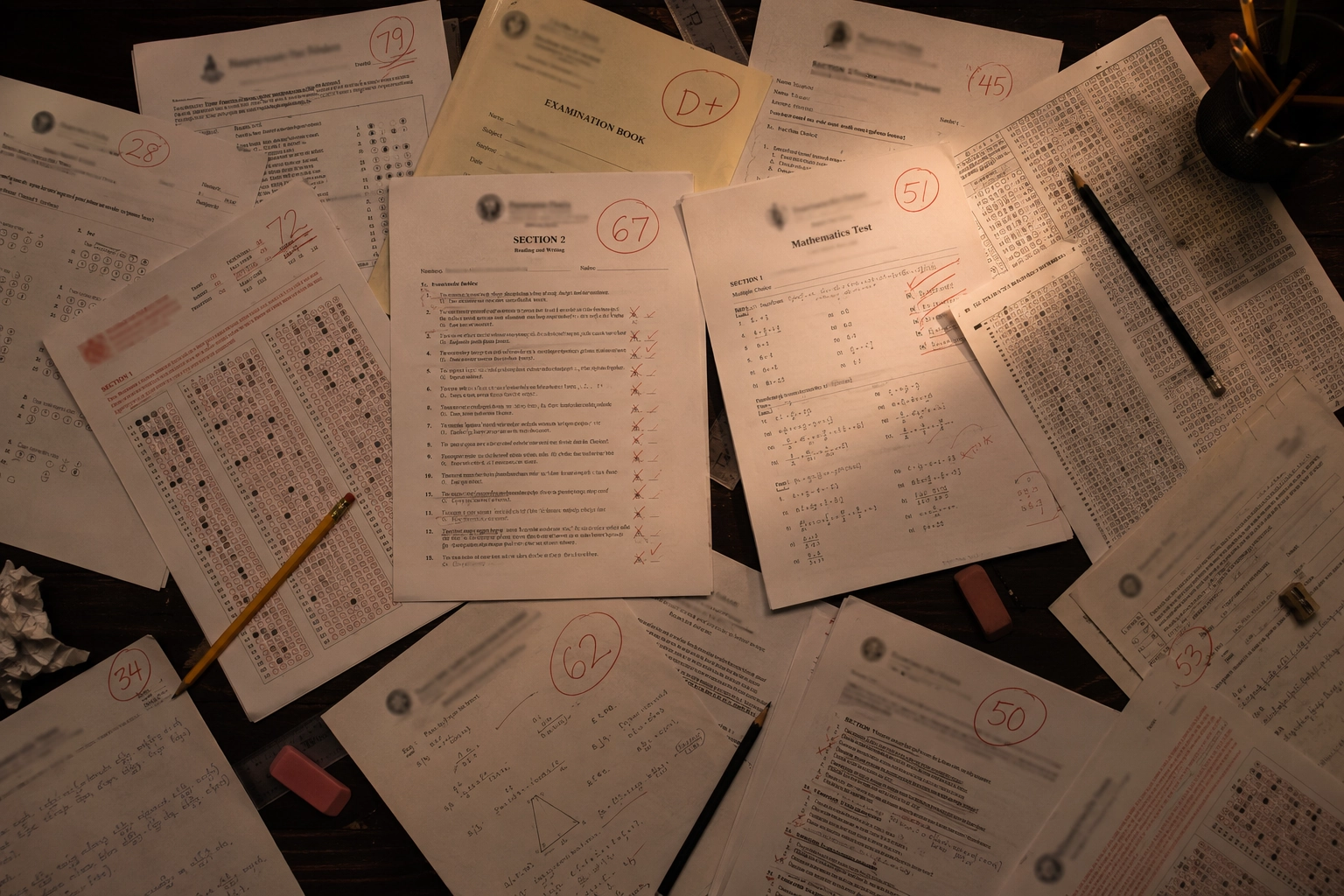
- Diagnostic / Screener assessments
- Beginning-of-year district benchmark (ELA)
- Beginning-of-year district benchmark (Math)
- PSAT/NMSQT (grades 10–11, 3rd Sat.)
- SAT School Day (some districts)
- Mid-quarter district assessments
- ELL English Language Proficiency (ongoing)
- SAT (2nd Sat.)
- ACT (select states)
- State early-window reading assessments (K–2 some states)
- SAT (1st Sat.)
- Semester / semester-final exams
- Mid-year district benchmark (ELA + Math)
- NAEP (select grades, biennial)
- ACT (early February in some states)
- SAT (last Sat.)
- State Regents Exams (New York)
- State interim assessments begin
- ACT (1st Sat.)
- State math interim assessments (grades 3–8)
- State ELA interim assessments (grades 3–8)
- PSAT 8/9 (grades 8–9 in some districts)
- District quarterly benchmark
- SAT (2nd Sat.)
- ACT (4th Sat., select states)
- State ELA assessments, grades 3–8 (PARCC / SBAC / state)
- NAEP administration window (select schools)
- ACCESS for ELLs (English language proficiency)
- State Math assessments, grades 3–8
- State Science assessments (grades 5, 8, 11)
- PARCC / SBAC / state summative exams
- High school end-of-course (EOC) exams
- AP exam prep / mock exams
- SAT (last Sat.)
- AP Exams: full two-week administration window
- SAT (1st Sat.)
- ACT (4th Sat.)
- State summative assessments continue
- EOC exams continue
- District end-of-year benchmarks
- SAT (1st Sat.)
- ACT (2nd Sat.)
- State Regents Exams (New York)
- End-of-year district benchmarks
- State graduation competency exams
Where All These Tests Come From: The Four Layers of Testing
The American standardized testing system is not a single program. It is an accretion of policies from four separate sources, each with its own rationale, its own schedule, and very little awareness of the cumulative burden it creates when stacked on top of the others.
ESSA, the current version of the federal education law updated from No Child Left Behind in 2015, requires states to test every student in English Language Arts and Math in grades 3 through 8, and once in high school. Science must be tested at least once in grades 3–5, 6–9, and 10–12. These are the non-negotiable floor; schools lose federal funding if fewer than 95% of students participate. Opt-out is legally complicated and socially discouraged in most states.
On top of ESSA requirements, 33 states have their own graduation exams or end-of-course (EOC) assessments that students must pass to receive a diploma. Many states also mandate additional assessments in social studies, history, or vocational subjects not covered by the federal floor. New York's Regents Exam system alone requires students to pass five separate exams in specific subjects.
Most large school districts administer their own benchmark tests, typically four per year in both ELA and Math, to track whether students are on track to perform well on state assessments. These benchmarks are not federally mandated, but districts use them to hold teachers and principals accountable. A student in a major urban district may complete 8–10 district benchmark tests in a single school year on top of all state and federal mandates.
Beginning in 8th or 9th grade, students on a college-bound track face an entirely separate testing hierarchy: the PSAT in 10th and 11th grade, the SAT and/or ACT multiple times during junior and senior year, and AP exams for each advanced course taken. A student in five AP courses taking the SAT twice and the ACT once will complete 8 high-stakes college-readiness tests in a single year, stacked directly on top of state and district requirements.
What Standardized Testing Overload Actually Costs Students
Lost Instructional Time: Measured in Weeks, Not Hours
The most direct cost is time. The Council of the Great City Schools 2015 study, the most comprehensive measurement ever conducted of district-level testing, found that the average student lost 4.22 school days per year to test administration alone. In heavily tested grades, test prep consumed an additional four to eight weeks of instruction. Put simply: by the time a student in grades 3–8 has completed all required tests and the test prep surrounding them, they may have lost the equivalent of a full month or more of actual learning.
The subjects that suffer most are those not tested by state assessments. Science (except in tested grades), social studies, art, music, physical education, and foreign languages are consistently deprioritized or eliminated in the weeks surrounding testing windows, and in many districts that deprioritization has become permanent. This is the "narrowing of the curriculum" that education researchers have documented consistently since No Child Left Behind took effect.

The Anxiety Spiral
High-stakes single-day performance events are among the most reliable triggers for test anxiety in children. When a student's entire academic standing and a school's public reputation ride on a single test administration, the psychological stakes extend far beyond the test itself. Teachers feel the pressure and transmit it, often unconsciously, to their students. Weeks of test prep deliver a consistent message: this test matters more than your daily learning. For children already prone to anxiety, this message is a wound that worsens with every new testing cycle.
Research published in journals including the Journal of School Psychology shows that performance anxiety specifically tied to standardized testing affects an estimated 25–40% of students, and that the anxiety responses triggered by high-stakes testing can persist long after the test itself is over, affecting concentration and academic engagement for weeks.
7th grade ELA teacher, Texas public school, 2025
What the Research Actually Shows About High-Stakes Testing
Correlation between increased standardized testing and improved NAEP scores, per the American Statistical Association
Estimated share of students who experience significant test-related anxiety affecting performance
Weeks of instructional time consumed by test prep in peak testing grades, per CotGCS data
U.S. states with mandatory high school graduation exams, on top of all other testing layers
The Countries That Outperform Us Test Much Less
Finland, consistently one of the top-performing education systems on the PISA (Programme for International Student Assessment) global rankings, administers only one standardized test in its entire K–12 system: a voluntary national matriculation exam at the end of secondary school. Finnish students are assessed primarily through teacher observation, portfolio work, and project-based learning throughout the year.
Japan and South Korea, the other perennial PISA leaders, do use high-stakes university entrance exams, but these are administered once, at the end of secondary school, rather than layered across every grade from third onward. The daily experience of a Japanese or Korean student involves rigorous learning without the near-continuous standardized testing cycle that defines the American public school experience.
The comparison is uncomfortable. The United States has built an elaborate testing infrastructure, spent billions of dollars administering and analyzing assessments, and produced no measurable improvement in average student learning outcomes. The PISA scores that provoked the initial push toward high-stakes testing in 2002 have barely moved in the two decades since. What has changed is the amount of time students spend being tested rather than taught.
Public School Testing vs. Online School: A Direct Comparison
- 20–25 mandatory tests per year in grades 3–8
- 4.22+ school days per year consumed by test-taking
- 4–8 weeks of instructional time lost to test prep annually
- High-stakes, single-day performance events tied to school funding
- Curriculum narrowed to tested subjects in testing grades
- Mandatory participation: opting out has legal and social consequences
- Teacher evaluations sometimes tied to student test scores
- April and May nearly unusable for new instruction
- No externally mandated standardized testing schedule
- Assessment through coursework, projects, and portfolios
- No test prep windows: full year available for real instruction
- Progress measured continuously, not by one annual event
- Full curriculum access year-round: no narrowing for testing
- Students demonstrate mastery when they are ready
- No high-stakes single-day anxiety events
- Fully accredited diploma, recognized by colleges and employers
What Changing the Environment Actually Does
For families whose children are experiencing the real effects of standardized testing overload: anxiety before test weeks, disengagement from learning after months of drill-and-practice, declining grades that do not reflect what their child actually knows. It is worth understanding precisely what changes when they leave the public school testing framework behind.

At an accredited online K-12 program like High School of America, students complete a rigorous curriculum that leads to a fully accredited diploma. The difference is in how progress is measured. Instead of high-stakes standardized tests administered on a fixed calendar, students demonstrate mastery through assignments, projects, and ongoing teacher assessment. There is no April crunch, no weeks of test prep, no days spent practicing how to bubble in answer sheets correctly.
The practical effect on anxious or disengaged students is often significant. When the testing treadmill is removed, many students report experiencing academic curiosity again, the ability to spend time on a subject because it is interesting rather than because it will be tested. Teachers at HSOA describe this shift as one of the most consistent changes they observe in students transitioning from public school environments.
If you are considering this transition, our guide on how to transition from traditional school to online homeschooling walks through every step, from withdrawing from your current school to building a productive home learning environment. And if you have questions about accreditation, diploma recognition, or what the curriculum covers, the complete HSOA FAQ for parents and students is the right place to start.
The 50 problems we track at High School of America do not exist in isolation; standardized testing overload feeds directly into GPA obsession, AP course pressure, and the grade comparison culture that make school miserable for so many students. Addressing the testing environment is, in many cases, the first domino.

Frequently Asked Questions
Your Child Deserves an Education Built Around Real Learning
High School of America offers a fully accredited K-12 curriculum where students are assessed on what they actually know and can do, not on their ability to perform under high-stakes test conditions on a fixed calendar day.