

11th Grade Online Classes
11th grade online classes are where it starts to click. Junior year is when coursework connects to college, the transcript, the test calendar, and the graduation plan all at once. The PSAT lands in the fall. Pre-Calculus opens up. American Literature, US History, Chemistry or Physics. These are the courses admissions readers actually look at.
We see the small wins every week. A junior finishes a Pre-Calculus unit before a 7 a.m. Swim practice. A young actor films an audition Tuesday and turns in American Literature Wednesday night. A dual-enrollment student maps a community college class around her online junior year and keeps both moving. A recruit on the road cleans up Algebra 2 in a hotel room between tournaments.
That is what online 11th grade looks like when the schedule finally fits the student. Talk with a counselor at High School of America about how junior year would actually map for your kid.
- Call (888) 242-4262
- Schedule a counselor call
- Start enrollment
Why Junior Year Matters
Junior year is the year colleges read most carefully. It’s the most recent full year of grades, rigor, and growth showing on the transcript when applications go out.
That’s the short answer. The longer one is what makes 11th grade the highest-leverage year a student gets. The PSAT/NMSQT lands in October. The SAT and ACT cluster in spring. The course list itself starts proving something, Algebra 2, Pre-Calculus, Chemistry or Physics, US History, American Literature, a third or fourth year of a world language. Admissions readers look at junior year to answer one quiet question: can this student handle college-level work next fall?
A 2023 College Board survey found 11th graders report higher stress than any other high school grade. There’s a reason. Recruiting visibility is sharpest now for athletes. Dual enrollment opens up. National Merit qualification runs through one test on one fall morning.
Online 11th grade classes give a junior room to build a stronger plan around real life. Instead of squeezing real life around a bell schedule.
Six Juniors. One Program Underneath.
Online 11th grade works when the program adjusts to the student. Six profiles show up most often on junior-year enrollment calls.
The college-bound junior. PSAT in October, SAT or ACT in spring, GPA still being built. Self-paced coursework returns real hours for test prep without falling behind in U.S. History or Algebra 2.
The club-sport or travel athlete. Recruiting season collides with junior year. Tournaments, showcases, training blocks. Coursework travels on a laptop, deadlines flex around the calendar, and a nationally accredited transcript supports athletic eligibility organizations review when the time comes.
The performing-arts student. Conservatory auditions, dance intensives, recording schedules, theater runs. Mornings belong to studio time. Afternoons hold English 3 and Chemistry. The academic year stops competing with the audition year.
The accelerated learner. Ready for Pre-Calculus, AP-level reading, or dual enrollment at a local community college. Junior year online lets a strong student stretch into harder coursework without waiting for a master schedule to open the door.
The mid-year transfer. Coming from public, private, charter, or a homeschool setup that stopped fitting. Year-round enrollment means a real start date in any month. Send the transcript by text, email, or upload; our team maps earned credits against what’s left.
The multi-commitment junior. Internship, part-time job, family caregiving, a health situation that needs morning hours. Coursework gets done in the windows that exist, with advisors and academic specialists on the other end of every assignment.
Different stories. Same program underneath.
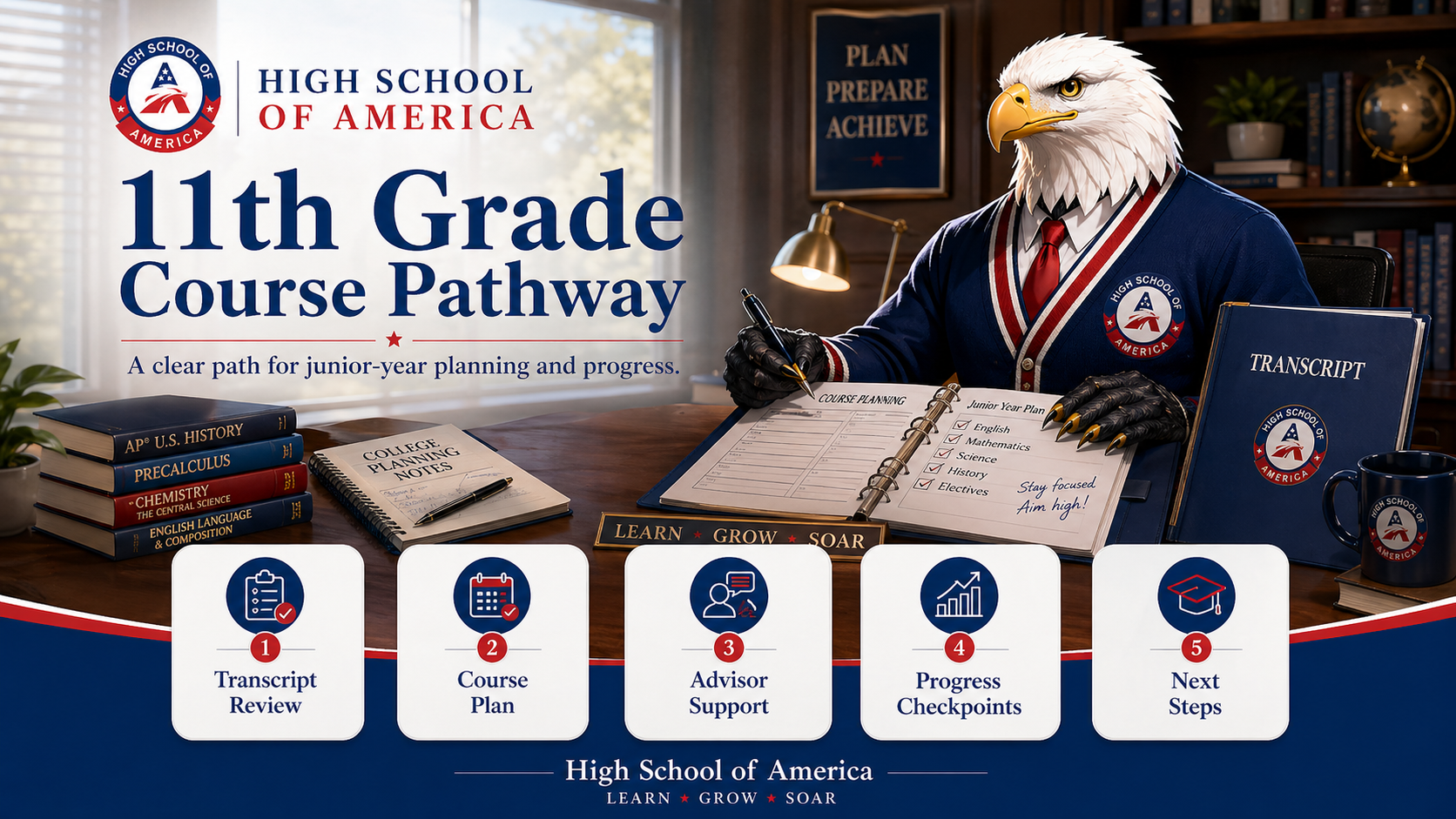
Junior Year Is Where the Transcript Earns Its Weight
Families assume senior year is the transcript that matters. It isn’t. Admissions readers spend most of their attention on 11th grade, because junior year is the last full year of grades they see when applications go in. The year families treat as a runway is actually the runway’s end. Our 11th grade online classes are built around that fact.
Core Subjects
English III is American literature with a research-paper backbone. Juniors close-read Hawthorne, Morrison, and Fitzgerald, then build the argumentative writing muscle that carries straight into college essays and SAT writing.
Algebra 2 locks in functions, logarithms, and the conic sections pre-calculus assumes you already own. Skip the gaps here and you pay for them in 12th grade. Students ready to move faster jump into Pre-Calculus, which sets up senior-year calculus and signals quantitative readiness on a transcript.
Chemistry runs stoichiometry, thermodynamics, and equilibrium with lab write-ups that sharpen scientific reasoning. Juniors aiming at engineering or pre-med often pair it with Physics the same year.
United States History anchors the social studies slot, Reconstruction to the present, primary-source analysis, the document-based writing colleges and AP-style assessments expect. Pairs naturally with U.S. Government for a civics-heavy junior year.
regional accrediting commission and Elective Options
Accelerated juniors layer Pre-Calculus alongside an regional accrediting commission science. Dual enrollment is on the table for students whose transcripts support it, with college credit earned in the exact window admissions officers scrutinize most. Foreign-language continuation matters here too: a third or fourth year of the same language is one of the cleanest signals of academic seriousness a transcript carries.
Electives like Economics, World History, and Art History and Criticism round out a portfolio that reads like a student with direction, not one filling slots. Browse the full course catalog to map the year.
Questions about which combination fits your junior? Call (888) 242-4262 and a counselor will walk through the transcript with you.
How Online Junior Year Works
The junior year pathway runs on six steps. Each step has a job. None are decorative.
1. Transcript review of grades 9-10. Before a course plan exists, our registrar reads what’s already on the record. What was passed, what was attempted, what carries weight for college admissions. Families upload the transcript during enrollment, text a photo, or email it to support@highschoolofamerica.org. Students can start before the transcript arrives. The official credit map is finalized once it does.
2. Course plan built around what’s left. Remaining graduation requirements, college-prep goals, and the standardized-testing calendar sit on the same page. A typical 11th-grade load: US History, English 3, Algebra 2 or Pre-Calculus, Chemistry or Physics, and a world language. The plan reflects the student in front of us, not a template.
3. A self-paced week with structured pacing. Self-paced does not mean unstructured. Each course has weekly targets. Students who train, work, or travel build the day around the targets instead of the bell.
4. Counselor check-ins and a parent dashboard. Progress, grades, and assignment status are visible in real time. Parents see the work without having to teach the work.
5. Test-prep windows on the calendar. PSAT in October. SAT or ACT in spring, often twice. Coursework loosens around test dates so prep weeks aren’t a collision.
6. End-of-year review. Transcript audit for senior year, and the first real conversation about a college list. Junior year ends pointing forward.
Questions about the pathway? Call (888) 242-4262.
Transcript Review and College Planning
Junior year is when the transcript starts talking back. Our counseling team pulls the 9th and 10th grade record, lines it up against remaining graduation requirements, and builds the 11th grade plan from there. Math sequence. Science track. Foreign language depth. Electives that hint at an interest area. Each one gets weighed against where the student wants to apply.
The audit is concrete. What’s done. What’s missing. Where the rigor needs to climb. A junior aiming at selective admissions usually needs Algebra 2 anchored in 11th and a third lab science on the books. A junior pointed at a regional university or a workforce path can let the math runway breathe and load career-aligned electives instead. We don’t publish a credit count here because every incoming transcript transfers differently. Counselors map the exact path once they’ve reviewed the record.
Dual enrollment in 11th grade is on the table for students ready for college-level work. The team helps map prerequisites for community college or four-year extension courses, and walks families through how those credits land on the transcript.
For recruited athletes, the timeline gets real in junior year. Most verbal commitments happen during 11th or early 12th grade. Academic eligibility verification stays with the family and the recruiting body; we make sure the coursework on file supports it.
Send the transcript to support@highschoolofamerica.org or call (888) 242-4262 to start the review.

Inside the Junior-Year Portal
Three things have to be true for an online junior year to work day to day. The platform has to be simple. The structure has to be visible. The access has to be portable.
Simple is one login, one dashboard, every course in a row. Each course runs on a weekly module: a short video lesson, structured reading, a practice set, then a quiz with feedback before the student moves on. Junior-year science — Chemistry or Physics, depending on the path — runs virtual labs inside the course, so a student writes up procedure and analysis the way a brick-and-mortar lab notebook would expect. Discussion threads sit alongside the coursework when a prompt asks juniors to defend a thesis or compare two interpretations.
Visible is the pacing dashboard. The course calendar shows what week the student is on, what’s due this week, and how the term is tracking against a college-prep timeline. Parents see the same view without chasing it.
Portable is the part juniors notice. Any device with a browser works. Coursework opens from a hotel room during a college visit, a host family’s kitchen table on a travel weekend, or a quiet hour between rehearsals. The portal goes where the junior goes.
The Eagle’s View on Junior Year
Let me tell you how I keep parents in the loop without turning you into the homework police.
You get a parent dashboard with real-time grades and assignment status. Open it Sunday night with your coffee, see exactly where your junior stands, close the laptop. That’s the ritual. No nagging required.
Your 11th grader is starting to own their college-prep timeline. PSAT in October. SAT or ACT prep ramping up. Common App profile waking up in the spring. I want them flying that plane. You’re the air traffic controller, not the copilot.
Here’s what lands in your inbox: progress notes from advisors and academic specialists, pacing flags when an assignment slips, a heads-up before a transcript moment matters. If your student stalls in Algebra 2 or US History, the team reaches out first. You’re not chasing.
Want to talk strategy? Pick up the phone. (888) 242-4262 gets you a real counselor who’ll walk the transcript, the credits left, the junior-year plan, and where dual enrollment fits if your student is ready for it.
The Eagle has your back.

Preparing for 12th Grade
Junior year closes with a transcript review. The same counseling team that guided 11th grade pulls the record, confirms credits earned, and maps the senior-year course plan. No handoff. Same names, same email thread.
The 12th grade online lineup typically includes Pre-Calculus or Calculus, Physics, English IV, and U.S. Government with Economics, plus capstone electives from the full course catalog. Course selection is built around the student’s stated next step: four-year college, two-year college, dual enrollment, workforce, or military.
Application timing shapes the spring conversation. The Common Application opens August 1 before senior year and is accepted by more than 1,000 U.S. Colleges and universities. Admissions offices read three senior-year data points: course rigor at registration, mid-year grades, and the final transcript at graduation. Fall courses locked in during 11th grade are the ones that appear on the initial Common App profile.
Call (888) 242-4262 to schedule the end-of-junior-year review.
11th Grade Online FAQs
Junior year is when families finally start asking the right questions. Here are the ones we hear on repeat, answered straight.
What is 11th grade online, exactly?
A full junior-year course load delivered through a self-paced online platform: U.S. History, English III, Algebra II or Pre-Calculus, a lab science, a world language, and electives. Same academic substance as a traditional junior year, minus the bells. Students log in, work through structured coursework, and submit assignments on their own schedule.
Is the program accredited?
Yes. Nationally accredited K-12. The transcript that comes out of junior year is a real academic record that colleges, the military, and employers read like any other.
Can my junior transfer credits in?
Yes. Most students arrive with roughly two years of high school behind them, and our team reviews the official transcript to map what’s complete and what’s left. Transcripts can be texted, emailed to support@highschoolofamerica.org, or uploaded during enrollment. Students can start before the transcript arrives.
How is junior year self-paced?
No 7:45 a.m. Bell. No Friday quiz the whole class takes together because the whole class is one student. Coursework is laid out unit by unit, and juniors move through it at the speed that fits their brain, their sport, their job, or their sanity. Faster on strong subjects, slower where they want to go deep.
How much does 11th grade online cost?
Tuition depends on how many credits the student still needs, which is why we don’t post a flat number on a webpage and pretend it fits everyone. After a transcript review, the enrollment team walks through the full breakdown and payment plan options. Call (888) 242-4262 for exact figures.
Is online 11th grade good for college-bound students?
It can be a strong fit. Juniors get more time for application research, campus visits, essay drafts, and test prep without losing academic ground. The transcript reflects the same rigorous junior-year subjects admissions officers expect to see: American Literature, Algebra II or Pre-Calc, Chemistry or Physics, U.S. History.
Does the program prepare students for the PSAT, SAT, and ACT?
Coursework aligns with the content these exams test, and the flexible schedule leaves real room for prep. We don’t promise score outcomes. No honest school can. What we can say: students often use reclaimed hours for tutoring, practice tests, and review. One logistical note: the PSAT/NMSQT itself is administered at a registered school site, so families typically arrange a seat at a local school.
Can my junior do dual enrollment?
Many juniors do. Dual enrollment runs through community colleges and universities, and eligibility, cost, and credit transfer are set by the college, not by us. We coordinate with whichever dual enrollment program a family chooses, and the self-paced schedule makes it logistically realistic.
What courses are required for junior year?
The core junior load typically includes English III (American Literature), U.S. History, Algebra II or Pre-Calculus, a lab science like Chemistry or Physics, and continued world language. Electives round it out. Every student’s exact path depends on what they’ve already completed, which is why a counselor reviews the transcript before finalizing the plan.
Is online 11th grade good for athletes during recruiting season?
Yes. This is one of the most common reasons families enroll in junior year. Travel, training blocks, and showcase weekends stop competing with the school day. One note for athletic organization hopefuls: Division I and II eligibility requires coursework from an athletic-organization-approved program, so confirm approval status with the recruiter before enrolling anywhere.
Can homeschoolers continue into online 11th grade?
Regularly. Homeschool families transition into our junior year often because college applications are getting closer and they want a structured accredited transcript heading into senior year. Previous coursework is reviewed and credited where documentation supports it.
How do families get started?
Call (888) 242-4262, schedule a counselor conversation, or begin the enrollment form online. The transcript can follow. The first conversation covers where the student stands, what junior year will look like, and what tuition works out to for their specific path.
Your Junior Year, Built Around Your Plan
Twelve months from now, transcripts go out. Test scores get reported. College lists firm up, and senior year opens with a clear runway instead of a scramble. That future is built this year. And it starts with one conversation.