
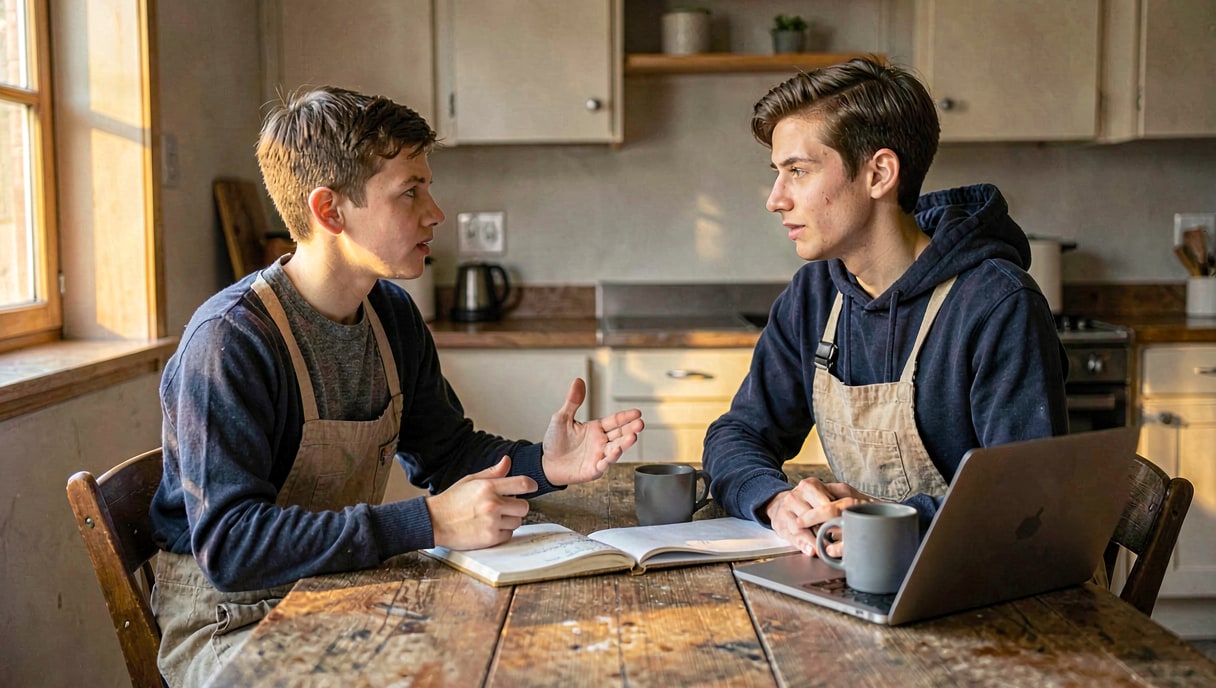
You're sitting at the kitchen table with your student's history essay. It's clean, organized, with a thesis that actually lands. Then you pull up the unit quiz: 58%.
Something doesn't add up. You don't need a software report to see it.
Here's where Eagle stands: the grade stopped measuring learning, and AI detectors are the wrong fix. A detector tries to answer "who typed this?" The question that matters is "does the student understand this?" You can answer that one out loud, at home, tonight, for free.
What the numbers say
Start with what the headlines confirm, and what they don't. The Washington Post ran a story titled "AI is hurting students' ability to think, educators say: 'It's the illusion of learning'". Education Week published "How AI Suspicions Are Undermining Student-Teacher Relationships." Newsweek mapped which states are trying to limit AI in schools. France 24 reported that US universities are shunning AI detectors amid "homework scams."
Eagle was able to confirm those headlines. The article text behind them was not available to us, so we are not going to hand you statistics or quotes we can't verify. Read the full pieces before you cite them at a school meeting.
The research picture is also unsettled, and the people studying it say so. Cognitive-offloading research (the idea that handing a mental task to a tool weakens your memory of it) is real and growing. But faculty in STEM fields who study AI in learning admit the long-term impacts are not yet known. Anyone who tells you AI is definitely rotting your student's brain is ahead of the evidence. Anyone who says it's harmless is too.
What holds up without a single new study is the mechanism. If a student prompts a draft and submits it, the essay shows the tool's ability. It says nothing about the student's. The grade attached to it measures the wrong thing.
Detectors don't rescue this. The published concerns about them are consistent: they produce false positives, and independent research has flagged non-native English writers as especially likely to be wrongly accused. That research predates this fall, so treat the specific rates as dated and check current figures before quoting one. The practical result is the one Education Week's headline describes: suspicion creeping into the student-teacher relationship. Teachers doubt the work. Students fear being accused of work they did honestly.
That is a trust problem. Software that guesses at authorship makes it worse.

What schools are doing instead
The schools getting this right stopped trying to police the product and started redesigning the assessment. Three methods keep showing up:
- Oral defense. The student submits the work, then explains it live. Two minutes of "why did you choose this evidence?" tells a teacher more than any scan.
- In-class writing. The draft happens in the room, on paper or on a locked-down screen. AI can still help students study. It just can't sit the test for them.
- Process portfolios. The grade covers the notes, the outline, the messy second draft, and the revision. A prompted essay has no mess to show.
None of this is punishment. It's the old idea of showing your work, rebuilt for a world where the final product is cheap to fake. And it costs a teacher's time and a little rethinking, not a software license.
There's a useful distinction underneath all of it. A student who asks AI to quiz them, explain a concept three different ways, or critique a draft is using it to learn. A student who asks it to produce the draft is using it to produce work. The first builds the skill. The second skips it. Good assessment redesign doesn't ban the tool. It makes the skill visible regardless.
The five-minute spot-check
No software. No teacher. Pick one recent assignment and run these in order. Keep your voice curious, not prosecutorial.
- Ask your student to explain the piece in their own words. "Walk me through what you wrote, like I've never seen it." Good result: a confident, specific summary with their own phrasing. Concerning: vague generalities, or they start reading it back.
- Change one variable. For math, swap a number. For an essay, ask "what if the author had said the opposite?" Good: they adapt, even if slowly. Concerning: they freeze, because they memorized a path, not a method.
- Have them rewrite one paragraph from memory. Close the document. Good: different words, same ideas. Concerning: they can't reproduce the reasoning at all.
- Ask what they would cut and why. Every writer knows which sentence is the weakest. Good: an instant, reasoned answer. Concerning: "it's all good" with no judgment behind it.
- Ask where they got stuck. Real work has a snag. Good: a specific story about the hard part. Concerning: "nowhere," on a hard assignment.
How to respond. One shaky answer means nothing. Students blank under parent attention all the time. If most of the five go badly, skip the accusation. Say: "I want to see you own this. Let's redo the weak part together." Then ask how they used AI, as a real question. Many students will tell you plainly if they don't expect a fight, and you'll learn whether they used it as a tutor or a ghostwriter.
If you want a broader checklist for the tools your student's school is rolling out, Eagle's guide on AI in your student's classroom: pilot or product has seven questions worth asking.
The homeschool and online advantage
Families who control their own assessment can build all of this in from day one: oral check-ins, in-room writing, a portfolio that shows the process. No district approval, no vendor contract. That's a real structural edge, and it's one reason Eagle keeps pointing at the gap between online homeschool and public virtual school, where who owns the assessment makes a big difference.
If you're weighing a move, High School of America can walk you through how assessment works in an online setting, and local pages like Sarasota Online High School or Tallahassee Online High School show what that looks like by region.
But you don't need to switch schools to use any of this. Any parent can run the five-minute check tonight. The grade may have stopped measuring learning. Your kitchen table hasn't.
- AI is hurting students’ ability to think, educators say: ‘It’s the illusion of learning’ · The Washington Post
- Map Shows States That Are Trying to Limit AI in Schools · Newsweek
- How AI Suspicions Are Undermining Student-Teacher Relationships · Education Week
- Grappling with ‘homework scams,’ US universities shun AI detectors · France 24