

Missouri K-12 Online Home School
Missouri is one of the few states in the country where a family can decide Tuesday morning to homeschool and legally begin Wednesday. No state approval. No notification letter. No waiting period. That’s the law under Mo. Rev. Stat. § 167.031, and it means the only thing standing between your child and a better school situation is finding the right program. This is a Missouri K-12 online home school built to meet that moment.
Here’s what the name doesn’t tell you: we serve kindergartners. We serve third graders and seventh graders and high school sophomores. From the Gateway Arch to the Ozarks, families across the state enroll because they need a full K-12 Online Home School solution in one place, with real teachers, real coursework, and an online program that colleges and employers take seriously. Not a workaround. Not a placeholder. The real thing.
National structure matters in a state that demands proof before trust. The credential isn’t just a word on a website. It’s what makes a transcript readable by a Missouri college admissions office, a military recruiter, or a first employer. And year-round enrollment means a family pulling their child in November faces no administrative wall, on either the state side or ours.
If you already know this is what you need: (888) 242-4262.
What every Missouri family gets, at a glance
Structured Records
Real Teachers, Real Answers
Enroll Any Month
Kindergarten Through Senior Year
What Missouri families should know first
Is this an online school, or a curriculum package?
This is a private K-12 online school, not a curriculum kit and not a parent-run co-op. Families may use HSOA transcripts, course records, and academic documentation when applying to colleges, workforce programs, or other postsecondary options. Final review decisions are made by each institution or organization.
Can an online program support Missouri §167.031 home school records?
A structured online program can help organize the documentation Missouri asks for: course logs by subject, time-stamped completion records for the 1,000 hours and the core-subject share, and progress-tracking that helps build the portfolio Missouri parents maintain. Parents remain responsible for meeting §167.031 requirements.
Does Missouri require notice or testing for home school students?
No. Missouri §167.031 does not require parents to file notice with the school district before homeschooling, and it does not require state-mandated standardized testing. Parents maintain a portfolio of materials and records, and may choose to administer assessments for their own progress monitoring.
The Show-Me framework, in plain order
⚠️ Our program handles the academics. Missouri law puts compliance responsibility in your hands. And in Missouri, those hands have more freedom than most families realize.
Under Mo. Rev. Stat. § 167.031, a home school is already a private school the moment instruction begins. No application. No government approval. No waiting period. Missouri does not require families to notify any school district or state agency before starting. If your child is currently enrolled in a public school, notify the school of your withdrawal. Then instruction can begin the next day.
The statute does set a 1,000-hour annual instruction requirement, with at least 600 of those hours spent on reading, language arts, mathematics, social studies, and science. That sounds like a compliance burden until you look at what it actually means: follow the program’s standard course sequence and you are covering the required subjects. The counting takes care of itself.
Missouri record-keeping is yours and yours alone. A plan book, a portfolio of student work, and a progress record. Kept privately at home, never filed with any agency. No school board, no superintendent, and no state office has routine authority to ask for it. Compulsory attendance applies to children ages 7 through 17. If your youngest hasn’t turned 7 yet, you are already ahead of the legal clock. And building a documented record from Day 1 is its own advantage.
No testing requirement. No credential required to teach your own children. Missouri wrote the statute that way on purpose.
Counselors at High School of America can walk through how the program’s structure aligns with Missouri’s requirements. Call (888) 242-4262. This is general program information, not legal advice. For specific legal questions, consult a licensed Missouri attorney.
Missouri home school, the framework
Missouri is one of the most parent-directed home education frameworks in the country. The statute lays out clear targets, but does not ask parents to file notice or administer state tests.
- Statute: §167.031 RSMo. No state notification required to begin homeschooling.
- Hours: 1,000 cumulative annual hours of instruction, with at least 600 hours in core subjects (reading, language arts, math, social studies, science).
- Core hours at home: at least 400 of the 600 core-subject hours occur at the regular home location.
- Records: parent maintains a portfolio of materials, samples of the child’s academic work, and a daily log or equivalent record.
- Testing: not required by §167.031. Parents may choose assessments for their own progress monitoring.
Source: §167.031 RSMo · Missouri Department of Elementary & Secondary Education
K through 12, the whole path
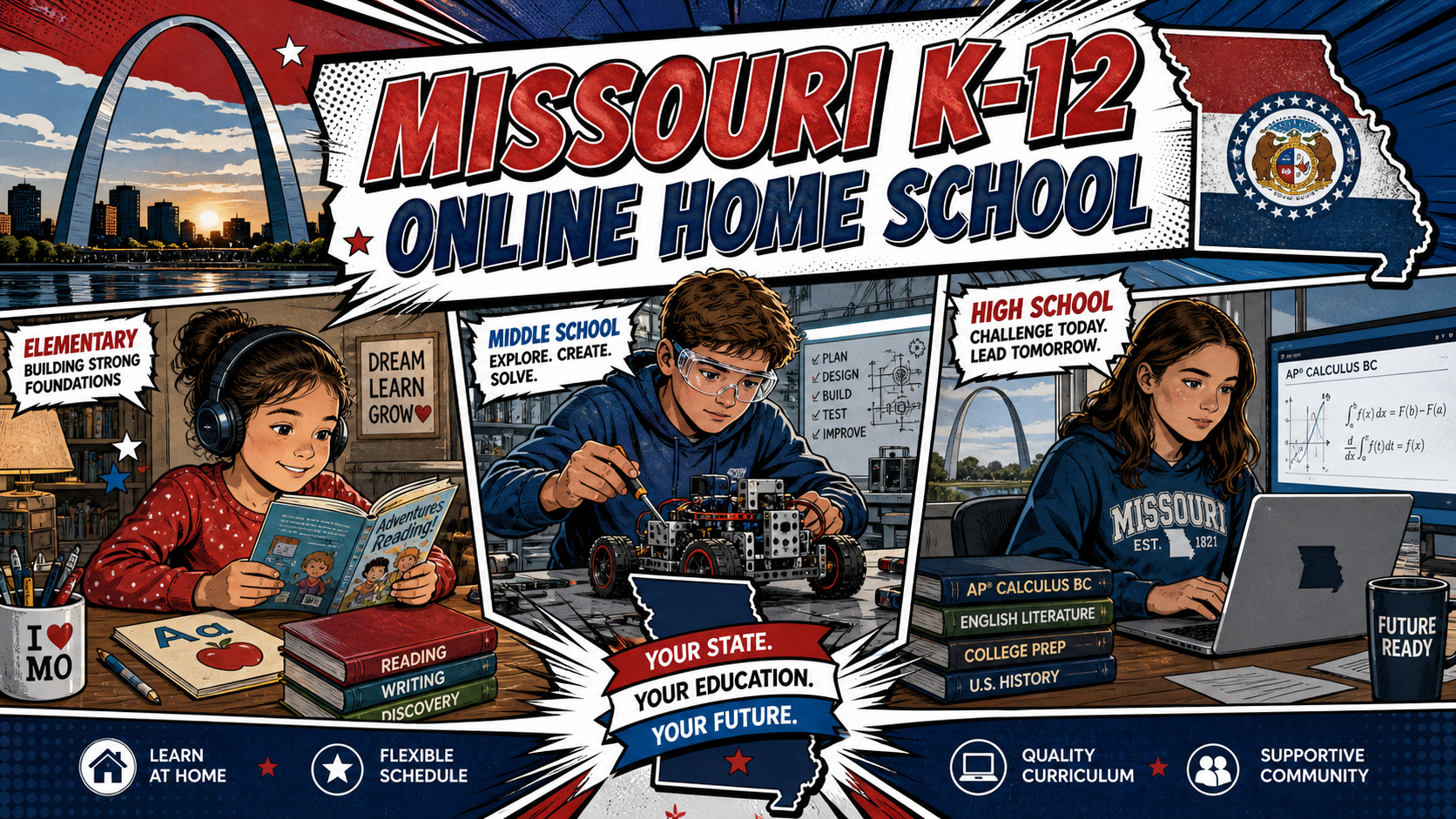
Every grade has its own rhythm. A kindergartner building phonics skills, a 7th grader ready to race ahead in math, a 10th grader balancing coursework with competitive athletics. The path looks different at each level. Here is what each band looks like, and why it works.
Elementary School (K-5)
Something shifts when a young learner is no longer dreading the bus. Not just the hour-and-a-half of daily travel time, though that is real. For families in the Ozarks or the Bootheel, the round-trip can eat more of a child’s day than recess and lunch combined. The shift is bigger than logistics. It is the recognition that a 2nd grader who freezes on timed tests can demonstrate mastery another way. That a curious 1st grader who is reading two grades ahead does not have to wait for anyone else.
The K-5 program is built around reading, language arts, math, social studies, and science. Those are Missouri’s five required homeschool subjects, and they are precisely what elementary students study here. The curriculum is sequenced and structured, but the pace belongs to the child. Real teachers are present at every stage. Not automated feedback, not a parent guessing at phonics instruction, but a credentialed teacher whose job is to respond, guide, and catch gaps.
Missouri’s no-testing framework means there is no standardized exit exam standing between a young learner and the next level. A 3rd grader who masters a concept moves forward. A student who needs more time gets it. The program also saves and time-stamps every assignment, which matters for Missouri families who are required to keep work samples on file. The portfolio practically builds itself.
Parents at this level are partners, not instructors. You support the environment. The teacher handles the teaching.
Middle School (6-8)
Middle school is where a lot of families first consider a different path. The social pressure intensifies. The academic pace feels either too slow for one kid or too fast for another. And the worry that surfaces most often: if we leave, will my child miss out?
Missouri’s 2025 Homeschoolers Sports Act answered that question directly. Middle school homeschoolers now have the right to try out for public school sports teams, and the October 2025 MSHSAA rule change extended that access to extracurriculars like debate and robotics as well. The ‘my kid will miss everything’ concern, which was real and understandable, is now largely resolved by state law.
What the program offers in the meantime is pacing that fits the student. A 7th grader who is mathematically ready for algebra does not have to wait for a district pacing calendar to catch up. There is no standardized exit exam at the end of 8th grade in Missouri, which means mastery is assessed through coursework and teacher evaluation rather than a single high-stakes test.
This grade band also builds something that matters later: a record. Course completion logs, grades, teacher feedback, skill assessments. A Missouri 6th, 7th, or 8th grader working through an established online program is assembling the foundation of a high school transcript without realizing it. By the time high school applications and college conversations begin, the documentation is already there, organized, and credible.
For families navigating the 6th grade transition in particular. One of the highest-pressure jumps in all of K-12. The ability to withdraw and begin immediately, with no waiting period and no administrative hurdle, is not a small thing. It is often the thing.
High School (9-12)
High school is where stakes feel the highest, so it is worth being direct about what the program produces. Students complete a 24-credit online program. An official transcript is issued. That transcript is recognized by Missouri’s public universities. Including Missouri S&T in Rolla, the University of Missouri, and Missouri State in Springfield. And by military recruiters at installations like Fort Leonard Wood, where an online program credential combined with ASVAB scores meets documentation requirements.
Missouri’s STEM economy gives the coursework real-world stakes. Boeing’s manufacturing operations in the St. Louis area, the healthcare systems anchoring Kansas City, the growing tech corridor stretching across the metro region. Rigorous online work in biology, chemistry, physics, and algebra-through-precalculus is not just transcript-building. It is pipeline preparation for the industries that define the state’s economy.
The self-paced structure also resolves the conflict that trips up so many high school families. A student who trains six days a week for a competitive sport does not have to choose between the sport and the coursework. Evening sessions, weekend blocks, flexible scheduling. The online program bends to the student’s life, not the other way around.
High school counselors here review incoming transcripts and map exactly what each student still needs. No guesswork. No generic plan. A specific path, credit by credit, built around where that student is right now. Talk to a counselor at (888) 242-4262 to get that conversation started.
At a glance, three bands, one program
| Grade Band | What Students Study | Best Fit in Missouri |
|---|---|---|
| K-5 Elementary | Reading, language arts, mathematics, social studies, science, plus arts and enrichment, structured for §167.031 portfolio documentation. | Rural Ozark and Bootheel families with long bus commutes; mid-Missouri families who pulled out mid-year and want a structured plan; suburban families wanting a portable record they can share with relatives or evaluators. |
| Grades 6-8 Middle School | Pre-algebra through algebra, life science, language arts, U.S. studies, electives, asynchronous and self-paced. | Travel sports families across St. Louis and Kansas City metros; military families on Fort Leonard Wood / Whiteman AFB rotations; competitive academic students who outpace classroom timing. |
| Grades 9-12 High School | Full college-preparatory sequence: English, math, sciences, history, government, economics, and electives, with academic support contact for every course. | Students building transcripts for Mizzou, Mizzou S&T, MSU Springfield, Truman, and Missouri State University review; healthcare-corridor families on shift schedules; early-college and dual-enrollment-bound students. |
Every grade and every course, in one program
Kindergarten through twelfth grade, online and self-paced. Click any grade to see what runs at that level, or any course to see the full subject page.
Pick a grade
Browse the high school course catalog
English 2
English 3
Algebra 1
Algebra 2
Geometry
Pre-Calculus
Biology
Chemistry
Physics
U.S. History
World History
U.S. Government
Art History & Criticism
View the full high school course catalog →
Online High School Diploma
The credential families work toward, with transcript and academic-record support for college and workforce paths.
Self-Paced Online High School
How the schedule actually works, day to day, when work is asynchronous and the student sets the pace.
Students & Parents Guide
How students and parents step into the program, what the dashboard shows, and what support looks like.
Sports, clubs, and the §167.031 reality
Here is what most Missouri families believe: choose homeschooling and your kid sits out. No Friday night lights. No debate trophy. No team bus. That belief was largely accurate until July 2025. It is no longer true.
Missouri’s 2025 Homeschoolers Sports Act created a statutory right for homeschool students to try out for and compete on public school athletic teams. Not a district-by-district favor. Not a principal’s discretion call. A right, written into Missouri law, that applies in every county from Kansas City to the Bootheel. The governor signed it, and by August 2025 homeschool students were already suiting up.
What the October rule added
Then October 2025 arrived, and MSHSAA’s rule update extended the access further. Sports were just the beginning. The October change opened non-athletic extracurriculars: debate, robotics, academic competitions. A student who learns online can now walk into a Springfield or Columbia public school, compete in a state robotics qualifier, and walk back out. No full enrollment required.
Eligibility does come with a condition worth knowing. MSHSAA requires homeschool participants to meet the same academic standards applied to regularly enrolled students. That is not a barrier for students in an established online program. Grade records, course completion reports, and transcript documentation from an online K-12 program satisfy that requirement directly. The online grades count. They are the evidence.
Where homeschool leagues are heading
For families who prefer to stay entirely outside public school systems, that path is thriving too. Columbia’s homeschool baseball team drew coverage from the Columbia Missourian in April 2026. The March 2026 statewide archery championship in Springfield included homeschool competitors. Missouri’s homeschool community has been quietly building its own competitive infrastructure for years.
When training shapes the school day
Two paths now exist. A student who trains before dawn can schedule coursework in the afternoon or evening, working at whatever pace the week allows. That kind of day-split is exactly what self-paced online learning is built for.
Where the transcript and diploma land
Every school website promises a credential that ‘opens doors.’ Here is what that actually looks like in practice.
The transcript that comes out of this program is an official, program-issued document from a Structured Records K-12 school. It lists course names, grades, and a cumulative GPA. Missouri’s four-year public universities, Mizzou, Missouri State, Missouri S&T in Rolla, UMKC. Each publish admissions instructions specifically for homeschool applicants, and what those offices evaluate is exactly this: an official transcript paired with a course description document. A counselor can walk you through preparing that package before any application deadline.
What college offices actually receive
For families in central Missouri near Fort Leonard Wood, the military pathway deserves a specific mention. Recruiters distinguish between online program diplomas and unaccredited ones. That distinction matters for enlistment tier and job classification. An established transcript, combined with ASVAB scores, provides the documentation military branches require. This is not a loophole. It is the intended process, and the program credential satisfies it.
Where the military pathway fits in
Missouri homeschool juniors and seniors can register for the ACT independently as non-enrolled students. Missouri does not require any state assessment for homeschoolers, so the ACT sits entirely outside that framework. A strong score added to the program transcript makes a college application file look exactly like what admissions offices know how to read.
When test scores enter the picture
Dual credit is worth a conversation, too. Missouri colleges offer dual-enrollment opportunities, and whether a student qualifies depends on each institution’s own requirements. A counselor can help a family think through the timing.
For the graduation plan specific to your student. What they have, what they need, what the online high school diploma will show. Call (888) 242-4262 or schedule a time to talk.
Academic support, and what the parent dashboard shows
Most online programs are repackaged PDFs with a progress bar. Here’s what’s actually different about how this program runs day to day.
- 📬 The 24-Hour Rule, Post a question, get a real teacher response by the next day. Not a chatbot. Not a ticket queue that disappears into silence.
- 📊 Your Dashboard, Right Now, Grades, assignment progress, teacher feedback: all of it visible in real time. No waiting for a report card to find out how your kid is doing.
- 🕐 No Bell Schedule, Self-paced coursework means school fits around your life, not the other way around. A farm schedule, a competition schedule, a parent’s work-from-home window. The program bends to that.
- 📅 Enroll Any Month, There is no wrong time to start. Year-round enrollment means the door is open in January as much as August.
- 📄 Transcript Auto-Generated, Every completed course appears on an official established transcript, ready for Missouri colleges, military branches, or employers. It builds itself as your student works.
- 📍 Works from Anywhere, Ozarks, Kansas City suburbs, Fort Leonard Wood mid-PCS. The program continues without a re-enrollment process. Same login, same teachers, same record.
What families come back to mention
Numbers first, because they’re clear.
In our own parent surveys, 95% of parents rate their student’s teachers as helpful. Ninety-eight percent say the curriculum is high quality. These aren’t marketing claims. They’re patterns from families who have already been through a semester and answered honestly.
More than a thousand students have completed the program. Their transcripts have gone to colleges, employers, and military recruiters. The path is worn. You’re not the first family to walk it.
What families notice after one semester
What do families say they notice most? Three things come up again and again: flexibility that actually fits the schedule, teachers who respond, and a transcript that makes sense to the people reviewing it.
A family in the Ozarks who pulled their seventh grader mid-year described the first semester as the first time their child was reading at grade level instead of falling behind it. They didn’t find a miracle. They found a pace that matched their student.
When the pace finally matches the student
Sports families mention it too. Farm families. Families who moved mid-year and needed something that didn’t punish them for the move. The details differ. The first-semester relief tends to sound the same.
Families often mention flexibility, support, and transcript guidance in their reviews. That pattern holds whether the student is in fifth grade or eleventh.
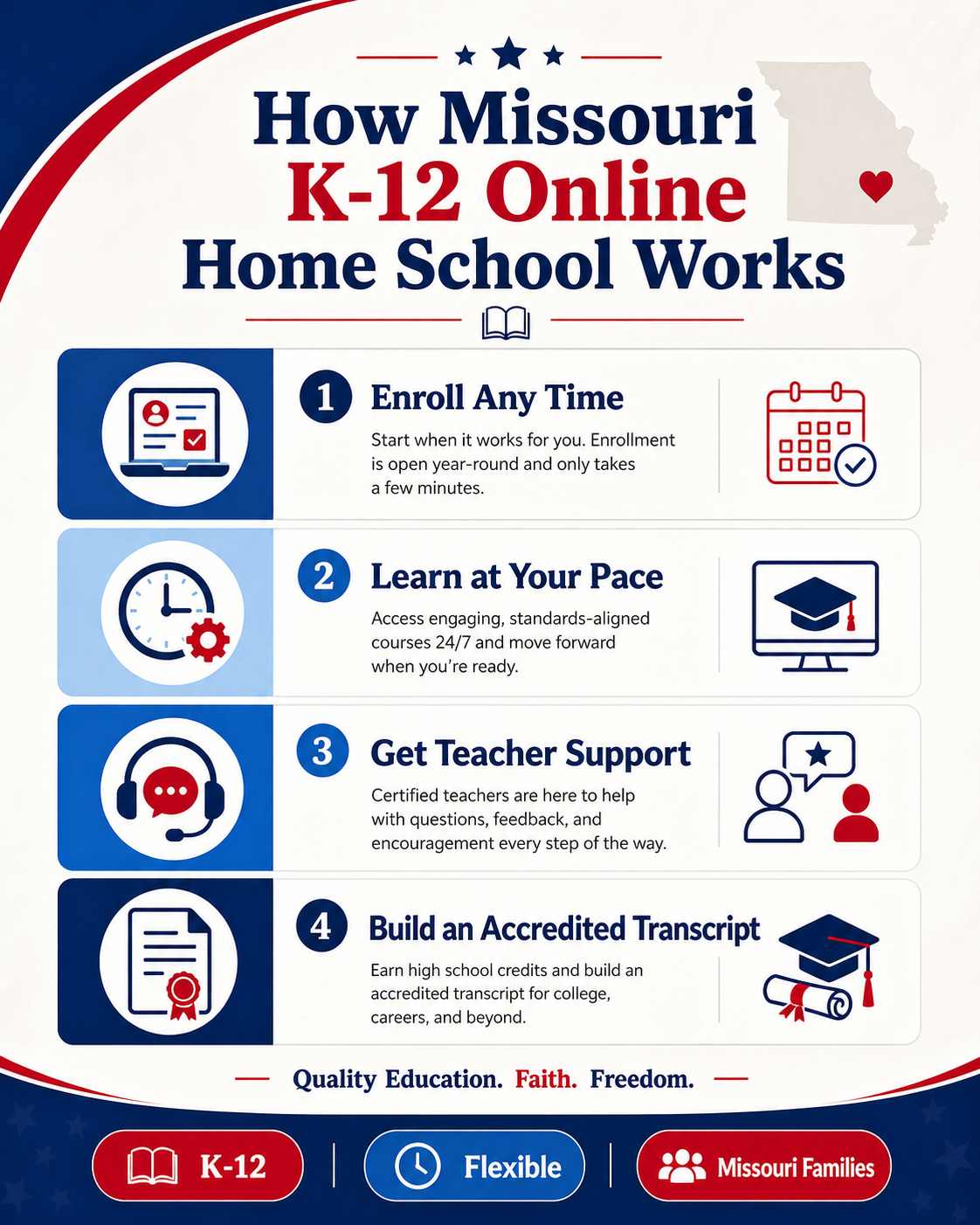
From Decision to First Lesson: How Enrollment Works
You can call Monday and be in coursework by Wednesday, here is exactly how that happens.
-
1Call or reach out online
Dial (888) 242-4262 or visit highschoolofamerica.org. A real person picks up. Tell them where your student is, what grade they’re in (or what grade feels right), and what you’re trying to solve.
-
2Choose a grade and start month
Any month works. The program runs year-round, so there is no enrollment window to chase and no semester you have to wait for. Mid-year, mid-move, mid-crisis, all fine. Browse the course catalog beforehand if you want a head start on what your student will be working through.
-
3Send a transcript, or don’t yet
You can start without one. Don’t let the transcript slow you down. When it arrives, text a photo to the enrollment number, email it to support@highschoolofamerica.org, or upload it on the website. Our credit transfer process is built to be quick and straightforward.
-
4Counselor maps the academic path
A counselor does an official credit evaluation, figures out exactly where your student stands, and walks through the tuition breakdown on the call. No surprises waiting on the other side of enrollment.
-
5Access the parent dashboard
Log in and open the first course materials. Assignments, grades, teacher contact, and pacing are all there, a real-time window, not a quarterly report. Families curious about what a full year looks like can check how many credits are needed to graduate before day one.
-
6Hear from a teacher within 24 hours
That first teacher response arrives within a day of starting coursework. The first lesson isn’t a student alone with a screen, it’s a student with a real teacher already in their corner.
Missouri families across all 114 counties
Here’s something most families don’t realize until they’re already deep into their research: an established K-12 online program doesn’t care whether you live inside a St. Louis suburb or at the end of a gravel road in the Ozarks. Our program reaches all 114 Missouri counties and the independent city of St. Louis. From the Kansas City metro to the Bootheel. And the experience is identical regardless of your zip code.
That matters most in places where the gap between what families want and what’s locally available is widest. New Madrid County, down in the Bootheel, is one of Missouri’s most rural and historically underserved regions. Families there get the same established curriculum as anyone in St. Charles or Boone County, with no transportation burden attached. Pulaski County is another place we’d call out specifically: Fort Leonard Wood sits there, and military families on PCS orders know better than anyone that a school tied to one address is a school you’re leaving behind. Ours follows the student. Jackson County and St. Louis County together cover Missouri’s two largest urban concentrations, and families in both metros. Whether in a Kansas City suburb or deep inside St. Louis County. Can access the program without any geographic barrier. Greene County, Clay County, Jefferson County, Jasper County, and Boone County round out a statewide picture that runs from Springfield’s Ozarks hub to Columbia’s university corridor and everywhere between.
What tuition looks like, and why it starts with a conversation
Tuition here is credit-based, which is a small detail that matters a lot for families who are arriving mid-journey. A student transferring in with coursework already on the books pays only for the credits they still need, not a flat annual rate that ignores what they have already earned. That is a real difference. A counselor does a credit evaluation first, reviews whatever transcript exists, and builds the picture from there. No transcript yet? That is fine too. A counselor can walk through a cost range based on grade level, then sharpen the numbers once the transcript arrives.
Payment plans are available, and the counselor on the other end of (888) 242-4262 will cover the options specific to where your student stands today. There is no public price grid because there is no one-size answer worth publishing. What there is: a straightforward conversation, a full breakdown, and a path forward. Families can also reach the enrollment team at support@highschoolofamerica.org. Either way, the goal is the same. You leave the conversation knowing exactly what this looks like for your student, not for a hypothetical one.
Neighboring states, same program
State lines shift under families more often than anyone plans. A job transfer from Kansas City to Overland Park, a move from Joplin to Fayetteville, a military family rotating out of Fort Leonard Wood toward a new assignment. The school shouldn’t be the casualty every time the address changes. Our online K-12 program is portable by design. It travels with the student, not the zip code.
Missouri shares a border with eight states, more than nearly any other in the country. Families near the Kansas City metro straddle the Missouri-Kansas line on a daily basis. Families in greater St. Louis are minutes from Illinois. Families in the Bootheel are closer to Arkansas and Tennessee than to Jefferson City. If your household moves, or if you’re simply researching options from the other side of a state line, the neighboring state pages below cover the same online program.
Where the borders run close
- Iowa K-12 online home school
- Illinois K-12 online home school
- Kansas K-12 online home school
- Arkansas K-12 online home school
- Tennessee K-12 online home school
Wherever you land, the program follows.
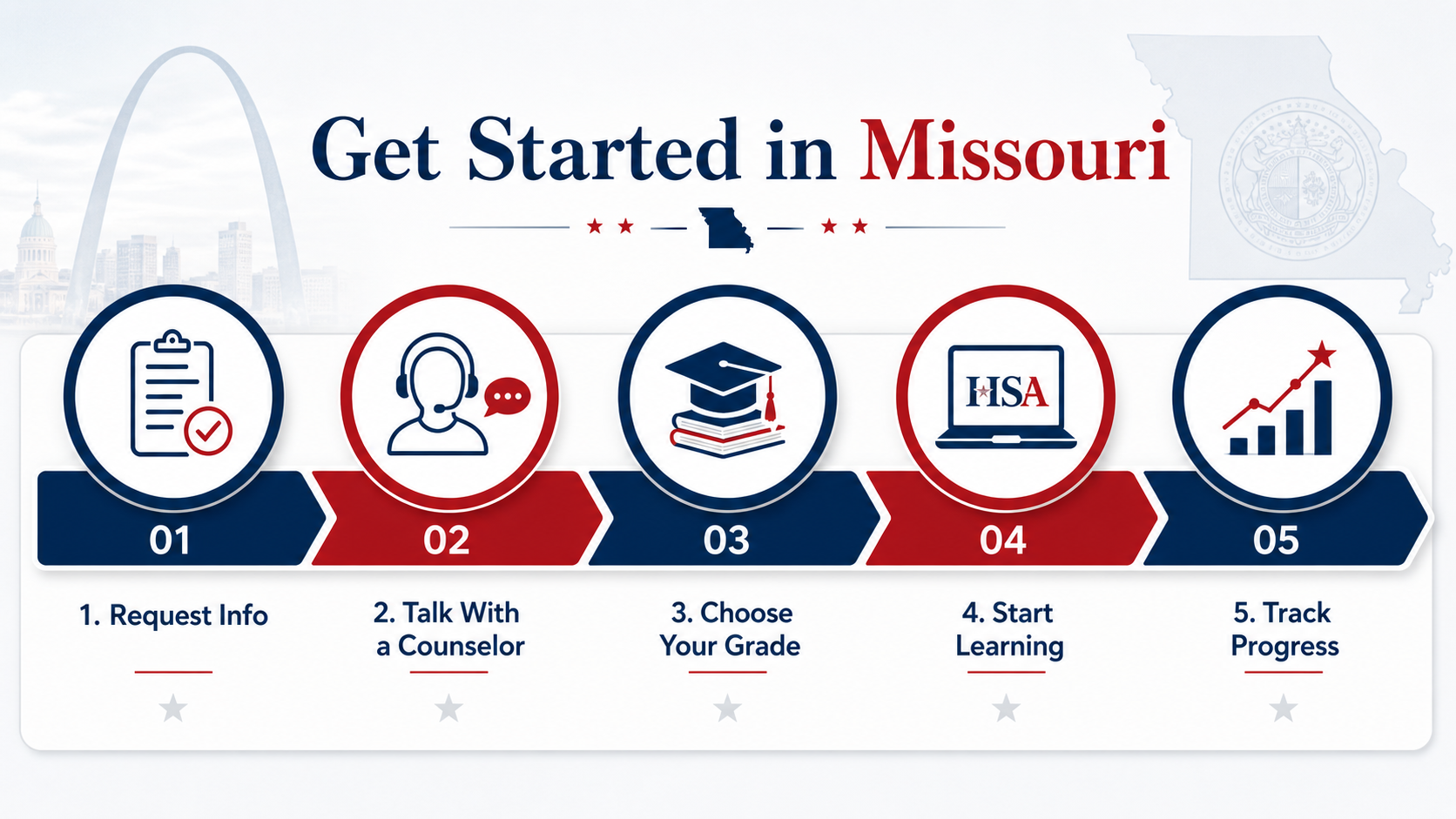
Missouri says: show me.
A counselor will walk through grade level, credits, and cost on the first call. No commitment required.