Anaheim K-12 Online Home School
High School of America delivers a fully online, flexible curriculum for elementary, middle, and high school students available anywhere in Anaheim and Orange County. Our program is designed to fit real life, supported by expert teachers and an AI-powered student assistant.

Quick Answer
High School of America provides online K-12 courses, academic support, parent visibility, course records, and transcript documentation for Anaheim and Orange County families. California families using online learning for home education should choose the legal pathway that fits their situation, such as a Private School Affidavit, private school satellite program, public independent study program, or credentialed private tutor option. Families remain responsible for verifying current requirements with official California Department of Education guidance.
Pick the Legal Path That Fits Your Family
Private School Affidavit (PSA)
File with CDE between Oct 1-15. Establishes the home as a private school of record. Parent maintains attendance + faculty records.
Private School Satellite Program
Umbrella school files PSA on the family’s behalf. Offers third-party recordkeeping support.
Public Charter or Independent Study
Student is publicly enrolled. Parent acts as learning coach. No-tuition public-school enrollment.
Credentialed Private Tutor
3 hours/day, 175 days/year, in required subjects. Tutor must hold a CA teaching credential.
High School of America provides structured online K-12 coursework families may use as part of any of these pathways. Verify current requirements with the California Department of Education.
The Anaheim family this school is for
Anaheim isn’t one kind of place. It’s the Hills, the Colony, West Anaheim, the Platinum Triangle, and the working stretches along Lincoln and Beach. The family on Saturday at the Little League diamond on Sycamore lives a different Anaheim than the family commuting to the Resort District at five in the morning, lives a different Anaheim than the family whose kid is in club volleyball driving to Long Beach twice a week. What they share is a kid in school and a school day that wasn’t built around the rest of their life.
An online K-12 program isn’t the right answer for every family in Anaheim. It’s the right answer for the ones whose week keeps colliding with the school week — the families with a kid in competitive sports, the families with a parent working hospitality or Resort District hours, the families who travel for work and don’t want their kid to lose a quarter every time, the families whose kid is ahead of the room or behind it and needs the pace adjusted, and the families who just want school to be the part of the week that bends.
The school day at HSOA isn’t a brick-and-mortar day moved to a screen. It’s a different shape: the kid sits down in the morning with the harder subjects while the family’s day is starting, breaks for lunch when the family eats, and is usually done by mid-afternoon. The curriculum does the teaching. The parent’s job is closer to running a small school — making sure the kid is showing up to his own day, knowing when something is harder than expected, picking up the phone for a counselor call when it is.
What the curriculum actually teaches
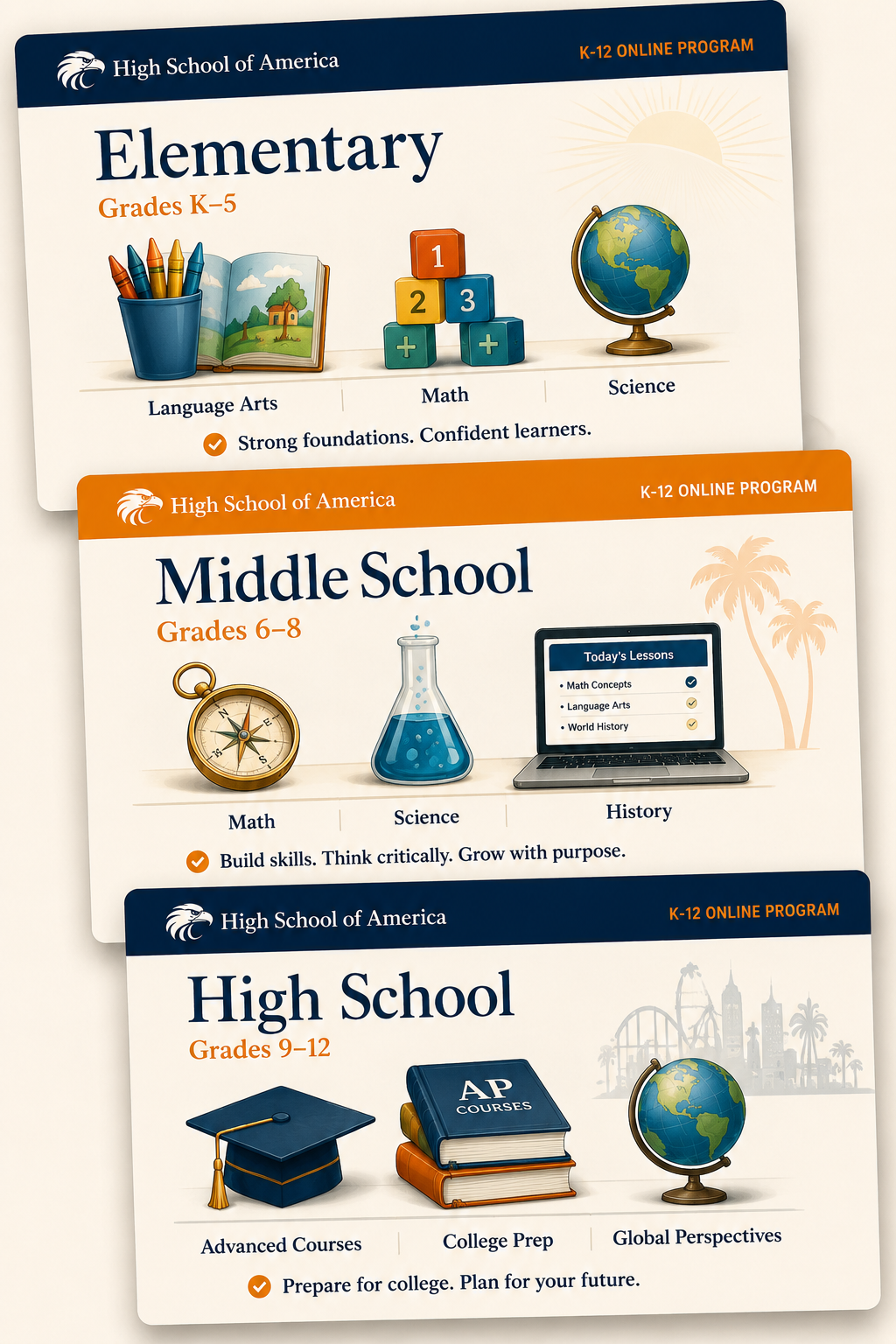
Reading: the subject that decides the rest
Reading decides the rest of K-12. A kid who reads well by the end of third grade has a school year that opens doors. A kid who doesn’t has a school year that feels like running uphill in every subject for the next nine years. The K-2 reading sequence at HSOA is built around the science-of-reading consensus: phonemic awareness, then phonics, then fluency, then comprehension. Sequential and explicit. Around third grade the kid stops learning to read and starts reading to learn; the curriculum shifts with him.
Math: mastery, not spiral
Math uses a mastery model. A kid finishes one topic before the next one starts. He doesn’t move on to two-digit multiplication until the single-digit tables are automatic. This means the kid who’s ahead can accelerate; the kid who needs more time on fractions gets more time on fractions, and that time doesn’t cost him the next four years. The pacing matches the kid, not the calendar.
Writing: the progression nobody skips
Writing is sequenced separately from reading and starts before the kid is comfortable with it. First-graders write a sentence. Second-graders write a paragraph. By fourth grade the kid writes a real essay; by middle school analytical writing with a thesis; by high school longer-form work that makes a sustained argument. Skipping any of it is how kids arrive in tenth grade able to read but not write. One of the most common gaps in K-12.
Science: the lab problem and how it’s solved
Science at K-12 online has one problem to solve: the lab. The curriculum separates the parts science needs physical experience for (cellular biology, chemical reactions, simple machines) from the parts it doesn’t (theory framework, reading, data analysis, modeling). The hands-on parts come in shipped materials. The student actually grows a bean plant in seventh-grade life science, mixes baking soda and vinegar to titrate a base in tenth-grade chemistry, runs the electromagnet experiment in eighth-grade physical science. The rest happens in the curriculum itself.
Featured Subjects & Courses
- American Curriculum Overview
- English II, English III
- Algebra II, Geometry, Pre-Calculus
- Biology, Chemistry, Physics
- U.S. Government, World History
Curious about graduation requirements? Learn more about credit requirements and earning your cumulative record.
Technology That Powers Learning for Anaheim Students
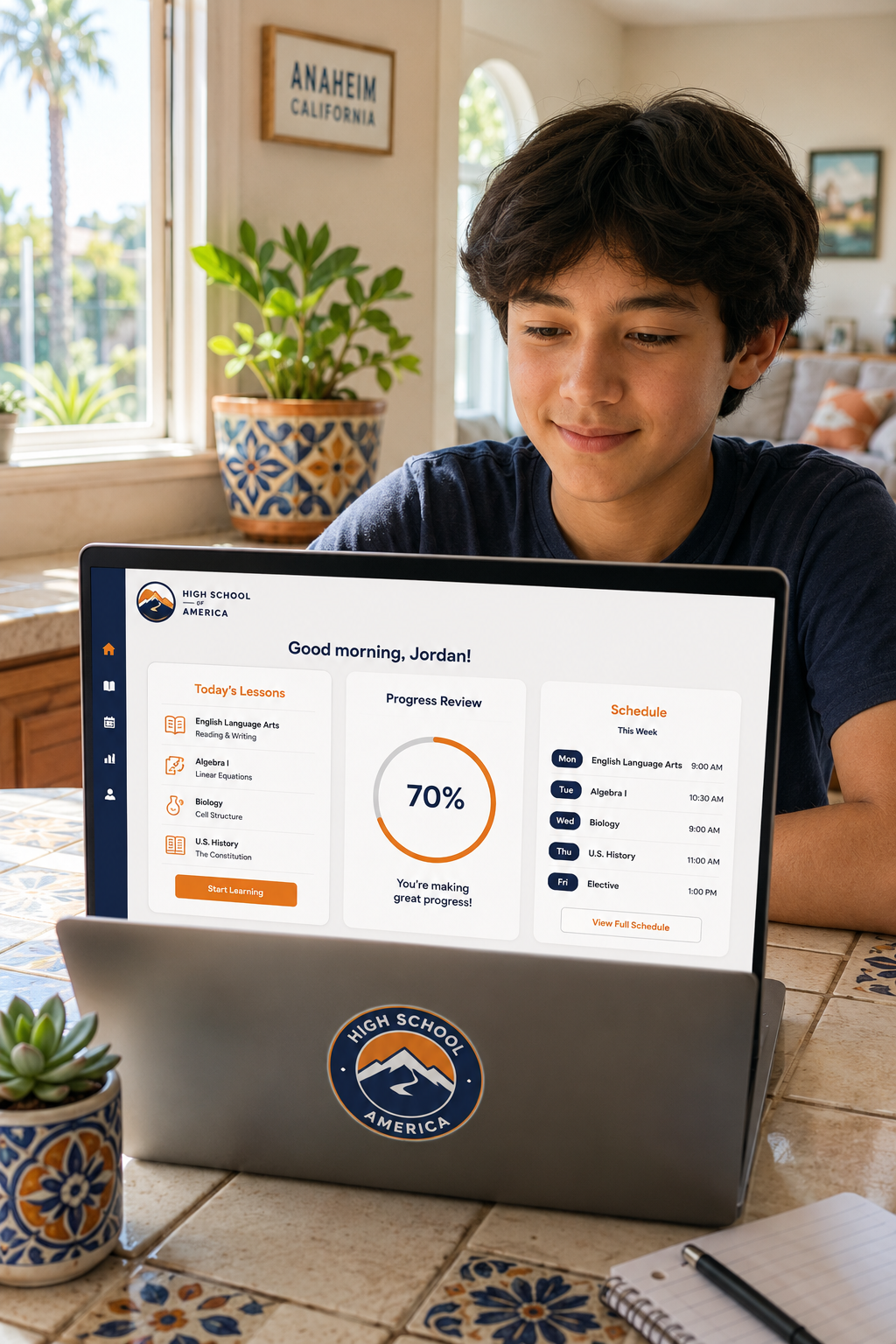
High School of America runs on a modern learning platform designed for flexibility, clarity, and results. Students get an intuitive dashboard, parents get real-time visibility, and everyone benefits from AI-enhanced tools that keep learning on track.
What Students Experience
- AI Study Assistant: Personalized nudges, topic tips, and progress reminders.
- Interactive Courses: Videos, e-books, virtual labs, practice quizzes, and auto-graded assessments.
- Gamified Progress: Points, badges, and milestones students can see and celebrate.
- Real-Time Progress Tracking: Grades, time on task, and checkpoints in one place.
- Virtual Classrooms: Live help, small-group sessions, and office hours.
- Any-Device Access: Laptop, tablet, or mobile learn from anywhere in Anaheim or across California.
Key Platform Features
- AI-Enhanced Learning Topic suggestions, study plans, and instant feedback.
- Gamification Points, streaks, and achievements for motivation.
- E-Books & Digital Library Built-in resources for independent learning.
- Virtual Labs & Simulations Hands-on digital activities in science and math.
- Assessments & Mastery Practice plus mastery checkpoints before big tests.
- Integrated Help In-course hints, knowledge bases, and optional live support.
- Optional Tutoring 1:1 or small-group sessions for extra support.
- Accessibility-First Captions, alt text, and readable layouts where supported.
- Security & Privacy Encrypted access and role-based permissions.
The records the kid leaves with
HSOA is an accredited K-12 online homeschool program. That means a student who finishes a year here, and a student who finishes the K-12 program here, leaves with the kind of records other institutions know how to read: per-course completion records, grades, standards-aligned descriptions, and a cumulative transcript the family can hand to another school, an employer, a military recruiter, or the next K-12 school during a transfer.
The transcript follows the kid. If a family moves out of Anaheim mid-year, the transcript moves with them. If a kid finishes ninth and tenth grade here and goes back to a brick-and-mortar high school for eleventh, the receiving school gets a transcript that other receiving schools read the same way. Final review decisions stay with each receiving school, the way they always do, but the records HSOA produces aren’t records that get questioned.
What Anaheim families receive
- Per-course records and grades Completion records with grades and standards-aligned course descriptions for every subject the kid takes.
- Cumulative transcript A document the family can submit to other schools, employers, or military programs during transfer or intake review.
- American Curriculum framework Coursework follows the American Curriculum framework.
- Flexible pacing on the record Self-paced scheduling that supports student-athletes, performers, and traveling families. The pacing is part of the record, not a footnote.
Who this school is for in Anaheim

Anaheim families come to this school for a handful of specific reasons, and a counselor on a fifteen-minute phone call will recognize them within the first five.
🏆 The competitive-sports family
Travel ball, club soccer, JO volleyball, hockey at the Honda Center, dance at one of the OC studios. A school day that bends to a tournament weekend or a 6 a.m. practice. The self-paced structure handles the schedule; the parent doesn’t have to negotiate with the front office every time the kid is on the road.
🎮 The Resort-District-hours family
Hospitality, food service, entertainment, retail. The working backbone of a city built on tourism. Shift schedules that don’t line up with a 7:30 bell. A school day the kid can do in the late morning while the parent is on the afternoon shift, or the morning, depending on the week.
👨👩👧 The two-Anaheims family
The household that speaks two languages: Spanish, Vietnamese, Korean, Tagalog, Arabic, Persian, or one of the others Anaheim quietly contains. The reading sequence at HSOA works the same way for the bilingual kid as the monolingual; what changes is the English-vocabulary scaffolding. Both languages grow.
📊 The pace-mismatch family
The kid who’s reading three grades ahead and has run out of patience with the pace of the room he’s in. The kid who’s six months behind in math and has stopped raising his hand. Self-paced is not a code-word; it’s an actual structure. The kid moves at the speed of his own work.
✈️ The travel-and-relocate family
Corporate moves, military transfers, performers on tour, families who split the year between cities. The transcript and the school day come with them. The receiving program at the other end gets a record other receiving programs read.
Talk to an Academic Counselor
Map out a custom Anaheim K-12 plan in a 20-minute call. No pressure, just answers.
Benefits of Online Home School K-12 in Anaheim, California

High School of America gives Anaheim students and families the freedom to design an education that fits real life—without the gridlock on I-5, the 91, or the 57, rigid bell schedules, or overcrowded classroom distractions.
🎯 Academic & Learning Advantages
- Standards-Aligned Curriculum Coursework families may submit to other schools, workforce programs, and other programs.
- Personalized Learning Paths Progress at your own pace with teacher guidance and adaptive tech.
- Career & Life ReadinessAmerican Curriculum and career electives.
- Comprehensive Subjects From Biology and Geometry to World History and Art History.
🌐 Lifestyle & Accessibility Benefits
- Self-Paced Online Access Coursework available on desktop, tablet, or phone — students log in when the household schedule allows.
- No Commute Skip the freeway traffic—learn from home.
- Perfect for OC Families Ideal for parents whose work hours shift or who travel frequently.
- Safe & Supportive Learn clear of classroom distractions and peer pressure.
- Parental Oversight Real-time dashboards and grade tracking.
Students with an IEP or 504 plan, and twice-exceptional learners
HSOA accommodates students with active IEP or 504 plans and works with families on the specific accommodations the plan calls for. The starting point for any family bringing an existing plan into the program is a counselor call: the counselor reviews the plan with the parent, walks through how the accommodations land in the K-12 curriculum, and aligns the kid’s pacing and supports to what the plan asks for.
For twice-exceptional learners (students simultaneously advanced in some subjects and needing extra support in others), the self-paced mastery model does work that a fixed-grade classroom can’t. A kid can be reading at an 11th-grade level and working through 6th-grade math at the same time, on the same day, without either pace becoming the wrong pace for the kid. The structure that hurts most 2e kids in a brick-and-mortar setting (the same room, the same level, the same week for every subject) doesn’t exist here.
What HSOA does NOT do: replace the role of clinical specialists, therapists, or service providers a family is already working with. The school works alongside that ecosystem. Specific therapy hours, specialized assessments, and clinical evaluation stay with the providers the family already trusts. The school’s job is the K-12 academic work, accommodated to fit the plan and the kid.
Families with an existing plan should bring it to the counselor call. Families who think their kid might need a plan but doesn’t have one yet should still call. The counselor can talk through what the pace and structure look like before any formal accommodations are in place.
What the financial side actually looks like
HSOA is a tuition-funded private K-12 school. The financial side is a real conversation, and the right place to have it is a counselor call, not a tuition table on a webpage. Costs vary by grade level, by course load, and by how a family wants to phase enrollment, so a number on a page would be wrong for most of the people reading it.
What’s usually true:
- Tuition is structured to be accessible Payment plans exist. The counselor walks through what fits the family’s situation.
- Per-course flexibility Families who only need part of the year, or a subset of courses, can usually structure enrollment that way. The full K-12 stack and the partial-year path both work.
- No surprise fees mid-year The cost of enrollment is the cost of enrollment. Materials shipped for hands-on science and the platform access are part of the program.
- External programs vary by state California-administered programs that fund private-school education exist and change over time. HSOA’s eligibility for those programs is a question the counselor can take directly, not a promise made on the page.
For exact numbers and a written plan for your family’s situation: schedule a counselor call.. Fifteen minutes. No pressure.
Homeschool Laws & Requirements for Families in Anaheim, California
In California home school, compulsory education laws require school-age children to attend a full-time school option, but families can meet this requirement in several ways, including home-based private schooling and independent study.
Common Options California Families Use
- Home-Based Private School Parents may establish a home-based private school by filing a Private School Affidavit with the California Department of Education.
- Independent Study / Charter Schools Public districts and charter schools may offer independent study or online options that satisfy compulsory attendance.
- Private Tutor Option A credentialed tutor may provide full-time instruction in required subjects.
For detailed, up-to-date information, always refer directly to the California Department of Education and, if needed, consult your local district or a legal adviser.
Anaheim Map
Anaheim families enroll with High School of America from Anaheim Hills, The Colony, West Anaheim, and nearby communities.
Ready to Make the Switch?
Anaheim and Orange County students can begin self-paced K-12 learning any week of the year.
Frequently Asked Questions About Anaheim Online Home School K-12
Is High School of America accredited?
Can my child learn at their own pace?
What grades do you offer?
How do parents monitor student progress?
Who supports my student?
Can Anaheim students switch from a local public school?
Can international or mobile families enroll?
How long does it take to finish a course?
How much does online home school K-12 cost?
Read a little. Talk to a counselor. Take a week.
A K-12 school decision shouldn’t be made in an afternoon. The right next step is a fifteen-minute call with a counselor who can walk through your kid’s grade level, your family’s schedule, and whether the pace of this program actually fits. The call is at no charge. There’s no commitment after the call. There’s no follow-up sales push.
If the family decides this isn’t the right school, that’s a real answer. If the family wants a week to think, that’s a real answer too. The door doesn’t close.
- Talk to a counselor. Fifteen minutes by phone. Bring whatever the kid’s current school year looks like: transcript, grade level, any plan paperwork.
- Walk through the program. The counselor shows what the day, the curriculum, and the pacing actually look like for a kid in your grade band.
- Take a week. Let the family sit with it. If it fits, the enrollment paperwork is straightforward when you come back. If it doesn’t, that’s fine.
Helpful Resources for Anaheim & California Homeschool Families
Explore popular articles and trusted resources on homeschooling, online learning, and getting started to support your family’s decisions.
- 🧠 What Is a Self-Paced Online High School?
- 📅 How Many Credits Do You Need to Graduate High School?
- 🏫 The American Curriculum Explained
- 📊 NCES Fast Facts: Distance Learning
- 📈 Research Facts on Homeschooling (NHERI)
- 🌍 Homeschooling & Online Education (U.S. Department of State)
- ⚖️ HSLDA State Homeschool Laws
Socialization & Community for Anaheim Online Homeschoolers
Homeschooling changes where socialization happens, but it doesn’t remove it.
Ways Anaheim Homeschoolers Connect