
Raleigh Online High School: Earn an Accredited Diploma, Any Grade, Any Month
Wake County’s calendars are complicated: year-round tracks, magnet commutes, RTP shift schedules, training calendars that ignore the school day. High School of America is an independent private online high school for grades 9-12 where the schedule belongs to the student. A counselor maps the transcript before the first lesson, enrollment opens every month, and the diploma carries accreditation and a College Board CEEB code wherever it travels.
An independent online high school, in plain terms
Most online options Raleigh families find first are public programs: a statewide supplemental course platform that issues courses but no diploma, virtual charters with enrollment windows, and district-run virtual school bound to the district calendar. Useful programs, but every one of them runs on someone else’s schedule.
High School of America is the other kind: a private school that issues its own diploma and official transcript from its own registrar. Qualified teachers teach and grade every course. A counselor holds each student’s graduation map. The credential is verified the way any school’s is, by its accreditation and its College Board CEEB code, and it is recognized by colleges, employers, and the military.
Families usually arrive here comparing three doors: stay in the public system, homeschool fully parent-led, or enroll in an independent online school that handles the teaching, records, and the credential while the family controls the setting. This page is the third door, explained honestly.
What 9th through 12th grade look like online
The four years carry the same jobs they carry on any campus.
Freshman year lays the core foundation and teaches the student to run a self-paced week. Sophomore year deepens the core and opens honors choices. Junior year shapes the GPA that colleges weigh hardest. Senior year closes the credit count and ends at a commencement with a cap and gown.
Each year has its own program page with the course sequence and what the counselor checks at that stage: 9th grade, 10th grade, 11th grade, and 12th grade. A student can enter at any of them, in any month, including mid-year, because the program starts from the student’s actual transcript rather than from a calendar.
Can a North Carolina student transfer credits from a public school to an online high school?
Yes. Credits already posted at a Wake County or any NC public school transfer in after a counselor’s transcript review, so nothing earned is repeated. The family files one Notice of Intent with the state’s Division of Non-Public Education, and the diploma at the end carries the school’s accreditation and CEEB code.
The course catalog behind the diploma
The catalog is a full college-prep program. English runs four years through composition and literature. Mathematics runs from Algebra I through Pre-Calculus with honors sections along the way. Laboratory sciences cover Biology, Chemistry, and Physics. Social studies covers World History, American History, Civics, and Economics, and world languages run in two-year sequences beside electives in arts, technology, and physical education.
Prerequisites and course rigor are tracked from the first semester. Students aiming at the UNC system, NC State, or out-of-state schools plan course depth with the counselor early, because what counts as a strong GPA depends on the courses behind it as much as the number. The complete course list shows every title currently offered, and honors options are open to any student ready for the work.
| Subject | 9th | 10th | 11th | 12th |
|---|---|---|---|---|
| English | English I | English II | English III | English IV |
| Math | Algebra I | Geometry | Algebra II | Pre-Calculus |
| Science | Earth Science | Biology | Chemistry | Physics |
| Social Studies | World History | Civics & Economics | American History | Government elective |
| Languages & Electives | Language I | Language II | Arts / tech | Senior electives |
A school day with no bell schedule
There is no first period. No passing bell, no tardy slip, no seat time. The day’s rhythm belongs to the student: coursework opens 24/7 on any device, lessons replay as often as needed, and assessments unlock the next unit when the student shows mastery rather than when the week ends.
A student who works best at 6 a.m. before a shift at the hospital campus works at 6 a.m. A student who trains mornings works afternoons. The pace itself is adjustable course by course: gentler where a subject is hard, accelerated where it is not, which is how students recover lost ground or graduate ahead of schedule. The self-paced model is the structure, not a perk.
Parents are not guessing, either. Progress is visible: completed lessons, current grades, and pace all sit in the parent’s view the way a parent portal works at any modern school, and the counselor flags a slow week before it becomes a slow month. Families who want to see how engagement is tracked can read how attendance and completion work in a program with no seat time.
Mid-year transfer and credit recovery, mapped before day one
This is the question Raleigh families bring most often, and the place where waiting costs the most.
A student leaving a Wake County school in February has two honest options: transfer now to a school with rolling enrollment, or wait out the semester in a placement that is not working.
The math favors moving. A transcript review maps every credit already posted before the first lesson, so the student starts from their actual standing. Coursework continues through the move instead of pausing for August. One decision gets made once, instead of a countdown the whole family lives under. The withdrawal itself is one state filing, the Notice of Intent, which the counselor walks through on the enrollment call.
For students behind on credits, recovery is targeted: the counselor names exactly which credits are missing and schedules those, not a repeated year. Because courses run self-paced and in parallel, a motivated student can close a real credit gap inside a semester. Families can start that conversation today and have the credit map before committing to anything.
Built for the schedules this region actually runs
The Triangle does not work 8 to 3. Hospital systems and labs run shifts. RTP parents travel. Club soccer, swim, and travel baseball calendars own their weekends, and performers rehearse when the production says so. A bell-schedule day collides with all of it; a self-paced day absorbs it.
High School of America holds NCAA approval, so student-athletes keeping college eligibility in view stay on core-course track while training takes the hours it takes. The counselor watches the core-GPA requirement beside the graduation map from day one rather than discovering it senior year. The same structure serves working teenagers, students managing treatment or recovery schedules, and families whose caregiving responsibilities move week to week. A counselor call starts with the family’s actual calendar, not a template.
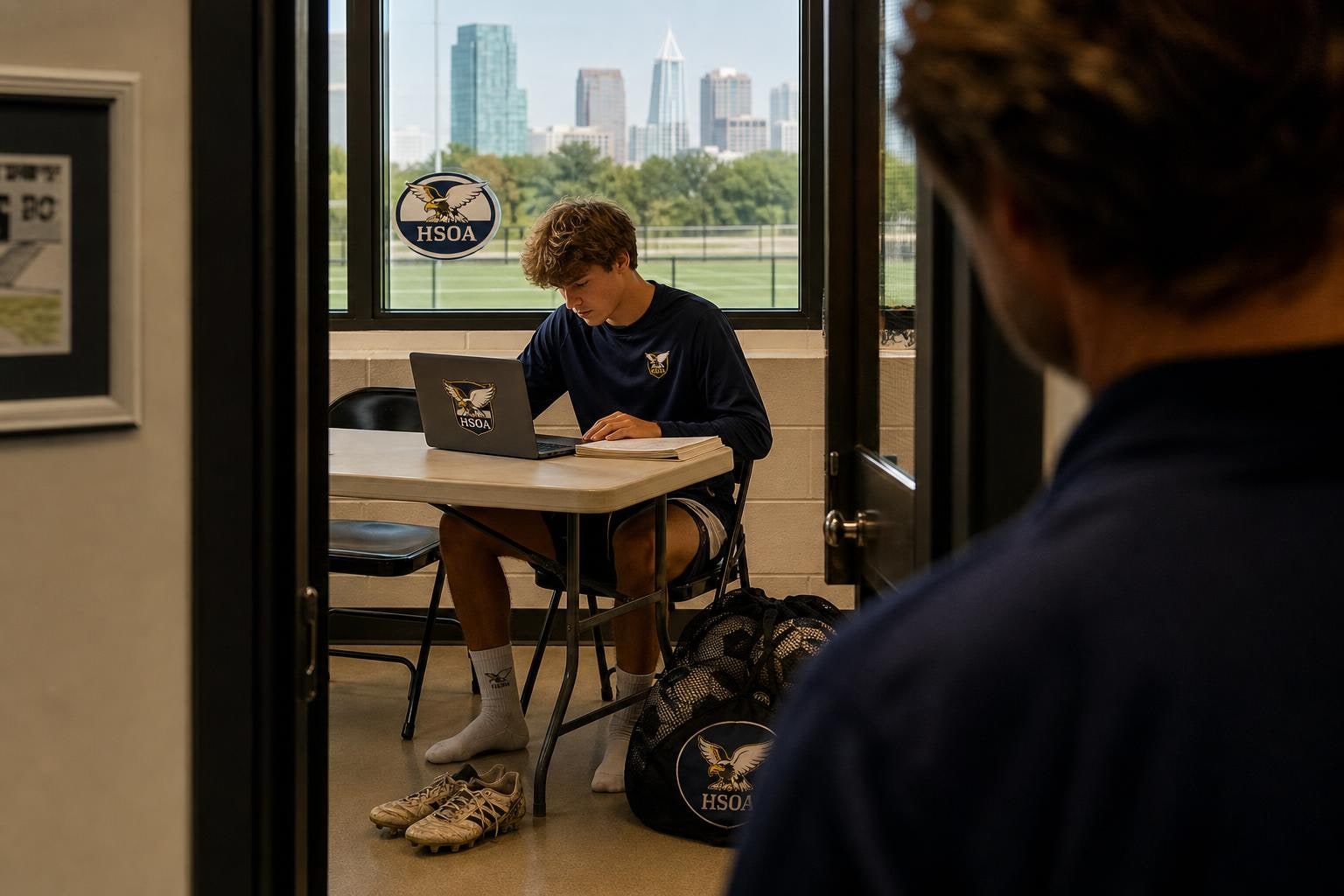
IEPs, 504 plans, and students the classroom wears down
Precision matters here, so plainly: an IEP is a special-education plan with services; a 504 plan is an accommodations plan. As an independent school, High School of America is not bound by IDEA the way a public school is, and families should bring the actual plan to the first counselor call to walk through what the student needs.
What the structure itself provides covers a large share of common accommodations by default. Extended time is simply how self-paced work functions. Instruction replays without limit. The setting is the student’s own quiet space, which also matters for students whose plans exist because of medical safety: a severe allergy or a condition a campus health office manages by exception is managed at home by routine.
The context many Raleigh families carry into this decision is bigger than paperwork. Adolescent anxiety and depression have risen sharply over the past decade, and for a meaningful group of students the daily campus environment is the aggravating factor. A calmer setting with genuine social connection on the student’s terms changes the daily experience without changing the academic bar.
Roughly 1 in 3 U.S. teens now reports persistent feelings of sadness or hopelessness, the highest level in a decade of CDC tracking.
CDC Youth Risk Behavior Survey, most recent cycle
Two honest paths from here
Not every student should switch schools, and a counselor who pretends otherwise is selling, not counseling. The fit question has real answers. Self-paced online school rewards students who can start work without a bell, or families ready to build that habit with the structure’s help: visible progress, a counselor checking in, a parent portal that shows the week at a glance.
It is the wrong move when what the student mainly needs is what a campus uniquely offers and the current campus is providing it; families weighing the social side specifically can see how online students actually socialize before deciding. It is frequently the right move when the schedule, the environment, or a credit hole is the obstacle, because those are exactly the things this structure removes. The decision tree below is the honest version of the first counselor conversation.
The transcript is the product. Here is what it looks like.
Everything on this page ends in one document. The official transcript is maintained by the registrar, issued sealed on request, and read by admissions offices, employers, recruiters, and scholarship committees against the school’s accreditation and CEEB code. Grades from qualified teachers, weighted and unweighted GPA, honors designations, and the graduation date all live on it.
UNC system schools, NC State, Duke, community colleges, and out-of-state institutions read it the same way they read any school’s record: verify the school, then read the student. A family that understands the document early makes sharper course choices in 10th grade and 11th grade, which is exactly the conversation the counselor opens well before applications start.
| Student | Class of 2027 | |
| English III (Honors) | A | 1.0 credit |
| Algebra II | B+ | 1.0 credit |
| Chemistry | A- | 1.0 credit |
| American History | A | 1.0 credit |
| Cumulative GPA | 3.71 weighted / 3.55 unweighted |
- Sealed official copies issued by the registrar on request
- Weighted and unweighted GPA both reported
- Honors coursework designated on the record
Graduation requirements, and what the diploma opens
Graduating takes a verified credit count across English, mathematics, science, social studies, world language, and electives, confirmed line by line by the counselor and the registrar before the diploma prints. There are no surprise requirements in May because the same map has been visible since enrollment.
Then the diploma goes to work. It is the credential four-year admissions offices verify, the document recruiters check at enlistment, the record trade programs and employers request, and the baseline scholarship committees read past to the coursework underneath. Commencement itself is a ceremony with a stage and a tassel, and for families who were told a year earlier the student would not finish on time, it tends to be a loud one.
Tuition, plainly, and the three steps to a first lesson
Cost questions get direct answers. Tuition is stated plainly on the enrollment call, payment plans spread it across the year, and there are no fees discovered after the family commits. Transparent pricing is a requirement families bring to this decision, and it is treated as one here.
The path in is short. First, a fifteen-minute counselor call built around the family’s actual week. Second, the free credit map: send the transcript and see exactly how every earned credit transfers in, before day one and before any commitment. Third, enrollment and the first lesson, usually inside the same week. Raleigh families can request the credit map or enroll today, and the Notice of Intent filing is walked through step by step on the same call.
- Step 1Fifteen-minute counselor call: the family’s calendar, the student’s goals, the honest fit
- Step 2Free credit map: every transferable credit verified from the transcript, before day one
- Step 3Enrollment, the NOI filing walked through, and the first lesson the same week
Questions Raleigh families bring to the first call
How much does an online high school cost in Raleigh?
Can you do online high school in North Carolina as a private student?
What makes an online high school reputable?
How does withdrawing from a Wake County school work mid-year?
Does the annual standardized test requirement apply?
Can my student still get into the UNC system from an online high school?
Up and down the state
Same diploma, same teachers, wherever the family lands. Where Raleigh families look next.
Send your transcript, get a graduation plan
Upload your transcript and a Raleigh counselor maps every credit you have already earned, then lays out exactly what is left.