
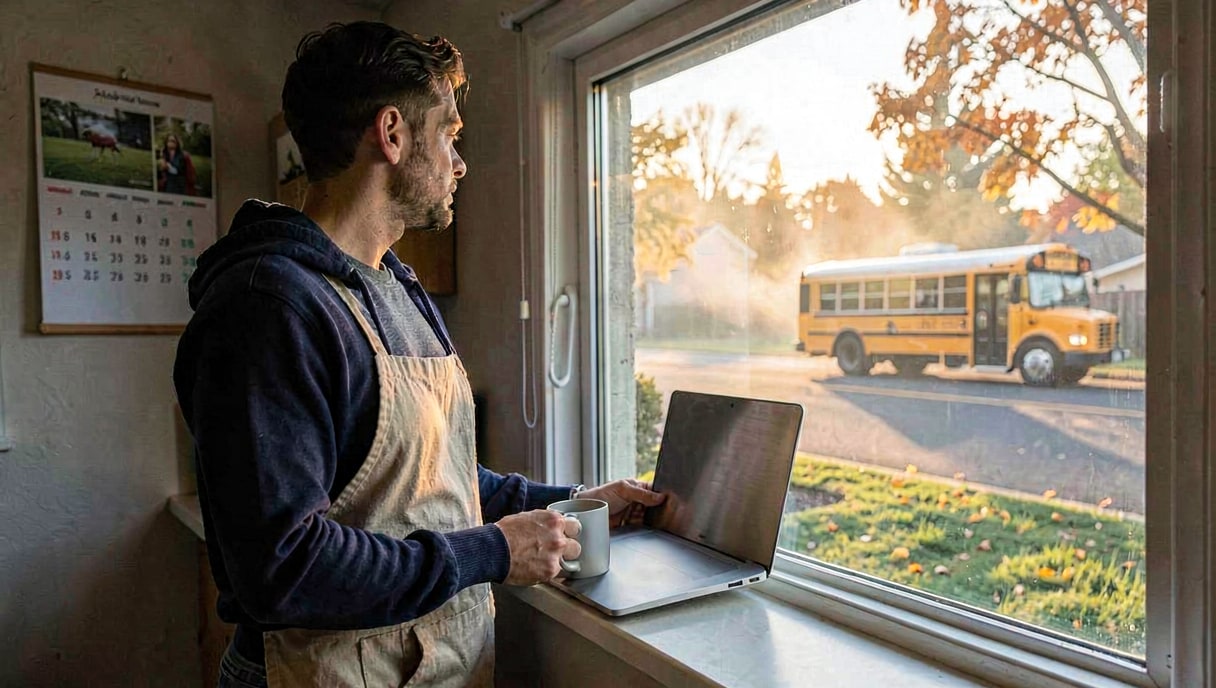
Alief ISD is knocking on doors to find 1,100 missing students. Tucson Unified is polling parents on 4-day and year-round schedules. Clark County is paying families $1,000 to get students into seats. A Saskatchewan school is floating an alternate calendar.
Four districts, one signal: the September-to-June, 180-day calendar is being rebuilt, one district at a time. Surveys and board votes that set 2027-28 schedules are opening now, in October 2026. Your district may be next.
That calendar was built around farm labor and factory shifts. Districts are finally admitting it. But the pitch you will hear is about flexibility and retention. The part you will feel is Friday at 8 a.m., when your student is home and you are not.
Here is the briefing.
What the evidence says
A note on sourcing: I have no fresh studies to hand you today, and I will not pretend otherwise. What follows is my read of the debate, labeled as judgement. Check any claim a district makes against a source you can open.
Fact box: the 4-day week
What the research roughly shows: Researchers have studied 4-day weeks in states like Oregon, Oklahoma, and Missouri, and the results are mixed on achievement. Some studies are now several years old, so treat them as background, not news. Districts tend to cite savings and teacher recruitment as the real drivers.
What it doesn't tell you: Whether your district's version looks like the studied ones. Whether your students, including those who need the most structure, land on the winning or losing side of the average. What a family spends on day five.
Fact box: year-round and balanced calendars
What the research roughly shows: The classic argument is summer learning loss, and in my judgement that case is thinner than the marketing suggests. Balanced calendars shorten the long summer and add breaks through the year, and the instructional-minute total usually stays the same.
What it doesn't tell you: Whether shorter, more frequent breaks help your student or just scramble your household. Nobody studies what happens to the camp your student has attended for six summers.

The Day Five Problem
Surveys ask whether you "support" a schedule. They rarely ask what your week looks like under it. Here is how the same family fares under each model.
The traditional week
Monday through Friday, one schedule. Your work hours, the bus, the after-school pickup, and the camp calendar all grew up around it. It is inefficient, and it is also the thing your whole life is already wired to.
The 4-day week
Day five is the problem. If you work Friday, someone has to supervise your student. Options are a district-run program (is it free, and does it cover every grade?), a paid private program, a relative, or a student left alone, which gets less appealing the younger they are.
Single parents and shift workers absorb this hardest. So do families whose student receives special-education services, because a service delivered on four days is a service reduced by a fifth unless the district says otherwise in writing. Meals count too: for some students, school breakfast and lunch are the reliable ones.
Custody handoffs shift as well. If your agreement says "Friday after school," what does Friday mean now?
The year-round or balanced calendar
No day five problem, but a different one: your calendar stops matching everyone else's. Camps, church programs, and sports leagues that run on the traditional summer will not line up with a July break. Two siblings in different buildings on different tracks is a logistics puzzle with no clean answer.
Custody gets harder here. Agreements written around "summer" and "school year" assume the same calendar your district is about to retire.
My judgement: the 4-day week is mostly a cost-to-families problem, and the balanced calendar is mostly a coordination problem. Both are real, and neither shows up in a satisfaction survey.
Questions to ask before the vote
Bring these to the survey comment box or the board meeting. Get answers on the record.
- Who provides day-five childcare, and for which grades? "Community partners" is not an answer.
- Is it free or fee-based? If fees, how much, and is there a sliding scale?
- What happens to transportation on the off day? Do students in the program get a bus?
- How do meals work on the off day? Will students who rely on school meals get them?
- How are special-education services and 504 plans delivered? Does the number of service minutes change?
- What is the actual instructional-time total? Hours, not just days.
- How will results be measured, and by when? Which metrics, who reports them, and what triggers a reversal?
- Is this a pilot with an exit, or a permanent change? Who decides, and when?
- How does the calendar align with neighboring districts, community colleges, and camps? Especially for dual-enrollment and sports.
- What did the district do with the survey results last time? If the answer is "nothing," you are being consulted, not heard.
When the surveys and votes happen
I cannot verify your district's dates, and I will not hand you a deadline I cannot confirm. Typical pattern, as a rough guide:
- Fall: surveys open, which is now.
- Winter: board discussion and draft calendars.
- Winter to early spring: board vote, ahead of staff contracts and hiring.
- Spring: families learn the 2027-28 calendar.
Check your district's website or call the board office this week. Surveys that are open now will close, and nobody sends a reminder.
Eagle's take
Here is a practical observation, not a pitch. Schedule control is the one thing homeschool families have always had by default. They start when it works, take breaks when it suits their travel or work, and teach on whatever days their household really runs.
Districts are now bolting some of that flexibility onto the traditional system as a retention tactic. That is a reasonable move, and it also tells you something: the 180-day, one-calendar model was never sacred.
If your district votes for a calendar that breaks your household, you have options beyond writing a comment. Some families look at flexible online programs where the schedule bends to the family. If that is on your list, start with an online high school near you or a K-12 online home school program and ask the same questions in this piece. Ask what a school day looks like, who controls it, and what happens on the days you need it to flex.
The schedule shapes your whole week, so ask who controls it before anyone votes on it.
- 2026 School Shootings: Data, Definitions, and Significant Events · Omnilert
- See which Texas school districts are under takeover or at risk · Houston Chronicle
- Cell phones in schools · Britannica
- Time in school matters for student achievement · University of Oregon
- Districts, states grapple with 4-day school week · K-12 Dive