
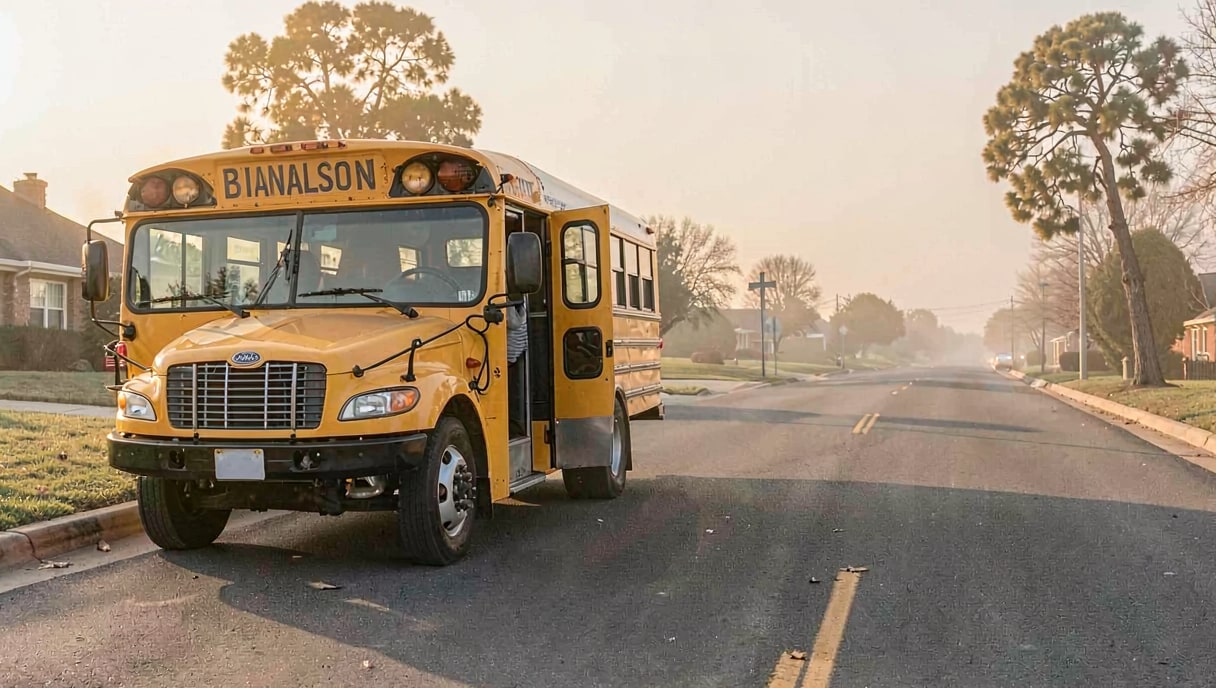
A single parent works a 6 a.m. warehouse shift. She has one car, and it leaves the driveway at 5:20 with her in it. The district just offered her student a seat at a school across town, and the bell rings at 7:45.
That seat is a coupon with no store. She can't redeem it, so she declines. The district logs her as "chose not to participate."
The Showdown: Two Districts, Two Opposite Fixes
Clark County School District (CCSD) and Houston ISD (HISD) landed on opposite answers to the same question: how does a student physically reach a school that isn't down the street?
A note on what I can and can't confirm. Both districts are six weeks into the school year, the numbers are moving, and I could not independently verify current per-student figures for either program. Where I use a number below, it is an illustration I built to show the shape of the tradeoff, labeled as such. Check the district's own transportation page for the live figure before you decide anything.
CCSD: The Pay-to-Drive Stipend
What it is: The district pays a family a flat $1,000 to get a student to a school of choice on their own. No bus. You drive, carpool, or figure it out.
What it costs the district: The figure is the stipend itself: $1,000 per participating student, a known and capped number. No driver, no fuel, no maintenance, no route planning.
What it costs the family: The $1,000 is a flat sum, and your real cost depends on the commute. A short drive may leave you ahead. A long one, twice a day, 180 days, can eat the whole stipend in gas and wear, before you count your time.
Who it quietly excludes: Families without a car. Families with a rigid shift that doesn't bend around a drop-off window. Families where the second parent isn't there to share the load. The stipend pays you to solve a problem you have to be equipped to solve.
HISD: Hub Stops
What it is: Instead of door-to-door or near-door routes, the district consolidates pickups into fewer central stops. Students walk or get dropped at a hub, and the bus runs from there.
What it costs the district: Fewer stops and shorter routes should cost less per student than traditional service. Treat that as the logic of the model, not a measured result.
What it costs the family: Time, mostly. Someone has to get the student to the hub and be there when the bus returns. For a family with flexible hours and a nearby hub, that's trivial. For a family whose hub is a mile and a half away along roads with no sidewalks, it's a daily logistics project.
Who it quietly excludes: Families who live far from any hub, parents who can't be at a stop at the right minute, and students with mobility needs who can't cover that last stretch alone.

The Cost Comparison, With Honest Labels
Here is the cost-per-student picture. Only one of these numbers is a hard figure, and I've labeled each by what it is and how old it is, because pretending otherwise would be the kind of thing I write articles making fun of.
| Model | Per-student cost | Source and age |
|---|---|---|
| Flat stipend (CCSD) | $1,000 | District-announced figure, current 2026 school year |
| Traditional bus service | Not verified | No source I can cite; varies widely by district, route length and driver availability |
| Hub model (HISD) | Not verified | No published per-student figure I could confirm; expected to land below traditional service by design |
Two of three cells say "not verified." That is the point. The one number everyone can quote is the stipend, because it's a price tag. The bus and hub costs are buried in budget lines, which makes the stipend look cleaner than it may be. A clean number is not the same as a cheaper outcome.
Here is my judgement, and it is judgement, not a finding: the stipend is cheap to administer and expensive to families who can't use it. The hub model is cheap to run and expensive in parent time. Neither district is paying the full cost of getting a student to school. They are choosing who absorbs it.
What the Research Says
I don't have a study to hand you here, and I won't dress up a hunch as one.
What I can say is a reasoned observation: transportation is one of the more plausible reasons a family never applies, or says no after an offer, in open enrollment, magnet and charter settings. The logic is simple. A choice program asks families to take an action, and every extra step, a longer commute, a pickup window, a car requirement, is a place where a family with less slack drops out. Districts rarely track the families who looked at the offer and walked away, so the loss stays invisible.
If you want hard numbers on this, ask your district directly how many offered seats went unaccepted last year and whether anyone asked why. If they can't answer, that tells you how seriously they treat the barrier.
Ask Before You Accept a Seat
Before you say yes to any seat that isn't walkable, get answers to these in writing:
- What are the exact pickup and drop-off windows? Compare them to your actual shift, not your ideal one.
- What is the backup plan if your ride falls through? If the answer is "the family handles it," you have your answer.
- What happens if you miss a day, or a week? Ask whether missed transport counts as an absence against your student, and whether a stipend gets reduced or clawed back.
- Is the stipend taxable, and when does it arrive? Ask whether it's paid up front or reimbursed after the fact. A late reimbursement means you float the gas money first.
- What are the sibling logistics? If one student has a choice seat and another stays at the neighborhood school, can you physically be in two places at 7:40?
- Where is the nearest hub, and is the route to it walkable and safe? Go look at it yourself at the hour your student would be there.
- What happens mid-year if your work schedule changes? Find out whether you can switch back without losing the seat or the neighborhood placement.
If a school or district can't answer these cleanly, the seat is less free than it looks.
Eagle's Verdict
Choice is sold as a door. Transportation decides who can walk through it.
The stipend is honest about the price and dishonest about who can spend it. The hub is honest about efficiency and dishonest about the parent hours it quietly consumes. Neither one is a scandal. Both are a quiet sorting mechanism, and almost nobody debates the sorting because the debate stays on test scores and ratings, never on whether your car starts at 5:20.
If a commute is the thing standing between your student and a good fit, it's reasonable to ask whether the fit has to be across town at all. For some families, a school that needs no pickup window at all, like HSOA's online high school in Fresno, removes the ride from the equation. That isn't the right answer for everyone, and I won't pretend it is. It's one more option for a family whose real constraint is the clock, not the quality of the seat.
For families weighing whether to leave a district program altogether, the process is laid out in this first-year binder guide on tracking what you're actually leaving. And if you're in Houston and the transportation question is tangled up with a bigger one, start with what your student's IEP actually protects before you accept any move.
For more on what to ask your district before you trust it, the pattern is the same: the glossy offer is never the whole contract.
- CCSD boosts internal ‘school choice’ option with novel perk: $1,000 to drive your kids to school · Nevada Current
- EDITORIAL: Ebert comes out in favor of school choice · Las Vegas Review-Journal
- HISD moves magnet students to centralized hub stops. Some parents driving miles to reach the bus. · Click2Houston
- Austin ISD first day of school comes amid takeover threat · Austin Current
- Austin ISD bus stop changes · FOX 7 Austin