Pennsylvania · the town side of the avenue
State College Online Homeschool
State College grew up around a school it never ran. The Farmers’ High School of Pennsylvania was founded in 1855, a settlement formed around it, and in 1896 the people living there separated from College Township and incorporated so they could have better streets, street lighting and an adequate school of their own. A State College online homeschool begins from the same habit: before any online school gets a hearing, the household writes down what its own child needs. This page is that list, one line at a time, from kindergarten through twelfth grade, and it ends at an accredited online homeschool that has to answer every line. The statewide rules sit on the Pennsylvania online homeschool page.
Go through the list with a counselor Enroll once the list adds up Send me the details to read first
- The grade
- The pace
- The legal route
- The record
- The cost
Before the list
State College homeschool choices start from a household list
A town named for a college is easy to read as a town about one school. The borough’s own story runs the other way. Its residents asked for a school of their own in 1896, and in 1953, after the college had become a university, they turned down a proposal backed by its president to rename the town Mount Nittany and kept the name they had. The university’s account of that vote is short, and the borough’s longer history fills in the rest.
Why State College families start with their own list
For a family the lesson is practical. The name up the avenue settles a great many questions for a great many people. It cannot say which grade a particular child is ready for, how quickly she moves through fractions, or whether the parents want to file their own paperwork. Those answers come from the household, so they go on paper before any school is compared.
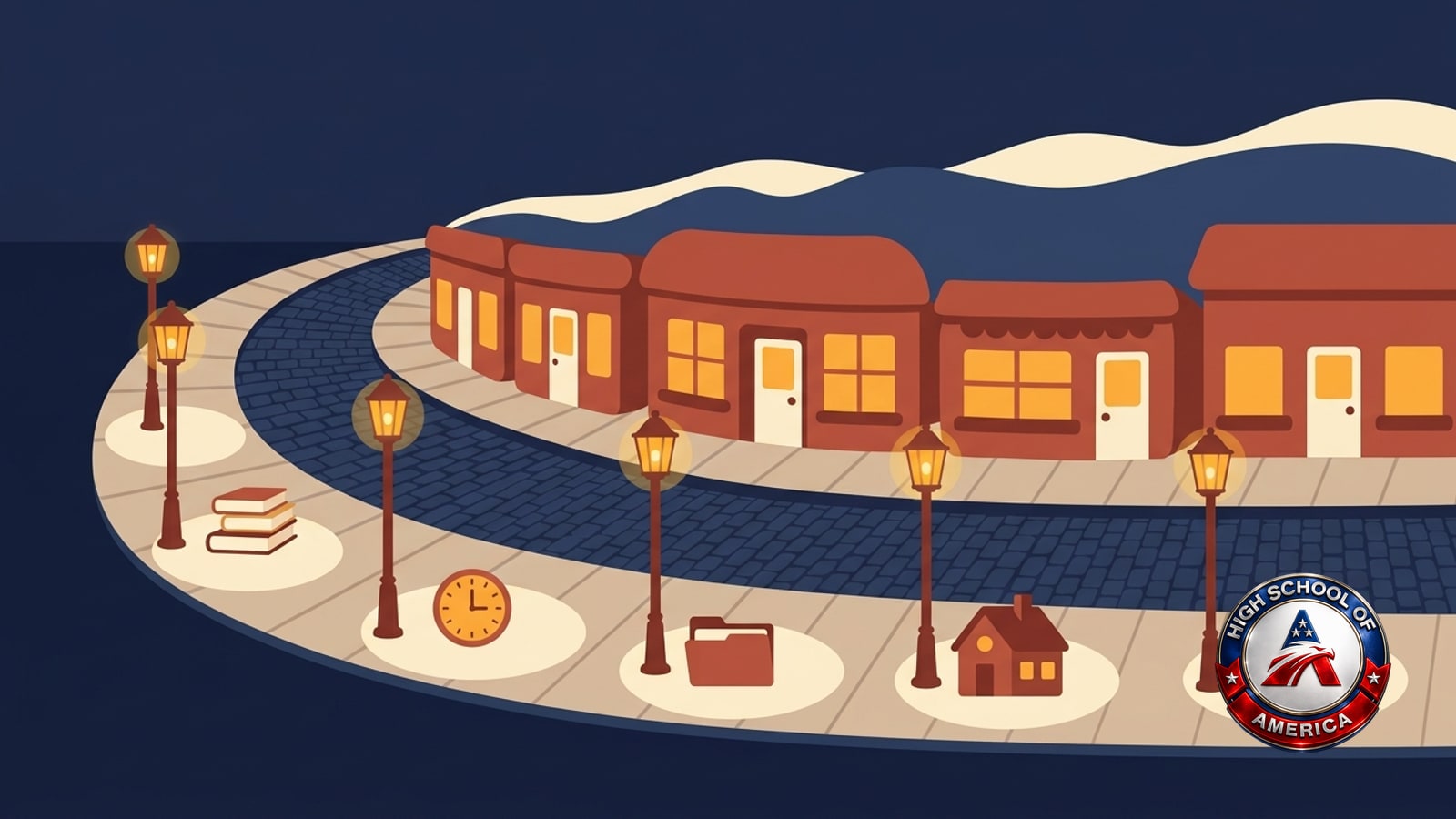
Five lines a State College family writes before comparing schools
Most lists that families bring to a first call land on the same five lines, planned or not. Weighing accredited online k12 schools in State College only helps once those lines exist, because accreditation tells you a school’s record is checked by an outside body, not that the school fits this child. It is worth reading what accreditation means for an online high school or elementary school before the first call. The admissions requirements are brief: recent records and a conversation.
The household’s list, before any school’s
Which grade the work actually supports. How fast this child moves in each subject. Which legal route the family is on. Who keeps the record. What it costs. A school earns a place on the list by answering all five in plain words on the first call.
On the list: the grade
Item one: kindergarten and the elementary grades
Grade is the first line because everything else hangs from it. For the youngest children the question is less about content than about the length of the day and who sits beside them. Parents weighing an online curriculum for kindergarten for State College Pennsylvania households often picture hours at a screen. What they find is short lessons, a parent close by, and kindergarten reading and language arts built on read-aloud time and letter sounds.
Choosing among State College elementary homeschool programs
Sorting through State College online elementary homeschool programs comes down to three questions: does a certified teacher grade the work, can a unit move when the child is ready, and can the parent see progress without keeping every record personally. The guide to online classes for elementary education for State College families walks through a typical week, and the week below is one such plan for a student in second grade online.
One second grader’s week, set with the family. Lessons move when a unit is finished, not when a bell rings, and the open blocks belong to the household.
Company for younger students learning at home
Some parents worry that learning at home costs a child the company of other children. The research on social connection online is more hopeful than the worry, and the open blocks in that week exist so the household can fill them with people.
On the list: the pace
Middle school grades, where one label stops fitting
Somewhere around sixth grade, a single grade number stops describing a child. One student reads like a high schooler and still needs steady practice with ratios. Another is ready for algebra and wants more time with long essays. Writing each subject as its own line on the list keeps a school from averaging the two into a year that fits neither.
Placing each middle school subject on its own
A counselor places subjects separately, so seventh grade courses in English can sit beside eighth grade pre-algebra for a student who is ready for it. A certified teacher grades the work in each subject, and staying engaged in online school shows up in the work itself, so a stalled unit is noticed while it is still small.
What a counselor reads before placing a student
- The latest report card or transcript, read subject by subject
- Any IEP or 504 papers from the last school
- The subjects the student finds too easy, said out loud
- The subjects that need more time, said just as plainly
On the list: the pace, continued
Self-paced homeschool on an academic calendar
Households that live by a university calendar know how uneven a year can be: a term spent somewhere else, an appointment that starts in January, a summer that runs long. A self paced online homeschool in State College PA keeps a child’s school year from being set by anyone else’s. Enrollment is open in any month, lessons advance when a unit is finished rather than when a bell rings, and the weekly rhythm is agreed with the family at the start.
Who watches the pace for a State College student
Setting up the house for the school day
Pace also depends on the room it happens in. Getting your home set up for online school is a short job: a steady connection, a quiet corner with good light, and a shelf for books and folders. The rest is routine, and routine is easier to keep when the family chose it.
On the list: the legal route
Pennsylvania homeschool law: the affidavit or an enrolled school
This line decides most of the paperwork, so it belongs on paper before anything is filed. Pennsylvania offers more than one route. The Home Education Program is what most people mean by homeschooling: a parent supervises, files an affidavit, keeps a portfolio and arranges testing. Signing up with an accredited private or online school puts the family under a different part of Pennsylvania law, and that part carries different rules. Reading about homeschool law for State College families is easier with the two routes side by side.
The two routes, side by side
| Requirement | What Pennsylvania asks for |
|---|---|
| Affidavit | Notarized affidavit (or sworn declaration) filed with the local superintendent, due August 1 each year |
| Standardized testing | Required in grades 3, 5, and 8, reading/language arts and math. Cannot be administered by the parent |
| Portfolio | Work samples and a reading log, kept through the year |
| Evaluator review | A qualified evaluator reviews the portfolio and certifies it, due to the district by June 30 |
| Instructional time | 180 days, or 900 hours (elementary) / 990 hours (secondary) |
That is what Pennsylvania’s Home Education Program under 24 P.S. § 13-1327.1 asks of a family teaching independently. It is not the only path: Pennsylvania separately recognizes Private Tutoring and enrollment in a licensed private or online school, a different legal category with its own, lighter requirements. Both pathways are described on the Department of Education’s Home Education and Private Tutoring page; a counselor can confirm which one applies once enrollment specifics are worked out.
Filing a Pennsylvania affidavit, if that is the route
A family that chooses the Home Education Program files with the superintendent of the district it lives in. What the affidavit carries is set out here.
The supervising parent or guardian’s name, and confirmation of a high school diploma or equivalent.
Each child’s name and age.
The family address and phone number.
Educational objectives by subject area for the coming year.
Notarized, and filed with the superintendent of the district covering State College, no later than August 1. Keep a copy; it is the record you will need when the year’s portfolio and evaluator certification come due the following June.
This is the independent Home Education Program path. A family enrolling through an accredited private or online school follows that school’s own enrollment process instead, a distinct category under Pennsylvania law with different requirements. A counselor can walk through which applies before anything is filed.
What State College parents hear about home-taught diplomas
Stories of a home-taught student’s diploma being questioned, the kind that sends a parent looking up homeschool diploma lawsuit State College, usually trace back to one fact: the state does not issue a diploma to a child taught under the Home Education Program. An accredited school issues its own.
The choice to enroll in homeschool State College Pennsylvania style is really a choice between those two categories, and other states are revisiting their rules too, as the homeschool boom meeting regulatory backlash shows.
On the list: the record
High school credits and the transcript that travels
Many households arrive in town for an appointment and leave after one, so the record is the line that has to move with them. The transcript belongs to the accredited school, which means it stays whole through a move across the county or across an ocean. For ninth through twelfth grade this is the online high school part of the list, and a counselor counts every finished credit before new work is assigned.
How a State College record is built
The latest report card or transcript, any IEP or 504 papers, and the month the family wants to begin.
Every accredited credit and completed grade goes on the record before new work is assigned.
A verification of enrollment letter goes to the school the student is leaving.
A certified teacher per subject, at the level the student has reached.
Arriving in State College with credits from another school
Students who transfer credits from a district, a private school or a school abroad have them reviewed first, and a mid-year high school transfer follows the same order. A student entering tenth grade might pick up high school Chemistry where the last school stopped; one arriving for eleventh grade coursework brings a record that is already long. An official high school transcript can be requested whenever the next school asks.
When the next move is overseas
- How US high school accreditation works for international students, for families heading abroad
- Whether a US online high school diploma works at universities abroad
- Test-optional reversals in college admissions, and what a transcript now needs to carry
Credits, the diploma and the full course list
The credits question behind every State College diploma for homeschoolers conversation has its own page on the credits you need, which sets out what it takes to earn a diploma. The high school courses online are listed in full.
On the list: the cost
Tuition for a State College online homeschool, stated plainly
Cost goes last because it is simplest to answer once the other four lines are settled. Tuition is set per grade level and published, so the question of whether does k12 cost money near State College PA has a direct answer: an accredited private school charges tuition, and a counselor walks through it before any commitment.
What the cost conversation covers
- The cost of k12 online education in State College, including what tuition covers
- Payment options and how families spread them across a year
- What changes when a second child joins the same household
Questions from the list
Homeschool questions from households on a college calendar
Answers for families new to State College
What does it cost?
Tuition is per grade level and published on the tuition page. The first conversation with a counselor carries no charge, and nothing about it commits you to enrolling.
What happens to my child’s IEP or 504 plan?
An IEP or 504 plan does not automatically travel with a child who leaves a district roll; it belongs to the school that wrote it. What does travel is the federal right under IDEA to request a no-cost evaluation from your local public school district, which applies whether or not your child is enrolled there. Put the request in writing to the district serving State College and keep the copy. Tell a counselor what the plan covered before you enroll, because the accommodations we can make are a real conversation and not a form.
Does my child need to test at grades 3, 5, and 8?
That requirement applies to Pennsylvania’s independent Home Education Program under § 1327.1. Enrollment through an accredited private or online school like HSOA is a separate legal category with its own requirements, not that one. A counselor can confirm exactly what applies to your enrollment before you file anything.
Will a diploma from an online school be taken seriously?
It is an accredited diploma issued by High School of America, and admissions offices and employers treat it as one. Worth knowing the distinction Pennsylvania draws: a family who files a Home Education Program affidavit and completes the portfolio process satisfies compulsory attendance, but the state does not itself issue a diploma to a child educated that way. Ours is not that, and it is not a GED.
Our family is arriving in State College for an academic appointment that starts in January. Can the children start school then?
Yes. Enrollment is open in any month, so a January arrival starts in January. Bring the most recent report card or transcript from the last school, wherever it was. A counselor counts the finished work first, sets each child’s grade from it, and sends a verification of enrollment letter to the school they are leaving.
We may move to another country after a year or two here. What happens to the school record?
The record belongs to the accredited school, not to the house you live in, so it stays whole through a move and a transcript can be requested for the next school. How a receiving school abroad reads an American transcript depends on that country, so ask a counselor to walk through it before the move is set.
If our child works at their own pace, who notices when a unit stalls?
A certified teacher grades the work in every subject and sees when it slows down, and a counselor keeps the overall plan. The family agrees on the weekly rhythm with them at the start, so pace belongs to the student without the student being alone with it.
Enroll from your own list, in any month
A counselor call is where the five lines get their answers. Bring the list, the last report card, any plan the old school wrote, and the month you want to begin. Talk the lines through with a counselor first, or begin enrollment if the list already adds up.
A year in town, in three panels
Other Pennsylvania cities: Monroeville · Montgomery Township · Mt. Lebanon Township · Murrysville · Norristown · North Huntingdon Township · all Pennsylvania