
The Woodlands, Texas K-12
The Woodlands K-12 Online Home School
An accredited, self-paced K-12 program for families in The Woodlands who want a clear, personal plan for their student, not a one-size-fits-all classroom. Here is exactly how that plan comes together.
Start here
A Planned Community Deserves a Planned Education
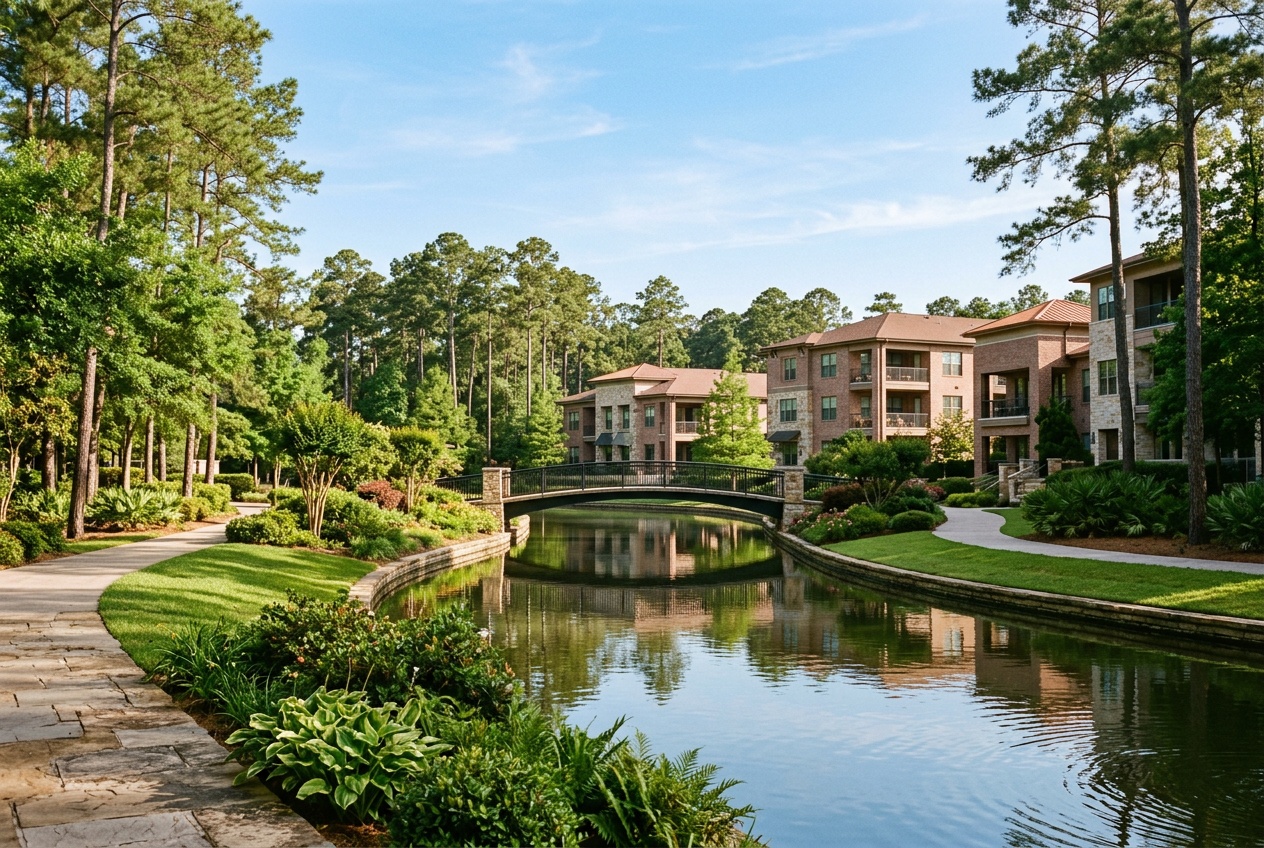
The Woodlands was built on a plan: a forested town of villages, pathways, and the Waterway, where families tend to think carefully about every decision, school included. Many parents here work in the energy corridor and travel often, and plenty of students are ready to move faster than a class of thirty allows. A self-paced, accredited K-12 program meets that head on. The work is set for your student, the schedule belongs to your family, and you can see exactly where things stand. Want the overview first? Here is how self-paced online high school works, and a plain summary of the accredited K-12 program.
The program runs the full K-12 path, and it works the same whether your family is in Grogan’s Mill, Sterling Ridge, Creekside Park, or Alden Bridge. Families across Conroe, Spring, Magnolia, Montgomery, Oak Ridge North, and Shenandoah use it the same way, with the same plan and the same accredited record behind it.
How placement works
Placed by Skill, Not by Birthday
Your student does not get dropped into a grade by age. A counselor reviews recent work and places them by demonstrated skill, subject by subject, so a child who is ahead in math and building confidence in writing starts each at the right level on day one. Here is the shape of the path.
| Stage | What the work looks like | Where it leads |
|---|---|---|
| Elementary, K-5 | Short, clear, repeatable lessons that build reading, writing, and math without long, exhausting days. | Elementary program |
| Middle, 6-8 | Stronger independence and study habits, with the pace easing up or speeding up as each subject clicks. | Middle school |
| High, 9-12 | Accredited coursework with honors-level options inside one structure, on a schedule that fits training, travel, and real life. | Online high school path |
An example: one student, placed by skill on the same day, not by birthday
The curriculum, grade by grade
How the Grades Build on Each Other
The program runs the whole way from kindergarten through senior year, and each stage is built to hand the student to the next one ready. The level is set by what the student can actually do, so the move from one grade to the next is a real step forward, not a date on a calendar.
Elementary, K-5
The early years stay short and steady. Reading, writing, and math come in clear, repeatable lessons that build a foundation without the long, draining days a young child does not need. Confidence is the real subject here, and a calm morning of focused work leaves the rest of the day open. A parent stays close to the daily work at this age, which is exactly what it calls for, and the lessons are simple enough to run without a teaching degree.
Grade pages: Kindergarten, 4th grade, 5th grade.
Middle school, 6-8
These grades are where independence and real study habits form. The work asks more of the student, the pace eases up or speeds up subject by subject, and a counselor keeps an eye on the whole picture so nothing slips while a young teen is finding their feet. A student who was bored or lost in a crowded room often steadies here, because the work finally meets them where they are instead of dragging them along or leaving them behind.
Grade pages: 6th grade, 7th grade, 8th grade.
High school, 9-12
The high school years are accredited coursework with honors-level options inside one structure, arranged around training, travel, and whatever else the family’s calendar holds. A counselor maps the path year by year so the student stays on track to finish, with no surprise gaps at the end. The result is a record built to carry the student cleanly into whatever comes next, with the work organized so the final year is a finish line, not a scramble.
Grade pages: 9th grade, 10th grade, 11th grade, 12th grade.
Sample courses: Algebra, Geometry, Biology, Chemistry, Physics, World History, U.S. History, Government, Economics.
A week in practice
What a School Week Actually Looks Like
There is no bell and no fixed homeroom, but there is a clear rhythm. Most families settle into a simple weekly shape that keeps the work moving without filling the whole day.
| Part of the week | What happens |
|---|---|
| Set the targets | At the start of the week you and your student see what each subject needs, then decide which mornings or afternoons the work lands in. |
| Focused blocks | The student works in short, real sessions instead of a six-hour day. Lessons are interactive, not just pages to read, so attention holds. |
| Review and adjust | You see every finished assignment and grade as it lands, from anywhere, and shift the plan when a week gets busy. |
Because a parent can see the full record at any time, a mom or dad traveling for work still knows exactly where the week stands without having to ask anyone.
How a focused school day tends to split
What’s included
What Comes With the Program
Enrollment is not just a login and a pile of links. Every family gets the same core pieces, whether the student is in second grade or finishing twelfth.
| What you get | What it means day to day |
|---|---|
| A full course load | Core subjects plus electives, all online and built for self-paced work, so a student is never waiting on a shipment, a substitute, or a classroom to catch up. |
| A personal plan | A written, subject-by-subject plan set at enrollment and revisited as the student moves, so you always know what is finished and what is next. |
| Academic support | Help is there when a lesson does not click, by message or a scheduled call, instead of waiting for office hours the next day. |
| Progress you can see | A live record of finished work and grades that a parent can open from anywhere, at any hour, with no email to the front office required. |
| One accredited record | The transcript is kept for you and follows the student through every move and every year, ready whenever it is needed. |
Why families here choose it
Room for the Way The Woodlands Actually Lives
Between the corporate campuses, the constant relocations in and out of the energy sector, and a calendar full of club sports, the arts at the Pavilion, and the trails, a fixed 7:45 bell fights the way families here really spend their days. Self-paced coursework lands in the hours you actually have, and a parent who travels can still see the whole week’s progress from anywhere.
The day bends around the family. The accredited record stays solid the whole time.

A note from the Head of School
Do not wait for a semester to start. The most useful first move for a The Woodlands family is the fifteen-minute counselor call with your student’s most recent records in hand. We place by skill, subject by subject, so a student who is ahead in one area and steady in another begins each at the right level on day one.
Who it fits
The Students Who Do Well Here
Self-paced school is not for one kind of student. In The Woodlands it tends to fit a few families especially well.
The student with a schedule of their own. Club soccer, a swim practice before dawn, a part in a Pavilion production, or serious hours of training a week. When the school day is yours to arrange, the sport or the stage stops fighting the coursework for the same morning.
The focused learner who needs a calmer room. A student who reads ahead, or one who simply does better away from the noise of thirty desks, sets the pace that suits them. The work speeds up where a subject clicks and slows down where it does not, with no one held up and no one left behind.
The family that moves. The energy corridor sends parents to Houston, to other states, and overseas on short notice. The accredited record is one continuous document, so a relocation in March does not cost a semester.
From the front lines
What We Hear From The Woodlands Families
The call we get most from The Woodlands tends to start the same way: a capable student who is bored, or a family whose real schedule stopped fitting the school bell. Parents in the energy corridor travel, students train and perform at a serious level, and the village-to-village rhythm of the town leaves families wanting a plan that respects all of it. What surprises them is how fast the pressure drops once the work is set to the student instead of the class. The mornings get calmer, a tournament weekend stops costing a grade, and the student who was coasting finally has somewhere to go. The families who settle in quickest are usually the ones who came in worried they were making a drastic move, and then found the opposite, a steadier week and a clearer plan. That is the whole point of a planned education in a town that was built on a plan.
The record that lasts
An Accredited Record That Holds Up
The reason families pick an accredited program over a loose curriculum is the paperwork at the end. Coursework here is accredited, which means the transcript is a professional document built to recognized standards, not a homemade list. It carries grades, course titles, and progress in a form a Texas university admissions office or an employer reads without a second thought.
The high school path leads to a real diploma earned through completed, accredited work, with honors-level options inside the same structure for students who want them. A counselor builds the four-year plan subject by subject, so the record is complete and the student is never short at the end.
That record is the quiet reason families stay. A transcript built to recognized standards is read the same way whether the next step is a local high school, a move to another state, or an application years down the road. The work a student does this year keeps its value long after the year is over.
Changing schools
Switching in the Middle of the Year
Most families do not arrive at the start of a semester. They arrive when something stops working: a schedule that will not bend, a class moving too slow or too fast, a move across town or across the country. Switching mid-year does not mean starting over.
A counselor reviews the most recent records, places the student by skill, and carries forward the work that already counts, so a strong semester is never thrown away. Because the coursework is self-paced, the student picks up at the right point instead of repeating a finished unit or sitting through one they have not reached yet. There is no waiting for the next term, and no lost time while the paperwork catches up.
The legal basics
Homeschooling in Texas, in Plain English
Is online home school legal in The Woodlands?
Yes. Under Texas law, a home school is treated as a private school (Texas Education Code 25.086). Families teach in good faith a curriculum that includes reading, spelling, grammar, math, and good citizenship. Authority: the Texas Education Agency.
What records should we keep?
Keep it simple: a course list, progress reports, and a withdrawal letter if you are leaving a Conroe ISD campus. Our accredited program keeps the cumulative record for you.
What does a compliant home school actually need?
Three things: teach in good faith, cover the basic subjects (reading, spelling, grammar, math, and good citizenship), and use a written curriculum. An accredited program satisfies all three and documents it for you, so there is nothing to assemble yourself.
How do we leave a Conroe ISD campus the right way?
Send a short written withdrawal notice to the campus, ask for a copy of the records, and begin the home routine. There is no waiting period, and a counselor walks you through the wording.
Do we have to report to the state or take state tests?
Texas does not require home-schooled students to register with the state or sit the state standardized tests. You teach the required subjects in good faith and keep your own records, and our accredited program handles that record-keeping for you.
Will this be recognized later on?
Yes. Because the coursework is accredited, the transcript is a recognized document, and a counselor makes sure the high school plan lines up with whatever the student is aiming for after.
A day that fits
School That Goes Where the Family Goes
When a parent is posted overseas for a season, when a tournament weekend eats a Friday, or when the family just wants a quiet morning on the pathways before the work begins, the coursework opens on your schedule and the student picks up exactly where they left off. Nothing is marked late, and no cohort moves ahead without you.

A self-paced day leaves room for the trails, the team, and the family.
A 40-second look
How It Works for Texas Families
From families like yours
What The Woodlands Families Say
★★★★★“The plan made it click. Our daughter finally works at her real level instead of waiting on the class.”
A Woodlands parent
★★★★★“My dad travels for work and still sees everything I finish each week. School comes with us.”
A Woodlands student
★★★★★“We switched in October and did not lose a thing. The counselor mapped it out and our son was settled in about a week.”
A Woodlands parent
Worth knowing
A Few Things Worth Knowing
Study skills and executive function, taught on purpose
Most schools hand a student a planner on day one and assume the rest takes care of itself. It does not. Planning, prioritizing, and knowing when you have actually learned something versus when you just read the words, these are learnable skills, not personality traits you either have or do not have. That distinction matters enormously, especially in an asynchronous environment where no bell rings to herd you to the next subject. Here, the weekly rhythm is deliberately designed to build executive function grade by grade: younger learners work through structured daily checklists that make the invisible architecture of a school day visible, while middle and high school students shift toward managing multi-step timelines, monitoring their own mastery, and catching their own drift before a deadline does it for them. Teachers do not just assign work; they model the thinking around the work. What does a good study session actually look like? How do you break a project into pieces without waiting for anxiety to do it for you? How do you know when review is finished versus when it only feels finished? These questions get real answers, built into the curriculum on purpose, not tacked on as a unit about organization in October and then forgotten. The payoff shows up in the cumulative record, in smooth transitions to the next school level, and in students who can describe their own learning process because someone took the time to teach it to them directly.
Computer science and AI literacy
There is a difference between a student who uses a calculator and a student who understands why the math works. The same gap exists with artificial intelligence: a kid who prompts a chatbot is not automatically a kid who grasps probability, bias, or the logic behind the output. That distinction is exactly why our computer science and AI literacy curriculum is built around creation and critical thinking, not passive clicking. Students write code, trace algorithms, and interrogate data sets so that technology becomes a medium for their ideas rather than a substitute for them. They learn what a model is trained on, why outputs can be confidently wrong, and how to verify before they trust.
This is not a trendy add-on. AI is already embedded in hiring platforms, medical screening tools, and the news feeds shaping public opinion, and K-12 is where the critical habits have to form. Our courses spiral across grade levels, so a fifth grader building block-based logic games is laying the same conceptual groundwork a tenth grader uses when writing Python scripts or auditing an algorithm for fairness. The goal at every level is the same: a student who walks away knowing that technology is something humans design, question, and improve, not a force that simply happens to them. That kind of fluency does not expire when the next tool arrives. It compounds.
Questions families ask
The Woodlands Online Home School FAQ
How fast can my student start?
Any week of the year. There is no semester start to wait for. After the counselor call, placement and the first lessons can be ready within days.
Is the program accredited?
Yes. The coursework is accredited, and the record supports applications to Texas colleges and universities.
What if we move or travel?
The accredited record is one continuous document that follows your family to a new address, another state, or overseas, with no semester lost.
Can a student who is ahead move faster?
Yes. Because the work is self-paced, a student who has mastered a unit moves straight into the next one, with honors-level options inside the same structure.
What technology do we need?
A reliable laptop and internet are the main requirements to get started.
How do we withdraw from a current school?
Send a withdrawal notice to your current campus, request the records, and begin the home routine. A counselor walks you through it.
What about friends and socialization?
Self-paced school frees up the daytime hours, which families fill with co-ops, club sports, scouts, church groups, and the parks and community spaces near home. The social life happens out in the community instead of a hallway. Here is how online students build a social life.
Do you support students with an IEP or 504 plan?
Yes. The self-paced structure already does much of what an accommodation asks for: extra time, a quiet space, and a flexible pace per subject. Bring the current plan to the counselor call and we build the routine around it.
How should we think about cost?
A home program removes a lot of the hidden spending around a daily commute and a packed school calendar, and it keeps the schedule open for a working parent. A counselor walks through exactly what enrollment includes on the call, and we are fully transparent about cost.
Can my student still do sports, clubs, or activities?
Yes. A self-paced day frees up the hours a fixed school schedule eats, which is exactly why competitive athletes, performers, and busy families choose it. Community sports, co-ops, and clubs all fit around the coursework instead of fighting it.
How much time does the school day take?
Less than a traditional day for most students, because there is no waiting on a class of thirty to catch up or move on. The hours are focused, and then the student is done, with the rest of the day theirs.
What if my student is behind in a subject?
Then that subject starts where the student actually is, not where a grade level says they should be. They build the missing pieces at their own pace while staying on level in the subjects where they are strong, so nothing stalls the whole year.
Getting started
What the First Two Weeks Look Like
The start is deliberately undramatic. After the counselor call, placement comes back within a few days and the first plan is ready to open. The opening days are about settling into a rhythm, not racing, so the student gets used to working in focused blocks and you get used to seeing the record fill in as the work is finished.
By the end of the first week, most families have found the hours that fit, whether that is early mornings before practice or quiet afternoons at home. By the end of the second, the questions usually shift from how does this work to what is next, which is exactly where a counselor wants you. Nothing about the first month is locked, and the plan is adjusted as real life shows you what actually fits your family.
Read next
Resources for The Woodlands Families
A few places to get the full picture before the call:
More Texas cities
Texas Cities We Serve
High School of America works with families across Texas. A few more cities we serve: Allen, Sugar Land, Garland, Arlington, Irving, Bryan, Harlingen, Edinburg, Tyler, Mansfield, Victoria, Temple.
Two ways in
Get Started in The Woodlands
Whether your student is transferring mid-year or starting fresh, the first step is the same fifteen-minute conversation.
Transferring from a local school
Bring your student’s most recent records to the counselor call. We review transcripts from Conroe ISD and other districts, place by skill, and carry forward the credits that count.
Starting fresh
No records yet, no problem. The counselor sets a starting point with a short skills check and builds the plan from there.