
Elmhurst, Illinois · K-12 Online Home School
School that fits an Elmhurst family’s real week.
An accredited, self-paced K-12 program for Elmhurst families, for the student ready to move faster, the anxious high achiever, and the household that wants a clear plan.
Start here
A college-town suburb, a school day built around the child
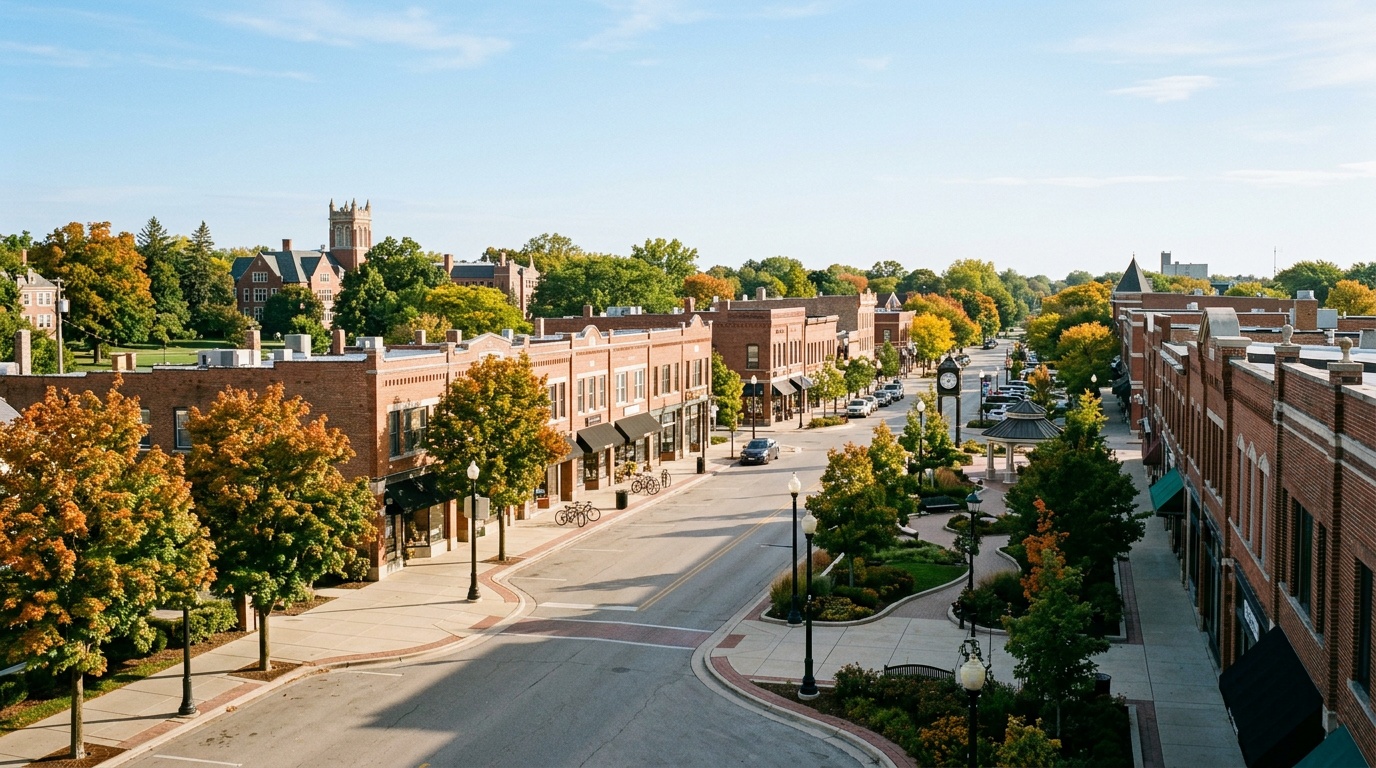
Elmhurst is a comfortable DuPage suburb with a college at its center and families who value a strong education. But even a good school is one pace for a crowded room, and plenty of capable Elmhurst students are either waiting at the top or quietly slipping. A self-paced, accredited K-12 program sets the level per student, subject by subject, so the day fits the child rather than the average.
The program serves families across Elmhurst, the DuPage suburbs, and the surrounding communities, with the same plan and the same accredited record behind every student. Start with how self-paced online high school works, or a plain look at online school versus homeschool versus public school. More about Elmhurst.
The program at a glance
What summer can be: pause, keep moving, or get ahead
Two ways to handle a student who is ahead
Learn more: online summer school
Placed by skill
One student, placed where they actually are
A child can sit above level in reading, on level in math, and still be building writing, all on the same day. The grid is a map, not a cage. A counselor reviews recent work and sets the starting point in each subject, then adjusts it as the student moves, so nobody is parked in a grade by birthday.
An example: one student, placed by skill the same day
Each subject starts where the student is, not where a birthday says.
Every student also gets a written, subject-by-subject plan, real teachers who grade the work and answer questions on the student’s schedule, academic support when a lesson does not click, and one accredited record kept for the family year after year. The day mixes on-screen lessons with real books and hands-on work.
Single-parent households
School that fits the household
Learn more: how self-paced learning works
Why it fits here
A day that keeps pace with an Elmhurst family
Between two-career households, a commute toward the city, and activities that fill the evenings, a fixed bell rarely fits. Self-paced coursework lands in the hours the family has, a strong student races ahead, and a struggling subject gets time without a room of thirty watching.
Two ways to run a school day
The deeper answer
Making Friday a lighter day on purpose
There is something quietly brilliant about a family that decides, on purpose, that Friday belongs to them. In a traditional school building, the schedule owns the week and hands it back empty on Friday afternoon. Online learning flips that. Because the coursework is self-paced, families can front-load Monday through Thursday with the heavy lifting, then let Friday breathe. Review sessions, passion projects, portfolio catch-up, a local co-op, a nature walk that doubles as science observation, a long read that nobody interrupted. These are not slack days. They are the days where the week actually makes sense, where a student looks backward at what landed and forward at what comes next, instead of just surviving until the bell.
The rhythm matters more than people give it credit for. Students who know Friday has a different texture learn to pace themselves, which is a skill that outlasts any single lesson. Parents who protect that day report less Sunday-night dread and more genuine conversation about what their child is actually learning. A week with an honest finish line, one the family drew themselves, tends to produce steadier students than a week that just stops. If your household has been trying to squeeze traditional school into a traditional schedule and wondering why it feels like wearing someone else’s shoes, the fix might be as simple as deciding what Friday is actually for. You get to decide that here. That is not a small thing.
Find your Elmhurst family
Whatever brought you here, the model bends to it
The student ready to move faster
A student who mastered the unit in September should not wait until June. Mastery moves them to the next course now, with honors-level depth.
Two careers, one calendar
When both parents work, the school day works around the hours you have, and either parent can open the record from anywhere.
how self-paced works
The anxious high achiever
Removing the room-of-thirty pressure helps a perfectionist breathe. The pace lowers, the standard stays high.
Athlete, dancer, or performer
Travel teams and rehearsals do not have to cost the school year. The accredited core compresses into focused blocks.
Switching mid-year
You do not have to wait for fall. A counselor reviews the records and the student picks up at their real level on a clean record.
Wants more than the district offers
When a good district still is not the right shape for your child, here is how the options actually compare.
The deeper answer
Mornings that do not start with a fight
The alarm goes off. The negotiating begins. Sound familiar? For millions of families, the morning school rush is less “routine” and more hostage situation, complete with slammed doors, skipped breakfasts, and a student who arrives at their desk already defeated before a single lesson loads. A self-paced school day quietly dismantles that whole drama by doing one radical thing: letting the student decide when “morning” actually starts. A genuine night owl who absorbs information better at 10 a.m. than at 7:15 a.m. is not lazy. That student is just operating on a schedule that was never designed for them in the first place. Shift the start time, and something surprising happens, the resistance softens. When a teenager is not being dragged out the door, they often show up to their own learning with noticeably less friction.
Of course, flexibility without structure is just a different kind of chaos, so the small adjustments matter enormously. Anchor the day with a consistent personal start ritual, same wake time within a reasonable window, a real breakfast, five minutes of quiet before opening a single tab. Let the student set that anchor themselves rather than having it handed down. Ownership is the point. A resistant student who chooses 9 a.m. is infinitely more reliable than one forced into 7 a.m. Who knew the secret to a peaceful morning was simply getting out of the way of the student who lives there?
Kindergarten through senior year
One continuous record, every grade
The same program runs the whole way, and the level is set by what a student can do.
One continuous path, one record
K-5Foundations
6-8Analytical turn
9-12Four-year sequence
GraduationAccredited
Grade pages: Kindergarten, 4th, 5th, 6th, 7th, 8th, 9th, 10th, 11th, 12th.
The deeper answer
Ownership: when a student starts driving their own day
Something shifts quietly, usually without fanfare. A student who once needed three reminders to open a lesson starts setting their own schedule, tracking their own progress, and – here is the part worth celebrating – actually caring about the outcome. That shift is not a happy accident. It is the whole point. Online learning structured around a self-paced model is engineered, deliberately, to hand the steering wheel over. The layout of the day, the order of the units, the decision to push harder on a strong week or slow down during a rough one – those choices belong to the student, and making real choices is the only way anyone ever learns to own them.
What does ownership actually look like on a Tuesday afternoon? It looks like a student who knows which subject is due, knows what the week’s workload feels like, and adjusts without being told. It looks like a parent who has quietly moved from manager to witness, still present but no longer running logistics. The model builds toward this on purpose by giving students low-stakes practice early, gradually pulling back the scaffolding, and letting natural consequences do the teaching that no lecture ever could. Skills like time management, self-assessment, and follow-through are not electives here – they are baked into every ordinary school day. By the time a student transfers, graduates, or steps into any next chapter, they carry something no transcript line captures: the habit of running their own show.
The course catalog
A full course load, online and self-paced
From the early grades through senior year, the program covers the core subjects and a real slate of electives, all built for self-paced work. Tap a subject to see the course.
Elementary, K-5
Reading, writing, and number sense built carefully, one mastered step at a time.
Middle School, 6-8
The analytical turn: pre-algebra, real writing, and a student learning to own a plan.
High School, 9-12
A full accredited course load with honors-level depth inside the same self-paced structure.
The deeper answer
Personal finance before the first paycheck
Most teenagers can tell you the Pythagorean theorem but have no idea what a W-4 form is asking them. That gap is not an accident, it is a curriculum priority problem, and it is one worth fixing before a student ever clocks in for a first shift. Personal finance belongs in the school day for the same reason driver’s ed does: the moment you need the skill, you are already in motion. Budgeting, compound interest, the real cost of a monthly payment, the difference between a want and an emergency fund – these are not adult topics students will figure out later. They are life mechanics that reward anyone who learns them early and punish everyone who does not. The good news is that a well-structured K-12 program can weave money sense directly into the academic day, not as a one-week elective afterthought, but as a thread running through math, social studies, and critical thinking from elementary through high school.
Our students work through personal finance concepts at whatever grade level fits their development, because money literacy is not a senior-year surprise, it is a years-long conversation. A middle schooler can absolutely understand why saving fifteen dollars a week beats spending it, and a high schooler can absolutely model a simple household budget before writing a single check. When the learning is self-paced and the content is built to stick, students arrive at graduation not just holding a credential but holding something arguably more useful: a working relationship with their own money.
Learn more: the K-12 program
A week in practice
What a real week looks like
No bell and no homeroom, but a clear rhythm: set the week’s targets, work in short focused blocks, and watch the record fill in as the work lands.
A self-paced week, set by the family
- Targets set
- Math
- Reading
- Science
- Writing
- History
- Co-op
- Math
- Art
- Catch-up
- Review
The deeper answer
Practice versus performance, and why both matter
There is a reason athletes run drills before game day, and musicians log hours in the practice room before the recital. Mistakes in rehearsal cost nothing except a little pride and a lesson learned. Mistakes on opening night cost something real. Good instructional design works the same way, and the model here draws that line on purpose. Low-stakes practice, the kind where a student can attempt a concept, stumble, reread, and try again without a grade hanging over the moment, is where actual learning happens. It is where the brain processes, self-corrects, and builds the pattern recognition that sticks past Friday. Our self-paced structure is built to protect that space, giving students room to rehearse a skill until it feels like theirs rather than racing toward a grade before they are ready.
The graded performance that follows is not a trap. It is a fair test of something the student has genuinely had time to absorb. When practice and assessment are sequenced this way, the assessment actually measures learning rather than measuring who got lucky under pressure. That distinction matters at every level of K-12, whether a fourth grader is learning long division or a junior is wrestling with literary analysis. Parents notice it too: students who feel prepared before they are evaluated tend to show up with more confidence and less anxiety, which turns out to be pretty good for the cumulative record they carry forward.
Ready when you are
See if it fits your family
A short conversation is the fastest way to know, with no pressure, just answers.
The record that lasts
One accredited record, wherever life goes next
The coursework is accredited, so the transcript is a professional document read cleanly by the next school. It is one continuous record across every grade and every move, with no gap to explain.
What is on the accredited record
-
Course list and gradesEvery completed course, year by year
-
A cumulative GPACalculated and kept current
-
Descriptions a registrar readsStandards-aligned course descriptions
-
No gap across a moveOne continuous record, anywhere you go
The deeper answer
Proof of grade level for a club, league, or program
Youth sports leagues, scouting troops, community theater programs, and other organized activities all share one quiet bureaucratic ritual: they want proof that your child is actually in the grade you claim. For families who school online, this moment can feel like a pop quiz nobody warned them about. The good news is that an accredited online school keeps the same administrative paper trail as any brick-and-mortar building, and producing official documentation is genuinely straightforward. Enrollment verification letters, grade-level confirmations, and official transcripts are standard outputs from a real student information system, not something a parent types up at the kitchen table. A league coordinator or troop leader who receives school letterhead with a student name, grade, and enrollment dates has exactly what they need to check that box and move on.
The smartest move is to ask early rather than the night before sign-ups close. Reach out through the counselor scheduler to flag the request and clarify the exact format the organization wants, because some programs need a letter, others want a transcript, and a few just need a registrar signature on their own form. If you have broader questions about how records and enrollment documentation work, the frequently asked questions guide walks through the process clearly. Online schooling does not put your student on the sidelines of community life. It simply means the paperwork arrives in a PDF instead of a manila folder from a front office.

A note from the Head of School
Do not wait for a semester to start. For a Elmhurst family, the most useful first move is the fifteen-minute counselor call with your student’s most recent records in hand. We place by skill, subject by subject.
Questions families ask
Elmhurst online home school FAQ
Is online home school legal in Illinois?
Yes. Illinois treats a home school as a private school. Families do not register with the state, seek approval, or sit state tests; you teach the same branches of education the public schools teach, in English. Authority: the Illinois State Board of Education.
Is the program accredited?
Yes. The coursework is accredited, so the transcript is a professional record built to recognized standards and read cleanly by the next school.
What about friends and activities?
A self-paced day frees up the hours a fixed schedule eats, which is why active families choose it. Co-ops, club sports, park-district programs, and city activities fill the daytime. Here is how online students build a social life.
Do you support an IEP or 504 plan?
Yes. The self-paced structure already provides extra time, a quiet space, and a flexible pace per subject. Bring the current plan to the counselor call and the routine is built around it.
How should we think about cost?
A home program removes much of the hidden spending around a daily commute and keeps the schedule open for a working parent. A counselor walks through what enrollment includes, and we are fully transparent about cost.
What if we try it and it is not working?
A struggling stretch gets caught by the weekly check and the counselor, the pace and support adjust, and the accredited record travels if a family decides to move on. No year is lost.
How much do I need to know to make this work?
Less than most parents fear. The school carries the instruction and the grading; the parent is a coach who keeps the rhythm, not a teacher who delivers the algebra. Not knowing the material yourself is fine, and on purpose.
What technology do we need to start?
A reliable laptop and a steady internet connection are the main requirements. Books and any hands-on materials are shipped to the house, so the day is a mix of on-screen and off-screen work.
The legal basics
Homeschooling in Illinois, in plain English
In Illinois a home school is treated as a private school. Families are not required to register with the state, seek approval, give notice, or sit state tests; you teach the same branches of education the public schools teach, language arts, mathematics, the sciences, social studies, fine arts, and health, in English, and keep your own records. Compulsory attendance runs from age 6 to 17. Authority: the Illinois State Board of Education.
More Illinois cities we serve
Families across Illinois, one program

Two ways in
Get started in Elmhurst
Whether your student is transferring mid-year or starting fresh, the first step is the same short conversation.