
Cicero, Illinois · K-12 Online Home School
School that fits a working Cicero family.
An accredited, self-paced K-12 program for Cicero families, built for newcomers finding their footing, households on long shifts, and students who need the day to fit real life.
Start here
A dense, hard-working town, a school built per child
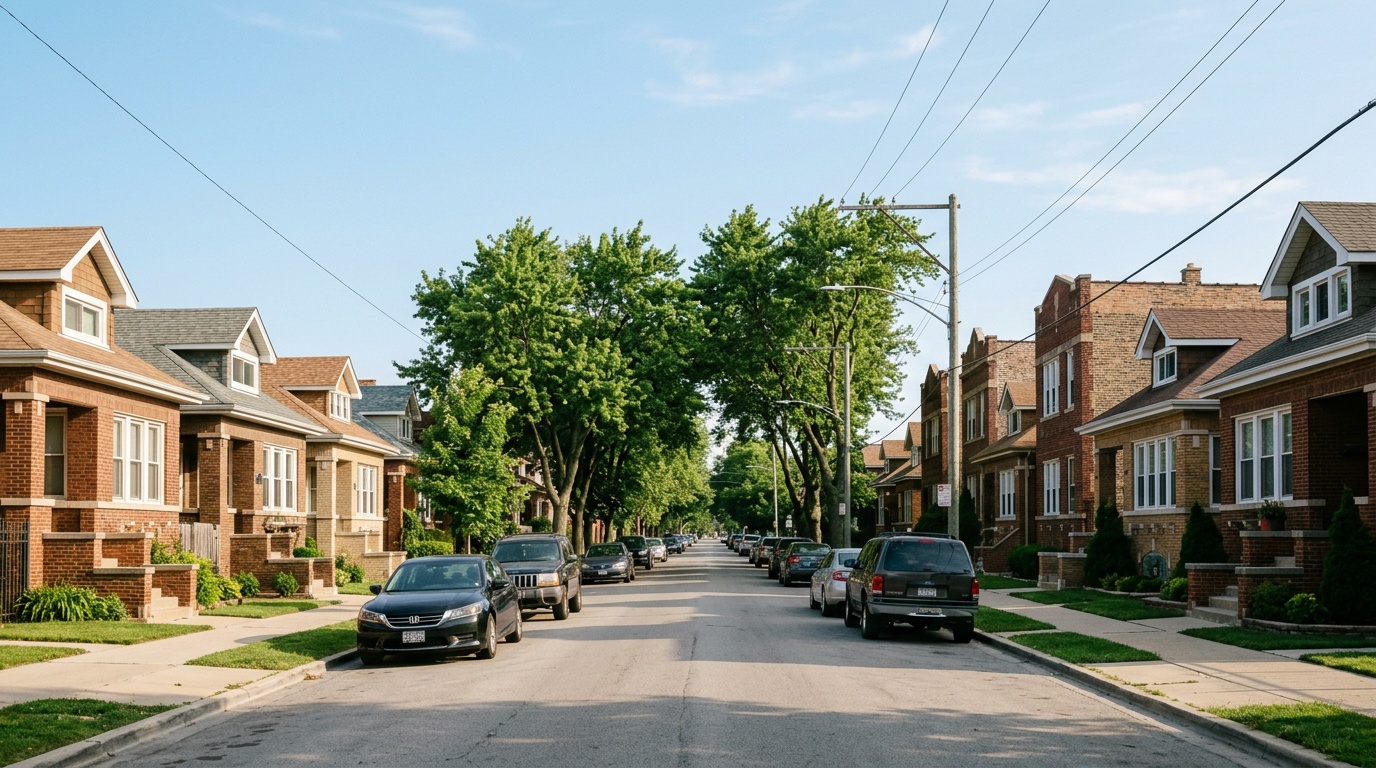
Cicero is a dense, diverse, hard-working town right at Chicago’s edge, where many families are new to the country and the schools are crowded. A self-paced, accredited K-12 program places each student by demonstrated skill and lets the day fit the household that is actually living it, instead of one pace for a packed room.
The program serves families across Cicero, Berwyn, and the near-west suburbs, with the same plan and the same accredited record behind every student. Start with how self-paced online high school works, or a plain look at online school versus homeschool versus public school. More about Cicero.
The program at a glance
Migrant and agricultural families through the harvest
School that fits the household
Learn more: considerations for immigrant and ELL students
Placed by skill
One student, placed where they actually are
A child can sit above level in reading, on level in math, and still be building writing, all on the same day. The grid is a map, not a cage. A counselor reviews recent work and sets the starting point in each subject, then adjusts it as the student moves, so nobody is parked in a grade by birthday.
An example: one student, placed by skill the same day
Each subject starts where the student is, not where a birthday says.
Every student also gets a written, subject-by-subject plan, real teachers who grade the work and answer questions on the student’s schedule, academic support when a lesson does not click, and one accredited record kept for the family year after year.
Rural and long-commute families: the school comes to the house
A day that bends around two jobs
Learn more: the K-12 program
Why it fits here
A school day that bends around real Cicero work
Between long shifts, a commute, and a child still building English or confidence, a fixed bell rarely fits. Self-paced coursework lands in the hours the family has, a student can re-read and replay at their own pace, and a working parent can check the week from anywhere.
Two ways to run a school day
The deeper answer
Signs your child’s current school isn’t actually working
Some signs are loud: the Sunday-night stomach ache that shows up like clockwork, the tears at the breakfast table, the backpack that gets kicked instead of carried. Others are quieter but just as telling: two hours of homework that still lands a D, a student who used to love science now staring blankly at a worksheet, a once-chatty child who stops talking about their day altogether. Parents often chalk these up to a phase, a tough teacher, or growing pains. Sometimes that is exactly right. But sometimes it is the environment itself that is the problem, not the child. A classroom built for 28 students moving at one speed will always leave some students spinning their wheels and others watching the ceiling. Neither group is learning at their best, and both groups feel it in their confidence long before the report card shows it.
If you are watching your child shrink a little more each semester, that pattern deserves a real look, not just reassurance. The connection between learning environment and student well-being is well documented, and changing the setting genuinely changes outcomes for many students. Online K-12 is not a magic fix, but it removes a specific set of friction points that traditional schools structurally cannot. Before you decide anything, it helps to weigh the options honestly. A side-by-side look at online school versus homeschool versus public school is a solid place to start that conversation.
Find your Cicero family
Whatever brought you here, the model bends to it
New to English, new to the system
A student building English can re-read, replay, and work at their own pace instead of falling behind a fast spoken lesson, with the whole family able to follow.
Long and rotating shifts
When the household runs on service, warehouse, or factory hours, the school day flexes around them instead of pretending they do not exist.
The student who needs more time
A quieter setting and a pace set per subject let a student build a real foundation without a crowded room moving on without them.
Watching the budget
A home program removes much of the hidden spending around a daily commute. A counselor walks through exactly what enrollment includes.
Switching mid-year
You do not have to wait for fall. A counselor reviews the records and the student picks up at their real level on a clean record.
A family on the move
If life means another address, the accredited record is one continuous document that follows the family, with no gap to explain.
The deeper answer
Student mental health and a supportive environment
The numbers are hard to ignore. CDC data shows that roughly 4 in 10 high school students reported persistent feelings of sadness or hopelessness in recent survey cycles [VERIFY], and NCES findings point to a steady climb in reported anxiety among school-age students over the past decade [VERIFY]. Packed hallways, rigid bells, social pressure measured in real time by hundreds of peers, and a schedule that leaves zero breathing room are not just inconveniences. For a growing slice of students, that environment is a genuine barrier to learning. When a student spends the first hour of class recovering from the walk through the cafeteria, very little algebra is actually happening.
That is exactly where a calmer, more intentional setting starts to matter. Online learning and student mental health are more connected than most families expect. Working from a comfortable space, moving through lessons at a pace that respects their energy, and skipping the social landmines that make traditional school exhausting gives many students room to actually think. Teachers can focus on the curriculum instead of managing a room of thirty restless students, and students can flag a hard day without performing wellness in front of a crowd. NHERI research increasingly links reduced environmental stressors to improved academic engagement and emotional regulation [VERIFY]. Quieter does not mean lesser. Sometimes it means a student finally gets to show up as their actual, capable self.
Kindergarten through senior year
One continuous record, every grade
The same program runs the whole way, and the level is set by what a student can do.
One continuous path, one record
K-5Foundations
6-8Analytical turn
9-12Four-year sequence
GraduationAccredited
Grade pages: Kindergarten, 4th, 5th, 6th, 7th, 8th, 9th, 10th, 11th, 12th.
The deeper answer
Students with Tourette’s or tic conditions, away from the spotlight
A tic does not announce itself on a schedule, and a packed classroom is one of the least forgiving places for something that unpredictable. The sideways glances, the stifled laughs, the well-meaning but awkward teacher pause mid-lesson – that ambient social pressure can quietly erode a student’s confidence until the fear of being noticed drowns out every lesson on the board. Learning from a private setting at home changes the equation in a real, practical way. The space is familiar, the audience is gone, and the student can redirect mental energy toward the actual coursework instead of managing how they appear to thirty peers. That shift alone can be significant. Our approach to student mental health is built around the idea that environment shapes learning outcomes just as surely as curriculum does.
HSOA is not a medical program, and we make no claim to treat or manage tic conditions. What we do is align the academic setting with the student’s real life, working alongside whatever care team and support structure the family already has in place. Families decide the pace, parents stay in the loop, and students move through coursework without a spotlight on them. For students who qualify, a self-paced high school path offers even more breathing room on harder days. The condition does not define the student’s potential, and the setting should never be the thing standing between them and demonstrating it.
The course catalog
A full course load, online and self-paced
From the early grades through senior year, the program covers the core subjects and a real slate of electives, all built for self-paced work.
Elementary, K-5
Reading, writing, and number sense built carefully, one mastered step at a time.
Middle School, 6-8
The analytical turn: pre-algebra, real writing, and a student learning to own a plan.
High School, 9-12
A full accredited course load with honors-level depth inside the same self-paced structure.
The deeper answer
Support without hovering: staying off your child’s shoulder
There is a particular kind of parent love that expresses itself by hovering three inches behind a child’s shoulder and narrating every math step in real time. You know who you are, and so does your child, because they have developed an uncanny ability to freeze the moment they sense your presence. Here is the hard truth worth accepting early: the wrong answer left standing until the teacher’s feedback arrives is not a failure, it is the actual lesson. Productive struggle, that slightly uncomfortable period when a student sits with a problem they have not cracked yet, is where the learning sticks. Rescuing them from it is the academic equivalent of carrying a student who is perfectly capable of walking. They arrive at the destination, but their legs never get stronger.
Being available without taking over is a skill, and it looks less dramatic than you might expect. It sounds like “I’m here if you get stuck” rather than “let me just show you real quick.” It looks like closing your laptop and giving them space rather than perching nearby with unsolicited commentary. For families using a self-paced program, this dynamic becomes especially important because the schedule is flexible enough that a parent can accidentally become a full-time co-student. Set office hours for your help. Let the curriculum do its job. Trust that a student who wrestled with a concept and got feedback on a wrong answer has learned something no amount of narrating could have given them.
A week in practice
What a real week looks like
No bell and no homeroom, but a clear rhythm: set the week’s targets, work in short focused blocks, and watch the record fill in as the work lands. A counselor watches the weekly target, so a slow stretch is caught early and a strong week is confirmed rather than wasted.
A self-paced week, set by the family
- Targets set
- Math
- Reading
- Science
- Writing
- History
- Co-op
- Math
- Art
- Catch-up
- Review
The deeper answer
Test-taking skill without teaching to the test
There is a difference between a student who knows material cold and a student who has simply been marinated in practice tests until the right bubbles fill themselves in by reflex. We lean hard into the first kind of learner. Inside our courses, assessments are woven into the rhythm of learning rather than dropped on students like a final verdict. That means students practice pacing on shorter, lower-stakes checks all year long, so when a high-stakes moment arrives, nothing about the format feels alien. They already know how to budget time across a section, flag the questions worth returning to, and resist the panic spiral that kills an otherwise solid performance. That is a transferable skill, not a one-exam trick.
Review habits matter just as much as raw content knowledge. Students learn to look back at wrong answers as data points rather than shame receipts, asking why the logic misfired instead of just memorizing the correct answer for next time. Because our platform lets learners move through material at a self-paced rhythm, a student who needs an extra pass through persuasive writing techniques can take it without holding back a classroom or rushing ahead before the concept sticks. The cumulative result is a student who walks into any assessment, standardized or teacher-built, with genuine confidence rooted in real understanding. That is the kind of track record that follows a student into the next grade, the next school, and every challenge after.
Ready when you are
See if it fits your family
A short conversation is the fastest way to know, with no pressure, just answers.
The record that lasts
One accredited record, wherever life goes next
The coursework is accredited, so the transcript is a professional document read cleanly by the next school. It is one continuous record across every grade and every move, with no gap to explain.
What is on the accredited record
-
Course list and gradesEvery completed course, year by year
-
A cumulative GPACalculated and kept current
-
Descriptions a registrar readsStandards-aligned course descriptions
-
No gap across a moveOne continuous record, anywhere you go
The deeper answer
The arts are not an afterthought
Somewhere along the way, a rumor started that the arts were a reward for finishing the “real” subjects. Wrong. Visual art, music, and design are not the dessert at the end of a long academic meal; they are part of the meal itself. When a student learns to read a musical score, they are practicing pattern recognition and sequencing. When they work through a design brief, they are applying iterative problem-solving in a way that a multiple-choice worksheet simply cannot replicate. When they study color theory or composition, they are doing spatial reasoning with a paintbrush. These are transferable skills that show up in math, in writing, in science, and in every creative corner of a developing mind.
Online learning is actually a surprisingly strong environment for arts education, because the schedule can breathe. A student who needs ninety minutes to finish a charcoal study does not have to abandon it when a bell rings. A student obsessed with music production can follow a thread of curiosity without waiting for the one elective slot in a crowded timetable. That flexibility matters because creative work rarely respects a forty-five-minute block. The arts also do something quieter and equally important: they give students a genuine sense of authorship over their own learning. Building that internal confidence, the kind that comes from making something and standing behind it, turns out to be one of the most durable things a K-12 education can produce.
Learn more: the American curriculum

A note from the Head of School
Do not wait for a semester to start. For a Cicero family, the most useful first move is the fifteen-minute counselor call with your student’s most recent records in hand. We place by skill, subject by subject.
The day fits the family, not a bell, and the work is genuinely the student’s own.
Questions and answers
Cicero online home school, in plain English
Is online home school legal in Illinois?
Yes. Illinois treats a home school as a private school. Families do not register with the state, seek approval, or sit state tests; you teach the same branches of education the public schools teach, in English. Authority: the Illinois State Board of Education.
Is the program accredited?
Yes. The coursework is accredited, so the transcript is a professional record built to recognized standards and read cleanly by the next school.
What about friends and activities?
A self-paced day frees up the hours a fixed schedule eats, which is why active families choose it. Co-ops, club sports, park-district programs, and city activities fill the daytime. Here is how online students build a social life.
Do you support an IEP or 504 plan?
Yes. The self-paced structure already provides extra time, a quiet space, and a flexible pace per subject. Bring the current plan to the counselor call and the routine is built around it.
How should we think about cost?
A home program removes much of the hidden spending around a daily commute and keeps the schedule open for a working parent. A counselor walks through what enrollment includes, and we are fully transparent about cost.
What if we try it and it is not working?
A struggling stretch gets caught by the weekly check and the counselor, the pace and support adjust, and the accredited record travels if a family decides to move on. No year is lost.
How much do I need to know to make this work?
Less than most parents fear. The school carries the instruction and the grading; the parent is a coach who keeps the rhythm, not a teacher who delivers the algebra. Not knowing the material yourself is fine, and on purpose.
What technology do we need to start?
A reliable laptop and a steady internet connection are the main requirements. Books and any hands-on materials are shipped to the house, so the day is a mix of on-screen and off-screen work.
The legal basics
Homeschooling in Illinois, in plain English
In Illinois a home school is treated as a private school. Families are not required to register with the state, seek approval, give notice, or sit state tests; you teach the same branches of education the public schools teach, language arts, mathematics, the sciences, social studies, fine arts, and health, in English, and keep your own records. Compulsory attendance runs from age 6 to 17. Authority: the Illinois State Board of Education.
More Illinois cities we serve
Families across Illinois, one program
Two ways in
Get started in Cicero
Whether your student is transferring mid-year or starting fresh, the first step is the same short conversation.