

Online Elementary School: What Parents of K-5 Students Need to Know Before Deciding
The parent of a high schooler considering online school asks, “Will colleges accept this?” The parent of a 6-year-old asks something different: “Will my child develop normally? Will they learn to read? Will they have friends? Am I making a decision for someone who cannot make it for themselves?”
Those are honest questions. They deserve honest answers, not a sales pitch. Here is what the research, the data, and the experience of millions of elementary families actually show.
The Reading Crisis Nobody Wants to Talk About
Before we discuss whether online school can teach elementary students effectively, we need to discuss whether traditional school is doing it. The NAEP data from 2024 is not encouraging.
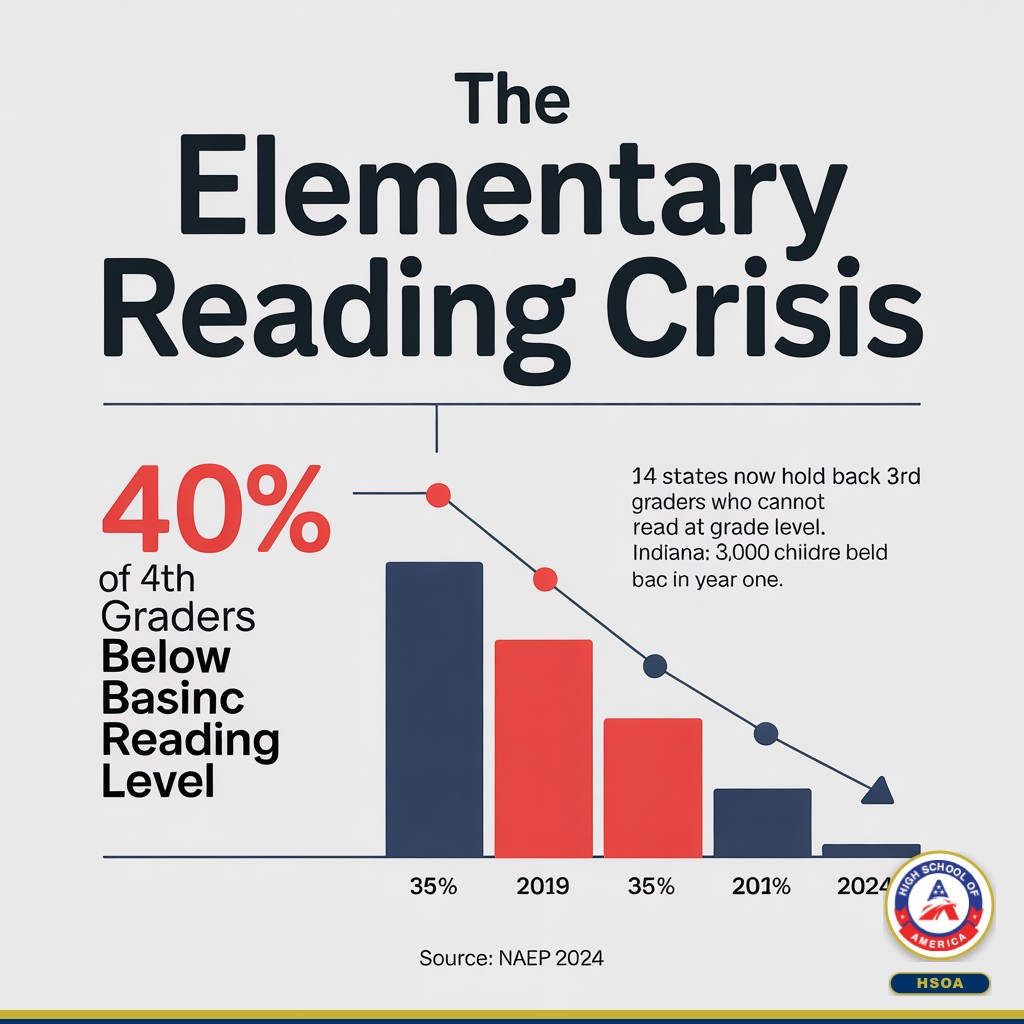
40% of American 4th graders now score below the NAEP Basic level in reading. That is the highest percentage since 2002. Only 31% read at or above proficient. The number has declined steadily: 35% in 2019, 33% in 2022, 31% in 2024. For the bottom 10% of students, pandemic learning losses grew 70% larger between 2022 and 2024. They are not catching up. They are falling further behind.
14 states now enforce 3rd-grade reading retention laws, holding back students who cannot read at grade level. Indiana held back 3,000 children in the first year of enforcement alone. These laws exist because the traditional system is not producing readers at the rate it should.
This is not an argument against public school teachers. It is arithmetic. One teacher, 25 students, five different reading levels, 45 minutes of reading instruction. The child who needs 20 minutes of one-on-one phonics practice gets 3 minutes of it. An online elementary program with certified teachers providing direct instruction can offer what a crowded classroom structurally cannot: attention proportional to the student’s need.
The question is not “Can online school teach reading?” The question is “Can we afford to keep doing what produces 40% below basic?”
The Parent Dashboard Advantage
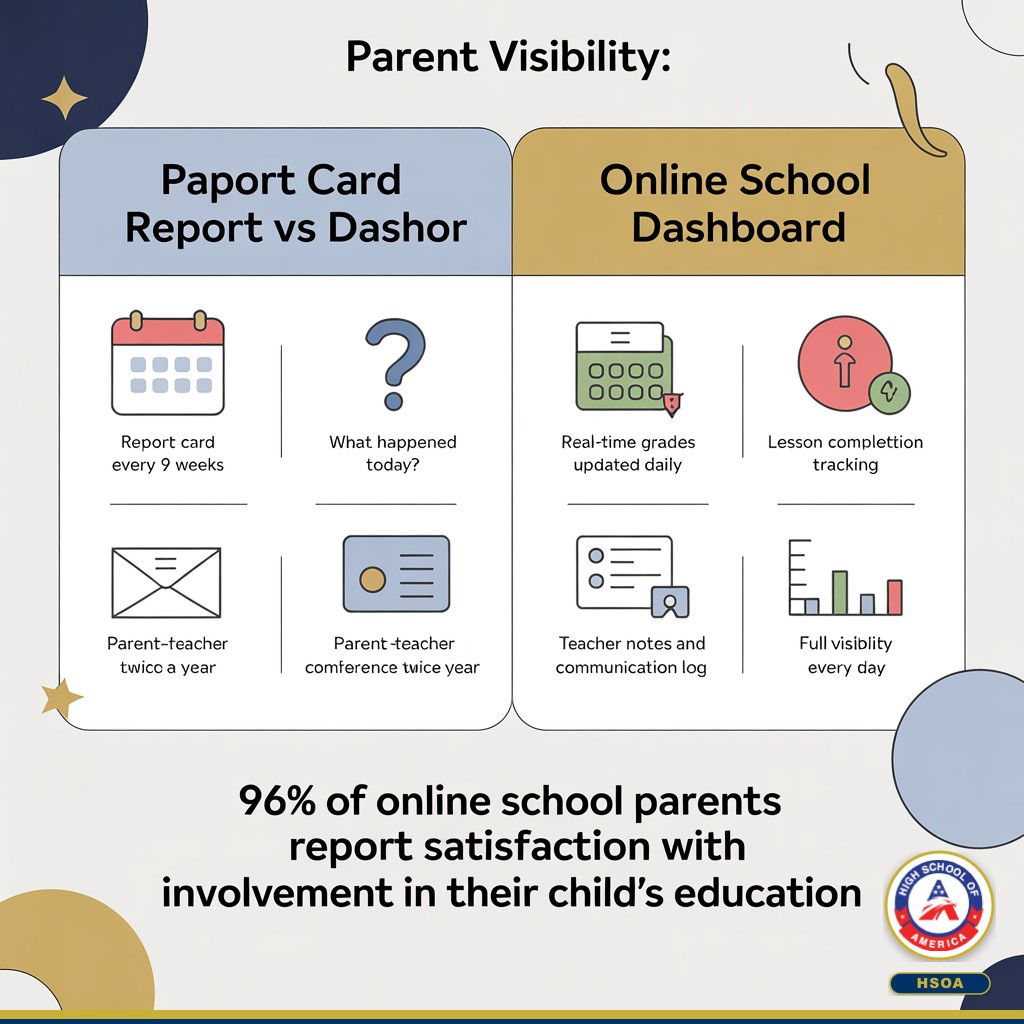
In a traditional elementary school, you find out how your child is doing every 9 weeks. A report card arrives. It tells you that your student earned a B in math. It does not tell you which specific skills they struggled with, which assignments they missed, whether the teacher had to reteach a concept, or what your child is actually working on tomorrow.
In an online K-12 program, the parent dashboard updates in real time. You see every grade as assignments are submitted and reviewed. You see lesson completion data showing which subjects are on track and which are falling behind. You see teacher notes and communication logs. You know, every single day, exactly where your student stands.
For parents of elementary students, this visibility changes the relationship between parent and school. You are not waiting 9 weeks to discover your 7-year-old has been struggling with subtraction. You see it on Tuesday and address it on Wednesday. The teacher sees the same data and adjusts instruction accordingly. Problems get caught in days, not months.
96% of online school parents report satisfaction with the level of involvement they have in their child’s education. That number is not surprising when you consider that the alternative is a quarterly report card and two parent-teacher conferences per year.
What Online Elementary Actually Looks Like (Hours, Not Myths)
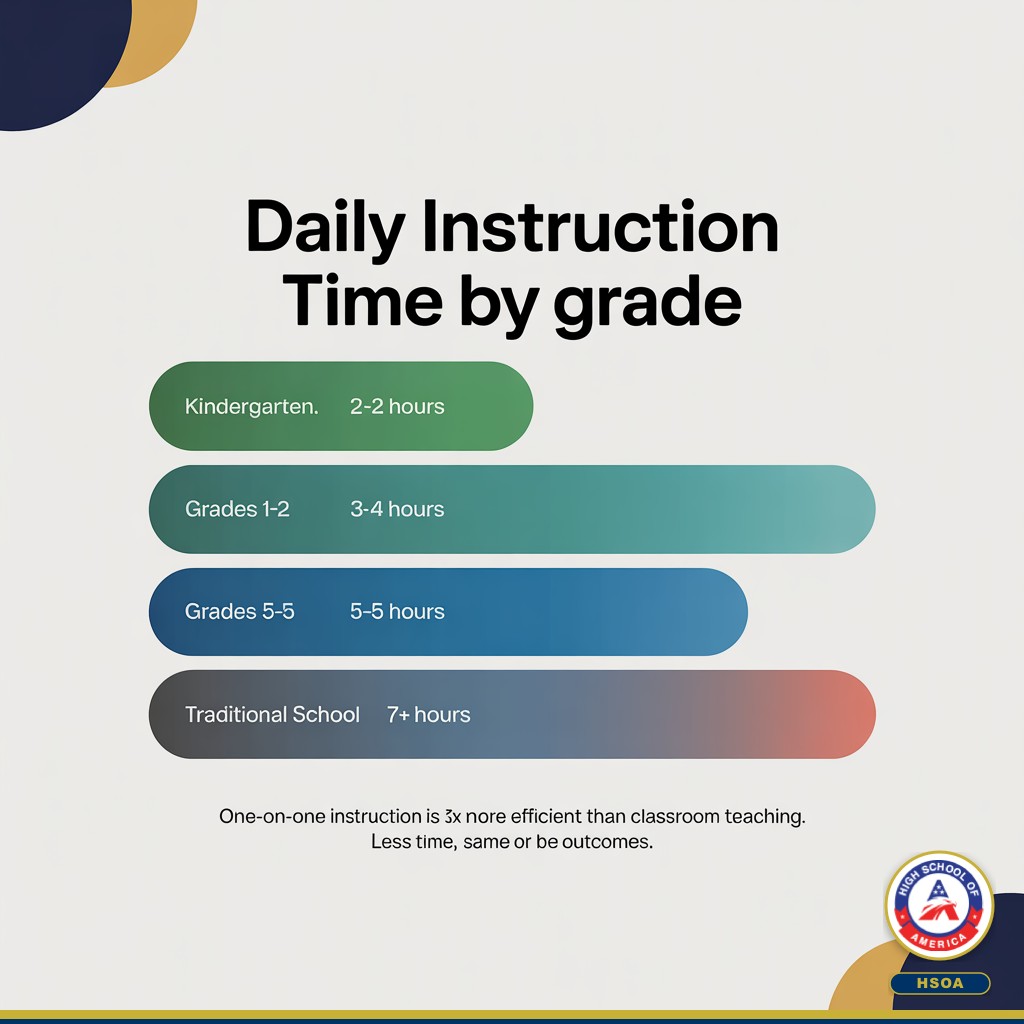
Online kindergarten takes 2 to 3 hours of structured learning per day. Grades 1 and 2 take 3 to 4 hours. Grades 3 through 5 take 4 to 5 hours. Traditional school runs 7 or more hours.
The reason for the difference is not that online school covers less material. It is that one-on-one instruction is roughly three times more efficient than classroom instruction. A teacher managing 25 students spends significant time on transitions, classroom management, repeating directions, waiting for attention, and re-explaining concepts for the third time. When a certified teacher works directly with your student through structured, self-paced coursework, the wasted time disappears. What remains is actual instruction.
The parent’s role varies by age. For kindergarten through 2nd grade, expect 4 to 6 hours of involvement per day as a Learning Coach: structuring the day, keeping the child on task, facilitating hands-on activities, and communicating with teachers. By 4th and 5th grade, that drops to 1 to 2 hours as children become increasingly independent. The transition from “I sit beside my child” to “I check in after they finish” happens gradually and naturally.
Screen Time: The Conversation Parents Actually Need
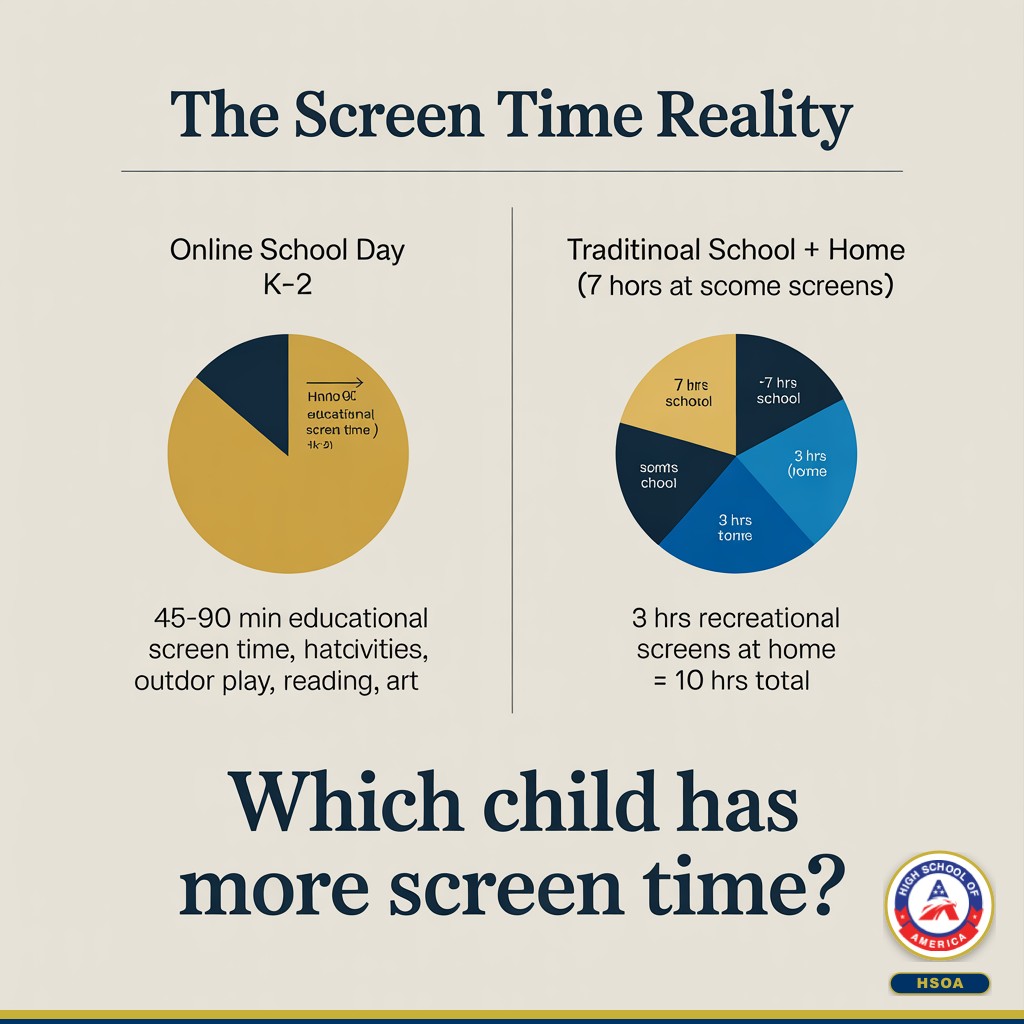
This is the #1 objection elementary parents raise, and it deserves a honest answer rather than dismissal.
Online kindergarten involves approximately 45 to 90 minutes of actual screen instruction per day. Grades 1 through 3 involve 1.5 to 2.5 hours. Grades 4 and 5 involve 2 to 3 hours. The rest of the school day is hands-on activities, reading physical books, outdoor time, art projects, science experiments with real materials, and movement.
Now consider the comparison nobody makes. A traditional elementary school student spends 7 hours in a building where 90% of schools now have 1:1 devices. Multiple states are proposing legislation to cap elementary school screen time at 45 to 60 minutes per day, which tells you usage has crept well past that. That same student comes home and spends an average of 3 additional hours on recreational screens. Total daily screen exposure: 10+ hours.
An online elementary student spends 1 to 3 hours on educational screens and has the rest of the day for sports, outdoor play, music lessons, and family time. The parent controls the environment. There is no recreational screen creep during the school day because the parent is present.
The American Academy of Pediatrics updated its guidelines in 2026, moving away from strict time limits toward a framework that distinguishes between types of screen use. Active screen use (interactive lessons, coding, creative projects, live discussion with teachers) supports cognitive development. Passive screen use (watching videos, scrolling) is associated with attention problems. Online school is almost entirely active use. The 3 hours of YouTube after traditional school is almost entirely passive.
The Screen Time Question to Actually Ask
Not “how many hours of screen time?” but “what is the total screen diet across the entire day, and how much of it is active versus passive?” By that measure, online elementary students typically fare better than their traditionally schooled peers.
The Teacher Shortage Parents Do Not See
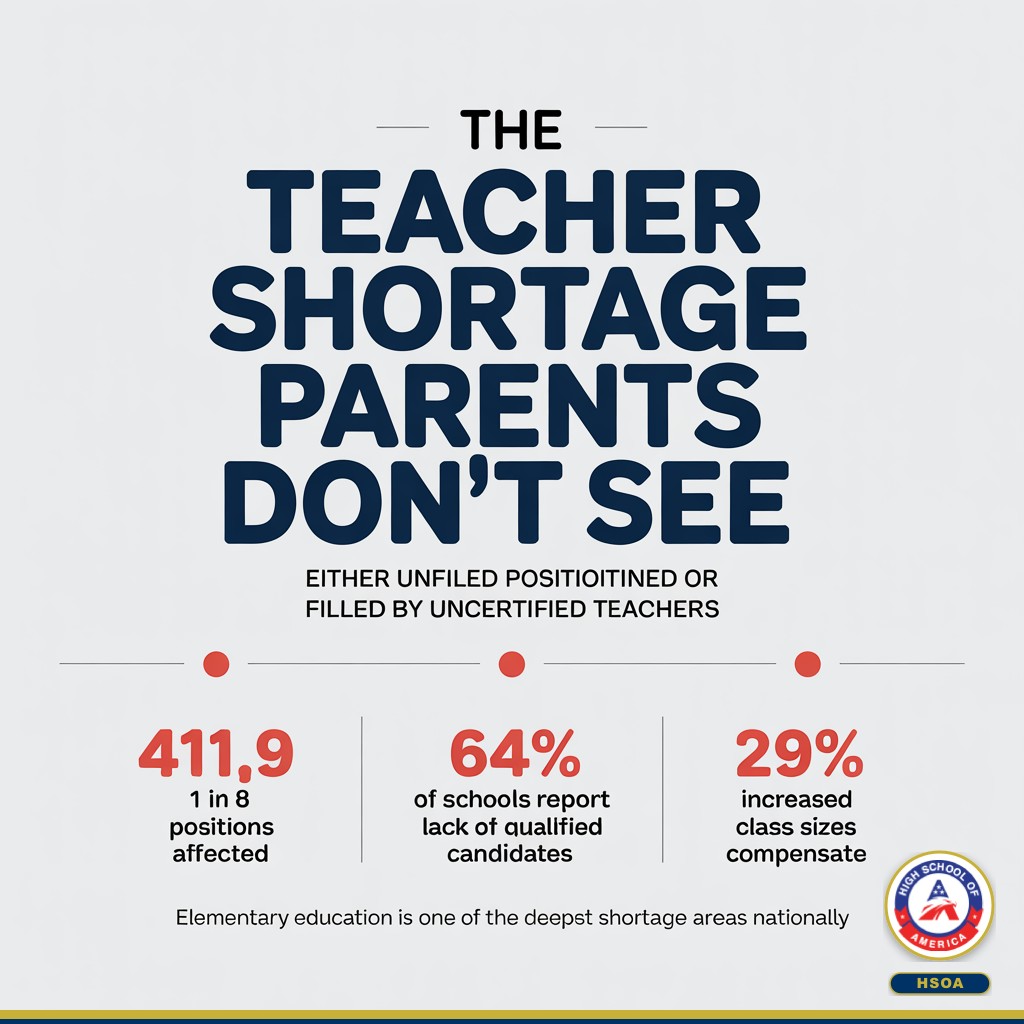
411,549 teaching positions nationally are either unfilled or filled by uncertified teachers. That is 1 in 8 positions. 64% of schools report a lack of qualified candidates as a top hiring challenge. 29% of schools increased class sizes to compensate for vacancies. Elementary education is one of the deepest shortage areas.
This means roughly 6 million students are being taught by under-qualified educators or sitting in oversized classes. Your child’s teacher might be a certified, experienced professional. Or they might be a long-term substitute with a bachelor’s degree in business who took the job because nobody else applied.
An accredited online K-12 program staffs its classrooms intentionally. The certified teachers behind each course were hired because they know their subject and know how to teach it, not because they were the only warm body available in a district with 50 open positions. When a family chooses online school, they are not just choosing a format. They are choosing a staffing model that does not depend on a county’s ability to recruit.
The Early Start Compound Effect
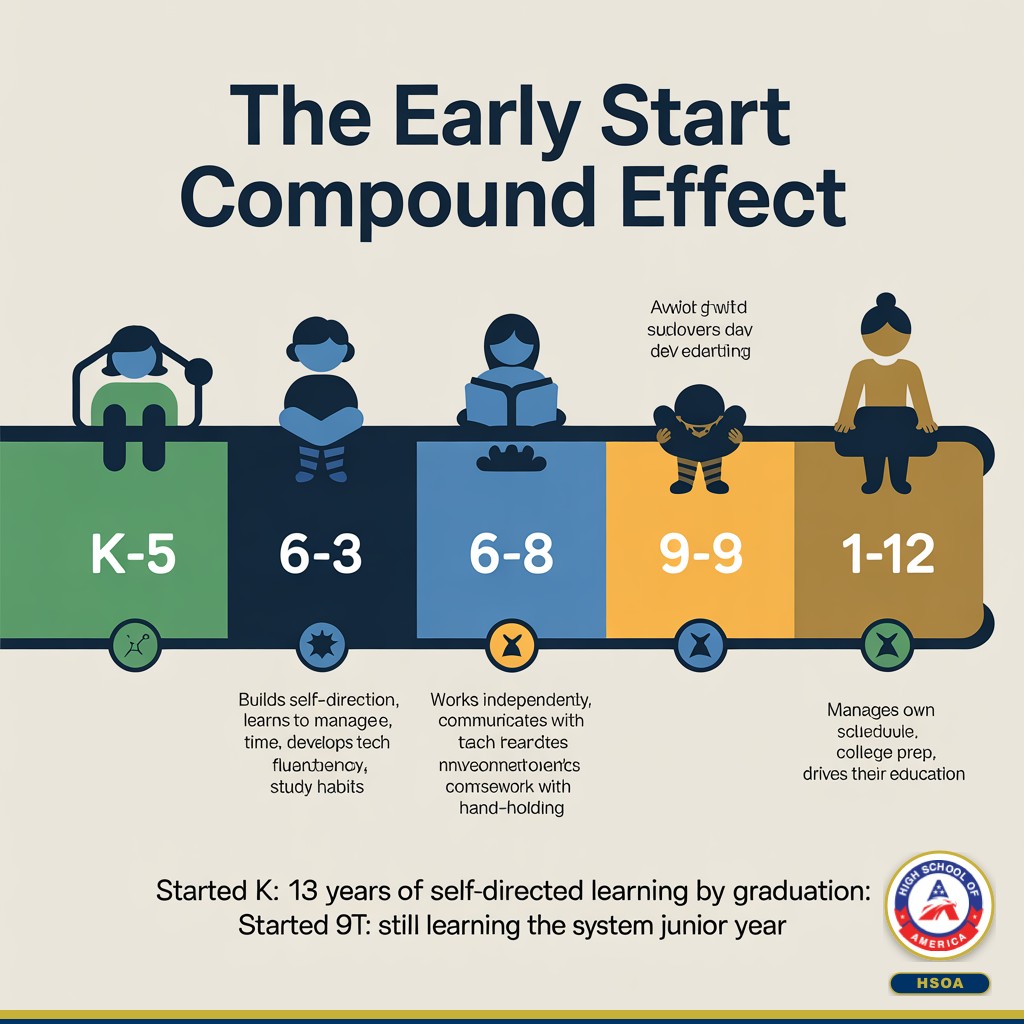
A family that starts online school in kindergarten builds something a family that starts in 9th grade cannot replicate: years of compounding self-directed learning habits.
By 3rd grade, a student who started online in kindergarten manages their own login routine, navigates coursework independently for short stretches, and knows how to communicate with a teacher through the platform. By 6th grade, they work independently for full sessions, manage assignment deadlines without reminders, and have developed the digital literacy that most traditionally schooled students do not acquire until high school.
By 9th grade, this student owns their education. They manage their own schedule. They communicate with teachers directly. They track their own credit progress toward graduation. They are ready for dual enrollment at community college because independent learning is not a new skill for them; it is the only way they have ever learned.
Compare that to the student who switches to online school in 10th grade. The first semester is spent learning how the platform works, adjusting to self-paced scheduling, and developing study habits that were never required in a traditional classroom. They spend junior year catching up to the independence level the early-start student reached in middle school.
The compound effect is real. The earlier a family starts, the more time the student has to build the habits that make high school, college, and career success dramatically easier.
Who Online Elementary Is For (And Who It Is Not)
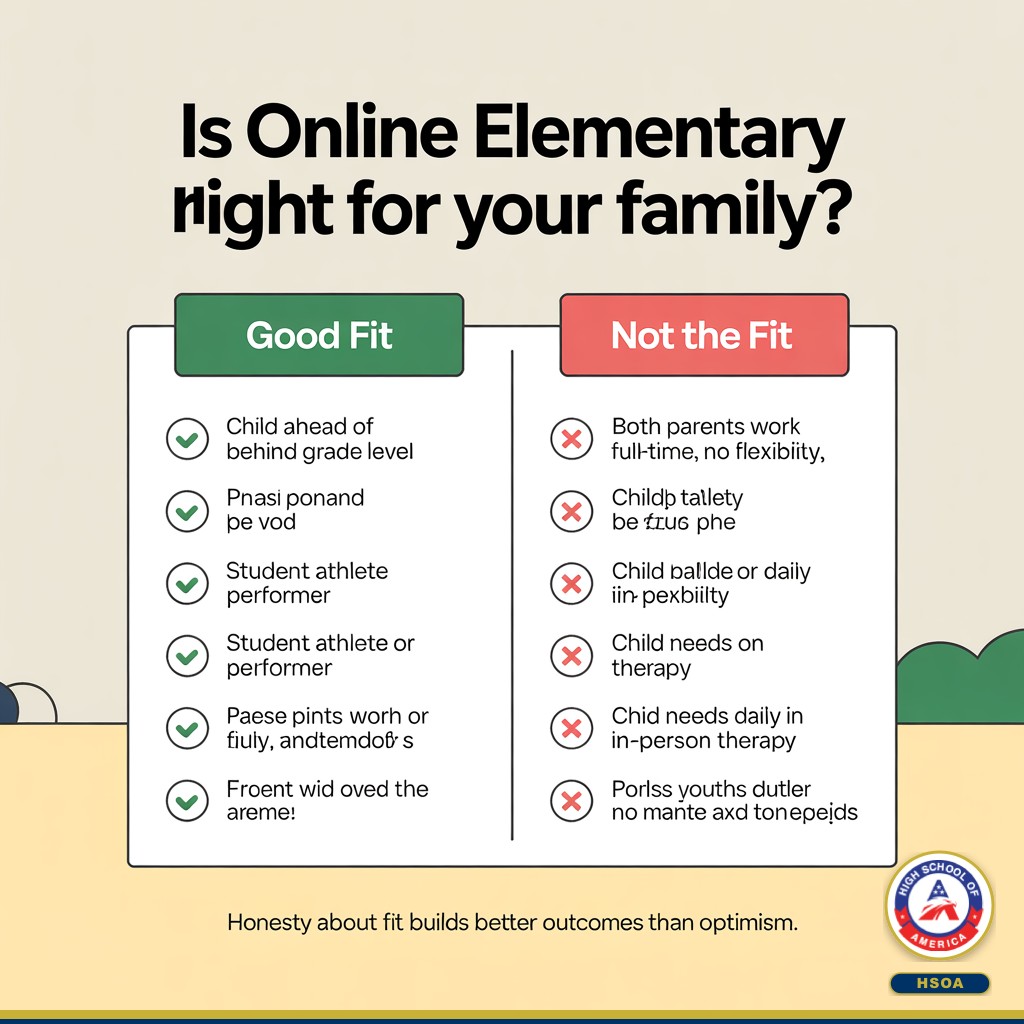
It Works When:
- Your child is ahead of or behind grade level. A self-paced program lets them work at their actual level, not the average of 25 classmates.
- Your family moves frequently. Military families transfer mid-year without losing a single day of instruction.
- Your child has anxiety or sensory processing needs. No fluorescent lights, no bells, no hallway chaos. The family controls the learning environment.
- You want daily visibility into your child’s education. The parent dashboard replaces the 9-week report card with real-time data.
- Your local school has staffing issues. When 1 in 8 positions nationally is affected, this is not a hypothetical concern.
- Your child is a young athlete or performer. Competitive gymnastics, dance, and athletics at ages 7 to 10 require schedule flexibility traditional school cannot offer.
- You want to start the compound effect early. 13 years of self-directed learning habits by graduation starts in kindergarten.
It Does Not Work When:
Be Honest About These
Both parents work full-time outside the home with zero flexibility and no other responsible adult is available. Online elementary (especially K through 3rd grade) requires 4 to 6 hours of parent involvement per day. This is non-negotiable for young children. If nobody is home, it will not work. Some families solve this with a grandparent, au pair, or nanny who serves as the Learning Coach, but the need for an adult present is real.
Your child has significant special needs requiring daily in-person therapists. Children who need on-site speech therapy, occupational therapy, or behavioral intervention may be better served by a school that integrates those services in the building. Online school can complement therapy but cannot replace hands-on, in-person intervention for significant needs. Some states (Washington, Montana, Oregon, Illinois) allow homeschooled students to access public school special education services for free, which gives families the best of both worlds.
Your child has zero social outlets outside of school and the family is isolated. This is rarer than parents assume. Most communities have co-ops, sports leagues, scouting, church groups, library programs, and neighborhood play. But if you genuinely live in an isolated area with no community infrastructure and your child is deeply extroverted, the social density of a school building may be what they need.
Socialization: What the Research Actually Says
64% to 87% of peer-reviewed studies show homeschooled students perform equal to or better than conventionally schooled students on measures of social, emotional, and psychological development. 98% of homeschooled students participate in an average of 5 extracurricular activities per week. A 2025 study found long-term homeschoolers had the lowest depression and anxiety scores and the highest life satisfaction of all groups studied.
The socialization concern assumes that sitting in a room of 25 same-age children, being told to stop talking for 7 hours, with 20 minutes of recess constitutes optimal social development. Research does not support that assumption. Online and homeschooled elementary students socialize through co-ops, community sports, scouts, church, neighborhood play, library programs, music lessons, and multi-age friendships. The socialization is different in structure but equal or better in outcome.
One honest caveat: socialization quality varies by family effort. 25% of homeschool alumni in one survey reported poor socialization. The difference is intentional parenting. Families who actively connect their children to community and social opportunities produce well-adjusted children. Families who isolate do not. Online school does not automatically socialize a child. Neither does traditional school. Both require adults who pay attention.
The K-5 Subjects: What Gets Taught and How
Reading and Language Arts: Phonics-based instruction through interactive tools and live teacher sessions. Guided reading with the parent using physical books. Digital and physical decodable readers. A Stanford study found struggling readers using adaptive digital phonics programs made 28% more progress in phoneme segmentation than non-adaptive programs. 40 states plus DC have now passed science-of-reading legislation. An accredited online elementary program using these methods provides the one-on-one reading instruction that a classroom of 25 cannot deliver consistently.
Math: Physical manipulatives (blocks, counting tools, fraction tiles) combined with interactive whiteboard sessions. Math instruction adapts to the individual student. The child who needs more time on subtraction gets it. The child who finished subtraction two weeks ago moves to multiplication. This is how elementary math was always supposed to work.
Science: Hands-on experiment kits. Planting seeds. Building circuits. Mixing baking soda and vinegar. Online science at the elementary level is MORE hands-on than many traditional classrooms because the experiments happen at the kitchen table, not in a demo at the front of a room of 25 students watching one child pour the liquid.
Art, PE, Music: Physical art supplies, outdoor activity logs, movement breaks built into the daily schedule. Some programs use fitness trackers. Many co-ops provide group PE, art classes, and music instruction. Virginia State Parks run formal homeschool programming. Museums across the country offer homeschool classes and field trip days.
The 13-Year View
A family that enrolls a kindergartner in an accredited K-12 online home school is not making a five-year decision. They are setting the trajectory for 13 years of education. The kindergartner who starts today will be a 7th grader who manages their own coursework, a 10th grader taking Algebra II on their own schedule, and a senior applying to college with an accredited transcript, years of self-directed learning, and the confidence that comes from owning your education since the beginning.
That trajectory does not happen overnight. It compounds. And it starts with one decision: clearing a space at the kitchen table, opening the laptop, and letting the first lesson begin.
Ready to Explore Elementary?
High School of America is an accredited K-12 online home school with certified teachers for every grade, kindergarten through 12th grade. Year-round enrollment means the start date is whenever your family decides.