
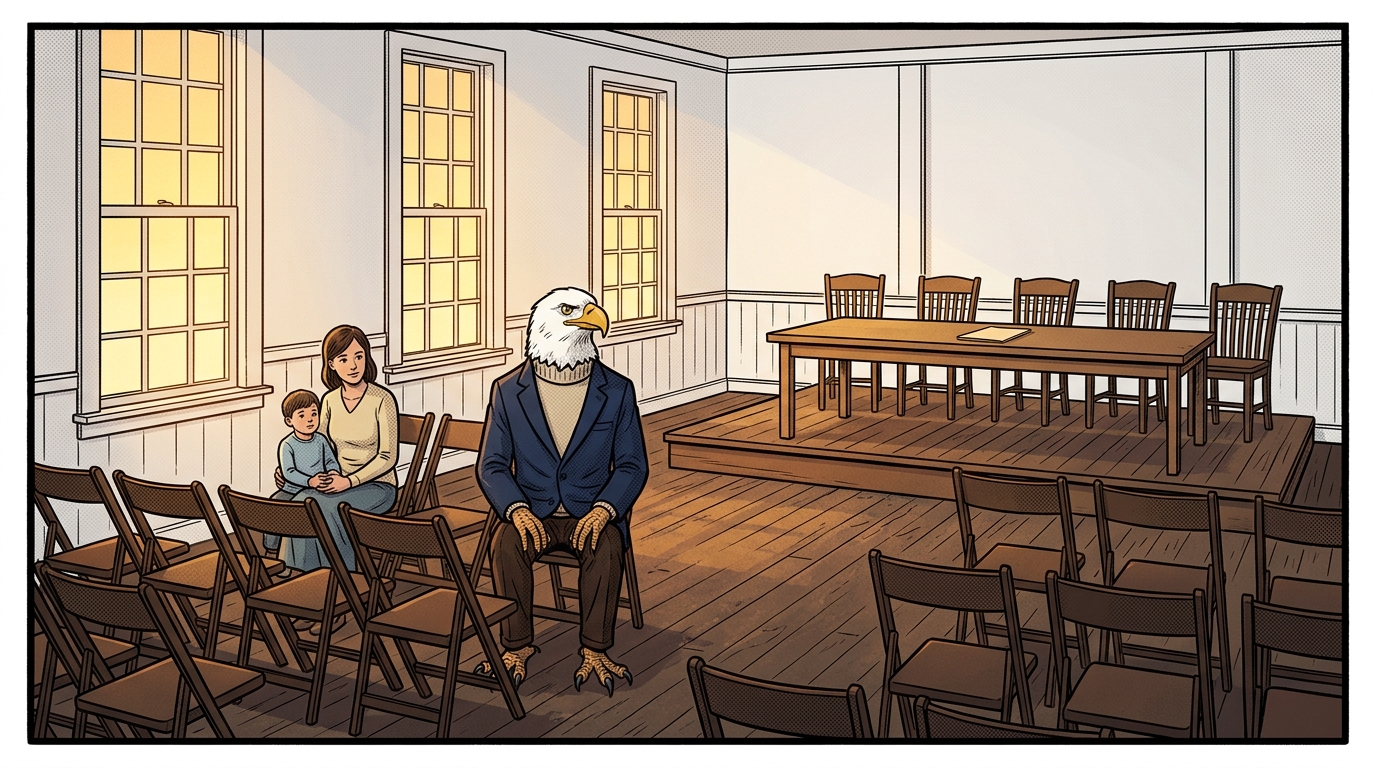
Almost everywhere else, leaving is something you tell an office. In Rhode Island it is something you ask a committee, and the committee is elected, and it meets in public.
At-home instruction here has to be approved by the school committee of the town where your child lives, before the instruction begins. That is approval, not notice. There is no state form to send and no state office that decides it. Your town decides it, in a room anyone may sit in.
Which produces the single most useful thing on this page, and it has nothing to do with the law’s wording:
The timetable is the committee’s calendar, not yours.
A committee that meets once a month means the earliest you can lawfully begin is the next meeting, and the deadline for getting on that agenda is earlier still. A family that writes a letter on Monday and keeps the child home on Friday, which is exactly right in most states, has not done the Rhode Island thing at all. Find the meeting date before you find anything else.
What the committee is being asked to approve
The statute names what at-home instruction has to contain, and the list is short enough to quote.
Reading, writing, geography, arithmetic, the history of the United States, the history of Rhode Island, and the principles of American government shall be taught in the English language, substantially to the same extent as these subjects are required to be taught in the public schools.
Rhode Island General Laws 16-19-1
Alongside that: the time given to instruction must be substantially equal to the public schools, which is a 180 day year, and you keep attendance registers and registers of the daily instruction given in each subject. Those registers are not incidental. In a state where somebody approved your plan, they are the evidence that you did what was approved.
Because there is no statewide form, towns ask for different things. One committee wants a two page outline, another wants curriculum titles and a calendar. The only authority on what yours requires is yours, so ask the district office what a home instruction submission looks like there before you write a word of it.
The clause that makes this genuinely different
Approval is a public act, and Rhode Island wrote down what follows from that.
Any interested person resident in any city or town aggrieved by the action of the school committee of the city or town either in approving or refusing to approve at-home instruction may appeal the action to the department of elementary and secondary education.
Rhode Island General Laws 16-19-2
Read it twice, because it runs in both directions. A parent who is refused has a route, at no cost, to a hearing at the state department. That is the half that protects you, and it is a real protection: a committee’s no is not the end of the road.
The other half is that any interested resident may also appeal an approval. In practice this is rare and it is not a reason to be frightened. It is a reason to submit a plan you would be content to have read by someone other than the person who asked for it, and to keep those registers from the first week rather than the first complaint.
Where Rhode Island sits in the series
Two neighbours in this series are worth naming, because a reader arriving from either will have the wrong instinct.
Wisconsin also files before leaving, so the order will feel familiar. It is not the same thing: a Wisconsin form is filed in an afternoon and nobody approves it. Hawaii signs your notice and hands it back, and the department there says in as many words that the signatures are an acknowledgment of receipt and not a grant of permission. Rhode Island is the state where it really is permission.
| State | What you are doing | How long it takes |
|---|---|---|
| Hawaii | Giving notice, acknowledged but not approved | As long as the office takes to sign it |
| Wisconsin | Filing a form nobody approves | An afternoon |
| Washington | Filing a declaration, or asking one superintendent | Two weeks at the outside |
| Rhode Island | Asking an elected committee to approve a plan | Until their next meeting, whenever that is |
Working out a Rhode Island timeline?
Fifteen minutes on the phone covers when your town’s committee meets, what a submission usually contains, and how to keep the registers without it taking over your week. No records needed to have the conversation, and deciding against it costs nothing.
What leaving actually requires
- The committee’s meeting calendar, found first
Everything else hangs off it. Ask the district office for the meeting dates and the deadline for submissions, and work backwards from there rather than forwards from today. - A plan covering the named subjects
Reading, writing, geography, arithmetic, United States history, Rhode Island history and the principles of American government, in English. Rhode Island history catches people out; it is in the statute by name. - Time substantially equal to the public schools
A 180 day year. How you shape the days is yours; the total is what is being compared. - Attendance registers, and a daily record by subject
Both are named. Start them the first week. Reconstructing a year of them in June is miserable and unconvincing. - Approval in hand before the instruction begins
In practice that means before you take your child out, because until the committee has approved, the lawful place for your child is the school they are enrolled in. - The transcript and immunization records, requested in the withdrawal letter
Along with course descriptions for anything half finished. Schools release these readily while a student is fresh in mind and slowly a year later.
Doing it in order
Find the next school committee meeting and the submission deadline
One call to the district office. Do this before you write anything, because it sets every other date.
Ask what a home instruction submission contains in your town
There is no statewide form, so this genuinely varies. Ask in writing and keep the reply.
Submit the plan and attend the meeting
You are an agenda item, not a defendant. Bring the plan and answer what is asked.
Get the approval in writing, then send the withdrawal letter
Not before. Ask the school for the transcript, immunization records, and course descriptions for any course in progress in the same letter.
Open the registers on day one
Attendance, and the daily instruction by subject. They are what an approval is worth a year later.
The withdrawal letter, ready to send
Short is correct. This goes to the school your child attends now, addressed to the principal and copied to the registrar, after the committee has approved.
Dear Principal [name],
This letter is formal notice that our child, [student full name], date of birth [DOB], currently in grade [grade], is withdrawn from [school] effective [last day of attendance]. The [town] school committee approved at-home instruction for [him/her/them] on [date of approval].
Please update your enrollment records accordingly and confirm receipt of this letter by reply. Please also send a complete transcript, immunization records, and course descriptions for any course in progress to [address / email].
Thank you for your help.
[Your name]
[Address]
[Telephone]
What we can and cannot tell you
High School of America is an accredited private school based in Florida, not a Rhode Island school. This page has said who approves at-home instruction and when, quoted the subjects and the appeal clause, named the registers, and been plain that the calendar belongs to your town. What it will not do is tell you which route to take, or suggest that enrolling here removes the need for your school committee’s approval. That approval is owed to your town whatever school your child attends next, and the choice belongs to your household, least of all to a school that gains from your enrollment. Ask the district in writing and keep the reply.
If you want a person to talk it through with, that is what the counselor call is for, and it is not a sales appointment. Bring whatever records you have, or none.
The statute is at the Rhode Island General Assembly’s own text of 16-19-1, the department keeps a home schooling page, and its Overview of At-Home Instruction sets out the appeal. The wider picture sits on the requirements state by state, and if you are early enough to still be deciding, the three-route comparison weighs this against staying exactly where you are.