
Berwyn, Illinois · K-12 Online Home School
School that fits the family Berwyn actually has.
An accredited, self-paced K-12 program for Berwyn families, for newcomers finding their footing, households on long shifts, and students who need the day to fit real life.
Start here
A dense bungalow town, a school built per child
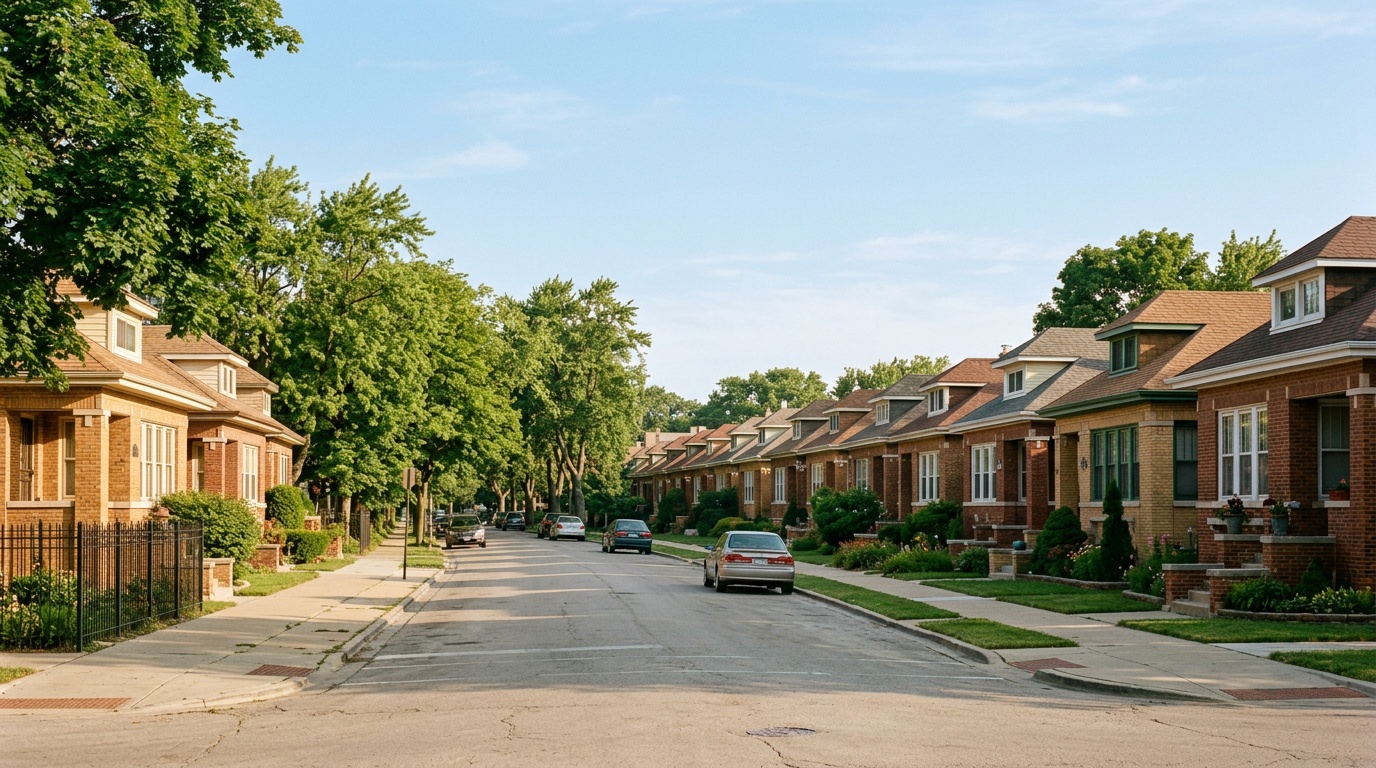
Berwyn is a dense, diverse near-west town of classic bungalows and working families, many new to the country, with crowded local schools. A self-paced, accredited K-12 program places each student by demonstrated skill and lets the day fit the household that is actually living it, instead of one pace for a packed room.
The program serves families across Berwyn, Cicero, and the near-west suburbs, with the same plan and the same accredited record behind every student. Start with how self-paced online high school works, or a plain look at online school versus homeschool versus public school. More about Berwyn.
The program at a glance
Migrant and agricultural families through the harvest
School that fits the household
Learn more: considerations for immigrant and ELL students
Placed by skill
One student, placed where they actually are
A child can sit above level in reading, on level in math, and still be building writing, all on the same day. The grid is a map, not a cage. A counselor reviews recent work and sets the starting point in each subject, then adjusts it as the student moves, so nobody is parked in a grade by birthday.
An example: one student, placed by skill the same day
Each subject starts where the student is, not where a birthday says.
Every student also gets a written, subject-by-subject plan, real teachers who grade the work and answer questions on the student’s schedule, academic support when a lesson does not click, and one accredited record kept for the family year after year. The day mixes on-screen lessons with real books and hands-on work.
Rural and long-commute families: the school comes to the house
A day that bends around two jobs
Learn more: the K-12 program
Why it fits here
A school day that bends around real Berwyn work
Between long shifts, a commute, and a child still building English or confidence, a fixed bell rarely fits. Self-paced coursework lands in the hours the family has, a student can re-read and replay at their own pace, and a working parent can check the week from anywhere.
Two ways to run a school day
The deeper answer
Becoming parent again after pulling from a hard school
When a family finally walks away from a school that left their student anxious, shut down, or just plain worn out, the first instinct is to hit the ground running, new curriculum, new schedule, new chapter. Resist that instinct hard. The first weeks at home are decompression time, not performance time, and the silence or sullenness you might see is not laziness. It is a nervous system exhaling for the first time in months. Early resistance to lessons, to schedules, even to you, is often relief wearing a grumpy costume. The child who stares at the ceiling for an hour is frequently the same child who, three weeks later, voluntarily reads for two. That is not magic; that is what happens when pressure lifts before expectations return.
Your job in this season is to become the steady adult again, not the teacher-warden, not the grade-hawk, just the person who is safe to be around. Rebuilding that trust is the actual curriculum right now, and it pays off in every subject later. Keep days loosely structured but low-stakes. Let curiosity lead even if curiosity currently looks like YouTube rabbit holes about deep-sea fish. When output does come back, it will come back warmer and more willing because it was never forced. If the emotional weight feels bigger than a schedule change can fix, our mental health support resources are built exactly for this transition, and a real conversation with a school counselor can help you map what comes next at a pace that actually sticks.
Find your Berwyn family
Whatever brought you here, the model bends to it
New to English, new to the system
A student building English can re-read, replay, and work at their own pace instead of falling behind a fast spoken lesson, with the whole family able to follow.
Long and rotating shifts
When the household runs on service, warehouse, or factory hours, the school day flexes around them instead of pretending they do not exist.
The student who needs more time
A quieter setting and a pace set per subject let a student build a real foundation without a crowded room moving on without them.
Watching the budget
A home program removes much of the hidden spending around a daily commute. A counselor walks through exactly what enrollment includes.
Switching mid-year
You do not have to wait for fall. A counselor reviews the records and the student picks up at their real level on a clean record.
A family on the move
If life means another address, the accredited record is one continuous document that follows the family, with no gap to explain.
The deeper answer
Checking to teach versus checking to grade
There are two very different reasons a teacher might ask you a question. The first is to find out what you already know so the next lesson can actually land. The second is to stamp a score in a gradebook and move on. Most traditional classrooms lean hard on the second kind, which means a student who half-understood Chapter 7 gets a C, and everyone pretends that settles it. Online learning built around a self-paced model treats those two purposes as genuinely separate jobs. Low-stakes checks happen constantly: short knowledge checks, quick concept reviews, practice problems that flag a shaky idea before it quietly derails the next three units. None of that shows up as a grade. It shows up as a signal, one that steers what the student works on tomorrow instead of just narrating what went sideways last week.
The formal grade enters the picture at a different moment entirely, when mastery is actually present. That sequencing matters more than it sounds. A student who hits a concept wall on Monday is not penalized for the wall; the system spots it, redirects the path, and the assessment waits. By the time an official score is recorded, it reflects what the learner genuinely understands rather than how they performed on a pressured Wednesday morning. That is not a softer standard. That is a smarter one, because the cumulative record a student carries forward should tell a true story, not a convenient one.
Kindergarten through senior year
One continuous record, every grade
The same program runs the whole way, and the level is set by what a student can do.
One continuous path, one record
K-5Foundations
6-8Analytical turn
9-12Four-year sequence
GraduationAccredited
Grade pages: Kindergarten, 4th, 5th, 6th, 7th, 8th, 9th, 10th, 11th, 12th.
The deeper answer
Civics and media literacy for a noisy world
Every student is swimming in an ocean of headlines, hot takes, and half-truths, so the question is not whether they will encounter contested information but whether they will know what to do with it. A strong civics and media literacy curriculum hands them a life jacket and a compass at the same time. That means going beyond memorizing the three branches of government and actually tracing how a bill gets stalled in committee, why a local zoning board meeting matters more than most cable news segments, and how a single misleading graph can flip public opinion on an issue that affects real people. These are not abstract exercises; they are practical skills that shape how a student reads a news alert, evaluates a social media post, or participates in a community meeting fifteen years from now.
Media literacy adds the critical second layer. Students learn to identify a primary source versus a commentary dressed up as reporting, spot an appeal to emotion masquerading as data, and cross-check a claim before forwarding it to every person in their contacts. That habit of verification is genuinely hard to teach in a passive lecture format, which is why active, discussion-driven coursework makes such a measurable difference. Online learning can actually sharpen these skills because students naturally encounter digital media as part of the curriculum itself, making the lesson and the real-world application happen in the same moment. Curiosity plus skepticism plus the patience to actually read the footnotes: that is the combination that produces an informed, engaged person.
Learn more: the American curriculum
The course catalog
A full course load, online and self-paced
From the early grades through senior year, the program covers the core subjects and a real slate of electives, all built for self-paced work. Tap a subject to see the course.
Elementary, K-5
Reading, writing, and number sense built carefully, one mastered step at a time.
Middle School, 6-8
The analytical turn: pre-algebra, real writing, and a student learning to own a plan.
High School, 9-12
A full accredited course load with honors-level depth inside the same self-paced structure.
The deeper answer
Dyscalculia and math built on understanding, not speed
For students whose brains process numbers differently, a timed math quiz is less a test of knowledge and more a test of nerves. Dyscalculia affects number sense, sequencing, and the mental agility that traditional classrooms prize when the clock is running. The result is a student who genuinely understands why seven groups of eight equal fifty-six but freezes the moment a timer appears, walking away with a grade that says nothing true about what they know. That gap between real understanding and recorded performance is exactly where school starts to feel like an unfair game. Our self-paced structure removes the stopwatch from the equation entirely, letting a student sit with a concept, revisit it visually, and confirm mastery before moving forward rather than being carried along by a calendar.
Math built on understanding looks different from math built on speed drills. Visual representations, pattern-based reasoning, and the simple freedom to pause a lesson and replay an explanation shift the whole dynamic. HSOA does not provide remediation or take the place of specialists, and we encourage families to keep those professional relationships active. What we do is move in the same direction: our American curriculum allows pace to flex around whatever support plan a student already has, so the school day reinforces progress instead of interrupting it. A student who needs ten minutes or ten days to own a concept gets exactly that, and the record they build reflects actual learning.
A week in practice
What a real week looks like
No bell and no homeroom, but a clear rhythm: set the week’s targets, work in short focused blocks, and watch the record fill in as the work lands.
A self-paced week, set by the family
- Targets set
- Math
- Reading
- Science
- Writing
- History
- Co-op
- Math
- Art
- Catch-up
- Review
The deeper answer
Dysgraphia and writing that doesn’t get stuck on the hand
When forming letters feels like running a marathon with your fingers, the idea stuck inside your head never gets a fair shot on the page. Dysgraphia is real, it is recognized, and it should not be the thing that decides how smart or capable a student gets to look. At HSOA, typing is not a workaround – it is just writing. Voice-to-text tools, extended time on assignments, and a self-paced structure mean a student can dictate a brilliant paragraph, take a breath, come back to it, and still turn in work that actually reflects what they know. No timed handwriting drills. No watching classmates finish while your hand cramps on the third sentence.
The American curriculum here is designed to flex around a learner, not the other way around. If a family is already working with an occupational therapist, a reading specialist, or a private evaluator, HSOA coordinates with that support rather than competing with it. Bring your accommodation plan, bring your IEP documentation, bring whatever your team has built – our teachers are trained to work alongside outside providers so nothing falls through the gaps between school and therapy. Students with dysgraphia often have sharp analytical minds and a lot to say; the only goal is clearing the physical bottleneck so those ideas can finally land on the screen the way they sounded in the student’s head. That is not a low bar – that is just fairness.
Ready when you are
See if it fits your family
A short conversation is the fastest way to know, with no pressure, just answers.
The record that lasts
One accredited record, wherever life goes next
The coursework is accredited, so the transcript is a professional document read cleanly by the next school. It is one continuous record across every grade and every move, with no gap to explain.
What is on the accredited record
-
Course list and gradesEvery completed course, year by year
-
A cumulative GPACalculated and kept current
-
Descriptions a registrar readsStandards-aligned course descriptions
-
No gap across a moveOne continuous record, anywhere you go
The deeper answer
Electives and the arts
Core subjects keep the academic engine running, but electives and the arts are where students discover who they actually are. A well-designed American curriculum does not treat art, music, and elective coursework as afterthoughts wedged between math and language arts. It treats them as legitimate intellectual territory where creativity, critical thinking, and genuine curiosity get to stretch. A student who spends a semester studying music theory is sharpening pattern recognition. One who works through a digital art course is learning visual communication that crosses every discipline. These are not soft extras. They are the connective tissue of a well-rounded education.
Online learning has a particular advantage here because the elective catalog is not capped by a single building’s budget or a single teacher’s specialty. Students can move through visual arts, music appreciation, drama, personal finance, journalism, and more without waiting for a seat to open up in an overcrowded classroom. Breadth matters because the cumulative academic record a student carries into the next school or through graduation reflects the full picture of who they are as a learner, not just their score on a standardized test. Electives give that record texture and dimension. They also keep students genuinely engaged, which research consistently links to better outcomes across every subject. The arts and electives are not the reward at the end of a hard week. They are part of the work itself, and they deserve a real spot in the schedule.

A note from the Head of School
Do not wait for a semester to start. For a Berwyn family, the most useful first move is the fifteen-minute counselor call with your student’s most recent records in hand. We place by skill, subject by subject.
Questions families ask
Berwyn online home school FAQ
Is online home school legal in Illinois?
Yes. Illinois treats a home school as a private school. Families do not register with the state, seek approval, or sit state tests; you teach the same branches of education the public schools teach, in English. Authority: the Illinois State Board of Education.
Is the program accredited?
Yes. The coursework is accredited, so the transcript is a professional record built to recognized standards and read cleanly by the next school.
What about friends and activities?
A self-paced day frees up the hours a fixed schedule eats, which is why active families choose it. Co-ops, club sports, park-district programs, and city activities fill the daytime. Here is how online students build a social life.
Do you support an IEP or 504 plan?
Yes. The self-paced structure already provides extra time, a quiet space, and a flexible pace per subject. Bring the current plan to the counselor call and the routine is built around it.
How should we think about cost?
A home program removes much of the hidden spending around a daily commute and keeps the schedule open for a working parent. A counselor walks through what enrollment includes, and we are fully transparent about cost.
What if we try it and it is not working?
A struggling stretch gets caught by the weekly check and the counselor, the pace and support adjust, and the accredited record travels if a family decides to move on. No year is lost.
How much do I need to know to make this work?
Less than most parents fear. The school carries the instruction and the grading; the parent is a coach who keeps the rhythm, not a teacher who delivers the algebra. Not knowing the material yourself is fine, and on purpose.
What technology do we need to start?
A reliable laptop and a steady internet connection are the main requirements. Books and any hands-on materials are shipped to the house, so the day is a mix of on-screen and off-screen work.
The legal basics
Homeschooling in Illinois, in plain English
In Illinois a home school is treated as a private school. Families are not required to register with the state, seek approval, give notice, or sit state tests; you teach the same branches of education the public schools teach, language arts, mathematics, the sciences, social studies, fine arts, and health, in English, and keep your own records. Compulsory attendance runs from age 6 to 17. Authority: the Illinois State Board of Education.
More Illinois cities we serve
Families across Illinois, one program
Two ways in
Get started in Berwyn
Whether your student is transferring mid-year or starting fresh, the first step is the same short conversation.