Waukesha County, Wisconsin
Brookfield Online High School
Change how you finish high school partway through, and keep every credit you have already earned.

Beside the 1867 depot, a high school changes lines
Brookfield online high school is for the student who wants to change how they finish partway through, without throwing away the part of the trip already behind them.
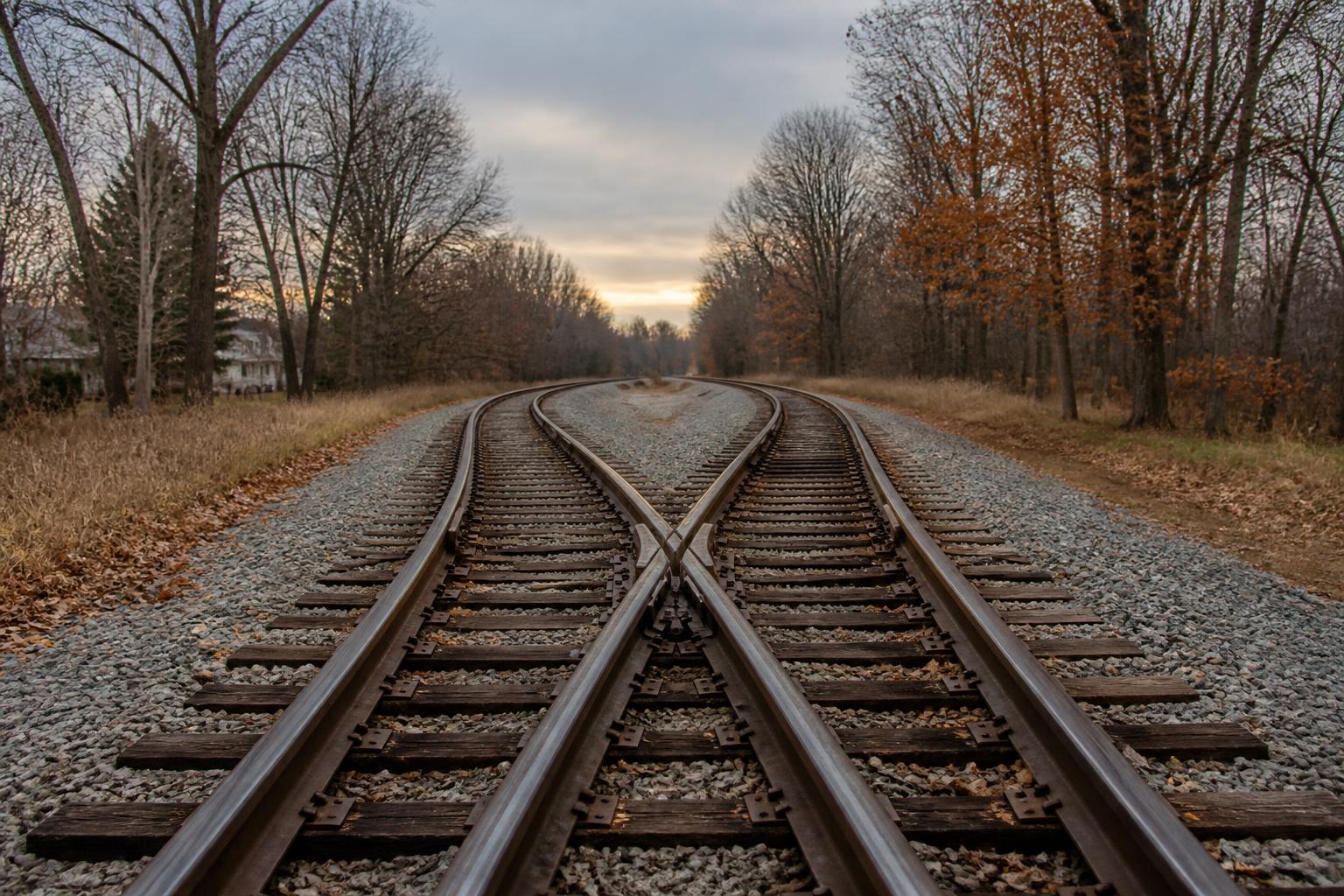
Brookfield began, in part, as a place where trains met. The first depot at Brookfield Junction went up in 1853, where the Milwaukee and Mississippi line crossed paths with a second railroad, and a second depot followed in 1867 (the state historical society’s record of that depot). By the 1850s the junction had a hotel, a sawmill, shops and a post office, because people were stepping off one line and onto another right there (an 1880s county history of the junction).
Nobody changing trains at a junction buys a new ticket from the start of the route. The miles already ridden are ridden. That is the whole idea of this page, and it is the part of online high school a family in Brookfield, Wisconsin most often asks about when a tenth or eleventh grader wants out of the current arrangement: does the change cost the years already done?
Change lines where you are. The miles behind you still count.
This page sits under the Wisconsin online high school hub, which covers the state as a whole. Here the subject is narrower: what a switch to our online high school looks like when it happens in the middle of grades 9 through 12, and how the credits already earned are carried across.
For the Brookfield sophomore switching to online high school
If you are in tenth grade and ready to change, the first thing that happens is not a course: it is a count of what you already have.
A sophomore usually arrives with a year and a bit of finished work: English, a math course, a science, some history, an elective or two. Every one of those passed courses is a credit that already exists, and none of them has to be taken again because the school has changed. The courses still ahead are what the new plan is built from.
- Ninth grade already done stays done; 9th grade online is only for a student who has not finished it yet.
- A student picking up partway through the year lands in 10th grade online with the finished semester already on the count.
- A junior who switches continues in 11th grade online, where the plan starts to point at the last stretch.
- A senior close to the end may need only a handful of courses in 12th grade online.
What changes is the shape of the week. Coursework is self-paced, so a student works through each course at the speed the material actually takes them, with a weekly rhythm and a target finish date set with a counselor. An assigned student services representative is the person a family writes to when something needs sorting out, and a counselor is on the very first call.
Three questions on the first call
Has the student passed courses at another school already?
Is there a course that was failed or left unfinished?
Does the family want to start before the next school year?
A counselor asks these on the first call, before any course is assigned.
Most of those questions are answered on one call. The one that is not, whether this is the right moment, is yours to decide, and nothing about the switch has to happen this week.
Ready to see where the count lands? Start the switch or Call (888) 242-4262.
Have every credit counted before the switch
Ask for the count first: before any course is assigned, our counselors read the student’s record and say which credits carry and which courses are left.
That order matters more than anything else on this page. A plan written before the count is a guess, and a guess tends to repeat a course the student already passed or skip one they still need. Our diploma asks for 24 credits, and the count tells the family how many of those 24 are already in hand. The transfer credit page sets out how that reading works, course by course, and the credit requirements for a diploma page explains what a credit is and how a full set is made up.
Sometimes the count turns up a course that was failed or left unfinished. That is not a reason to start over either. Credit recovery lets a student retake that one course on its own and move on, while the rest of the plan keeps going around it.
A student who finishes all 24 credits earns an online high school diploma issued by the school, on the school’s own high school transcript. The family is not the record keeper at any point.
A mid-year transfer, not a wait until June
A student can start any month, so a switch decided in November does not have to sit unused until the following fall.
The usual instinct is to finish the year where you are and change in September. Sometimes that is right. But a student who has already decided often spends the rest of the year marking time, and a semester spent waiting is a semester of courses nobody is counting toward the new plan. A mid-year start picks up where the student is: finished first-semester work goes on the count, and the second semester is planned around what is left.
| Detail | Wait for the fall | Switch at mid-year |
|---|---|---|
| When the count happens | August | The week the family calls |
| Finished fall courses | Counted in August | Counted now |
| Spring semester | Finished in the current setting | Planned around what is left |
| First online course | September | Within days of enrolling |
| What it suits | A year that is going well enough | A decision that is already made |
Neither column is wrong. The point is that the calendar is not the deciding factor. A family can choose the month on the merits rather than on the start date of a school year.
Decided already? Start the switch this month, or Call (888) 242-4262 to hear the count first.
4 grades on one online high school line
Grades 9 through 12 run on one continuous line here, so a student joining in tenth or eleventh grade is not slotted into a separate track for transfers.
That is the practical reason a mid-course change works. The courses a sophomore takes after the switch are the same courses a student who started with us in ninth grade takes, in the same order, held to the same grading scale. There is no second-class route for students who arrived later, and the diploma at the end does not record which stop they boarded at.
One line through grades 9 to 12
The line runs through English, mathematics, science and history every year, with electives filling the rest. The full catalog of high school courses shows each one, and the American curriculum page explains how they fit together across the four years. Every course is part of an accredited online high school, which is what lets the credit count on the other end.
- The count
- The reading of a student’s record that comes before any assignment.
- The plan
- The courses still needed, in order, toward 24 credits.
- The target finish date
- Set with a counselor, alongside a weekly rhythm that is honest about the workload.
- The transcript
- The school’s own record of every credit, the transferred ones included.
Online high school programs should not reset a student
A program that makes a transfer student begin again at the first course of ninth grade is asking them to ride the whole line twice, and ours does not.
All of our K-12 online homeschool programs run from kindergarten up, and the high school years are the stretch that matters most for a switch, because they are the years where credits add up toward a diploma. A family in Brookfield looking at online high school programs is usually looking for one thing above all: that the work already finished stays finished.
The core, laid across four years
Here is roughly how the core courses sit across the four years. A student who switches after tenth grade picks up in the third column with the first two already counted.
- English: English 1, English 2, English 3
- Mathematics: Algebra 1, Geometry, Algebra 2, Pre-Calculus
- Science: Biology, Chemistry, Physics
- History and civics: World History, United States History, U.S. Government
These are online high school courses in the full sense: each one ends in graded work and a credit on the transcript, and none of them is a review module bolted onto a different school’s record.
Want the course list in writing before deciding? Send me the details or Start the switch.
Is an online homeschool high school the same thing?
No: in a homeschool the parent is the school of record, and in an online high school the school is, which is the difference a transfer student feels most.
Families often use the words loosely, and searching for an online homeschool high school brings up both kinds of program side by side. The distinction that matters at a switch is who keeps the record. When a parent homeschools, the parent decides the courses, grades the work and writes the transcript. When a student enrolls in an online high school, the school does all three, and the credits that came from the student’s earlier school are entered on that same record.
Can a student who was homeschooled for a while switch in too?
Yes. The count works the same way, with the homeschool record read alongside any school transcripts. Courses that can be documented are reviewed one by one, and the plan is built from whatever is left.
Neither choice is wrong for every family, and an honest comparison of the options lays out what each one asks of a household. For a sophomore or junior who wants a school-issued diploma at the end, the online high school route is the one that keeps the record with the school from the switch onward.
Some parents start with home education programs and move to the school later; others do the reverse. Either way, the record follows the student, not the label on the program.
Along Bluemound Road, a high school junior’s own hours
A switch to online high school mostly changes when the work happens, and for a junior in Brookfield that often means mornings for the heavy courses and afternoons for everything else.
Picture a junior who finished chemistry homework by eleven and has a shift at a store on Bluemound Road, the city’s main shopping corridor, at three. The afternoon is not lost: the weekly rhythm set with a counselor belongs to the family, and the student decides which hours carry it. The evening might be a single history reading. The week still adds up.
- Morning. The hardest course first, while attention is at its best.
- Midday. A shorter course, or a quiz that closes a unit.
- Afternoon. Work, practice, an appointment, or nothing at all.
- Evening. One reading or one draft, and a look at what each course has next.
That rhythm is optional. Some students prefer the evenings, and some keep something close to a school-day schedule out of habit. What matters is that the student can finish high school online on a week that fits the rest of their life, and that the hours they choose are counted the same as anyone else’s.
For City and Town of Brookfield families, one diploma
Whether the mailbox is in the City of Brookfield or in what remains of the Town, the high school diploma at the end of our program is the same.
The City of Brookfield was incorporated from the Town of Brookfield on August 14, 1954, and part of the Town still survives along the city’s western edge (the Encyclopedia of Milwaukee on the Town). Two governments, one name, and plenty of households who have had to explain which one they live in. An online high school does not ask.
- The address goes on the enrollment form and nowhere else in the plan.
- The courses, the count and the diploma are identical on either side of the line.
- A later move across town, across the county or across the state changes none of them.
The same is true across Waukesha County. Families in Waukesha to the west, or in Milwaukee to the east, run on the same line, with the same 24 credits and the same school-issued transcript. A family that later moves within Wisconsin or out of it takes the record along unchanged.
For families with younger children as well, the Wisconsin K-12 online home school page covers the earlier grades. Questions about cost belong on the first call or the tuition page rather than here.
Prefer to ask first? Talk to a counselor or Send me the details.
Send the last transcript, then name a start date
The quickest way to make the switch real is to send the most recent transcript and pick the month the student will begin; everything else follows from those two.
- Gather the record. An unofficial transcript or the latest report card, plus anything from an earlier school or a stretch of homeschooling.
- Enroll. The application takes the student’s details and the record.
- Hear the count. A counselor reads the record and says which credits carry and what is left.
- Get the plan. The remaining courses, in order, with a weekly rhythm and a target finish date.
- Start. In whatever month the family chose, with a student services representative assigned.
The first course usually opens within days. Our online school keeps the same steps for every grade, and a private online high school like ours does not wait on a district calendar to begin.
A switch in high school feels large from the inside. Laid out in order, it is a record sent, a count heard, a plan read and a first course opened, with the miles already ridden still counted at the end.