
Grades 9 to 12, Charleston County, South Carolina
Charleston Online High School
Grades 9 through 12, taught and graded online for Charleston families, as part of our South Carolina online high school.
Start your enrollmentCall (888) 242-4262Book a counselor call
- Accredited online high school
- Self-paced, work submitted when ready
- Enroll any month
- Credits counted before work is assigned
- A counselor on the first call
The short answer
Charleston Online High School is the grades 9 through 12 program of High School of America for students in Charleston, South Carolina: an accredited, self-paced online high school that issues its own diploma at 24 credits. A counselor counts the credits a student already has before any course is assigned, enrollment opens in any month, and every course runs online at the student’s own pace toward a target finish date, with an assigned student services representative.
How it works
Online high school by the week, not the bell
Online high school here is self-paced: each course keeps a weekly rhythm and a target finish date set with a counselor, the student works at the hours that suit the household, and the work goes in when it is ready.
The longer answer to how does online high school work? is one chain: lesson, submitted work, grade, credit, transcript. A lesson is read, watched or worked through. The assignment goes in when it is ready. The grade comes back on the published scale, a passed course adds its credit, and the transcript records it.
- Know the rhythm. Each course has a weekly rhythm and a target finish date, set with a counselor.
- Work when it suits. Lessons fit the hours the household actually has open.
- Submit as you finish. Hand work in when it is done, not in one batch at the end.
- Read what comes back. Grades and comments arrive on each assignment; read them before the next lesson.
- Say when a course stalls. A short message to the student services representative gets a reply from a person.
A freshman’s first weeks are the steep part, because nobody rings a bell to start the day. Most students who join Charleston online high school as ninth graders settle into a weekly rhythm within the first month and arrange it around everything else in their lives. Our page on ninth grade online walks through that first year.
Self-paced does not mean unwatched. The representative follows every course, and the counselor can reset a plan on a call when a family’s month goes sideways. What the student gains is the right to put Tuesday’s lesson on Wednesday when Tuesday is taken.
24
The requirement
credits, our requirement, the same number in every month of every year.
A counselor counts the credits a student already has before any course is assigned.
The diploma
An accredited online high school issues its own diploma
The diploma a student earns here is issued by the school itself, on our own requirement of 24 credits, and the school’s accreditation stands behind the record it is based on.
- Issued by the school, not written up by the family.
- Earned at 24 credits, our requirement, the same number in every month of every year.
- Backed by a transcript that lists every course, every grade and every credit.
That deserves to be said exactly rather than loudly. Our page on what it means to be an accredited online high school explains what accreditation covers and how a family can check it for themselves. The online high school diploma is the document at the end of the four years. The school’s name is on it, and a single transcript stands behind it.
A diploma is only as clear as the record behind it, so the school keeps the record.
What no school can do honestly is predict how a particular college or employer will read a transcript, and we do not try. We can say what is on it: each course by name, each grade on one published grading scale, and the school that issued it. When a copy has to go somewhere, the high school transcripts page explains how it is requested and sent.
Charleston at work
Online high school for students working the dinner rush
A student who works evening shifts can still carry a full high school schedule, because an online high school measures progress by the work finished each week, not by hours spent in a seat.
Charleston is a working hospitality city. Charleston, South Carolina is the most populous city in the state, with 150,227 people at the 2020 census, and its economy is anchored by tourism, port and logistics, aerospace and information technology. Tourism leads, the port follows, and the city has become a nationally recognized dining destination. Some households here include a teenager who works a host stand, a prep line or a hotel front desk, and in the busy visitor weeks those shifts multiply.
That student is who this section is written for, and the promise of a self paced online high school in Charleston fits in five words: learn on your own schedule. There is no bell to clock in to. Each course keeps a weekly rhythm and a target finish date set with a counselor, and the work goes in when it is ready.
A busy visitor week and a slow one do not have to look alike, and nothing about the transcript changes because a manager added a Saturday double.
School stays the first job and work stays the second, and the student services representative, who follows every course, writes when one goes quiet for a week.
Credits and transfer
Count the credits before choosing a single course
Start with a credit count, because what a student has already earned decides every course that follows, and a counselor finishes that count before anything is assigned.
A family weighing a high school diploma in Charleston, South Carolina usually arrives with something already on paper: a semester at a district school, a year in another state, a course or two taken over a summer. Each line is read for the course, the grade and the credit value, and posted to our record before the plan is written against the credits you need to reach 24.
| On the old record | What the counselor checks | Where it lands |
|---|---|---|
| A passed full-year course | Title, grade and credit value | Posted as earned credit |
| A passed semester course | Whether it carried half a credit | Posted as a half credit |
| A course that was not passed | Which requirement it was meant to meet | Planned again, often through credit recovery |
| A course left half finished | How far the work got, and where | Read on its own before the plan is set |
| An elective with no match in our catalog | Whether it fills an elective place | Counted as an elective where it fits |
A check means the credit posts as it stands; a dash means the counselor plans that course again or reads it on its own first.
Our page on transferring credits walks through the whole process, including what happens to a course from a school that uses a different credit scale. When the count turns up a course that did not pass, credit recovery takes that one course on its own, alongside the student’s other work, rather than repeating a year.
The count goes to the family in writing. That pair of numbers, credits earned and credits left toward 24, is where the plan begins, and it is the same pair whichever month the student starts in. Any transfer credit that is posted stays posted.
Starting mid-year
Can a Charleston student finish high school online mid-year?
Yes. Enrollment opens in every month, so a student can start any month of the year, in January, in April or the week after a family move, and the plan is built from the credits they bring that day.
- Accreditedonline high school
- Self-pacedat your own pace
- Any monthto enroll
The route to finish high school online in Charleston, South Carolina is the same at a mid-year start as in September, and so are the steps to get back on track to a diploma. A counselor reads the record, counts it, and lays out the courses still needed, and the student begins the next week rather than waiting for a new semester.
A mid-year start is mostly a question of the count at the door.
- Courses the student finished at the last school count in full.
- A course left halfway is read on its own, and the counselor says which way it falls before anything is assigned.
- A student who is behind in one subject keeps moving in the others while that one is handled.
And a student whose current school is working well for them should stay put: nothing here asks a family to leave a school that fits, and a counselor will say so.
There is no fall deadline and no point at which the door closes for a student in grades 9 through 12. A sophomore whose family arrives in West Ashley in February, or a junior whose parent starts at the port in spring, begins in the month they arrive.
Across the harbor
A James Island porch, a transcript open after lunch
School can happen wherever the student is: a porch on James Island, a table in West Ashley, a back room on the Peninsula between a lunch shift and a dinner shift.
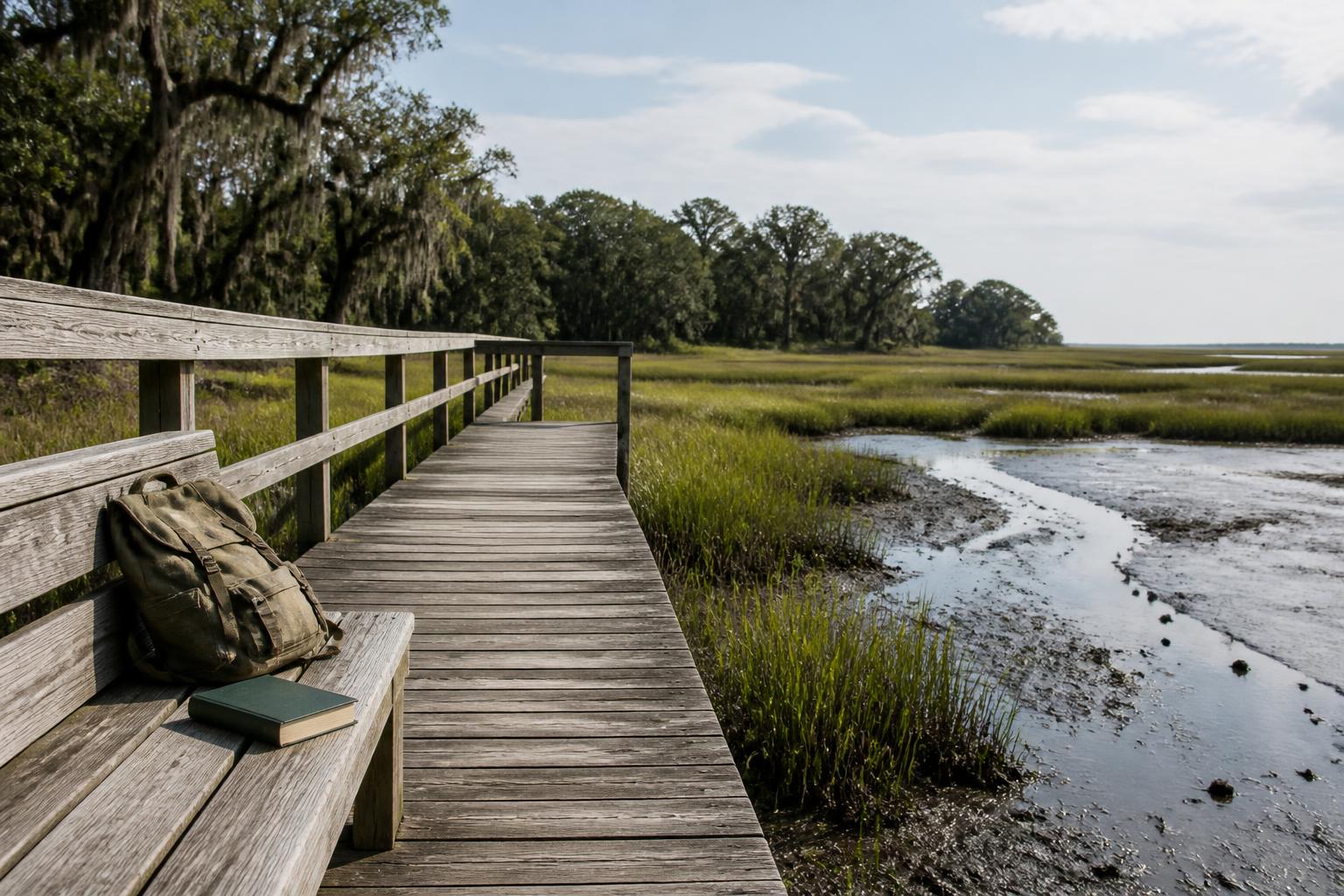
Charleston families are spread out. The city takes in Downtown, which people call the Peninsula, along with West Ashley, James Island, Johns Island and Daniel Island, all set around a harbor formed where the Ashley, Cooper and Wando rivers meet. A school that lives online asks nobody to cross a bridge before dawn, and a student whose family moves from one side of the harbor to the other keeps the same courses and the same representative.
The city has been here since 1670, when it was founded as Charles Town, and it is home to the College of Charleston and the Medical University of South Carolina. Nothing on this page speaks for either school’s admissions. What a counselor can do is help a student plan four years of coursework that keeps the doors they care about open.
Most students in the city attend the Charleston County School District, and many of them are well served there. This page is for the households where a different shape of week fits better, and it asks no family to leave a school that is working.
Grades 9 to 12
4 grades, 1 transcript, any starting point
Every student is placed in one of four grades by the credits they bring, and all four lead to the same transcript and the same diploma.
- 99th grade online: the first year of the core, with English, mathematics, science and history side by side.
- 1010th grade online: a second year of each core subject, often the year a transfer student joins.
- 1111th grade online: the core continues and electives begin to take a larger share of the week.
- 1212th grade online: the final credits toward 24, and the transcript that goes with the diploma.
Placement follows the record, not the calendar. A student can join at any of the four grades, and the record picks up where the last school left it. A student who arrives halfway through tenth grade with five credits posted is placed by those five, and the courses still needed are spread across the time left. A student with a gap in the record is not sent back a year; the gap is filled where it sits.
For parents
Parents following the record from across town
A parent does not teach, grade or keep the transcript; the parent reads progress and the grades, joins the first call, and answers when the school writes.
Charleston parents keep long hours of their own, in kitchens and hotels, at the port, in hospitals and offices. A parent finishing a late shift can read where every course stands the next morning, and nothing is lost by the hour it is read.
- The student
- Does the work, sets the hours and submits work when it is ready.
- The parent
- Reads progress and grades, joins the first call and keeps up with the weekly rhythm at home.
- The student services representative
- Follows every course, writes when one slows down, and stays the same person all year.
- The counselor
- Counts the credits, builds the plan and resets it when the household’s year changes.
That division is the practical meaning of a private online high school for a working family. The school holds the grading and the record, which is the part that takes the most hours when a household teaches high school at home, and the parent keeps the part only a parent can do.
Want to hear how the parent’s view works before deciding anything? Ring a counselor, or ask for the details in writing and read them after your shift.
Curriculum
Online high school courses follow one American curriculum
Every course is built on a standard American curriculum, so a credit earned here names a recognizable course with a recognizable scope.
| Subject | 9th | 10th | 11th | 12th |
|---|---|---|---|---|
| English | English 1 | English 2 | English 3 | English 4 |
| Mathematics | Algebra 1 | Geometry | Algebra 2 | Pre-Calculus |
| Science | Biology | Chemistry | Physics | A fourth science of the student’s choosing |
| History and social studies | World History | Art History and Criticism | United States History | U.S. Government and Economics |
| Electives | None yet | One | Two | Two |
A usual order, not a rule. A counselor rearranges it around the credits a student brings, and Art History and Criticism is one elective among many.
The full catalog of online high school courses sits under high school courses, grouped by subject. A student who has spent two summers on a restaurant floor may lean toward economics; one drawn to the harbor may want more science. The core stays whole either way, and what sits above it is the part a student chooses.
Enrolling
Send the latest report card before enrolling
Send the latest report card or transcript before the first call, because the credit count comes from it, and everything else in the plan follows the count.
- Send the record. A clear photograph of the latest report card or transcript is enough to begin.
- Book the first call. A counselor reads the record with you and counts it while you listen.
- Choose the month. Any month works; pick the one that suits the household’s season.
- Begin the courses. The first courses open, and the representative introduces themselves.
After the first call
What the family has in writing
The plan is the family’s to accept, change or set aside.
How the cost is set is laid out on the tuition page, and the counselor goes through it on the call. Families with younger children as well can read the South Carolina homeschool page for the K-12 side of the school.
For the wider picture, the main online high school page describes the program across every state, and our online school page covers kindergarten through grade 12.
Before you call
What do Charleston families ask before enrolling?
Is this an accredited online high school?
Yes. The school is accredited, and our accreditation page explains how a family can check that independently. The diploma and the transcript are both issued by the school.
Can my student keep working restaurant or hotel shifts?
Yes, and many self-paced students plan around a job. Each course keeps a weekly rhythm and a target finish date set with a counselor, and work is submitted when it is ready, so the hours around a shift are the student’s to arrange. If work starts to crowd out school, the student services representative will say so.
What happens to credits from my student’s current school?
A counselor reads the latest report card or transcript and counts every passed course before assigning anything. Credits that are posted stay posted. A course that was not passed can usually be retaken on its own through credit recovery.
Do I have to teach my teenager at home?
No. The courses, the grading and the transcript are the school’s. A parent reads progress, joins the first call and follows the weekly rhythm, and that is the whole of the job.
Who issues the diploma, and how many credits does it take?
The school issues it, at 24 credits, which is our own requirement. Every course and grade on the way there sits on one school-issued transcript.
Does it matter which part of Charleston we live in?
No. A student on the Peninsula, in West Ashley or on one of the islands has the same courses, the same target finish dates and the same representative. A move across the harbor changes nothing about the plan.
How do we find out what it costs?
The tuition page explains how the cost is set, and a counselor walks through it on the first call once the credit count is done. The family has the plan and the cost in writing before deciding anything.
Your graduation plan
A graduation plan on paper, not a guess
Tell us where your student stands and a counselor will send back a written graduation plan: the credits counted, the courses still to take, and a month to begin.
Graduation plan
Find out exactly what is left to graduate.
Ready when the household is
Start the enrollment online, or ring and a counselor will talk it through with you first.