Accredited K-12 Online Private School
Fremont K-12 online home school, rigor that fits a multilingual home.
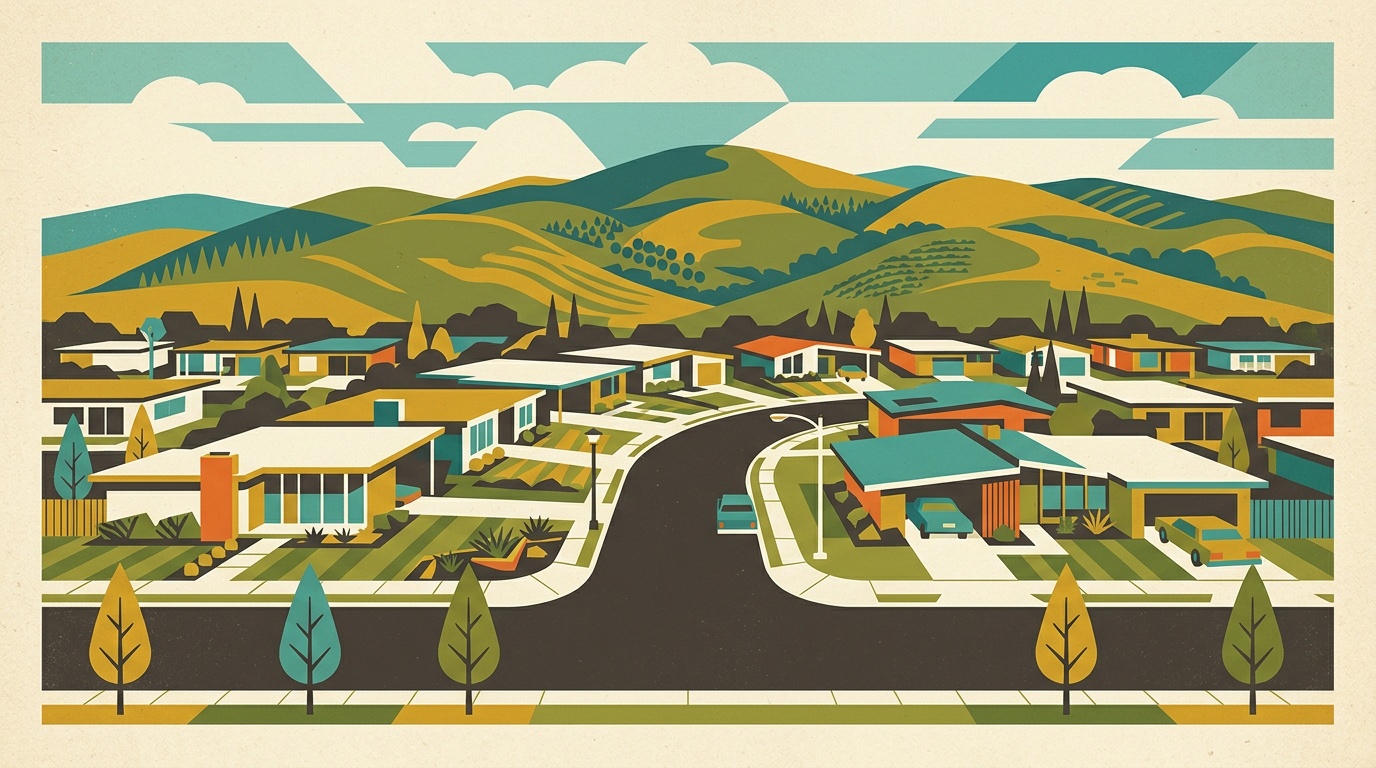
Under Mission Peak, Fremont is one of the most diverse cities in the country. A self-paced program lets a motivated child go as far and fast as they can, while the language spoken at home stays a strength.

01 A Multilingual Valley
Why a Fremont family chooses a self-paced online school.
Fremont is one of the most diverse and multilingual cities in the United States, a high-expectations Silicon Valley suburb gathered under Mission Peak. The families here ask a great deal of school, and a great many of them speak a language other than English at the dinner table. A fixed 8-to-3 bell was built for neither: not for a household running on two demanding careers, and not for a child whose first language is an asset the system too often treats as a gap. For families weighing the move, we wrote an honest comparison of online school, homeschool, and public school and a complete guide to getting started.
A self-paced, accredited K-12 homeschool program runs on the newer logic. Mastery moves the student up, not the calendar; the work is asynchronous and done in the windows the family actually has; progress is measured against the standard rather than the clock. For a household where both parents already work that way, it is simply how a school should have worked all along.
The result is not a lighter year. The coursework, the standards, and the checkpoints are fixed; what flexes is the timeline. A Fremont student who is racing ahead in math and taking an extra week on an essay is doing both at the right pace, on the same accredited record.
And it is not a parent turned teacher. The teachers are at HSOA. The family supplies the rhythm and the workspace; the school supplies the instruction, the grading, and the counselor who keeps the year on track.
Continuity comes built in, which matters in a valley where families relocate for the next role as a matter of course. The school does not change when the address does. There is nothing to re-enroll in and no credits to transfer across a move, because the student never leaves the school. The cumulative record simply keeps building, the same teachers, the same standard, wherever the family lands next.
02 The Way Work Actually Works
Online school for a high-achieving, multilingual Fremont household.
Picture the Fremont family this is built for. Parents who hold a high bar and hold their heritage just as tightly, and a child who is often ahead of grade level while growing up in two languages at once. A conventional classroom tends to force a trade between the two: it flattens the home language into a deficit to be remediated and the eager student into the middle of the room. The families here do not think that way about their own work, and they are right not to accept it for their children. They are also fluent in technology, which is why our program teaches AI literacy, not just AI tools.
A self-paced school speaks that language. The student works in concentrated blocks when they are sharp, checks in with teachers asynchronously, and moves to the next unit the moment the current one is mastered. A travel week, a parent on a deadline, a quiet morning that suddenly opens up: the schedule absorbs all of it without anyone falling behind, because the target is the work, not the hour it happened. And the worry every parent raises first, whether their child will have a social life, has its own answer: here is how online students actually socialize.
It also fits the kind of student this valley tends to raise: curious, often ahead, easily bored by a pace set for the middle of the room. Self-paced lets that student go deep and go fast where they are strong, and slow down without stigma where they are not. The pace meets the student in each subject, on any given day, rather than averaging them into a grade level.
None of this trades away rigor. A counselor reviews pacing on a regular cadence, so flexibility never drifts into gaps, and the cumulative record reflects mastered, accredited work. The standard holds steady. The only thing that flexes is the design of the day, which is exactly the thing this town is best at redesigning.
What it ultimately protects is the student’s relationship with learning. A child who spends years waiting through a pace set for someone else learns that school is something done to them on a fixed clock. A child who moves at their real pace learns the opposite: that effort and curiosity actually move the needle, and that being stuck for a week is a normal, fixable part of the work rather than a verdict. In a town that prizes that exact mindset in adults, it is worth building into a childhood.
03 The Curriculum, by Grade
The Fremont online K-12 curriculum, grade by grade.
The K-12 program is a full course of study. Here is its shape, subject by subject across the four grade bands. A student is placed by demonstrated skill, not birthday, so the grid is a map, not a cage. New to this with a young child? Start with our K-5 parent guide.
| Subject | K–2 | 3–5 | 6–8 | 9–12 |
|---|---|---|---|---|
| English | Phonics & fluency | Reading to learn, writing | Literature & argument | Composition, honors and AP-equivalent options |
| Mathematics | Number sense | Fractions & operations | Pre-algebra to Algebra I | Geometry, Algebra II, Precalculus, Calculus |
| Science | Observation & inquiry | Scientific method | Life & physical, shipped lab kits | Biology, Chemistry, Physics |
| Social Studies | Community & maps | US & world geography | World & US history, civics | US History, Government, Economics |
| Electives | Art & music | Introductory languages | World languages, computer skills | Computer science, visual & performing arts |
None of this is a lighter course of study. A Fremont student takes the full sequence in every subject, held to the same standards a strong campus would, plus the electives and world languages that round out a real K-12 education, all built on the American Curriculum framework. What changes is that the grid is read by skill rather than birthday: a student can sit in the 9–12 column for math and the 6–8 column for a language they just started, with one cumulative record holding all of it at once.
Underneath the grid is one mechanic: mastery moves the student up, not the calendar. Honors and AP-equivalent courses sit inside the same self-paced structure, so a student ready for them simply takes them. Every grade has its own page: kindergarten, elementary, middle school, and high school nine through twelve. The counselor walks through placement and course selection in detail.
A high bar and the home language are not a trade. Keep both.
Self-paced mastery lets a motivated child accelerate while the home language keeps growing right beside the English. The record reflects the academic work and counts the second language as the strength it is.
04 How the Teaching Works
How a self-paced online home school actually teaches.
Self-paced is a method, not a shortcut. Here is how each part of the K-12 day actually runs for a Fremont student.
Holding it together is a counselor who reviews each student’s pacing on a regular cadence. That is what keeps a self-paced year honest: a fast week is verified rather than assumed, a slow stretch is caught early and made up, and the parent always has one person who knows the whole picture. The flexibility is engineered, not improvised, which is the difference between a self-paced school that works and one that quietly drifts.
05 Accommodations
Two paces, one cumulative record.
HSOA accommodates students with active IEP or 504 plans and works with families on the specific accommodations the plan calls for. The starting point for any Fremont family bringing an existing plan is a counselor call. The counselor reviews the plan, walks through how the accommodations land in the K-12 curriculum, and aligns the student’s pacing and supports to what the plan asks for.
Twice-exceptional learners are advanced in some subjects and need extra support in others. The self-paced mastery model runs both at once: a student can be two grades ahead in math and building in reading on the same day, without either pace becoming the wrong pace. What HSOA does not do is replace the clinical specialists or therapists a family already works with. The school works alongside that ecosystem; its job is the K-12 academic work, accommodated to fit the plan and the student.
For a household that has spent years coordinating a child’s services, the relief is administrative as much as academic. The plan does not have to be re-explained to a new teacher every fall or re-litigated with a new campus after a move; it lives with the student in one continuous record. The counselor is the single point of contact who holds it, which means the family spends less energy managing the school and more energy on the child. For some students the calmer setting matters in its own right: online learning can be a safer, more supportive environment.
Wondering how far your child could actually go?
 Head of School
From the Head’s Desk · Fremont
On not making a child choose between rigor and roots.
A lot of first calls I take from a Fremont family carry a particular worry. The parents want a serious, demanding education, and they also want their child to stay fluent in the language their grandparents speak and steeped in the culture they came from. Somewhere along the way they were made to feel those two wishes compete, that the price of pushing hard in English is letting the home language fade. I want to be clear that they do not have to choose.
A self-paced school holds the standard exactly where it belongs and lets the child move at their real pace, which frees up the thing a rigid bell schedule always crowds out: time and energy for the second language, the weekend cultural school, the grandparents at the table. English develops the way it would for any student; the home language keeps growing beside it; and the record treats a bilingual child as what they are, ahead, not behind.
What I tell Fremont parents is that a child raised steady in two languages, held to a high bar, is building something most students never get the chance to. Our job is to give that child a full, accredited, demanding education without asking them to leave half of who they are at the classroom door. That is not a lower bar. It is a fairer and, frankly, a more ambitious one.
So bring the real family to the counselor call. The languages spoken at home, where the student flies and where they stall, the prior records, the IEP if there is one. We will design the year around the whole child, the scholar and the heritage both. The plan starts there.
06 Cost
What K-12 online home school in Fremont costs.
The financial side is a real conversation, and the right place to have it is a one-to-one counselor call, not a generic tuition table posted on a webpage.
For exact numbers and a written plan for your family, schedule a counselor call. Fifteen minutes by phone. No pressure.
Field Recording · 60 Seconds
Sixty seconds with the Head of School.
07 The First Fifteen Minutes
Talk to a Fremont online school counselor.
Fifteen minutes by phone. No commitment after.
Pick a window and the counselor calls you.
Or call (888) 242-4262 directly. Same counselor, no slot needed.
08 Frequently Asked
Fremont online home school questions, answered.
We speak another language at home. Will the program support that?
My child is years ahead. Can they move faster here?
Is “self-paced” watered down or unstructured?
Do you offer honors and advanced courses?
How are the core subjects actually taught: reading, math, science?
How does placement work, by age or by skill?
Can my student transfer back to the local Fremont district later?
What does the K-8 student get at the end of 5th and 8th grade?
My child has an active IEP. How do accommodations work?
How long is the counselor call, and what does it cost?
Still have questions? See our complete online-school FAQ and the admissions requirements for an online K-12 school.
Locator
Fremont, California.
A landmark for context. The school itself is online, available wherever a Fremont family lives.
Cross-Reference
HSOA in nearby California cities.
Each city has its own page. The school is online, available wherever a family lives in California.
Before You Enroll
What the first call actually covers.
The first step is a fifteen-minute phone call with a counselor. No commitment, no pressure, and nothing to prepare ahead of time. Here is exactly what it covers, so you know what you are walking into before you ever decide to enroll.
Where your student is now
Their real level in each subject, where they fly and where they stall, and any prior records.
What the year would look like
How the self-paced day runs, how mastery works, and where honors or acceleration fit.
How it fits your family
The weekly rhythm around two working schedules and the parent’s coaching role.
What enrollment takes
The honest cost conversation, the timeline, and the few steps to start. Enroll any day of the year.