
Arlington Heights, Illinois · K-12 Online Home School
School that fits an Arlington Heights family.
An accredited, self-paced K-12 program for Arlington Heights families, for the high achiever who is bored, the busy household, and the student who needs a calmer, more personal day.
Start here
Strong schools, and still not the right fit for every child
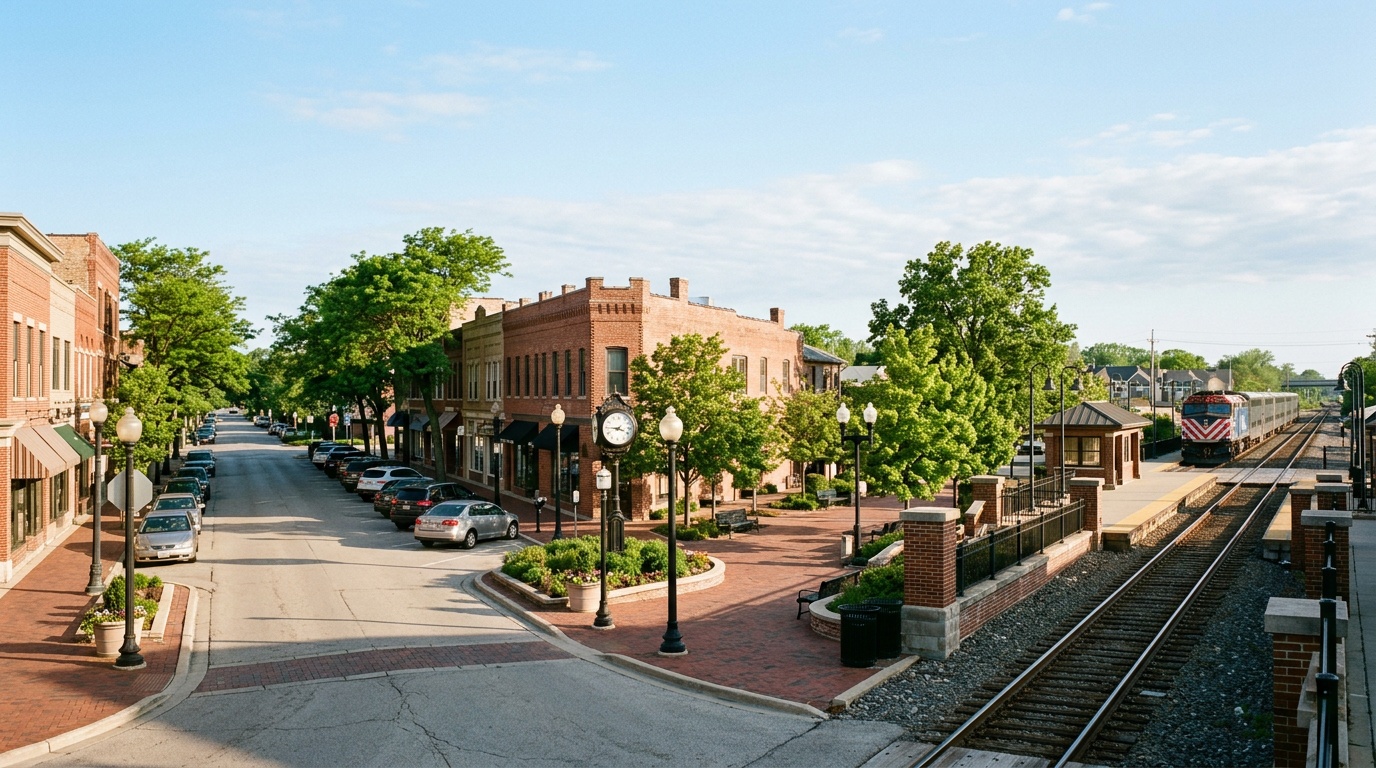
Arlington Heights is a comfortable northwest suburb known for its downtown and its schools. But even strong schools move one room at a time, and plenty of capable students are either waiting at the top or quietly slipping. A self-paced, accredited K-12 program sets the level per student, subject by subject, so the day fits the child rather than the average.
The program serves families across Arlington Heights, the Northwest suburbs, and the surrounding communities, with the same plan and the same accredited record behind every student. Start with how self-paced online high school works, or a plain look at online school versus homeschool versus public school. More about Arlington Heights.
The program at a glance
What summer can be: pause, keep moving, or get ahead
Two ways to handle a student who is ahead
Learn more: online summer school
Placed by skill
One student, placed where they actually are
A child can sit above level in reading, on level in math, and still be building writing, all on the same day. The grid is a map, not a cage. A counselor reviews recent work and sets the starting point in each subject, then adjusts it as the student moves, so nobody is parked in a grade by birthday.
An example: one student, placed by skill the same day
Each subject starts where the student is, not where a birthday says.
Every student also gets a written, subject-by-subject plan, real teachers who grade the work and answer questions on the student’s schedule, academic support when a lesson does not click, and one accredited record kept for the family year after year.
The hands-on, maker, or vocational-minded student
For the hands-on and career-minded
Learn more: the K-12 program
Why it fits here
A day that keeps pace with an Arlington Heights calendar
Between travel sports, music and theater, a commute on the Metra line, and high expectations, the evenings are already spoken for. Self-paced coursework lands in the hours the family has, a strong student races ahead where ready, and a perfectionist gets the pressure dialed down without the standard dropping.
Two ways to run a school day
The deeper answer
The guilt of not being a real teacher
Here is the quiet fear almost every home-school parent carries around like a backpack full of textbooks they never read: “What if my student asks me something I cannot answer?” Spoiler alert, that moment will come, and it will not ruin anything. The premise that you need to be a credentialed subject-matter expert to support your child’s education is one of the most persistent myths in the home-school space, and it is time to put it down. Our accredited teachers write the lessons, deliver the instruction, and handle the grading. Your job description looks nothing like theirs, and that is entirely by design. You are the habit coach, the schedule enforcer, the person who notices when your child is stuck and knows to say “log a question for your teacher” instead of guessing at algebra. That gap in your knowledge is not a disqualifier. It is actually a feature, because it keeps you from accidentally teaching the wrong thing and keeps the academic authority exactly where it belongs.
Parents who are anxious about their own subject knowledge often over-function in the wrong direction and under-function in the right one. The right direction is presence, structure, and emotional steadiness, none of which require a teaching certificate. If you have lingering questions about exactly how the model works, our complete FAQ guide walks through the practical details honestly. And when your student needs academic support beyond what you can offer, our school counselors are a real conversation away. You do not have to have all the answers. You just have to show up.
Find your Arlington Heights family
Whatever brought you here, the model bends to it
The high achiever who is bored
A student who finished the chapter in September should not wait until June. Mastery moves them to the next course now, with honors-level depth.
Athlete, dancer, or performer
Travel teams and rehearsal schedules do not have to cost the school year. The accredited core compresses into focused blocks.
The anxious high achiever
Removing the room-of-thirty pressure helps a perfectionist breathe. The pace lowers, the standard stays high.
Two careers, one calendar
When both parents work, the school day works around the hours you have, and either parent can open the record from anywhere.
Switching mid-year
You do not have to wait for fall. A counselor reviews the records and the student picks up at their real level on a clean record.
Wants more than the district offers
When a strong district still is not the right shape for your child, here is how the options actually compare.
The deeper answer
The heritage-language or Saturday-school student
Some students carry two academic lives at once. There is the core curriculum, and then there is the Saturday Mandarin school, the Sunday Greek Orthodox academy, the weekly Arabic language circle, or the evening classical dance institute that has been part of the family fabric since before the student could read. Fitting all of that into a traditional school week is like solving a spatial puzzle with one piece too many. Something always gets squeezed out, and it is usually the heritage commitment, because the bell schedule does not negotiate. Online school does. A self-paced model treats the week as a full canvas rather than a five-day grid, which means a student can front-load coursework on Tuesday and Wednesday, attend a three-hour language immersion program on Saturday morning without guilt, and finish a science module Sunday night without falling behind anyone or anything.
The payoff is real in both directions. Heritage-language fluency, cultural literacy, and the discipline of maintaining a serious outside commitment all feed back into the student’s academic character, not away from it. These are learners who already know how to sit with hard material, take direction from adults who hold high expectations, and perform under the weight of family investment. They do not need a school that tolerates their outside life. They need one built with enough room to honor it. That is exactly the kind of flexibility a well-structured online program is designed to deliver.
Kindergarten through senior year
One continuous record, every grade
The same program runs the whole way, and the level is set by what a student can do.
One continuous path, one record
K-5Foundations
6-8Analytical turn
9-12Four-year sequence
GraduationAccredited
Grade pages: Kindergarten, 4th, 5th, 6th, 7th, 8th, 9th, 10th, 11th, 12th.
The deeper answer
The highly sensitive child who feels everything more deeply
Some students feel the world at full volume. The hallway chaos, the fluorescent flicker, the hundred small social negotiations before first period even starts. For a child who processes everything deeply, a traditional classroom can spend more of their energy than it ever gives back, and by the time the actual learning happens, they are already running on empty. That is not a flaw in the child. It is a mismatch between the setting and the nervous system sitting inside it. When the setting changes, something interesting happens: the same student who shut down or melted down at noon is suddenly asking follow-up questions, staying curious longer, and finishing what they started. A quieter, more supportive learning environment does not lower the bar. It lifts the floor so a deeply feeling child can actually reach the ceiling.
Online learning hands that child something rare: control over the sensory temperature of their own school day. They can work at their clearest hour, step away when a reset is needed, and come back without the social cost of an audience watching them struggle. Parents often find that the academics were never the issue at all. The issue was the noise. If you have questions about how the structure works day to day, the FAQ page walks through the details in plain language, or you can call (888) 242-4262 and talk it through with a real person.
The course catalog
A full course load, online and self-paced
From the early grades through senior year, the program covers the core subjects and a real slate of electives, all built for self-paced work.
Elementary, K-5
Reading, writing, and number sense built carefully, one mastered step at a time.
Middle School, 6-8
The analytical turn: pre-algebra, real writing, and a student learning to own a plan.
High School, 9-12
A full accredited course load with honors-level depth inside the same self-paced structure.
The deeper answer
The K-5 foundation years
Everything a student does in middle school, high school, and beyond sits on a foundation poured between kindergarten and fifth grade. Get phonics wrong and reading stumbles in sixth. Skip number sense and algebra becomes a guessing game. That is not alarmist – it is just how cognitive scaffolding works, and any honest educator will tell you the same. Our kindergarten program treats five-year-olds as the serious little thinkers they actually are, building letter-sound mastery, counting fluency, and the kind of curious-questioning habit that makes a student want to dig deeper rather than just get through the worksheet. By the time a learner moves through our full elementary program, the skills compound the way interest compounds – slowly at first, then unmistakably.
What makes the early years work here is structure that bends without breaking. Lessons follow a clear learning sequence so no concept arrives before its prerequisite, yet the pacing adjusts to the child rather than forcing the child to match the calendar. A second-grader who needs two extra weeks on place value gets those two weeks. A third-grader who is ready to sprint through fractions can sprint. Parents stay in the loop with progress reporting that shows mastery, not just seat time – because knowing a child has “attended” a lesson and knowing a child has actually learned something are two very different victories. The early years are not a warm-up act. They are the whole first act, and we treat them that way.
A week in practice
What a real week looks like
No bell and no homeroom, but a clear rhythm: set the week’s targets, work in short focused blocks, and watch the record fill in as the work lands. A counselor watches the weekly target, so a slow stretch is caught early and a strong week is confirmed rather than wasted.
A self-paced week, set by the family
- Targets set
- Math
- Reading
- Science
- Writing
- History
- Co-op
- Math
- Art
- Catch-up
- Review
The deeper answer
The medically fragile or chronically ill student
A fever spike at 7 a.m. does not have to mean a missed lesson, a note to the attendance office, or the quiet dread of falling two weeks behind while your body does the hard work of healing. For students managing chronic illness, autoimmune conditions, recurring hospitalizations, or the unpredictable energy calendar that comes with long-term medical treatment, a traditional school schedule can feel less like a structure and more like a trap. Online K-12 learning flips that equation entirely. Coursework lives in the cloud, not on a chalkboard, so a student can log in from a treatment center, a living room couch, or a bed propped up with three pillows and still move forward, even if “forward” today means one short lesson and a saved draft. Our self-paced model means the calendar bends around the student’s reality, not the other way around.
Low-energy days are real, and a good school should acknowledge that without penalizing a student for having a body that sometimes needs to come first. Families dealing with the emotional weight of ongoing illness also find meaningful support in how we approach the whole student, not just the academic one. That intersection of physical circumstance and emotional steadiness matters enormously, and you can read more about how we think through it on our page about supporting student mental health. The goal is simple: no student should have to choose between getting well and staying on track.
Ready when you are
See if it fits your family
A short conversation is the fastest way to know, with no pressure, just answers.
The record that lasts
One accredited record, wherever life goes next
The coursework is accredited, so the transcript is a professional document read cleanly by the next school. It is one continuous record across every grade and every move, with no gap to explain.
What is on the accredited record
-
Course list and gradesEvery completed course, year by year
-
A cumulative GPACalculated and kept current
-
Descriptions a registrar readsStandards-aligned course descriptions
-
No gap across a moveOne continuous record, anywhere you go
The deeper answer
The night-owl teenager
Science has been trying to tell school schedules something for years: the adolescent brain, by genuine biology, shifts toward later sleep and later waking. Asking a teenager to absorb algebra at 7 a.m. is a bit like asking a houseplant to photosynthesize in a closet. The fight to get out of bed, the glazed stare through first period, the chronic exhaustion that parents mistake for laziness – none of that is attitude. It is circadian rhythm doing exactly what circadian rhythm does. Online K-12 learning quietly dismantles that conflict by letting a student open the first lesson when their brain has actually arrived for the day. No tardy bell, no frantic commute, no breakfast skipped in a parking-lot panic.
The downstream effects are real. A student who starts rested actually retains material, engages with assignments rather than sleepwalking through them, and stops associating school with that dreadful alarm-clock dread. Parents often describe a personality shift – not because the student changed, but because the structure finally stopped working against their biology. This is one of the quieter, underrated advantages of self-paced online high school: the schedule bends toward the learner instead of demanding the learner contort toward the schedule. For families who have spent years in a tug-of-war with morning routines, that single shift can turn a reluctant, exhausted student into one who actually shows up – alert, on time by their own clock, and ready to learn.

A note from the Head of School
Do not wait for a semester to start. For a Arlington Heights family, the most useful first move is the fifteen-minute counselor call with your student’s most recent records in hand. We place by skill, subject by subject.
The day fits the family, not a bell, and the work is genuinely the student’s own.
Questions and answers
Arlington Heights online home school, in plain English
Is online home school legal in Illinois?
Yes. Illinois treats a home school as a private school. Families do not register with the state, seek approval, or sit state tests; you teach the same branches of education the public schools teach, in English. Authority: the Illinois State Board of Education.
Is the program accredited?
Yes. The coursework is accredited, so the transcript is a professional record built to recognized standards and read cleanly by the next school.
What about friends and activities?
A self-paced day frees up the hours a fixed schedule eats, which is why active families choose it. Co-ops, club sports, park-district programs, and city activities fill the daytime. Here is how online students build a social life.
Do you support an IEP or 504 plan?
Yes. The self-paced structure already provides extra time, a quiet space, and a flexible pace per subject. Bring the current plan to the counselor call and the routine is built around it.
How should we think about cost?
A home program removes much of the hidden spending around a daily commute and keeps the schedule open for a working parent. A counselor walks through what enrollment includes, and we are fully transparent about cost.
What if we try it and it is not working?
A struggling stretch gets caught by the weekly check and the counselor, the pace and support adjust, and the accredited record travels if a family decides to move on. No year is lost.
How much do I need to know to make this work?
Less than most parents fear. The school carries the instruction and the grading; the parent is a coach who keeps the rhythm, not a teacher who delivers the algebra. Not knowing the material yourself is fine, and on purpose.
What technology do we need to start?
A reliable laptop and a steady internet connection are the main requirements. Books and any hands-on materials are shipped to the house, so the day is a mix of on-screen and off-screen work.
The legal basics
Homeschooling in Illinois, in plain English
In Illinois a home school is treated as a private school. Families are not required to register with the state, seek approval, give notice, or sit state tests; you teach the same branches of education the public schools teach, language arts, mathematics, the sciences, social studies, fine arts, and health, in English, and keep your own records. Compulsory attendance runs from age 6 to 17. Authority: the Illinois State Board of Education.
More Illinois cities we serve
Families across Illinois, one program
Two ways in
Get started in Arlington Heights
Whether your student is transferring mid-year or starting fresh, the first step is the same short conversation.