Rochester · Monroe County · K-12
Rochester K-12 Online Home School
The Eagle is ready. So is the program.. Self-paced. K through 12. From kindergarten through senior year, right from your house in Monroe County.
For families searching for a Rochester online home school, the credential question comes first: is this real, is it accredited, and will it hold up? The answer is yes on all three. High School of America is a K-12 program. academic support. Year-round enrollment. Every grade, every subject, structured and supported.
Rochester, New York runs on a school calendar that Lake Ontario regularly ignores. A program that moves when the family moves. Not when the district cancels buses. Is not a luxury here. It’s a practical decision.
Families from Brighton to Webster, from the city neighborhoods to the rural stretches of Monroe and Wayne counties, are already in this program. The child might be in third grade or eleventh. The reason for switching might be snow days that stack up, a schedule that doesn’t fit the household, or a kid who simply needs more than the building can offer. The starting point is a conversation.
Call (888) 242-4262.
For Rochester families who measure school by what it actually produces
Rochester runs on records. Hours, transcripts, completion logs, the paperwork the district will eventually ask for. This page is for parents who want a program that produces those records cleanly, not a curriculum kit they have to hand-document.
Year-round enrollment · §100.10 aligned
What Rochester families ask first
Three questions we answer before anything else, because nothing else matters if these aren’t clear.
Is this an online school, or a curriculum package?
This is a private K-12 online school, not a curriculum kit. Families may use HSOA transcripts and academic records when applying to colleges, workforce programs, or other postsecondary options. Final review decisions are made by each institution or organization.
Can an online program support New York Part 100.10 documentation?
A structured online program can help organize what Part 100.10 asks for: course descriptions and syllabi for the IHIP, time-stamped progress records for quarterly reports, and completion logs for the annual assessment. Parents remain responsible for filing required documents with the resident district.
What does a Rochester school day look like when both parents work shifts?
Asynchronous coursework. The student’s day is set by the household and the dashboard, not by a 7:50 AM bell. Sessions can run before a hospital shift, after a shift, or split. Hours log automatically into the records the district will eventually ask for.
Why Rochester’s homeschool numbers moved , and kept moving
Cornell University researchers published findings in December 2025 that are worth sitting with for a moment: New York’s homeschool enrollment doubled over the past decade while public school enrollment fell. Statewide. Structural. Not a blip.
Rochester families searching this right now are not early adopters. They are part of a movement that predates the pandemic and has continued well past it. Cornell’s researchers were clear on that point: the enrollment decline is structural, not pandemic-driven. The families making this choice in 2025 and 2026 are responding to long-term conditions. That matters, because it means the infrastructure around online homeschooling, the curriculum, the teacher access, the accreditation frameworks, has had time to mature.
One driver that national statistics tend to blur: New York-specific policy. A 2025 medRxiv study examined homeschooling trends in New York before and after the state’s 2019 repeal of nonmedical vaccine exemptions for public school attendance. The data showed measurable increases in homeschool enrollment after that repeal. This is a documented, New York-specific demographic shift. It is not a national trend that happens to include the city; it is a New York policy change with a measurable Rochester families consequence. Families navigating that decision found that homeschooling under Part 100.10 operates under a different framework than public school enrollment, and many stayed.
What keeps the numbers moving is something different. By February 2026, New York Magazine was framing structured online programs as the mainstream on-ramp for families new to homeschooling. Not a fringe option. Not a last resort. The curriculum-ready path that lets a parent start without building a lesson plan from scratch or becoming an expert in Part 100.10 overnight.
That description fits a wide range of households. University-affiliated families in the community, drawn to the area by U of R, RIT, or Nazareth, whose K-5 children are moving faster than the classroom can accommodate. Refugee families navigating English acquisition alongside content learning. Faith-motivated families who want instructional alignment with their values. Shift-working parents at UR Medical Center who need the school day to start when the household is ready, not when a first bell rings.
Different entry points. Same structural need. A flexible, accredited program that holds regardless of what the day looks like.
The filing chain New York actually requires
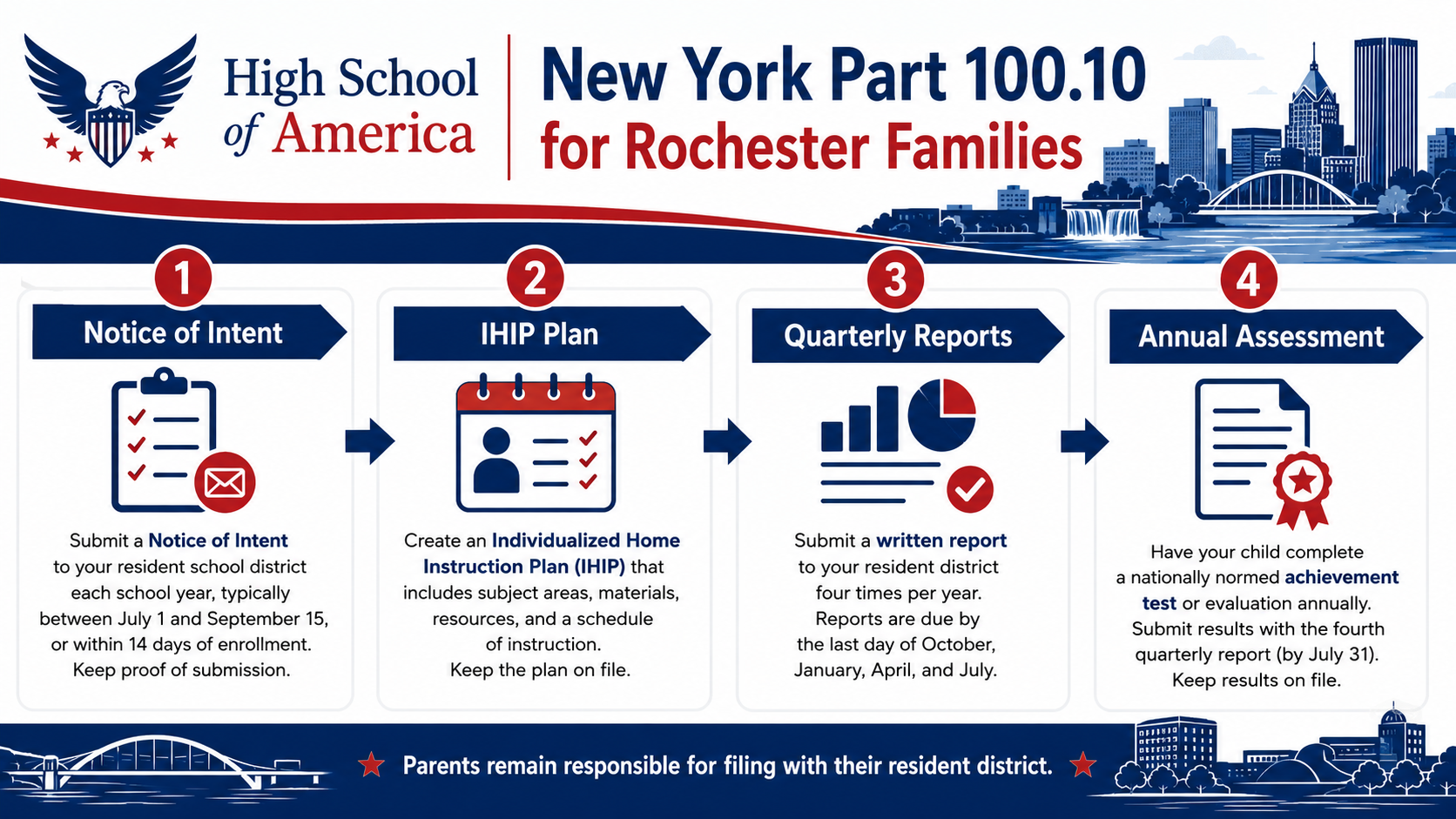
New York’s Part 100.10 framework is one of the more detailed homeschool regulations in the country. It runs in four distinct steps, each with its own deadline. Rochester-area families who understand the sequence before they start avoid the administrative scrambles that catch first-year filers off guard.
Step 01, Notice of Intent File with your local district superintendent by July 1 if you’re continuing into a new school year, or within 14 days of pulling a student from public school. City residents send this to the Rochester City School District. Families in Greece, Brighton, Penfield, Pittsford, Irondequoit, Webster, Fairport, or any of the other 17 Monroe County districts file with their own district’s homeschool coordinator. Not with RCSD. The regulation does not flow to a state agency; the superintendent is the first and primary contact.
Step 02, Individualized Home Instruction Plan (IHIP) Within 30 days of the Notice of Intent, you submit the IHIP: a document naming the subjects to be taught and the instructional materials to be used. New York Department of Education requires coverage of the same subject scope as public school students at the same grade level. Grades 1-6 must include arithmetic, reading, spelling, writing, English language arts, geography, U.S. History, science, health, music, visual arts, and physical education. Grades 7-8 add civics and economics and raise the required instructional hours. The IHIP is where naming a structured online curriculum is genuinely useful: a course list with subject descriptions gives families a ready-made documentation scaffold.
Step 03, Quarterly Reports Four times a year, families submit a report covering three things: hours of instruction logged, a description of material covered in each subject, and either a grade or a written narrative evaluating student progress. The hourly minimums are specific: 900 hours annually for grades 1-6, 990 for grades 7-12. That works out to roughly 225 to 248 hours per quarter. New York’s quarterly reporting obligation is more detailed than most states require, and the four-report structure means documentation gaps surface quickly.
Step 04, Annual Assessment The assessment requirement varies by grade. At grades 4 and 8, a standardized test is required. Either a state-approved commercially published exam or a district-approved alternative. For high school students, the annual assessment can be a Regents exam, a commercially published standardized test, or a portfolio review. In other years. Grades 1-3, 5-7, and most of 9-12 outside designated testing years. A written narrative evaluation prepared by a qualified person satisfies the requirement. The Regents option is notable for Monroe County high school families: exams many students take anyway can serve double duty as the Part 100.10 annual assessment.
—
A plain note on what we cover and what we don’t. Our program provides the academic curriculum, teacher access, and official transcript. New York’s Part 100.10 filing sequence. The Notice of Intent, IHIP, quarterly reports, and annual assessment submissions. Is the family’s legal responsibility with their local district. A counselor call can walk you through how our course documentation maps onto IHIP subject requirements and quarterly reporting. Call (888) 242-4262 to talk it through.
⚠️ A Note on New York Compliance
We provide the academic program, teacher support, and official transcripts. New York’s Part 100.10 obligations. The Notice of Intent, the IHIP, quarterly reports, and annual assessments. Remain the family’s responsibility to file with the local district. Those requirements are navigable, and counselors are available to explain how our curriculum maps onto what your IHIP needs to document. Call (888) 242-4262 or write to support@highschoolofamerica.org with questions.
Important note: NYC Public Schools states that homeschooled students do not receive a New York State diploma and that diplomas from online-only schools are not recognized by New York State. Online programs may be used as part of a homeschooling plan or IHIP, but parents remain responsible for New York home instruction compliance.
Source: NYSED Home Instruction
Four things this program is, before anything else
Accredited
The credential is. When a Rochester student’s transcript goes to Monroe Community College, RIT, or anywhere beyond, the accreditation travels with it.
Real Teachers
Every course has a real teacher. Questions submitted get a response within 24 hours, not a forum thread, not an automated reply, a person.
Enroll Any Month
Enrollment is open year-round. A family can start in November, February, or the week after a lake-effect cancellation wipes out a third straight school day.
Kindergarten Through 12th Grade
One K-12 online program covers all grades. A household with a third-grader and a sophomore doesn’t manage two separate schools.
K through 12, the whole path
Elementary (K-5): Building the Foundation, Subject by Subject
New York’s Part 100.10 specifies what a homeschool IHIP must cover in grades 1 through 6: arithmetic, reading, spelling, writing, English language arts, geography, U.S. History, science, health, music, visual arts, and physical education. That is not a short list. For a family new to home instruction, assembling an IHIP that accounts for every required subject. Before the school year begins. Is one of the first real friction points in the process. An online K-5 curriculum that addresses all of these subjects as built-in components gives Rochester-area families a ready scaffold for their paperwork, rather than a research project.
The structure matters beyond compliance. Reading instruction in the early grades follows a phonics-to-fluency sequence. Arithmetic builds from number sense and operations through foundational algebraic thinking. Science at this level is observational and concrete. Social studies in grades 3 through 5 introduces geography and U.S. History in age-appropriate frames. Health, music, visual arts, and PE are documented alongside core academics. Quarterly reports at the K-5 level require parents to log instruction hours and describe material covered. The program’s built-in tracking makes that documentation straightforward.
The enrichment layer matters too. The Rochester Museum and Science Center runs programming specifically designed for homeschool families, and its natural history and physical science exhibits align well with the science and geography units required under Part 100.10. The Rochester Public Library system offers early literacy resources across multiple branches. Seneca Park Zoo connects directly to life science content in grades 3 through 5.
There is a specific demographic context worth noting here. New York State has no statewide gifted education mandate. Local districts are not legally required to provide gifted programming, and in practice, many do not. Rochester families’ university-connected households. Faculty and staff from institutions concentrated in Monroe County. Include a cohort of elementary-age children whose academic pace outstrips what a standard K-5 classroom provides. For those families, a self-paced online K-5 program is not a preference. It is often the only structure that keeps up with the child. The program moves when the student moves, and the quarterly reporting creates a documented record of that progress regardless of how far ahead the student has traveled.

Grade band at a glance
Three different kids. Three different structures. Here’s exactly what each one looks like inside the program.
- K-5
- What Students Study: Reading, phonics, spelling, writing, arithmetic, science, social studies, health, music, and visual arts. The full subject stack New York Part 100.10 expects at grades 1-6, delivered through structured online units with teacher support.
- Parent Role: Active daily partner. You’re in the room, at least nearby. Lessons are designed for young learners, but a consistent adult presence keeps K-5 students on track and makes quarterly progress documentation straightforward.
- Best Fit: Academically advanced early learners in university-family households (U of R, RIT, MCC) where the local public school doesn’t offer a gifted track; multilingual learners who need self-paced phonics and vocabulary progression; Rochester K-5 students with sensory differences or early anxiety who thrive in a calm, predictable home environment.
- 6-8
- What Students Study: Pre-Algebra through Algebra readiness, Life Science, World Studies, English language arts, New York State and U.S. History, civics, health, and a foreign language introduction. Building toward the high school sequence without the social chaos of a traditional junior high transition.
- Parent Role: Schedule coordinator and quarterly report filer. The heavy instructional lifting shifts to the student and the academic support contact. Your job is maintaining the rhythm, filing reports on time, and knowing when to escalate.
- Best Fit: Students navigating the 6-8 transition who benefit from a consistent home learning environment; learners with ADHD, executive function challenges, or sensory sensitivities; Monroe County families building toward Regents math readiness at the 9th-grade entry point.
- 9-12
- What Students Study: A full high school sequence, English 1-4, Biology, Chemistry, Physics, Algebra 1 and 2, Geometry, U.S. History, World History, Government, Economics, and electives. Documented on one consistent transcript.
- Parent Role: Transcript manager and graduation planner. By 9th grade, most of the academic autonomy belongs to the student. Your critical job is making sure the paper trail is airtight before senior year ends.
- Best Fit: Students building toward Monroe Community College, U of R, RIT, Nazareth, or workforce entry at URMC or Paychex; homeschool graduates who want a documented, accredited transcript for New York college applications; travel-sport athletes and shift-schedule households who can’t make a 7:50 a.m. First bell work.
Where the 9-12 curriculum stops being abstract
Most high school students study the physics of light and walk away with a grade. A Rochester student studies the physics of light and looks out the window at the city that built a global economy on exactly that science.
George Eastman founded Kodak here in 1888. The University of Rochester’s Laboratory for Laser Energetics. One of the largest university-based laser research facilities in the country. Sits a few miles from downtown. RIT’s imaging science program trains the engineers who will define what optics looks like in the next generation. All of it is within ten miles of each other. That concentration is not a coincidence, and it is not background noise. It is the reason a physics unit on lenses, electromagnetic radiation, and the behavior of light carries a weight in Rochester that it simply does not carry most other places in America.
Self-paced structure matters here in a specific way. When a student in our 9-12 program reaches the optics unit in physics, they don’t have to move at the pace the class behind them sets. If that material is clicking, if it’s connecting to something they’ve seen at a science center or heard a parent talk about at the dinner table, they can stay with it. Two weeks instead of one. Three, if the curiosity is there. A bell schedule cannot do that. Our program can.
The same logic runs through biology and chemistry. URMC is one of the largest employers in Monroe County. Strong Memorial is a level-one trauma center. Highland, Rochester General, and Unity Hospital collectively form a health system that recruits from local talent, year after year. A student who moves carefully through cellular biology or organic chemistry is not building abstract academic credit. They are building the foundation for a career that has a real local address. That is not a small thing to be able to tell a fourteen-year-old.
The economics requirement tells an equally concrete story. The community’s own history. From Kodak’s peak employment to the diversified economy of optics, healthcare, and tech. Is as precise an illustration of regional economic change as any textbook offers. When the economics unit reaches industrial transformation, Paychex and Xerox are not hypothetical examples. They are headquartered here. The area students in computer science and business math can see the destination clearly; they just need the coursework to get there.
RIT’s co-op program is the oldest and one of the largest in the nation. It is the local model of what rigorous preparation actually earns you. A well-documented transcript from a structured online program is how you make that application credible. What a student builds in 9th through 12th grade, the choices they make about depth and pacing, matters when that moment arrives.
None of this requires a student to be certain about a career path. It requires only that the work they do in high school feel connected to something real. In Rochester, it does.
Every grade, every course, in one program
Kindergarten through twelfth grade. Click any grade to see what runs at that level, or any course to see the full subject page.
Pick a grade
Browse the high school course catalog
View the full course catalog →
Online High School Diploma
The credential families work toward, with transcript and academic-record support for college and workforce paths.
Self-Paced Online High School
How the schedule actually works, day to day, when work is asynchronous and the student sets the pace.
Students & Parents Guide
How students and parents step into the program, what the dashboard shows, and what support looks like.
Who tends to find this program , and stay
Not every family arrives at the same door. What they share is this: a student whose actual needs stopped fitting the available structure, and a parent who needed a real academic program. Not a workaround.
Here are four student types that consistently find a home here.
—
🎓 The K-5 Learner Who Outpaced the Room
The gifted elementary student in a university household
New York has no statewide gifted education mandate. Rochester has an unusually high concentration of university-affiliated families. Drawn by U of R, RIT, Nazareth, and others. And those families often include second-graders reading at a fifth-grade level whose classroom pace is calibrated to the class average, not the child. A self-paced program moves with the student. The curriculum matches where they actually are, not where the grade-level calendar says they should be. That’s not a luxury for this cohort. It’s the only structure that keeps an advanced learner engaged.
—
🧠 The Middle Schooler Whose IEP Wasn’t the Problem
The 6th-8th grader with ADHD or executive function challenges
The intelligence was never in question. What disrupted learning was the building itself: the noise, the transitions between periods, the unpredictable schedule that reset the cognitive load every 48 minutes. Asynchronous, self-paced delivery removes those triggers. Work happens when focus is available, not when the bell rings. There’s also something worth noting about New York’s Part 100.10 quarterly reporting requirement. The hours tracked, the material covered, the narrative evaluation submitted four times a year. For an ADHD student, that structure isn’t paperwork. It’s the same planning-and-self-assessment loop that researchers prescribe for building executive function. The legal compliance framework becomes a developmental tool.
—
🌍 The Multilingual Family Navigating Two Learning Curves at Once
Refugee and immigrant households where language and content need separate pacing
Rochester is one of the most active refugee resettlement cities in the United States. Karen, Somali, Congolese, and Spanish-speaking families here include children managing English acquisition and grade-level content at the same time. A self-paced program can move faster on visual science units where language load is lower, and slower on text-heavy social studies where vocabulary density is the real obstacle. Content mastery doesn’t have to wait for full English fluency. Families should also know: the right to a CSE evaluation under IDEA is preserved during homeschooling. A district evaluation for learning differences can be requested regardless of enrollment status.
—
🎯 The High Schooler with a Specific Destination Already in Sight
9-12 students building toward MCC, U of R, RIT, or the URMC pipeline
Some juniors already know exactly where they’re applying. MCC’s nursing program. RIT’s imaging science or game design department. The University of Rochester’s undergraduate engineering track. What those admissions offices want to see is a documented academic record. A consistent transcript, completed coursework in the relevant disciplines, and a clear trajectory. The program provides that scaffold. A counselor walks each family through exactly what the student’s path looks like, starting from the transcript on file. Every grade has its own structure, and the destination shapes how the pieces fit together.
What a Tuesday actually looks like
Snow is falling on the Ontario shoreline by 6 a.m. Rochester averages around 95 inches a year, and the lake-effect bands that stack up over Greece and Irondequoit and Webster are not politely spread across the calendar. They arrive in the middle of a Tuesday. For families in a traditional school schedule, that means a phone notification, a reshuffled morning, and another hole in the instructional year.
For families in this program, Tuesday in February looks the same as Tuesday in October. Log in, pick up where you left off.
Here is what that actually means in practice. The student opens their course materials, which are asynchronous and available any hour of the day. There is no live lecture to miss, no attendance window to make. A fifth grader working through reading and math moves at the pace the material warrants. A high schooler in the middle of a physics unit can spend an extra two sessions on wave optics if the concept needs more time, or move ahead if it does not. The schedule belongs to the household.
When a question comes up, a real teacher responds. Not a forum, not an automated reply. A teacher who knows the course, responding within 24 hours. A student stuck on a pre-calculus concept at 9 p.m. Gets an answer by the next morning, not at the next scheduled office-hours slot three days from now. That turnaround matters more than it sounds, because the moment a student loses momentum on a concept is exactly when most of the learning either happens or doesn’t.
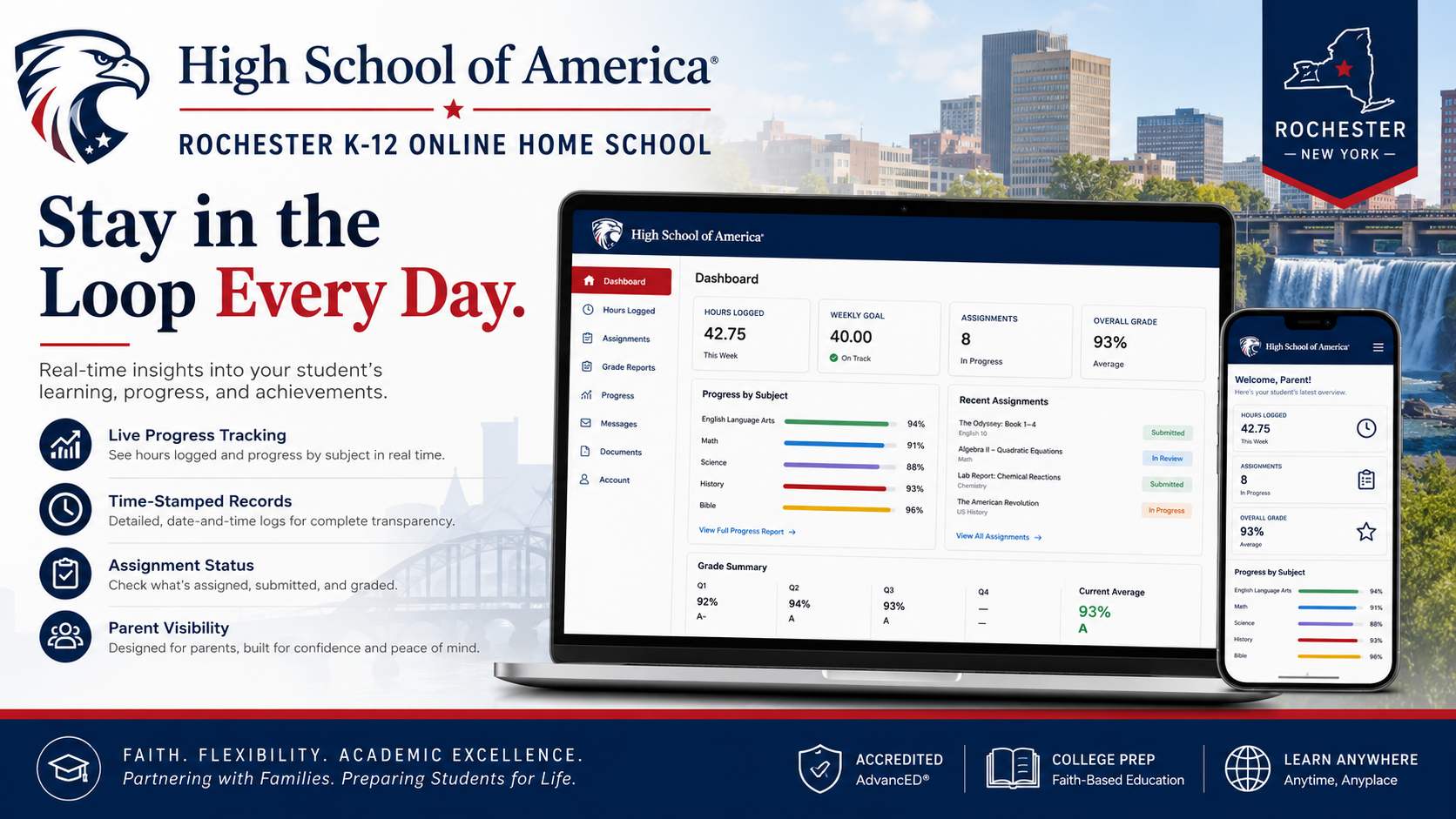
The parent side of this is handled through the dashboard. It shows assignment completion, grades, and upcoming work in real time. A parent covering a morning shift at a hospital or an evening rotation at a manufacturing facility doesn’t need to be sitting beside their student during lessons to stay informed. The record is there when they check in.
Documentation is worth naming directly, because New York’s Part 100.10 requires homeschool families to log instructional hours, 900 to 990 annually depending on grade level, and submit quarterly reports to the district. The program’s structure doesn’t file those reports for you, but the course activity and completion records that accumulate in the dashboard make the preparation straightforward. The hours are being tracked as the work is done, not reconstructed at the end of the quarter from memory.
One more thing worth saying about Rochester’s calendar: Part 100.10 specifies annual hours, not which months they fall in. A family that wants to front-load instruction through the winter when outdoor activity is limited, and move lighter in May and June when the Finger Lakes open up, can do exactly that. Or distribute the hours evenly across twelve months. The annual requirement is the ceiling, not the calendar.
If you want to see the full structure of how the program is organized before you call, the Teachers Guide at highschoolofamerica.org/teachersguide lays it out. It is a practical document, not a sales sheet.
Where the academic record can help after high school
High School of America provides structured coursework, course records, grades, and transcript documentation Rochester families may use when applying to colleges, workforce programs, technical schools, military recruiters, or other postsecondary options. Final review decisions are made by each institution, agency, employer, or organization.
For New York students specifically, the New York State Education Department states that homeschooled students are not entitled to a New York State diploma, and a diploma issued by an out-of-state online school may not be recognized by a New York institution of higher education for enrollment purposes. Families should confirm acceptance with each specific college, employer, or program before relying on the document.
Students considering military service should speak directly with a recruiter about current education documentation requirements. High School of America can provide transcripts and academic records families may submit when requested.
What families come back to say
Between us: most online schools lean hard on stock photos and vague satisfaction language. What actually tells you something is the pattern underneath the reviews. The specific friction points that kept coming up before a family enrolled, and whether those same points still come up after.
Across more than 1,000 alumni families in the program, three themes surface consistently. Flexibility comes up first, almost every time. Not flexibility in the abstract, but the very concrete kind: the ability to keep schoolwork moving when a lake-effect system drops a foot of snow before 6 a.m., when a second-shift schedule means the household doesn’t fully quiet down until 9 p.m., when a travel tournament burns a weekend that used to be for catching up. Families describe that flexibility less as a feature and more as the reason the whole arrangement works.
The second theme is teacher responsiveness. Parents mention that when a student hits a wall on a hard concept, the turnaround on a question is faster than they expected. For families who had quietly assumed “online” meant “on your own,” this is the detail that tends to land hardest.
The third theme is the transcript. Not glamorous, but it matters. Monroe County families in reviews frequently note that when it came time to look seriously at MCC, RIT, or another local program, the academic record held up the way they needed it to. The accredited program and the documentation behind it gave them something credible to present. That confidence. That the work they put in would actually count. Is what parents most often say they wished they had known to ask about before they started looking.
One more thing that comes up, especially among middle school families: the structure of quarterly progress documentation, which New York’s homeschool framework requires, ended up doing more than satisfying a compliance box. A Monroe County parent described watching their seventh grader develop genuine planning habits around it. The kid started tracking their own hours, noticed when they were falling behind, and adjusted. That kind of self-awareness usually takes years to build. It showed up faster here.
Rochester families ask
Is this an online school, or a curriculum package?
This is a private K-12 online school, not a curriculum kit. Families may use HSOA transcripts and academic records when applying to colleges, workforce programs, or other postsecondary options. Final review decisions are made by each institution or organization.
Can an online program support New York Part 100.10 documentation?
A structured online program can help organize what Part 100.10 asks for: course descriptions and syllabi for the IHIP, time-stamped progress records for quarterly reports, and completion logs for the annual assessment. Parents remain responsible for filing required documents with the resident district.
What does a Rochester school day look like when both parents work shifts?
Asynchronous coursework. The student’s day is set by the household and the dashboard, not by a 7:50 AM bell. Sessions can run before a hospital shift, after a shift, or split. Hours log automatically into the records the district will eventually ask for.
Does High School of America issue a New York State diploma?
No. NYC Public Schools states that homeschooled students do not receive a New York State diploma and that diplomas from online-only schools are not recognized by New York State. Online programs may be used as part of a homeschooling plan or IHIP, but parents remain responsible for New York home instruction compliance. Families may use HSOA transcripts and academic records when applying to colleges, workforce programs, or other postsecondary options. Final review decisions are made by each institution or organization.
When does the IHIP need to be filed?
The IHIP must be submitted within 28 days of starting homeschooling, and families may begin teaching before submitting it. If the transition is between school years, the Letter of Intent goes to the resident school district by July 1.
How many instruction hours does New York require?
Grades 1 through 6 require 900 cumulative annual hours of instruction; grades 7 through 12 require 990 cumulative annual hours. Hours are reported through the four quarterly progress reports filed with the resident district.
Across Monroe County, one program
The program reaches wherever the family is. Monroe County alone contains more than a dozen suburban districts: Brighton, Penfield, Pittsford, Webster, Greece, Gates-Chili, Fairport, Victor, Rush-Henrietta, Irondequoit, and Spencerport each file their Part 100.10 paperwork independently, but every one of those families logs into the same K-12 online program. One enrollment. Any suburb.
The reach doesn’t stop at the Monroe County line. Families in Ontario County, Canandaigua, Geneva. And Wayne County communities like Newark and Sodus use the same program as families five minutes from downtown Rochester. So do families in Livingston County, Genesee County, and Orleans County who commute into the metro for work and can’t structure a school day around a 7:50 a.m. Bell that was designed for people who live closer.
And here’s the part school websites don’t usually bother mentioning: the school day moves when you do. a Rochester household that spends summers at a Seneca Lake property or follows a parent’s work rotation somewhere warmer for a few winter months doesn’t interrupt anything. New York’s Part 100.10 filing stays with the district of residence. The instruction itself happens wherever the student opens a laptop. The program doesn’t require a fixed address, a fixed county, or. Frankly. A fixed season.
What tuition looks like, and why it starts with a conversation
Here is the thing nobody tells you upfront: tuition for an online K-12 program is not a flat rate. It is based on how many credits your student still needs. A child entering as a first-grader has a different path than a sophomore transferring in with a year and a half of coursework already behind them. The sophomore pays for what remains, not for ground already covered.
That distinction matters more than most families realize before they call. If your ninth-grader has a transcript showing completed coursework from a previous accredited school, those credits come with them. A counselor reviews the transcript, maps exactly where your student stands, and the tuition conversation is built around that specific number. Not a guess. Not a worst-case estimate. The actual number.
No transcript yet? That is not a reason to wait. Families enroll first and submit paperwork after, all the time. Your student picks a grade level, coursework begins, and when the transcript arrives, the official credit evaluation happens and the graduation path gets finalized. Getting that transcript in is easier than it sounds: a photo texted to our enrollment number works, an email to support@highschoolofamerica.org works, or you can upload it directly during enrollment on the website. The point is to get your student moving, not to hold everything hostage to a piece of paper.
Payment plans exist. The full breakdown of what those look like is a counselor conversation, not a line on a website, because the right plan depends on the credits needed and your family’s situation. A family in Pittsford working through the last six credits of a senior year has a very different conversation than a Brighton household enrolling a third-grader. Both are real conversations. Both have real options.
One more thing worth knowing: enrollment is open year-round. There is no fall window, no January cutoff, no application cycle to miss. The family that decides in February starts in February. For households in the Ontario shoreline belt where lake-effect weather can erase a week of school in a single storm, that open door is not a small thing.
When you are ready to get the actual numbers for your student’s situation, call (888) 242-4262. A counselor walks through the credits, the plan, and the path. Start to finish.
Neighboring states, same program
Rochester sits closer to the Pennsylvania border than most families realize. The Southern Tier corridor, Binghamton, Elmira, Corning. Runs straight south from Monroe County, and families along that stretch use the same program, the same academic support, and the same course sequence as families in Greece or Pittsford. If a household relocates across that border, nothing resets. The transcript carries, the graduation plan carries, and the student picks up on the next lesson.
That portability holds across the broader northeastern cluster. Because this is a private accredited national program, a family that moves from Rochester to New Jersey, Connecticut, Massachusetts, or Pennsylvania keeps the same record intact. No re-enrollment. No credit-evaluation limbo while a new school figures out what to accept. The transcript is the same document whether a college admissions office is in Albany or Philadelphia.
For families connected to Fort Drum or other northeastern military installations, this matters in a specific way: a transfer to another state doesn’t interrupt the student’s academic year. The program works the same in every state the family lands in, and the record follows without a gap.
Sibling hub pages for the region: Pennsylvania, New Jersey, Connecticut, Massachusetts, and Ohio.
Online homeschool near Rochester
HSOA enrolls K-12 students across Western New York, the Finger Lakes, and Central New York. Explore the same accredited, self-paced program in a community near Rochester.

Ready to enroll? Let’s talk through the path.
A counselor will walk through grade level, prior credits, and the IHIP paperwork on the first call. No commitment required.
Get Your Enrollment Plan
Fill out the form below and an enrollment counselor will reach out within one business day.
Or call us: (888) 242-4262