Rowan County, North Carolina · Kindergarten through twelfth grade
Salisbury Online Homeschool
For households in Salisbury weighing a school that works from home: an accredited online K-12 school where your student reads the lessons on the household’s own week, a certified teacher checks every course, and the school signs off on the record. It is a way to homeschool online without becoming a school yourself, and it sits within our wider North Carolina online homeschool pages.
Have a counselor read your situationEnroll your studentGet the particulars by email

Before the first reading
A course of study at home is only as good as the person who checks it. The rest of this page takes that one idea through every grade, from a five-year-old’s first reading lesson to a senior’s transcript.
Three questions run through all of it. What does the student read alone? Who checks that work? And who signs off when it is done?
Reading one
A Salisbury homeschool where the reading gets checked
Salisbury has been the seat of Rowan County since 1753, and its courthouse drew the kind of work that grows up around one. In 1784 and 1785 a young Andrew Jackson came to read law in the office of a local attorney, Spruce Macay, and the Rowan County court admitted him to the bar in 1787, according to the Dictionary of North Carolina Biography. Reading law was how most lawyers trained then. Nobody lectured. The apprentice worked through the books on his own time, the practitioner checked what he understood, and the court examined him before he could practice.
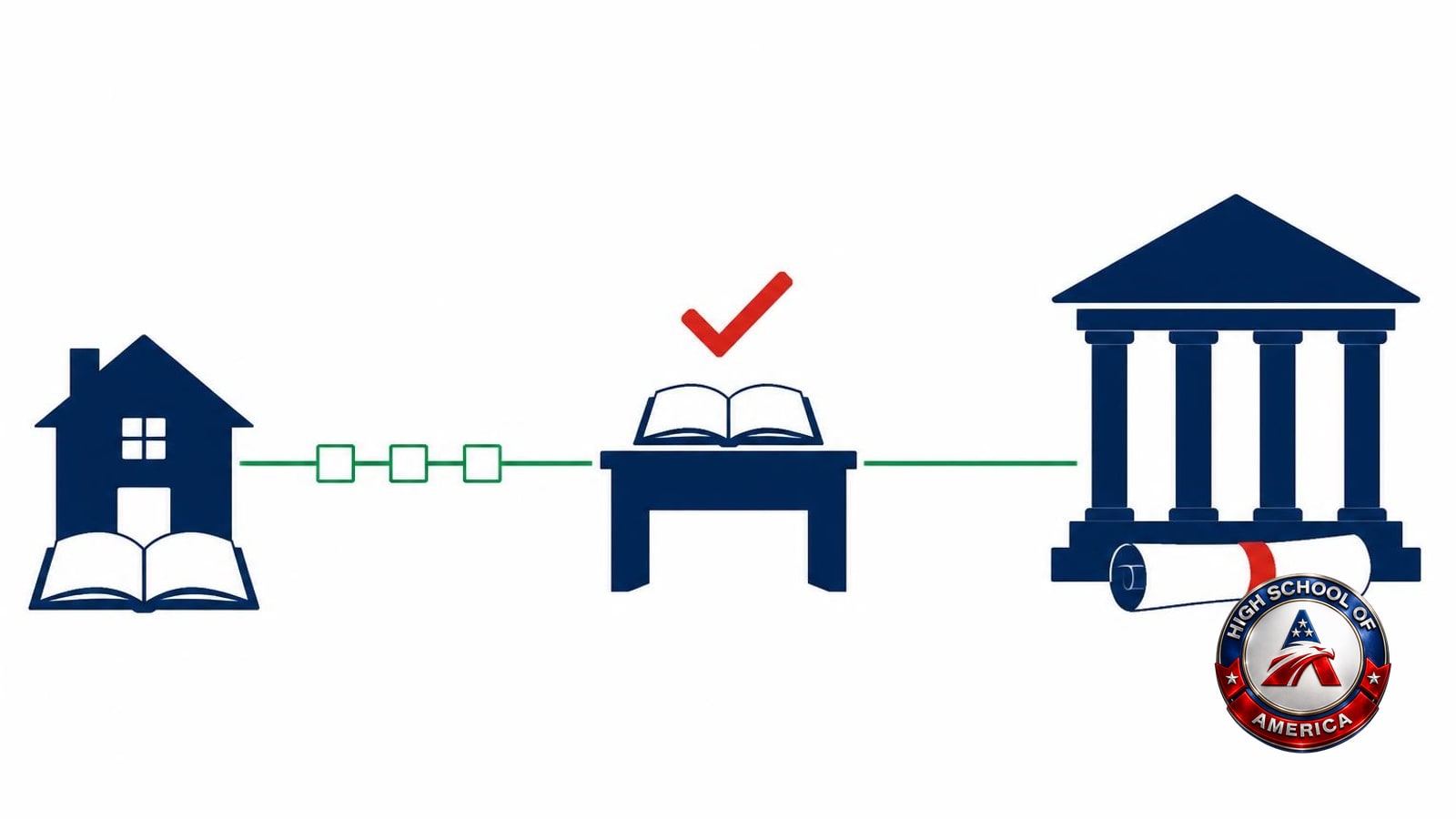
That arrangement is still the honest test of any study done at home. Self-paced reading is valuable only when someone qualified looks at the work and someone with standing puts their name to the result. A k12 homeschool in Salisbury, North Carolina should be judged on exactly those points.
Lessons, reading and practice, worked through on the household’s own week.
A certified teacher grades the work in each course and answers questions about it.
Completed courses go on the school’s record, and a transcript or diploma is issued from it.
What a Salisbury student reads alone
Each course is laid out as lessons, reading, practice and assessments that a student works through at their own speed. A morning person can be done by lunch. A student who needs a slower start can begin later. The material does not change with the hour, and nothing in it waits for a bell or a classroom roll call. Families who want the overview first can read how homeschooling online works before anything else.
Who checks the work
Certified teachers grade the work in every course, and a student’s questions about the material go to them. The parent’s job is closer to the clerk’s master in one sense only: making sure the day’s reading happened. Nobody at home needs to know chemistry to keep a chemistry student on track.
Who signs off at the end
Completed courses go onto the school’s record. From that record the school issues report cards, transcripts, verification of enrollment letters and, at the end of high school, the diploma. The household never has to write its own transcript or vouch for its own grades.
Reading two
Online homeschool programs Salisbury families can compare
Most households in Rowan County who search for an online homeschool are choosing between three things: staying in a district school, running a home school under North Carolina law, or enrolling in a private school that teaches online. Each of those is legitimate. They put the work and the paperwork in different hands, which is the part worth comparing. There is an honest comparison of the options if you want all three side by side, and a shorter piece on online home school versus a public virtual school.
When families look at online homeschool programs in Salisbury, the question that usually decides it is who carries the record. Enrolling means the school does. Running your own home school means you do, even when you buy every course from someone else.
Enrolling versus running your own home school in North Carolina
The table below sets out the duties on each route, using what North Carolina’s statutes actually require of a home school. Read it as a list of jobs and ask which column your household wants to hold.
What enrolling covers for a Salisbury household
Enrollment brings the whole of the full K-12 program: courses at every grade, a teacher for each, a counselor who places the student, and a record kept by the school. Households that prefer to assemble their own plan from separate classes can take individual courses instead, and in that case the home school route and its paperwork stay with the family.
Reading three
The homeschool notice of intent, and who files it
North Carolina treats a home school as a nonpublic school. A family that teaches its own children opens one by filing a notice of intent with the Division of Non-Public Education, and from then on the home carries a school’s duties. The table below is drawn line by line from the statutes. It describes legal homeschooling near Salisbury, North Carolina for a family teaching independently, and it is worth reading even if you plan to enroll, because it shows exactly what enrolling takes off your desk.
| Notice | A notice of intent to operate a home school, filed with the Division of Non-Public Education before the school begins. It gives the school’s name and address and the name of its chief administrator. It is filed once, not every year; the school stays open until the family closes it with the Division. North Carolina takes it online. |
|---|---|
| Who teaches | Anyone providing academic instruction must hold at least a high school diploma or its equivalent. |
| Time | A regular schedule for at least nine calendar months of the year, excluding reasonable holidays and vacations. |
| Testing | A nationally standardized achievement test every school year, covering English grammar, reading, spelling and mathematics. The results stay with the family for at least one year, available if the Division asks to inspect them. |
| Records | An attendance record each year and a disease immunization record for each student, kept at the home school. |
| Subjects | No prescribed subject list or curriculum. The family sets the scope and sequence of instruction. |
| Statute | N.C. Gen. Stat. §§ 115C-563 and 115C-564. The Division publishes the current home school requirements. |
If you are teaching at home yourself in Salisbury: North Carolina wants a notice of intent filed with the Division of Non-Public Education before you begin. It names the school, its address and its chief administrator, and it is filed once: the home school stays open until you close it with the Division. After that the school runs on a regular schedule for at least nine calendar months, keeps attendance and immunization records, and gives each student a nationally standardized test every year. The results stay at home for a year in case the Division asks to see them.
If your child enrolls in a school instead: that is a different route and the notice of intent is not yours to file. The yearly test, the nine months and the records are duties of a home school, and the school your child enrolls in holds the record in their place. If you have already filed, say so on the first call and a counselor will tell you what is left to do.
Leaving a Salisbury-area public school partway through the year
A student moving from a district school to an enrolled online school withdraws from the district and enrolls with the new school; the new school then requests the records. The step-by-step version, including what to put in writing, is in how to withdraw from an NC public school. For a wider view of why the rules differ so much from state to state, read how homeschool law works where you live.
Already filed a notice of intent?
Say so on the first call. A counselor will tell you what, if anything, is left to do with the Division of Non-Public Education before your student starts.
Checking eligibility before you apply anywhere
Some programs and services are tied to which route a student is on. Before you enroll in homeschool in Salisbury, or anywhere else, read the eligibility traps worth checking first, so the choice of route does not close a door you meant to keep open.
Reading four
Kindergarten and elementary grades for Salisbury readers
At five and six the reading is literal. A child sounds out words with a parent or grandparent close by, and the lessons are short because attention is. Online kindergarten is built for that: brief sessions, plenty of repetition, and a teacher checking progress so the adult at home is not guessing whether it is going well. Families searching for homeschooling curriculum for kindergarten near Salisbury, North Carolina usually ask how many minutes a morning runs and how many of those need a grown-up in the chair, and a counselor answers both for your child on the first call.
Short lessons, an adult beside the student, the teacher checking progress.
Reading, writing, arithmetic, science and social studies, each checked as it is finished.
Each course with its own teacher as the subjects deepen and split apart.
Courses earn credit, the transcript grows, and the school issues the diploma.
One school from the first reading lesson to the diploma.
What the elementary years add in a Salisbury household
Through the elementary grades the student starts to read to learn rather than learning to read. Writing, arithmetic, science and social studies arrive as separate courses, each checked by a teacher. A student in second grade online still works mostly beside an adult. By fourth grade online the same student is often working alone for stretches, with the adult nearby rather than at the elbow, and fifth grade online starts to look like middle school in its shape: several courses, each checked on its own.
Why early reading gets the most attention
Early reading carries everything after it. A student who reads comfortably by the end of the elementary years can handle self-paced courses later; one who does not will feel it in every subject. The research on elementary reading gains that fade later is the reason the early grades are checked as closely as the later ones. Online elementary homeschool programs in Salisbury, North Carolina should be judged on how they catch a reader who is slipping, not only on how they move a strong one forward.
Reading five
Middle school grades in Salisbury, a teacher per subject
Between eleven and fourteen the subjects split apart and deepen. In middle school online each course has its own teacher, which matters more here than anywhere else: a parent who was comfortable checking fourth-grade arithmetic may not want to be the one marking pre-algebra. The reading list gets longer and the student works alone for longer, so the teacher’s check carries more of the weight.
Sixth through eighth grade, one step at a time
- Sixth grade is the year a student learns to manage several courses at once.
- Seventh grade courses ask for longer written work and more independent reading.
- Eighth grade prepares the ground for high school credit, so placement here is worth getting right.
The middle school reading dip
Reading scores often stall in these years, a pattern covered in why reading gains vanish in middle school. Self-paced courses help in one specific way: a student can slow down in a dense unit without falling behind a class, and a teacher sees the slowdown in the work rather than at the end of a term.
Reading six
High school credit and transcripts for Salisbury homeschoolers
From ninth grade on, the reading earns credit, and the record starts to matter to people outside the household. The online high school is where a student builds that record, course by course. A counselor counts the credits a student already has before assigning any work, so a sophomore arriving from a district school does not repeat what they have finished.
Four years, read in order
- Ninth grade: the foundation courses, and the habits of working through a course alone.
- Tenth grade online: core subjects deepen, and electives start to show a direction.
- Eleventh grade online: the year admissions offices read most closely.
- Twelfth grade: finishing requirements and closing the record.
The full course catalog lists every course by subject, from Biology to United States History. For the numbers behind graduation, see credit requirements for a diploma, and if you are unsure where your own student stands, how many credits you have and need.
- 1The issuer. An admissions office reads who signed this before it reads a single grade.
- 2Each course named plainly, the way a college catalog would name it.
- 3Credit per course, so a reader can add it up without asking.
- 4A grade a teacher gave, not a self-assessment.
What a transcript has to show an outside reader
Every transcript is read by a stranger eventually: an admissions office, an employer, a district registrar. They read the issuer before the grades, which is why a transcript the school issues from its own record travels better than one a household writes for itself. There is more on this in how high school transcripts work and in what makes a homeschool transcript colleges accept. If a college asks for a percentage rather than a letter, see how high school grades convert to percentages.
A diploma for homeschoolers in Salisbury, NC
A student who completes the requirements can earn a diploma issued by an accredited school, not a GED. The online high school diploma page sets out what it is and how colleges and employers treat it. A Salisbury home schooling diploma written at the kitchen table is a different document, and families on the home school route should know that before senior year.
Credits from another school
Students who transfer credits from a district or private school have that work read first. Salisbury, NC is also a college town, with Catawba College and Livingstone College both inside the city, and a student with a campus in mind should read that college’s admissions requirements early and plan the high school record around them.
Still deciding whether this fits your student?
Reading seven
Accredited online K12 schools near Salisbury: what to verify
Accreditation is the outside check on the checker. An apprentice’s reading counted because the court that examined it had authority; a school’s grades count because an independent body reviews the school. When you compare accredited online k12 schools near Salisbury, ask to see what the accreditation covers and who can verify it. Our page on school accreditation explains how, and what an accredited high school is and who verifies it goes further.
Questions a Salisbury parent can ask any school
- Who grades the work, and are they certified teachers?
- Who issues the transcript, and from what record?
- Can the school send a verification of enrollment letter when someone asks for one?
- What happens to credits the student already earned elsewhere?
The parent checklist of virtual school red flags covers the rest. The same questions apply to any school, this one included.
How attendance is counted when nobody takes a roll
Self-paced does not mean unmeasured. Progress through each course is tracked, and a teacher can see when a student has stopped moving. The detail is in attendance, engagement and course completion.
Reading eight
Homeschool for special education in Salisbury and Rowan County
Families looking at homeschool for special education in Salisbury, NC often arrive with an IEP or 504 plan and one question: does it come along? The answer depends on the route, and it is covered in the North Carolina questions below. What a counselor needs first is a plain account of what the plan provided, so the household can judge whether self-paced courses meet the need before anyone enrolls.
- The most recent plan, or a summary of what it provided.
- Any recent evaluation the district carried out.
- A note of what worked in the last school and what did not.
Pace as an accommodation in itself
For some students, the pace is the help. A unit can take twice as long without a class moving on, and a strong subject can run ahead. That is not a substitute for services a student is entitled to, and the federal evaluation right stays with your local district. For background on how support works outside a district, read how home education programs work and the current picture on IEP and 504 funding.
Reading nine
Starting a Salisbury online homeschool in any month
An apprentice began reading when he arrived, not when a term opened, and the same holds here. Enrollment is rolling, so a student can start in October, in February or in the first week of summer. If you have been wondering whether autumn has already slipped past, the piece on enrolling late for fall settles it: the door stays open.
Moving mid-year from a Salisbury school
A mid-year move is ordinary. The parent guide to a mid-year high school transfer lists what to collect before the last day at the old school. For a household starting from nothing, there is also where to begin with homeschool.
Cost, asked plainly
Questions about the cost of k12 online education in Salisbury, North Carolina have one honest starting point: the tuition page, which explains how tuition depends on grade and track and lists the payment options. The figure for your own student comes from a counselor once the grade is known. When the household is ready, you can start enrollment online.
Reading ten
Rowan County homeschool questions before the first lesson
The answers below on filing, IEPs and returning to a district school apply anywhere in North Carolina. The last three are the ones households in and around Salisbury raise most.
What does it cost?
Tuition depends on grade level and program track, and both monthly plans and pay-in-full options exist. Start at the tuition page; a counselor gives you the actual figure on the first call, which carries no charge.
Do I still file with the state if my child enrolls with you?
No. The notice of intent, the yearly standardized test and the attendance records belong to North Carolina’s home school route under N.C. Gen. Stat. §§ 115C-563 and 115C-564. Enrolling in a school is the other route, and the school holds the record instead. If you have already filed a notice of intent, say so on the first call and a counselor will tell you what, if anything, is left to do.
What happens to my child’s IEP or 504 plan?
An IEP or 504 plan belongs to the district that wrote it and does not travel off that district’s roll. What does travel is the federal right under IDEA to request a no-cost evaluation from your local district, enrolled there or not. Put that request in writing to the district serving Salisbury. Tell a counselor what the plan provided before you enroll.
How many credits does my student already have, and how many are left?
The one question a general answer cannot settle. Send whatever the last school filed, even a photograph, and a counselor gives you both numbers before any assignment is set.
Will a diploma from an online school be taken seriously?
It is issued by an accredited school on that school’s own requirements, and admissions offices and employers treat it as one. It is not a GED.
Can my student transfer back to public school later?
Credits earned here travel on an accredited transcript, read like any transferring student’s record. Acceptance is always the receiving district’s call, so email the district you might return to and ask in writing how they treat credits from an accredited private school. Salisbury families should check which district their address falls in first.
Can we start partway through the year?
Yes. Enrollment is rolling and not tied to any district calendar, so a student begins on a real week. Mid-year starts are ordinary here.
Can a Salisbury student move faster in one subject and slower in another?
Yes. Courses are self-paced, so a student who finishes a unit early moves to the next one, and a hard unit can take the time it needs. Each course keeps its own teacher, so a slower subject still gets checked as closely as a faster one.
Who does a parent ask when a lesson does not make sense?
The teacher of that course. The adult at home keeps the week on track and notices when the student is stuck; the question about the material goes to the certified teacher who grades it.
We live in Rowan County outside the city limits. Does that change anything?
Not for enrolling, which does not depend on a city or district line. If you run your own home school instead, the notice of intent goes to the state’s Division of Non-Public Education wherever you live in North Carolina. If your student might return to a public school later, confirm which district serves your street.
Bring your student’s records to a counselor
Any record from the previous school helps, down to a phone snapshot of the latest report. A counselor reads it, tells you what carries over, places your student and answers the cost question, all on one call. If you would like to talk to a counselor first and decide later, that is how most families begin.
Put a time on the calendarBegin the enrollment formSend the details in writing
Other North Carolina cities: Graham · Asheboro · all North Carolina