Rock County, Wisconsin
Janesville Online High School
Finish high school with both roads out of town still open, at a pace your week can carry.
Start an applicationTalk it over with a counselorSend me the course list

For the Janesville high school student still deciding
You do not need to know what comes after graduation to finish high school well. You need a record broad enough that every road is still open on the day you do know, and a Janesville online high school year can be built to do exactly that.
Janesville is the Rock County seat, divided by the Rock River, and for generations the town was known for one employer: General Motors built tractors here from 1919 and Chevrolets from 1923, and the assembly line ran until the end of 2008. The students finishing high school here now were born after that line stopped. They are growing up in a town with two quite different roads on its edges:
- a university branch campus on the southwest side, UW-Whitewater at Rock County;
- and Blackhawk Technical College, out toward Beloit.
A lot of fifteen-year-olds have not chosen between those roads, and they should not have to yet. This page is for that student, and for the parent who would like the next three years to keep both doors open rather than shut one by accident. What follows is how our online high school builds a year for a student who is still making up their mind. It is one city under the Wisconsin online high school hub, which covers the state as a whole.
Undecided at fifteen is not a hole in the plan. With the whole core kept, it is the plan.
Nothing here asks a family to leave a school that is working. A building with a bell schedule suits a great many students, and the right answer for some households is to stay exactly where they are. This page describes the other option clearly enough to choose between them.
What does a Janesville online high school week hold?
A week of online high school is a set of courses, each with its own lessons, assignments and graded work, which the student moves through at a pace agreed with the school, while a counselor and an assigned student services representative keep track of where every course stands.
The short answer to how does online high school work? is that nothing about the courses is optional and almost everything about the clock is. A student logs in, works through the next lesson in each course, submits the work and gets it back graded. Graded work becomes a course grade, the course grade becomes a credit, and the credit lands on a transcript the school issues. That chain is what makes this an accredited online high school and not a library of videos.
- The student
- Does the reading, the problem sets, the essays and the lab write-ups, and decides which hour of the day each course gets.
- The counselor
- Counts the credits already earned before any course is assigned, then plans the remaining years with the family on the first call.
- Student services
- One named representative, assigned to the family, who answers when a week goes sideways and notices when a course stops moving.
- The target finish date
- Set with a counselor, alongside a weekly rhythm, so the student and the parent know where the year is headed.
- The transcript
- The school’s record of every finished course, grade and credit. It is the document that leaves with the student.
We run grades K to 12 as an online school, and the high school years, grades 9 through 12, are the part this page covers. For a household here, the practical change is the bus and the bell:
- the student who thinks best late in the evening does algebra then;
- the student who would rather be done by lunch is done by lunch;
- and neither one is doing less of the course.
Two roads from Rock County, one high school diploma
The campus on the southwest side and the technical college toward Beloit start from the same place: a finished high school diploma. Ours is earned at 24 credits, and which courses make up those credits is what keeps both roads open.
That is why we do not ask an undecided student to pick a lane in ninth grade. The online high school diploma is the same document whichever way a student turns at eighteen, and our page on graduation credit requirements sets out how the 24 credits are counted. What changes from one student to the next is how far the mathematics goes, which sciences are taken and what fills the years above the core.
No school can tell a family how a particular admissions office or employer will read a transcript, and we do not try to. What we can say is what the record shows:
- every course the student finished, by name;
- every grade, on one published scale;
- every credit, and the total against 24;
- the school that issued it.
The high school transcripts page explains how a copy is requested once the student needs one.
Three questions before narrowing anything
Does the student already know what comes after twelfth grade?
Is one subject clearly a strength?
Is a subject about to be dropped because it is hard?
Nothing here closes a road. Each answer only decides what to try next.
Those three questions are the whole of the planning conversation for most undecided students, and they get asked again every semester. The answers move as the student does, and the plan moves with them.
Not sure which road yet? That is a fine place to start a call. A counselor will count what is earned and sketch the next year with you.
Keep the whole core in ninth grade online
Carry every core subject in ninth grade: English, mathematics, a lab science and history, all four, all year. It is the cheapest insurance an undecided student will ever buy.
Ninth grade is where narrowing usually starts by accident. A student who finds algebra hard drops to the minimum, a science gets put off a year, and by eleventh grade a door has closed that nobody chose to close. Self-paced study changes that arithmetic: a hard course can slow down without being dropped, and the student finishes it late rather than never.
Some families weighing ninth grade at home look first at home education programs and a ninth grade homeschool curriculum they would teach themselves. The difference here is that the courses, the grading and the record come from the school, so a parent is not writing a transcript from scratch and a student is not relying on one written at the kitchen counter.
| Year | English | Mathematics | Science | History and more |
|---|---|---|---|---|
| 9th grade online | English 1 | Algebra 1 | Biology | World History |
| 10th grade online | English 2 | Geometry | Chemistry | Art History and Criticism |
| 11th grade online | English 3 | Algebra 2 | Physics | United States History |
| 12th grade online | English 4 | Pre-Calculus | A science the student chooses | U.S. Government and Economics |
Every course in that table sits in the high school courses catalog, built on a standard American curriculum. The order is a common one, not a rule. A student strong in mathematics can move faster through it, and one who needs longer in Geometry can take longer without falling out of the sequence.
When the narrowing happens, if it happens
Self-paced online high school along the Rock River
Self-paced means the student sets the hour and the order around a weekly rhythm and a target finish date set with a counselor, so one day can be all chemistry and the next all essays, as long as every course keeps moving.
Picture it plainly: a sophomore on a bench above the river in the middle of the morning, the chemistry reading open, while the rest of the grade is in third period somewhere across town. The river runs straight through Janesville, Wisconsin, so for a lot of students the nearest quiet place to read is on its banks. That is an ordinary self-paced day, and it is not a day off; the reading still gets done and submitted when it is ready.
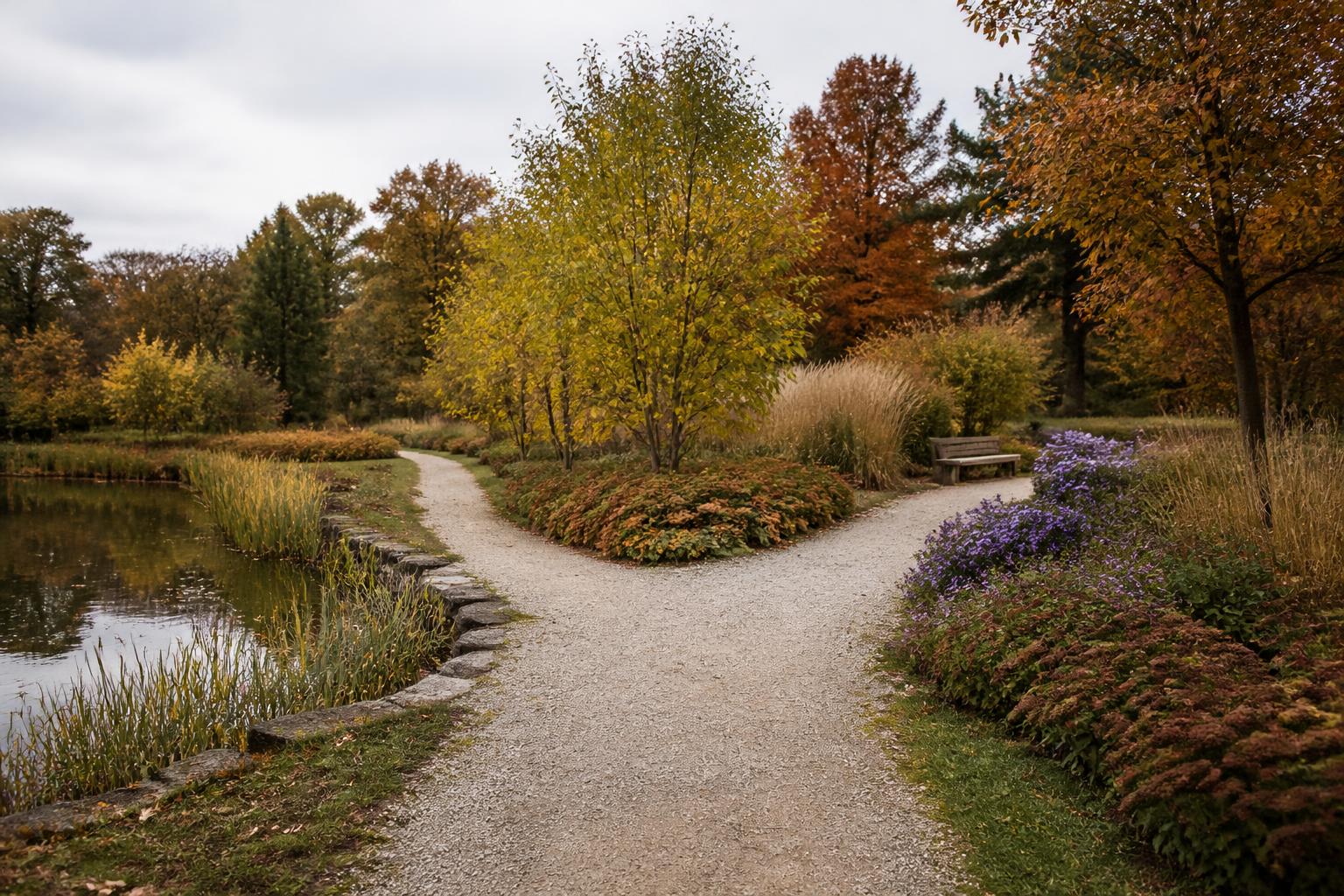
The town has a habit of seeing what a piece of ground could become. Rotary Gardens sits on what had been an abandoned sand and gravel quarry, and it was planted into the garden it is now a bed at a time. A self-paced year is planted the same way: nobody finishes the whole thing in the first week, and the order in which the beds go in is up to the person doing the planting.
Self-paced does not mean alone. The assigned student services representative follows every course, and a course that stalls for a week gets a message before it becomes a month.
Undecided students keep the full high school core
For a student who has not chosen, the strongest plan is the complete one: four years of English, mathematics as far as Pre-Calculus, three lab sciences and the full run of history and government.
The core is the part of a transcript both roads have in common. Keeping it whole costs an undecided student nothing they will later wish they had back, and dropping part of it early is the one decision that is hard to reverse at seventeen. So the planning advice for the student still deciding is almost boringly simple: keep the core going every year, and let everything above it be where the trying happens.
Claim
An undecided student should take the easiest path until they choose.
Reality
Every core course kept now is a road kept open later. Easier can always come later; harder rarely can.
Claim
Online high school is mainly for catching up.
Reality
It is a full program for grades 9 through 12, and the same courses serve a student who wants to carry more.
Claim
Picking the technical road means dropping the academic courses.
Reality
The core sits on the transcript either way. A student who keeps it has not spent anything on either road.
Claim
A self-paced student will drift.
Reality
An assigned student services representative follows every course, and grades post on a published scale the family can read.
A family can see the reasoning in the plan itself. The counselor writes the four years down, the student services representative tracks them, and every semester the plan is read again against what the student has found out since the last time.
A transcript kept open, not narrowed early
Narrowing belongs to the last two years of high school, and it should be decided by what the student has found out, not by a guess made at fifteen.
Courses are how a student finds out. Each one is a small, graded test of whether a subject holds their attention for a whole semester, and the grade is recorded against our high school grading scale whatever the answer turns out to be. Here is what a junior year can tell an undecided student:
- Physics shows whether working a problem through with numbers is satisfying or only tolerable.
- Art History and Criticism shows whether writing an argument about something they can see comes easily.
- United States History shows whether reading long sources and weighing them is work they would choose.
- Algebra 2 shows how far the mathematics wants to go, which is the single most useful thing to know before senior year.
None of those tests closes a door, because each is also part of the core. That is the contrast with narrowing early: a student who drops chemistry to make room for a guess has spent a door, and a student who keeps it and tries something beside it has spent nothing.
And if the student is already sure?
Then the plan says so. A student certain about the trade road or the campus road plans the last two years toward it with the counselor, and keeps the core whole anyway. Being sure at sixteen is good news; being able to change your mind at seventeen is better.
The core runs underneath every year; the trying sits on top
Want the full course list in front of you before deciding anything? We will send it, with no call needed.
For Janesville parents of an online high school sophomore
A sophomore can move to online high school mid-year without starting the year over: the counselor counts the credits already earned, and the student picks up each course where the record says they are.
Families can start any month, and the middle of tenth grade is a common point to make the change, because that is when a student has enough of a record to plan from and enough time left to use it. Tenth grade online carries the same core as the year in a building, with the order and the hour set at home. A parent does not become the teacher; the parent becomes the person who reads the posted grades and asks one good question about them.
A sophomore who switches in January
Nine credits counted from the old school before anything new is assigned, and the rest of the plan built from there.
What a parent sees week to week, and what a parent does not have to do:
- Sees: the grades for every course as they are posted, and a named student services representative to write to.
- Does not do: grade anything, build a transcript, or decide which credit counts.
The school does those, which is the whole point of a transfer credit review done before any new work is assigned.
Which credits from another school already count?
Credits from another accredited school are counted by a counselor before any course is assigned, and the family hears the number on the first call: what is done, and what is left.
Send the most recent report card or transcript, even as a photograph. The counselor reads each course and grade, posts what carries over, and only then builds the rest of the plan. A student is never asked to redo a course the record already shows as passed.
If a course along the way did not pass, credit recovery retakes that one course rather than the whole year, usually alongside the student’s other work. For a student who left school partway and wants to come back to it, the same review is the first step to finish high school online, counted from wherever the record stands.
The point for an undecided student is a little different. A clean count at the start means the plan for the remaining years is built on the facts of the record, so the core can be kept whole from the first month, rather than discovered to have a gap in senior year.
Three papers that start an online high school enrollment
Three things are enough to begin: the latest report card, a short list of what the student likes and avoids, and the month you want to start.
- The latest report card or transcript. A photograph is fine. The counselor counts it before anything else happens.
- Two short lists, written by the student. Subjects they would happily keep doing, and subjects they leave for last. Both lists shape the plan, and neither closes a road.
- The month to begin. Enrollment opens every month, so the right month is the one that suits the family, not a September deadline.
How the cost is set is laid out on the tuition page, and a counselor will go through it on the call. Families nearer the capital can read the Madison page, and those living northeast toward Milwaukee the Waukesha one; a household with younger children too will find the K-12 side on the Wisconsin homeschool page.
A student starting Janesville online high school undecided does not need to arrive with a decision. They need to arrive with the report card, and the rest gets worked out on the call, one semester at a time.
Ready when the student is. Start an application, or ring us and a counselor will pick up the first call.