Nelson County, Kentucky
Bardstown Online High School
Two years of high school already built? Keep them standing and add the rest here, course by course.

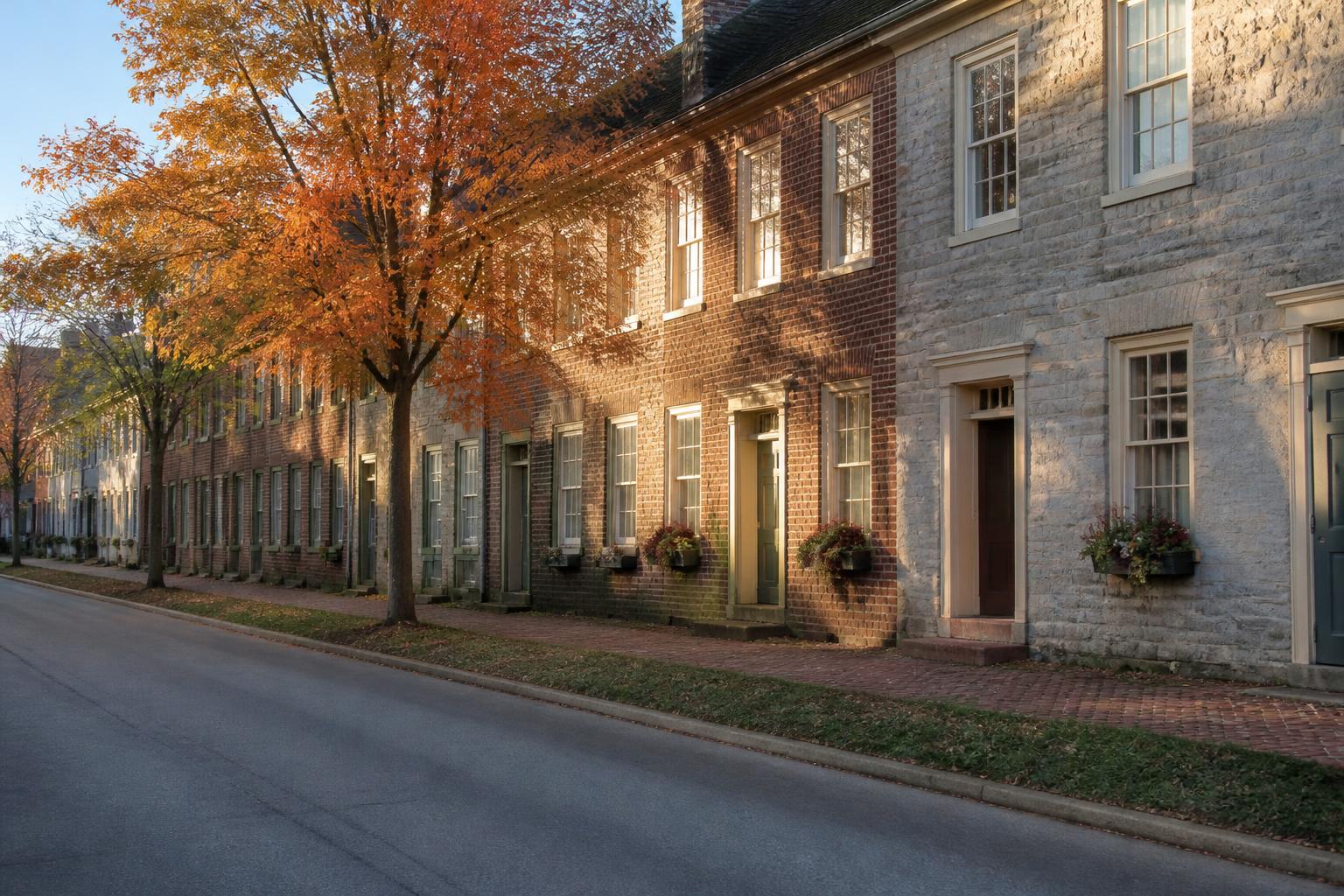
Bardstown kept its old town and went on living in it. More than a third of the buildings in the downtown historic district are Federal or Georgian, put up between the 1780s and 1850, and most of its blocks still follow the street grid laid out in 1797, according to the district’s National Register listing. Nobody in town thinks a sound building has to come down because the people inside want something new from it. That is the whole idea of this page. A student who switches to a Bardstown online high school partway through does not go back to the foundation. The courses already passed stay on the record, and the plan adds what is missing. This page is one city under our national online high school and the online high school in Kentucky hub; the younger grades belong to our online K-12 school.
A Bardstown morning, two years of high school standing
Online high school works like this: a student signs in, opens the courses they are enrolled in, and works through lessons that are already built and waiting. Teachers grade the work and answer questions, a counselor plans the order of courses, and every finished course becomes credit on a transcript the school issues.
- The lessons
- Built in advance and released by course, so a student can open Tuesday’s work on Monday night if Monday went well.
- The teachers
- Grade assignments, return feedback and answer questions by message or on a scheduled call.
- The counselor
- Reads the transcript, sets the sequence, and is the person a family talks to before anything is assigned.
- Student services
- An assigned student services representative handles logins, records requests and the practical questions that come up mid-term.
- The record
- Every completed course is posted with its grade and credit value, on a transcript the school keeps and sends.
Picture a tenth grader at a kitchen table a few blocks off the courthouse square, a little after eight. Nothing is wrong. The grades from ninth and tenth are fine. What the family wants is a different shape for the last two years: more hours in the day, a pace the student sets, and courses taken in the order that suits them. The worry underneath it is simple and it is the one we hear most often from families in this position. Will the two good years count, or does a new school mean starting again?
They count. That is the first thing a counselor says on the first call, and the rest of this page is the detail behind it. For the long version of a term, from the first sign-in to the last grade posted, how does online high school work? walks through it step by step.
Already know you want to keep the two years and add the rest? Begin enrollmentor ring(888) 242-4262
Keep every course the transcript already shows
Send the official transcript before anything else. We read it line by line, mark each course as credited here or not, and put that list in writing before a single new assignment is made.
The order matters. A family that enrolls first and asks about credit later is guessing; a family that sends the record first is planning. Credits earned at an accredited school move with the student, and our transfer credit page sets out how that works and what can stop a course from carrying over. If a family is unsure about one particular class, the page on whether credits will transfer answers the narrower question.
What a tenth-grade transcript usually shows
- 1Each line is checked against our catalog and marked credited or not, in writing.
- 2Credit values are read as issued. A full-year course stays a full credit.
- 3Grades carry over as earned. Nothing is re-graded or averaged away.
- 4The issuing school stays on the record, so anyone reading it later sees where each course was taken.
Most transcripts from a student who has finished tenth grade in good standing read cleanly. The questions that come up are small ones: a half-credit elective with an unusual name, a course listed by a local code, a semester taken somewhere else in between. None of them changes the shape of the plan. They just need to be answered in writing, so that nobody discovers a surprise in senior year. The admissions process lays out the paperwork in the order it actually happens.
24 credits, and how many are already standing
Our diploma takes 24 credits. A student who finishes tenth grade on schedule usually has about half of them, and the plan for the remaining twelve is written down before any work begins.
Twenty-four is our own requirement, the same for every student we enroll wherever they live. It is not a state number and it does not change from one county to the next. The useful question for a family is not what the total is but how the total splits by subject, because that is what decides the next two years. The page on the credits you need breaks the 24 into areas, and the table below shows what that usually looks like halfway through.
| Area | Required | Often standing after grade 10 | Left to add |
|---|---|---|---|
| English | 4 | 2 | 2 |
| Mathematics | 4 | 2 | 2 |
| Science | 3 | 2 | 1 |
| Social studies | 3 | 1 | 2 |
| World language | 2 | 1 | 1 |
| Health and physical education | 1 | 1 | 0 |
| Fine arts | 1 | 0 | 1 |
| Electives | 6 | 3 | 3 |
Read across any row and the plan is already half written. Two more years of English and math, one science, two social studies courses, a second year of the same language, a fine arts credit and a few electives. That is a full but ordinary load, and on a self-paced schedule it fits comfortably into grades 11 and 12.
Where a mid-way student joins
Want the count done on your own transcript? Book a counselor call
What changes when online high school picks up midway?
The pace, the hours and the order of courses change. The standard does not: the same grading, the same 24 credits, and a transcript that reads the same way to anyone who looks at it.
The most noticeable difference is time. A building day is six or seven hours long, and a fair share of it is spent moving between rooms and waiting for a class to settle. Online, the same coursework usually takes three to five hours, and the student decides where in the day it goes. Our asynchronous coursework is built for exactly that: no bell, no fixed log-in time, and a deadline structure a counselor sets with the family rather than one set for a whole building.
- Changes: when the work happens, how fast a strong subject moves, and which course comes first.
- Changes: who the student answers to day to day, which becomes a teacher by message and a counselor by appointment.
- Stays: the courses already passed, the grades already earned, and the credit value of each.
- Stays: the subject content, taught from an American curriculum with the same sequence a family would expect.
A good old building is not a problem to solve. Neither is a good first half of high school. You keep it, and you build the next part to fit.
The thing families tend to underestimate is how quickly a self-paced student finds a rhythm once the first two or three weeks are behind them. The first week feels strange. By the fourth, most students have worked out that an hour of focus in the morning does more than three hours of sitting in a room, and they plan around it.
If your Nelson County student homeschooled the early years
Then the high school years here can give that student a school-issued transcript and diploma, which is the piece a home record cannot supply on its own. Work done at home before ninth grade does not need to be converted; high school starts here at whatever grade the student is ready for.
Plenty of families in Nelson County teach their children at home through the middle grades and then want something more formal for high school. The question we hear is whether that is a contradiction. It is not. The page on comparing online, homeschool, and public school lays out where each one sits, and a family that is still at the beginning of that road can read how to start homeschooling first. For the younger grades in the same house, the Kentucky K-12 homeschool program is the place to look, and the full K-12 program shows how the grades fit together.
Homeschool to online high school, three worries answered
Claim
Years taught at home have to be redone before high school.
Reality
High school starts at the grade the student is ready for. Earlier years are not re-taught.
Claim
A homeschool family gives up control once a school is involved.
Reality
The pace stays at home. The school adds teachers, grading and a transcript.
Claim
A diploma for homeschoolers is something the family writes itself.
Reality
Here the school issues it, on its own 24-credit requirement, and keeps the record.
Each answer is about this school’s own program, not about any other.
Homeschooled through eighth grade and ready for a transcript? Request the detailsorBegin enrollment
New courses on the old record, not a restart
The online high school courses a student takes from here are added to the record they already have. Nothing earned is retaken, and the catalog covers every core subject in grades 9 through 12.
For a student joining in eleventh grade, the core usually runs like this. English continues with English 3, after English 1 and English 2 are already on the transcript. Math moves from Algebra 1 and Geometry into Algebra 2 and then Pre-Calculus. Science that began with Biology and Chemistry can finish with Physics.
Social studies is where a mid-way joiner most often has room to add. World History is usually done by the end of tenth grade; United States History and U.S. Government tend to sit in the last two years. A fine arts credit can come from Art History and Criticism, which suits a student who would rather write about art than make it. The full high school courses catalog has the electives.
One record, two halves
Each year has its own page for families who want to read ahead: ninth grade online, 10th grade online, 11th grade online and 12th grade online. A student who joins in 9th grade online simply has more of the grid left to fill.
The online high school diploma is ours to issue
This is a school-issued diploma backed by a school-issued transcript. The school awards it on its own 24-credit requirement, and the school stands behind the record when anyone asks to see it.
It is worth being exact here, because this is the point most often blurred. A family writing its own transcript at home is doing something legitimate and different. A private online high school issues the record itself, signs it, keeps it, and sends it on request. That is what our online high school diploma is, and the page on what accredited means here covers the accreditation behind it without the jargon.
For a student who has two good years on a district transcript, the practical effect is simple. The final record shows every course in order, the earlier ones credited from the original school and the later ones taken here, and the diploma names the school that awarded it.
Questions about the diploma itself? Ring (888) 242-4262orBegin enrollment
Summer night, this week’s online high school work finished
On a self-paced schedule the week’s coursework is finished when the student finishes it, not when a building closes. That is the practical gift of the format, and it is the reason many families choose it in the first place.
Every summer since 1959, an outdoor musical has played on the hill at the state park in Bardstown, Kentucky, and on those evenings half the town seems to be heading the same way. A student whose lessons were done by lunch can be part of that, or of whatever else fills the evening: a shift, a rehearsal, a younger sibling, a long run before it gets dark. The format does not care which. It cares that the work is done, graded and posted.
- Morning: two courses, the harder one first, with a teacher message answered before lunch.
- Afternoon: one more lesson or a quiz, then nothing scheduled by the school.
- Evening: whatever the family has planned, with the day already accounted for.
A word on pace in the other direction. Self-paced does not mean unpaced. Each course has a target finish, the counselor watches progress, and a student who drifts gets a call before the drift becomes a problem. Freedom with a calendar behind it is the arrangement, and it works best when the family sees the calendar too.
Enroll in any month from Bardstown, record in hand
Enrollment is open in every month of the year, so a student can start any month, including mid-year in January. The sequence is short and the transcript comes first.
- Request the official transcript from the current school. Families can ask for it before saying anything about leaving.
- Book the counselor call. The counselor reads the record with the family and writes down what is credited.
- Agree the plan. Courses, order and target dates for the rest of high school, on paper.
- Complete the enrollment form and the first courses open. A student services representative handles the logins.
Every month is a start month
Cost is quoted per student and depends on the grade and the number of courses; tuition explains how the figure is put together. Day-to-day help after enrollment comes through student services, which is the team a family will hear from most often once the courses are running.
Ready for step one? Begin enrollmentor ring(888) 242-4262
Three routes to finish high school online from Bardstown
Most families who reach us from Bardstown are on one of three routes: finishing the whole diploma here, taking one or two courses alongside their current school, or coming back after a short break from school.
The first is this page’s main subject, and it is the one where the two-years-standing idea matters most. The second is narrower. A student who needs a single course, often one that did not go well the first time, can take it through credit recovery without repeating the rest of the year, and the credit goes back to the school they already attend if that school accepts it. The third is for a student who stepped away from school in the last year or two and wants to finish; get back on track to a diploma is written for that situation.
Which route fits
Does the student want to finish the whole diploma online?
Is it one or two courses the student needs, and the current school is otherwise fine?
Has the student been out of school for a while and wants to finish?
One of these answers is to stay put. A counselor will say so when it is true.
For students thinking past graduation, Elizabethtown Community and Technical College runs a Springfield campus that primarily serves Nelson, Washington and Marion counties. Whatever comes next, it starts from the same thing: a complete, school-issued high school diploma and a transcript that shows every course.
What do Bardstown families ask about online high school?
Does the first half of high school really carry over in full?
Courses passed at an accredited school are credited here in almost every case, and the exceptions are named in writing before enrollment. A family is never asked to commit first and find out later.
Can a student switch at the semester rather than the start of a year?
Yes. Enrollment is open every month, and a mid-year start in January is common. The counselor plans the remaining semester so nothing is doubled up or left out.
Is this an accredited online high school?
Yes. The school is accredited and issues its own diploma and transcript. The accreditation page linked above explains what that covers and how a family can check it.
Will my student be working alone all day?
No. Teachers answer questions and grade work, the counselor checks progress, and an assigned student services representative is the first call for anything practical. The coursework is independent; the support is not.
Can a student who homeschooled until now start in tenth or eleventh grade?
Yes. A counselor reviews whatever record the family has and places the student at the grade that fits. Work done at home is discussed, not ignored, and the plan is written before courses open.
Is this the same school my younger children could attend?
The younger grades run through our K-12 program, linked in the homeschool section above. High school is the 9 through 12 part of the same school.
Keep what is built. Add the rest on your own schedule.