
Des Plaines, Illinois · K-12 Online Home School
School that keeps up with a Des Plaines family.
An accredited, self-paced K-12 program for Des Plaines families, built for commuters, busy households, and students who do better when the day fits them instead of a bell.
Start here
A busy suburb by O’Hare, a school day that flexes
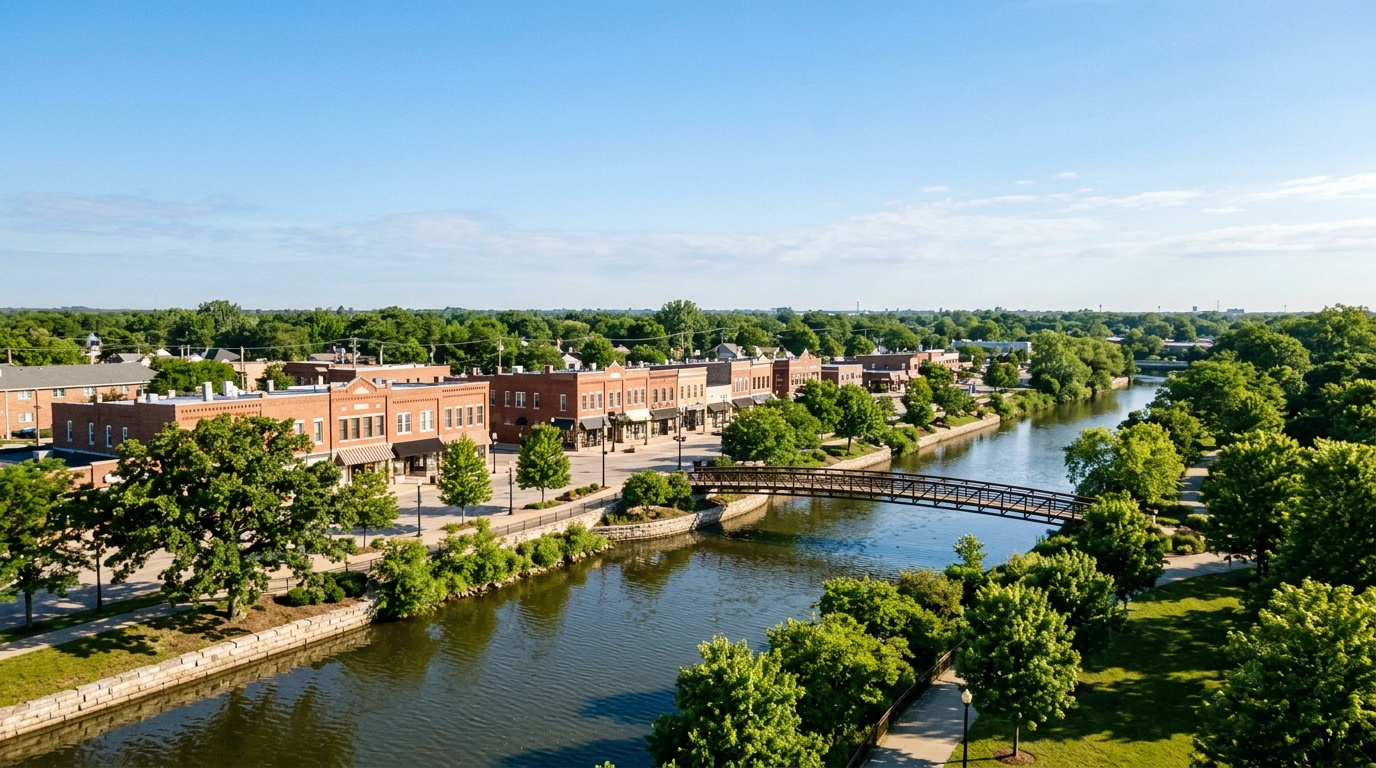
Des Plaines is a diverse northwest suburb in the shadow of O’Hare, full of commuters and working families on every kind of schedule. A self-paced, accredited K-12 program sets the work for your student and lets the family own the hours, so a long shift or a long drive never decides whether the school day happens.
The program serves families across Des Plaines, Park Ridge, and the O’Hare-area suburbs, with the same plan and the same accredited record behind every student. Start with how self-paced online high school works, or a plain look at online school versus homeschool versus public school. More about Des Plaines.
The program at a glance
The working parent’s real daily role
A day that bends around two jobs
Learn more: how self-paced learning works
Placed by skill
One student, placed where they actually are
A child can sit above level in reading, on level in math, and still be building writing, all on the same day. The grid is a map, not a cage. A counselor reviews recent work and sets the starting point in each subject, then adjusts it as the student moves, so nobody is parked in a grade by birthday.
An example: one student, placed by skill the same day
Each subject starts where the student is, not where a birthday says.
Every student also gets a written, subject-by-subject plan, real teachers who grade the work and answer questions on the student’s schedule, academic support when a lesson does not click, and one accredited record kept for the family year after year. The day mixes on-screen lessons with real books and hands-on work.
Migrant and agricultural families through the harvest
School that fits the household
Learn more: considerations for immigrant and ELL students
Why it fits here
A day that bends around a Des Plaines commute
Between airport-area shifts, a Metra or expressway commute, and activities that fill the evenings, a fixed bell fights the way families here live. Self-paced coursework lands in the hours you have, a student can re-read and replay at their own pace, and a working parent can check the week from anywhere.
Two ways to run a school day
The deeper answer
What to say to the nosy neighbor or relative without a defense
At every holiday table, there’s someone who squints across the mashed potatoes and says, “But what about socialization?” Here’s the move: smile, answer once, and let your child’s calm confidence do the rest of the talking. You are not on trial. You made a considered, fully accredited academic decision, and no one handed your neighbor a gavel. A short, warm reply closes the loop faster than any debate: “It’s a great fit for how they learn, and they’re thriving” is a complete sentence. So is “Happy to share the FAQ if you want the full picture” with a nod toward the answers most people are actually curious about. You are not obligated to defend, justify, or convert anyone at a family gathering.
The deeper truth is that the loudest skeptics are usually working from a decades-old image of a lonely student staring at a screen in a basement. That picture is just wrong. Online students build genuine friendships, participate in group projects, and show up in their communities in ways that surprise people who ask. If the relative wants evidence, they can read how online students actually socialize, but you don’t have to deliver the lecture yourself. The most powerful thing you can do at that table is be relaxed, because a parent who isn’t rattled, next to a student who is clearly okay, says more than any talking point ever could.
Find your Des Plaines family
Whatever brought you here, the model bends to it
The commuter household
When the day starts early and ends late, the school day works around the hours you have, and either parent can open the record from anywhere.
how self-paced works
New to English, new to the system
A student building English can re-read, replay, and work at their own pace instead of falling behind a fast spoken lesson, with the whole family able to follow.
Switching mid-year
You do not have to wait for fall. A counselor reviews the records and the student picks up at their real level on a clean record.
A day that actually sticks
A simple, repeatable rhythm anchored to real life, not a bell, is what makes a school week last past the first month.
Watching the budget
A home program removes much of the hidden spending around a daily commute. A counselor walks through what enrollment includes.
A family on the move
If life means another address, the accredited record is one continuous document that follows the family, with no gap to explain.
The deeper answer
When struggle is good and when it is just stuck
There is a difference between a student straining to lift a heavier idea and a student drowning in confusion with no life ring in sight. The first kind of struggle is actually the point. Cognitive scientists call it desirable difficulty, and the short version is this: when your brain has to work hard to retrieve, apply, or connect something, the memory sticks. A child who re-reads a solved example and immediately feels comfortable understood nothing yet. A child who stares at a problem, pulls at it from three angles, and finally cracks it just built a neural pathway that a lecture never could. That productive friction is not a sign the curriculum is broken. It is the curriculum working exactly right.
The trick is keeping that friction in the sweet spot before it curdles into shutdown. A self-paced model gives a student permission to sit with hard material long enough to actually wrestle it, rather than getting dragged forward by a bell schedule that does not care whether anyone in row four understood the last lesson. But pace alone is not enough. A skilled teacher reads the signal when productive struggle tips toward pure frustration, and steps in with the right nudge at the right moment, not the answer, just enough traction to keep the student moving. When you want to see exactly how that support is structured and scheduled, a quick conversation with our team through the counselor scheduler maps it out in plain terms.
Kindergarten through senior year
One continuous record, every grade
The same program runs the whole way, and the level is set by what a student can do.
One continuous path, one record
K-5Foundations
6-8Analytical turn
9-12Four-year sequence
GraduationAccredited
Grade pages: Kindergarten, 4th, 5th, 6th, 7th, 8th, 9th, 10th, 11th, 12th.
The deeper answer
When the basics become automatic, the hard thinking has room
There is a reason a new driver grips the wheel white-knuckled while an experienced one holds a conversation without drifting a lane. Attention is finite. When the brain is still burning effort on a basic skill, it has almost nothing left for the thinking that actually matters. Cognitive scientists call this automaticity: the point at which a skill runs on autopilot, releasing working memory for heavier lifting. A child sounding out every syllable in a sentence cannot simultaneously think about what the sentence means. A student counting on fingers cannot reason about why a pattern works. The skill has to become so practiced it costs almost nothing, and then comprehension, analysis, and problem-solving finally have room to breathe.
That insight shapes the way our American curriculum is built from the ground up. In the elementary years, foundational skills like decoding, sight words, and number-fact recall get deliberate, repeated practice until they run automatically, not because repetition is glamorous, but because it is the architecture everything else stands on. Teachers watch for the transition point where a student stops performing a skill and starts owning it, then steadily layer in the reasoning and critical thinking that curriculum standards actually demand. The model is not slow or remedial; it is sequenced with intention. Fluency first is not the opposite of rigor. It is the precondition for it, and students who hit that threshold earlier carry the advantage through every grade that follows.
The course catalog
A full course load, online and self-paced
From the early grades through senior year, the program covers the core subjects and a real slate of electives, all built for self-paced work. Tap a subject to see the course.
Elementary, K-5
Reading, writing, and number sense built carefully, one mastered step at a time.
Middle School, 6-8
The analytical turn: pre-algebra, real writing, and a student learning to own a plan.
High School, 9-12
A full accredited course load with honors-level depth inside the same self-paced structure.
The deeper answer
When to push and when to pause
Every homeschool family eventually faces the same fork in the road: your child is stuck, frustrated, or just plain flat, and you have to decide whether today calls for a gentle push or a full stop. Get this wrong consistently, and flexibility quietly curls into drift, where weeks slide by and the learning gap nobody wanted shows up anyway. The judgment is easier when you have a simple framework. Ask three questions. First, is the obstacle emotional or conceptual? A child who is sad, anxious, or physically off needs rest, not a harder explanation of fractions. A child who is bored or mildly resistant usually needs exactly the push they are resisting. Second, has this subject been paused more than twice this week? If the answer is yes, a pattern is forming and patterns deserve a real conversation, not another grace day. Third, can a shorter version of the lesson count as a win? Fifteen focused minutes often beats ninety scattered ones, and the record still shows progress. The flexibility built into a quality K-12 program is a genuine asset, not a loophole, but it works best when the family treats it like a tool with a purpose rather than a permanent escape hatch. Build in a brief weekly check, even just ten minutes on Friday, where you look at what got done versus what got delayed. That small habit is usually all it takes to keep flexibility honest and keep the year on track.
Learn more: the K-12 program
A week in practice
What a real week looks like
No bell and no homeroom, but a clear rhythm: set the week’s targets, work in short focused blocks, and watch the record fill in as the work lands.
A self-paced week, set by the family
- Targets set
- Math
- Reading
- Science
- Writing
- History
- Co-op
- Math
- Art
- Catch-up
- Review
The deeper answer
When your child says they are bored
When a student looks up from their screen and announces they are bored with school, most parents reach for reassurance: “Push through, it gets better.” That is the wrong move, and deep down you already know it. Boredom is not laziness wearing a costume. It is data. It is your child’s nervous system filing a formal complaint that the pace is too slow, the challenge is too thin, or the material landed sideways and nobody noticed. A sharp parent treats that complaint like a smoke detector, not background noise. Something real is behind it, and the signal deserves a real response.
The practical pivot starts with two questions: Is your child bored because the work is too easy, or because they genuinely do not understand it and checked out in self-defense? Both feel identical from the outside, and both have completely different fixes. A student who needs more rigor wants harder problems, faster movement, and the respect of being pushed. A student who is quietly lost needs a slower lane and a chance to rebuild confidence before speed matters again. Online home school handles this well because the structure bends around the learner instead of the other way around. When the adults in the room stop treating boredom as a character flaw and start treating it as a scheduling note, everything changes. Your child is not being difficult. They are telling you something worth hearing.
Learn more: the K-12 program
Ready when you are
See if it fits your family
A short conversation is the fastest way to know, with no pressure, just answers.
The record that lasts
One accredited record, wherever life goes next
The coursework is accredited, so the transcript is a professional document read cleanly by the next school. It is one continuous record across every grade and every move, with no gap to explain.
What is on the accredited record
-
Course list and gradesEvery completed course, year by year
-
A cumulative GPACalculated and kept current
-
Descriptions a registrar readsStandards-aligned course descriptions
-
No gap across a moveOne continuous record, anywhere you go
The deeper answer
Who self-paced online school is honestly not the right fit for
Straight talk earns trust, so here it is: self-paced online school is genuinely not the right match for every student. If your child’s energy runs entirely on hallway conversations, lunch-table banter, and the electric hum of a packed classroom, pulling that away cold-turkey can feel isolating in ways no screen fully fixes. Families who picture a plug-in-and-disappear setup should also pause: online learning asks parents to be present partners, not passive bystanders. And if a student flatly refuses any schedule, any check-in, and has no adult in the home who can hold a light accountability line, the flexibility that looks like freedom can quietly become a drift toward nothing.
Here is where honesty gets interesting, though. Several of those gaps are real but closeable. Students who miss daily peer connection can find structured social touchpoints when they know how online students build community rather than assuming it just happens. The wandering-schedule problem has a direct answer in our counselor and weekly target system, which gives students a living roadmap and a real human who notices when momentum stalls. So the honest answer is not a flat yes or no; it is a question. Does your student have even one anchoring adult and a flicker of self-motivation? If yes, the model has tools to build on that. If the answer is genuinely no on both counts, a traditional setting may serve them better right now, and saying so out loud is something we are comfortable with.

A note from the Head of School
Do not wait for a semester to start. For a Des Plaines family, the most useful first move is the fifteen-minute counselor call with your student’s most recent records in hand. We place by skill, subject by subject.
Questions families ask
Des Plaines online home school FAQ
Is online home school legal in Illinois?
Yes. Illinois treats a home school as a private school. Families do not register with the state, seek approval, or sit state tests; you teach the same branches of education the public schools teach, in English. Authority: the Illinois State Board of Education.
Is the program accredited?
Yes. The coursework is accredited, so the transcript is a professional record built to recognized standards and read cleanly by the next school.
What about friends and activities?
A self-paced day frees up the hours a fixed schedule eats, which is why active families choose it. Co-ops, club sports, park-district programs, and city activities fill the daytime. Here is how online students build a social life.
Do you support an IEP or 504 plan?
Yes. The self-paced structure already provides extra time, a quiet space, and a flexible pace per subject. Bring the current plan to the counselor call and the routine is built around it.
How should we think about cost?
A home program removes much of the hidden spending around a daily commute and keeps the schedule open for a working parent. A counselor walks through what enrollment includes, and we are fully transparent about cost.
What if we try it and it is not working?
A struggling stretch gets caught by the weekly check and the counselor, the pace and support adjust, and the accredited record travels if a family decides to move on. No year is lost.
How much do I need to know to make this work?
Less than most parents fear. The school carries the instruction and the grading; the parent is a coach who keeps the rhythm, not a teacher who delivers the algebra. Not knowing the material yourself is fine, and on purpose.
What technology do we need to start?
A reliable laptop and a steady internet connection are the main requirements. Books and any hands-on materials are shipped to the house, so the day is a mix of on-screen and off-screen work.
The legal basics
Homeschooling in Illinois, in plain English
In Illinois a home school is treated as a private school. Families are not required to register with the state, seek approval, give notice, or sit state tests; you teach the same branches of education the public schools teach, language arts, mathematics, the sciences, social studies, fine arts, and health, in English, and keep your own records. Compulsory attendance runs from age 6 to 17. Authority: the Illinois State Board of Education.
More Illinois cities we serve
Families across Illinois, one program

Two ways in
Get started in Des Plaines
Whether your student is transferring mid-year or starting fresh, the first step is the same short conversation.