|
The accredited academic authority for families in Chicago and nearby Cook County. K-12 Online Home School: The Complete Guide for Chicago Families 🎓Thinking about a K-12 online home school for your child in Chicago? You are not alone. Families everywhere want a better fit—more flexibility, less stress, and more control over pacing. Whether you are navigating the standards of Chicago Public Schools (CPS) or looking for a safer, calmer learning environment, this guide answers the big questions parents ask before they commit. For regional context and historical reference, many local scholars examine the documented progress of Chicago to understand the bar for excellence in the Prairie State. Get Started: Want a proven option that combines self-paced learning with teacher support? Visit our main K-12 Online Home School hub.
|
Accredited Learning for Chicago Residents. |
Local District & Community Integration in Chicago📍
Families in Cook County typically navigate a complex web of educational choices. Whether you are transitioning away from Chicago Public Schools (CPS) or seeking a more rigorous alternative to local private options, High School of America provides the stability you need. We prioritize regional relevance by connecting students to the broader community, ensuring that their academic journey is aligned with the high standards expected in this part of Illinois. This localized focus is what makes HSOA a preferred choice for parents looking for excellence.
We understand that students in our part of the state often have diverse needs—from elite athletic commitments at local academies to a desire for a safer, focused home environment. Our curriculum is designed to exceed the rigor found in local public schools while providing the 1-on-1 focus that large classrooms simply cannot offer. By integrating the high standards of the Prairie State with our self-paced model, we ensure that every student has the tools to succeed.
What Is a K-12 Online Home School?
A K-12 online home school is home-based learning powered by an online curriculum and learning platform. Your child learns from home (or anywhere in Cook County), and you guide the process as the parent. Depending on the program, your child also gets teacher support for feedback, questions, and academic guidance.
What it usually includes:
- Online lessons for each subject tailored to regional mastery.
- Practice activities and quizzes to ensure retention.
- Projects to prove understanding and real-world application.
- Grades and progress tracking in a real-time dashboard.
- Flexible pacing so students can move faster or slow down.
If your family is focused specifically on grades 9–12, you can also explore our online high school program.
Online Home School vs Virtual School vs Traditional Homeschool
| Option | Who Runs It | Pacing | Best For |
|---|---|---|---|
| Traditional Homeschool | Parent-led | Flexible | Families who want full control and like offline materials. |
| K-12 Online Home School | Parent-guided + platform | Usually self-paced | Families who want flexibility plus structure and tracking. |
| Online High School (9–12) | Student-led + teacher-supported | Varies by program | Teens who need credits, transcripts, and graduation planning. |
For teens and adult learners, many families prefer a dedicated self-paced online high school model to keep momentum strong.
How K-12 Online Home School Works (Step by Step)
Step 1: Choose your model
Self-paced: Learn anytime. Move fast or slow based on mastery. Teacher support: Get help when needed for questions, feedback, and guidance.
Step 2: Pick your grade level path
- Elementary (K–5): Foundational reading, writing, and math habits.
- Middle School (6–8): Independence and writing projects. Explore the middle school online hub.
- High School (9–12): Credit-based planning and transcript-ready records. Start at Online High School.
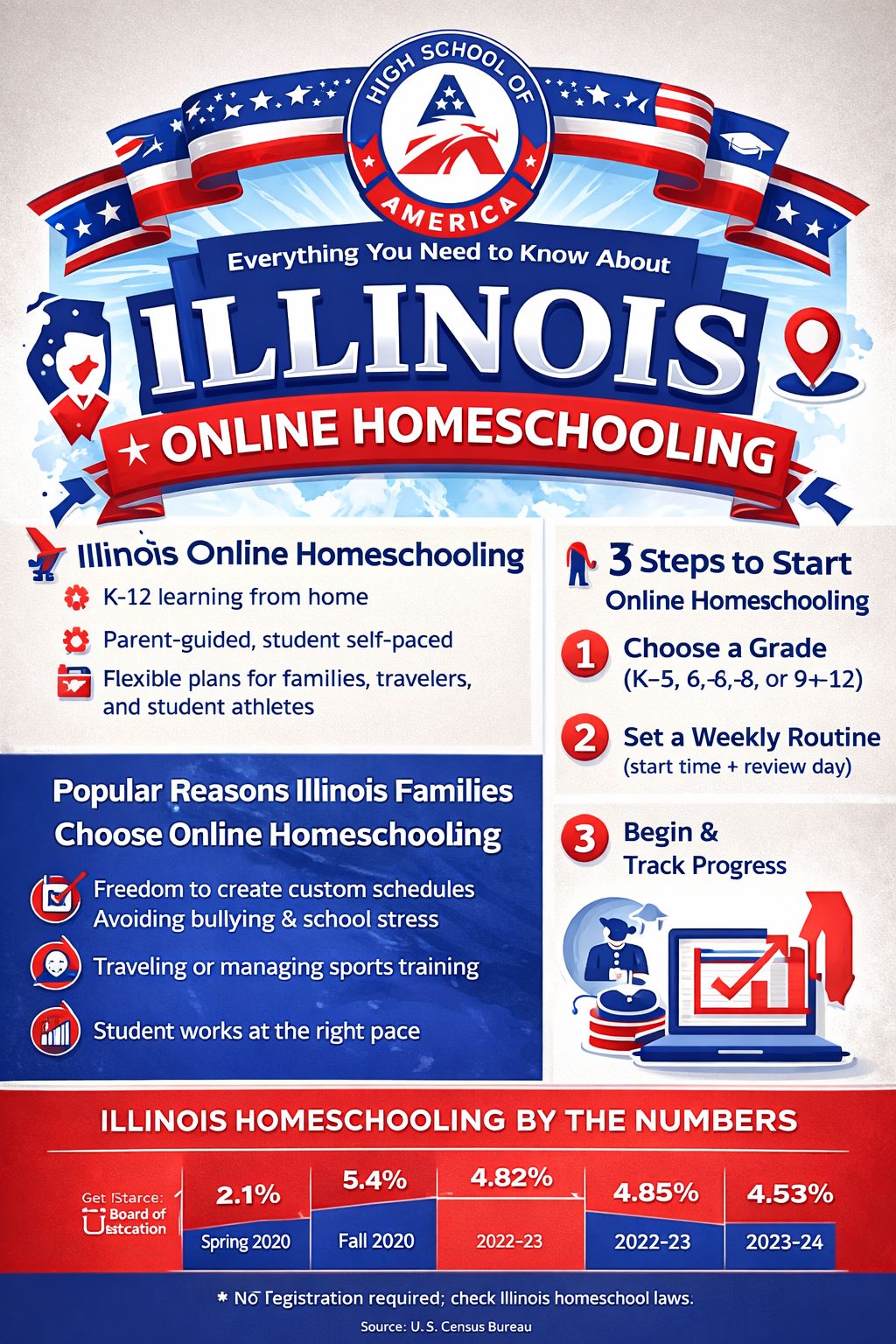
The simple path to success in Chicago.
Immediate Next Steps for Chicago Families ⚡
Don’t let academic uncertainty stall your student’s progress. Use these quick actions to secure your spot in Cook County. Our enrollment is open and streamlined for immediate access.
Note: Enrollment is processed on a first-come, first-served basis for all Illinois residents. Secure your placement today.
Is K-12 Online Home School Legal in Chicago? ⚖️
Education in this state is highly flexible, but structured. Within Cook County, homeschooling is legally recognized as a form of private education. This means your home is effectively a private school, giving you significant autonomy over your child’s academic environment. This autonomy is protected under Illinois law, but it requires that parents act with diligence in maintaining comparable standards to districts like Chicago Public Schools (CPS). Below is the authoritative breakdown of the laws and the exact steps you need to take.
Official Guidance for Local Families
Staying compliant starts with knowing the source. Use these authoritative anchors for your plan:
- Illinois State Board of Education:
State homeschooling guidance - Illinois.gov overview:
Home school my child - Compulsory attendance reference:
105 ILCS 5/26-1
The Legal Foundation
Under 105 ILCS 5/26-1, parents have the right to educate their children at home provided instruction is in English, covers “branches of education” comparable to local public schools, and the curriculum is at least “equal to” that of the schools in Chicago. This ensures that every child in the area receives a quality education regardless of the venue.
The “What to Do” Checklist for Residents
If you are pivoting from a traditional school in this district, follow this roadmap:
- Withdrawal: If currently enrolled in Chicago Public Schools (CPS), send a formal withdrawal letter to the principal. Clearly state your intent to transition to private education.
- Enroll: Join an accredited platform like High School of America to ensure credits are recognized across the county and by local university admissions officers.
- Records: Maintain an attendance log and a portfolio of “Proof of Learning.” This is your evidence of compliance.
- Consistency: Maintain an academic calendar that aligns with the rigor expected in this region. A focused student is a successful one.
Daily Time Expectations by Grade Level in Chicago
“How long does online homeschool take each day?” Use these ranges as a starting point. Efficiency is the local advantage—a focused block is often more productive than a full day of traditional desk time.
Elementary (K–5)
- 1.5 to 3 hours of focused learning.
- Breaks every 15 to 20 minutes are essential.
- Heavy mix of offline learning and reading for pleasure.
Middle School (6–8)
- 4 to 5.5 hours of learning time.
- More writing, research, and structured science labs.
- Focus on building self-management skills.
High School (9–12)
- 5 to 6.5 hours of dedicated work.
- Credit-based courses, essays, exams, and projects.
- Planning for transcripts and graduation milestones.
If your student is aiming for a diploma, learn the difference between a teen program and an adult diploma pathway.
Curriculum Quality Checklist & Course Explorer 📚
A robust education requires a well-mapped sequence of courses. High School of America offers a high-density catalog that covers everything from foundational skills to college prep. Many families in Cook County want to see course options before enrolling. Start here: high school courses.
Core High School Course Examples
- Math: Algebra 2, Geometry, High School Algebra, Pre-Calculus
- Science: Biology, Chemistry, Physics, Zoology
- English: English 2, English 3, English 4
- Social Studies: U.S. Government, U.S. History, World History, Economics
Middle School Courses (6–8)
- Civics: MJ Civics Online
- Science: Comprehensive Science 1, Comprehensive Science 3
- Math: Grade 6 Math, Grade 8 Pre-Algebra
- Language Arts: MJ Language Arts 1, MJ Language Arts 3
- History: MJ U.S. History, MJ World History
Review our diploma pathway and how many credits are needed for graduation.
Regional Homeschooling: By the Numbers 📊
The Shift Toward Individualization
The homeschooling landscape has evolved rapidly. Post-2020 shifts have led more families in Cook County to prioritize individualized curriculum pathways over traditional attendance models. Estimates show a significant increase in families opting for self-paced, accredited paths that protect academic integrity and safety. This trend mirrors a national movement toward personalized learning platforms.
Learn more about the future: AI & personalized learning.
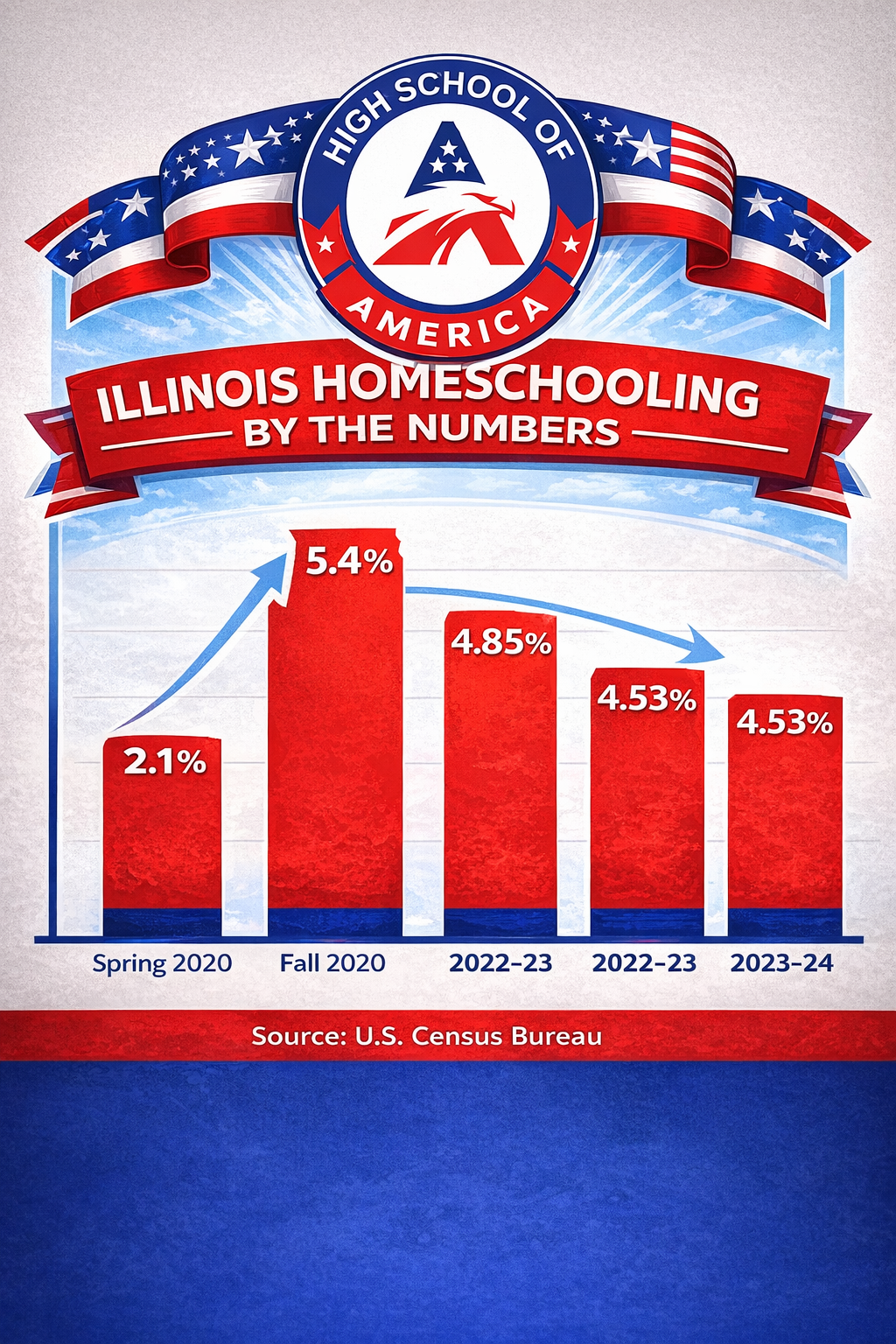
Stats: The rise of individualized K-12 education across Illinois.
Reviews from Nearby Families ⭐
“We finally found a program that respects our child’s pace. The chemistry labs were engaging and actually fun to do at home. The flexibility is unmatched.”
— Mark L., Cook County Resident
“Accredited transcripts meant our credits transferred back perfectly when we moved districts. Best decision for my teen’s mental health and academic focus.”
— Sarah T., Chicago Parent
“The teacher support is excellent. My student feels supported but independent. It’s the perfect balance for middle school.”
— Linda R., Local Resident
Other Illinois Locations We Serve 📍
Accredited coverage from the Great Lakes to the Southern Border. Your education travels with you:
| Chicago | Aurora | Naperville | Joliet |
| Rockford | Elgin | Springfield | Peoria |
| Champaign | Bloomington | Waukegan | Evanston |
| Schaumburg | Bolingbrook | Decatur | Skokie |
K–12 Online Home School FAQ ❓
Comprehensive answers for local families seeking high-density academic clarity.
Is homeschooling legal in Chicago?
Yes. Illinois recognizes homeschooling as a private school option. This is protected under the Illinois School Code. You can consult the state homeschooling guidance for local families. Our area has a long history of supporting educational choice.
Do I have to register my home school?
No. This region does not have a mandatory homeschool registry. You are considered a private school and are responsible for providing a comparable education. Many families appreciate this privacy.
Is HSOA accredited for our students?
Yes. Our accreditation ensures your diploma is recognized by colleges, the military, and regional employers in Cook County and across the nation.
How do I transfer credits from the local district?
Our advisors manage the credit transfer process by reviewing previous official transcripts and ensuring a smooth transition to our platform.
Can my student graduate early?
Yes. Because HSOA is self-paced, students who work ahead can graduate as soon as they meet the credit requirements. This is common in our area.
Does HSOA accommodate students with IEPs or 504 plans?
Absolutely. While we are a private school, our flexible platform allows for significant modifications. We recommend parents in Cook County review our support services for students with unique learning needs.
Are there live graduation ceremonies?
Yes! We offer virtual and regional in-person graduation options for our Illinois students so they can celebrate their achievements with family and local peers.
What tech is required for online homeschooling?
A stable internet connection and a computer/laptop are essential. Our platform is optimized for accessibility throughout Illinois, ensuring low-latency access to our full curriculum.
How do I request an official transcript from HSOA?
Transcripts can be requested through our student portal at any time. We send official records directly to colleges or local district offices as needed.
Are teachers available for one-on-one help?
Yes, HSOA provides access to certified instructors for academic support. Students can reach out for guidance on complex subjects within our curriculum dashboard.
What is the difference between an HSOA diploma and a GED?
HSOA provides a fully accredited high school diploma, which is widely recognized as superior to a GED. Colleges and employers in Cook County typically prioritize diploma holders for admissions and hiring.
Do you offer summer school or year-round enrollment?
Yes. HSOA offers rolling enrollment, meaning you can start in the summer or any time of the year. This flexibility is perfect for families in our region who need to adjust their schedule.
How do colleges view online high school diplomas?
Colleges view accredited online diplomas exactly like traditional ones. Many of our students from the area go on to top universities in Illinois and across the United States.
Can international students enroll in HSOA?
Yes. Our program is accessible globally. Students moving to or from Illinois can maintain their studies without interruption, as long as they have internet access.
Is there a physical campus I can visit?
HSOA is primarily a virtual institution to provide maximum flexibility and safety. However, we host regional events and in-person graduation ceremonies for our local Illinois community.
Pro-Tips for Academic Success ✨
Effective strategies gathered from high-performing families in this district. Use these to optimize your student’s experience. These tips are the “secret sauce” for regional success.
Record Keeping Mastery 📂
- Digital Archives: Use a cloud folder to save PDFs of finished coursework. This is vital for your official transcript.
- The 48-Hour Feedback Rule: Grade work within 48 hours for maximum retention. Students thrive on immediate feedback.
- Annual Academic Summaries: Write a one-page summary for your records. It helps track long-term progress.
Community Hacks 🤝
- Library Systems: Nearby libraries in Cook County are top-tier. Use them for science labs and quiet study time.
- Co-Op Selection: Don’t join every group. Pick one co-op that matches your student’s biggest passion (e.g., chess or drama).
- Service Learning: Encourage your student to volunteer. It builds character and a strong regional resume.
Final Thoughts: Your Student’s Future in Chicago 🚀
K-12 online home school can be a powerful move for your family. It gives you flexibility, a calmer path, and control over pacing. The secret is not perfection; it is a routine and a plan. Prepare your student for future entry into institutions like Chicago by starting their accredited journey with us today.
Getting Started Checklist
- Select courses based on grade level and skill needs.
- Set a weekly schedule with a consistent start time.
- Set up a learning space with reliable tech.
- Start Week 1 simple and focus on routine.
- Review weekly and adjust based on progress.
Essential Resources
High School of America is your localized partner in academic excellence. All internal links are silo-safe and point to global authority pages.