★ Lone Star Learning

Texas K-12 Online Home School

Texas K-12 online home school from High School of America gives families a flexible online learning option for elementary, middle school, and high school students across the state. The program is full-time, year-round, and designed around how real Texas families live, with parent visibility, academic support, and a clear path from early grades through graduation planning.

Texas is one of the most flexible states for home-based education. Families should compare parent-directed homeschool education, private online school options, and state-supported online learning pathways before choosing a plan. Texas Education Agency home schooling guidance covers the legal framework families operate under.

Call (888) 242-4262 to speak with a live agent, or start enrollment today.

Enroll Now
Talk to a Counselor
High School of America Texas K-12 eagle mascot logo

400,000+
TX Homeschoolers
Accredited
Yes
K-12
All Grades
Year-Round
Enrollment

Texas family doing online home school at kitchen table

How Texas K-12 Online Home School Works at the program

You already know why you’re here. Let’s talk about what happens next. Here is how families across Texas, from Houston to El Paso to the Dallas-Fort Worth metroplex, move from “thinking about it” to actually doing it.

Step 1: Enroll Any Time of Year

Texas public schools lock families into a fixed August start date set by the Texas Education Agency. High School of America doesn’t. Enrollment is open year-round. A family in San Antonio can start in October, a student in Lubbock can begin in March, and a child in Plano who needs to switch mid-semester can transition without sitting on a waiting list for months.

Texas homeschool laws make this easier than most states. No registration is required. No state-approved curriculum mandate. To withdraw from a public school, a signed parent letter stating that homeschool has begun is sufficient. Our enrollment team handles the rest, walking you through each step so nothing falls through the cracks.

Call (888) 242-4262 to speak with a live agent, or schedule a counselor call whenever it’s convenient.

Step 2: Receive a Full Curriculum Built for Your Child’s Grade Level

Once enrolled, your student gets immediate access to a structured, grade-appropriate curriculum taught by teacher-supported coursework. Not a box of worksheets. Not a YouTube playlist. Real courses, real instruction, every grade level:

Our program’s academic support staff deliver instruction through the student portal. The parent’s role is support, not lesson planning. We built it that way on purpose.

Step 3: Learn at Your Own Pace, on Your Schedule

Self-paced learning means something specific here. A 2nd grader in Corpus Christi who needs extra time on reading foundations gets that time without being labeled “behind.” A gifted 4th grader in Austin who tested into higher math can move forward without waiting for twenty-two other kids to catch up. A high schooler in Arlington balancing a competitive athletics schedule can log in at 9 p.m. and still get a full lesson from a advisor guidance.

All coursework runs on any device with an internet connection. Texas broadband access continues to improve (including roughly $3.3 billion in federal BEAD Program funding allocated under Texas HB 5 to expand rural infrastructure), but even families in areas with slower connections can work around their available bandwidth because the platform is not live-streaming-dependent.

Progress reports and transcripts are maintained throughout enrollment, so your student’s academic record stays organized and portable. Texas is the number one destination state for domestic migration. Families relocating from Harris County to another state, or moving into Dallas from out of state, don’t lose academic continuity.

Step 4: Complete Graduation Requirements

Students who complete their coursework receive transcript and diploma documentation according to school policies. Families should verify college admission, transfer, employment, military, or licensing requirements directly with the receiving institution or agency before making enrollment decisions.

The truth is, graduation requirements vary by grade level and individual student path. Don’t rely on a single credit number published on any website. Call (888) 242-4262 or book a call with a counselor to review exactly what your student needs.

Ready to get started? Request an enrollment packet or start enrollment today. For official Texas homeschool legal information, refer to the Texas Education Agency.

Texas Graduation Requirements and What They Mean for Your Student

Texas public school students follow state graduation rules under the Foundation High School Program, the public-school graduation framework set by the Texas Education Agency. Private online school students like those at the school follow the graduation requirements, transfer policies, transcript rules, and diploma pathway of the school awarding the diploma. The public-school distribution is summarized below for context:

  • English: 4 credits
  • Math: 3 credits
  • Science: 3 credits
  • Social Studies: 3 credits
  • Foreign Language: 2 credits
  • Fine Arts: 1 credit
  • Physical Education: 1 credit
  • Electives: 5 credits

Those are state minimums. The program is an accredited K-12 online home school whose diploma requirements meet or exceed that Texas baseline. Because graduation paths differ by grade level, transfer credit history, and individual circumstances, we don’t publish a single credit number that fits every student. Your child’s specific starting point is what drives the plan.

Your Student’s Path Probably Looks Different from the Template

Here’s what nobody tells you about credit requirements: the generic chart above is a starting line, not a map. If your child is transferring from a Houston ISD campus, a Plano Independent School District school, a San Antonio charter, or a home-based program you’ve been running independently in Dallas or Fort Worth, the credits already on their transcript count. HSOA reviews incoming transcripts and works with each family to map existing coursework against remaining graduation requirements.

For elementary students in grades K-5 and middle schoolers in grades 6-8, the conversation centers on grade-level progression and curriculum milestones rather than credit counts. Our course support track mastery of core subjects, provide progress reports, and keep students moving forward at the right pace. Parents in Austin, Corpus Christi, El Paso, or anywhere else in Texas can get a clear picture of where their child stands by talking to one of our enrollment counselors.

Texas Homeschool Law and Diplomas

Texas treats homeschools as private schools under state law, a legal framework established by the 1994 Texas Supreme Court case Leeper v. Arlington ISD. That means families are not required to register with the state, notify their school district, or seek prior approval before enrolling in an online home school program Texas families can start anytime. TEA correspondence on home schools confirms that homeschoolers are not under its direct authority.

Because there is no state oversight of homeschool programs, the accreditation status of the program you choose carries real weight. A diploma from a nationally accredited school like High School of America documented through transcripts and diploma records that families verify directly with each receiving institution. An unaccredited program may not offer the same portability, especially for students planning to apply to four-year universities or pursue military service. If you’ve been wondering “can my child get a diploma from an online school in Texas,” the answer is yes, provided the program holds genuine accreditation.

Get Your Student’s Requirements in Writing

Every family in Texas deserves a personalized graduation plan, not a generic checklist pulled from a website. Whether you’re in the Dallas-Fort Worth metroplex, down in the Rio Grande Valley, or out in Lubbock, the process is the same: we look at your child’s transcripts, current grade level, and goals, then build a plan around them.

Call (888) 242-4262 to speak with a live agent about your student’s situation. You can also talk to a counselor to review the specific requirements for your child’s path to an accredited diploma. If you’d rather start with information you can read on your own time, request our enrollment packet and we’ll send it over.

High School of America for Texas families — 40-second look.

Texas Student Spotlight comic  -  elementary and high school students at The program

K-12 Curriculum and Courses with our program

Texas families choosing an accredited online home school program want to know one thing before anything else: will my child get a real education, with real subjects and real teachers? At the program, the answer is yes, across every grade level from kindergarten through 12th grade.

Elementary School (K-5)

Young learners in Texas start building their academic foundation through structured courses in English Language Arts, Mathematics, Science, and Social Studies. As students move through the elementary grades, the curriculum deepens. A 3rd grader works through Mathematics, 3G, Science, 3G, and English Language Arts, 3G, along with other core subjects. Fine arts are woven in from the start, with courses like Music, 1G and Drama, 5G.

Here’s what nobody tells you about online elementary school: your child’s pace actually belongs to them. A 4th grader who reads at a 6th grade level can move ahead. A student who needs more time with a math concept gets it. teacher-supported instruction guide every lesson, so parents are support, not the instructor. That flexibility is the whole point of an online home school program in Texas.

Middle School (6-8)

The middle school years cover 6th Grade, 7th Grade, and 8th Grade courses built around rigorous core subjects. Math moves through MJ Grade 6 Mathematics, MJ Grade 7 Mathematics, and MJ Grade 8 Pre-Algebra. Language arts follows the MJ sequence: MJ Language Arts 1, MJ Language Arts 2, and MJ Language Arts 3. Science courses include MJ Comprehensive Science 1, MJ Comprehensive Science 2, and MJ Comprehensive Science 3.

This is an accredited online school for middle schoolers in Texas where self-paced learning actually works the way it should. Students move through the same grade-level content, but on a flexible schedule built around their readiness. Progress reports keep parents informed every step of the way. Families in Houston, Dallas, El Paso, or anywhere across the state get the same quality of instruction from academic guidance.

High School (9-12)

High school students work through a college prep curriculum covering the core subjects that colleges, employers, and the military expect to see on a transcript. Course options include:

Because Texas homeschool laws do not require a state-approved curriculum, families have real freedom to shape electives around their student’s interests and values. Families in the Dallas-Fort Worth metroplex, faith-based communities across Harris County and Bexar County, and secular families in Austin looking for a science-forward path can each build a program that reflects what matters to them, alongside the core academics every student needs.

All courses are taught or supported by online instructors. Your child is not learning from worksheets alone. This is a full-time k-12 online school in Texas delivered through a student portal that works on any device. A student in San Antonio and a student in Lubbock get the same quality of instruction. Some rural districts in West Texas have reported math and science teacher vacancies lasting entire academic years. That is not a variable for families enrolled here.

The truth is, we built this curriculum so that every grade level, from kindergarten through graduation, gets the same attention and the same rigor. Browse the full Course Catalog or see Individual Courses for specifics. To discuss which courses fit your student’s current level, connect with a counselor or call (888) 242-4262 to speak with a live agent.

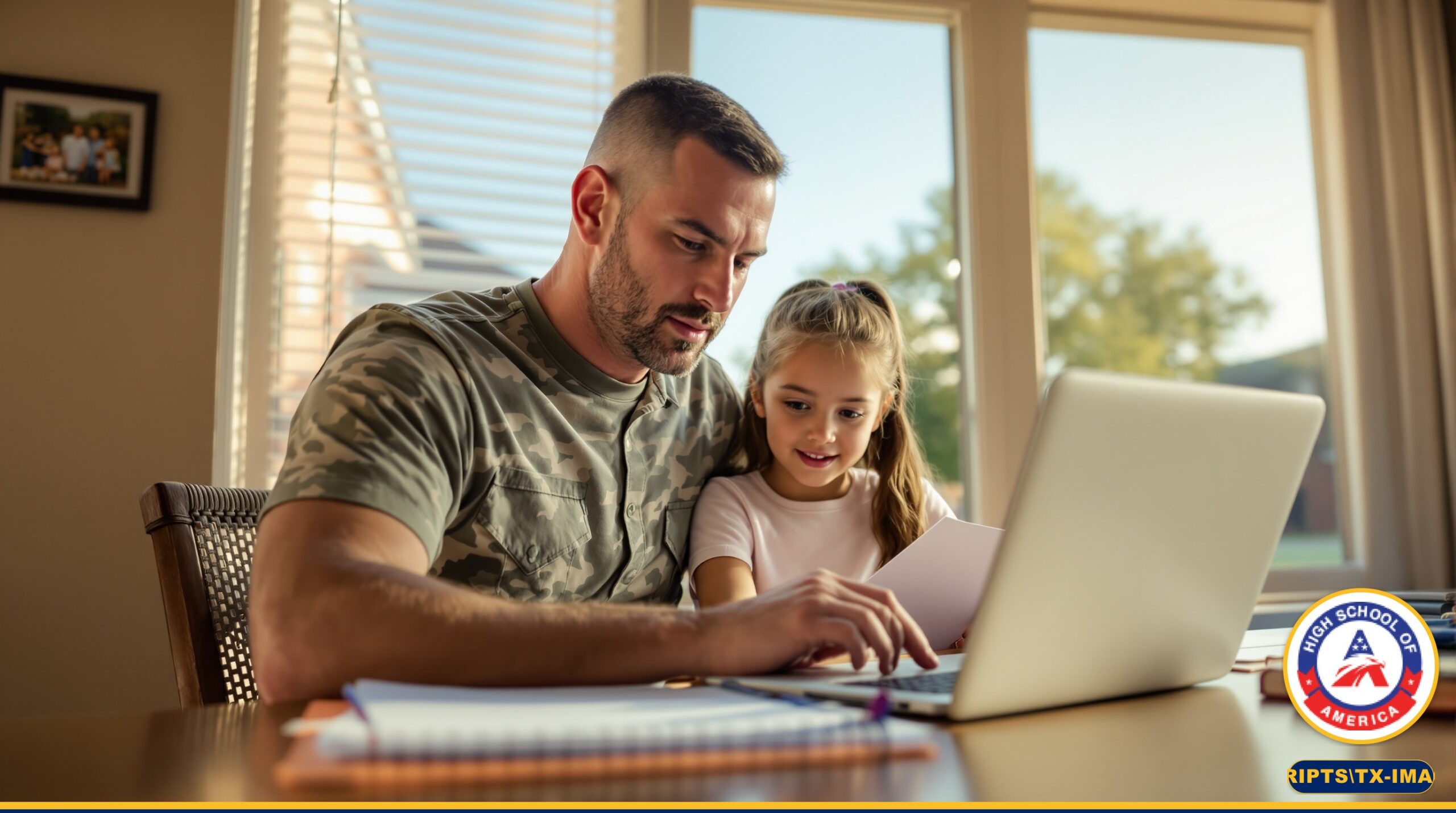
Texas military family enrolling in online home school

Texas K-12 Online Home School: Who It’s For

Families find High School of America for all kinds of reasons. Some planned to homeschool before the baby was born. Others made the decision over one bad weekend. Both belong here. These are the students and families who tend to do best in our accredited online home school program Texas families are choosing every day.

The Kid Who Outgrew the Classroom

Texas gifted-and-talented programs are inconsistent, and the waitlists are real. On overcrowded Houston and Dallas-Fort Worth metroplex campuses, plenty of GT-eligible students never get identified at all. If your elementary-age child is reading three grade levels ahead and stuck in a room of 30 kids moving at one speed, self-paced learning lets them go as fast as their curiosity allows. No committee. No waiting. Just a course staff who actually sees where your child is and adjusts.

The Military Kid Who’s Moved Three Times in Four Years

Texas is home to hundreds of thousands of military-connected students near installations like Fort Cavazos, Joint Base San Antonio, and Dyess AFB. Every PCS move means a new school, a new curriculum sequence, and gaps nobody tracks. A virtual home school Texas family can count on travels with you. The coursework, the teacher-supported coursework, and the student portal all stay exactly the same regardless of which state the moving truck stops in next. That consistency matters more than most people realize until the third transfer.

The High School Athlete

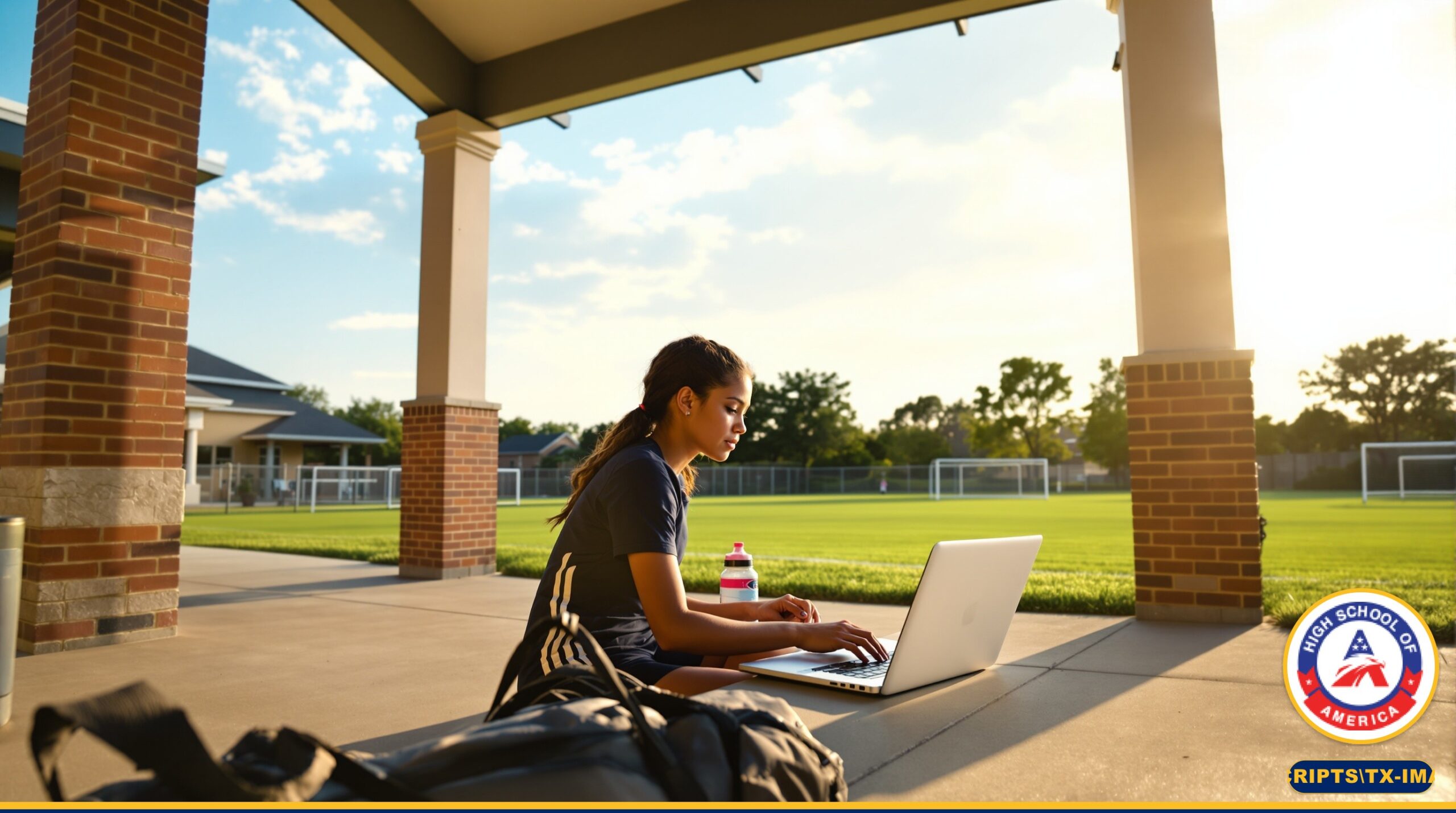
Texas passed HB 547 in 2021, giving homeschool students the right to participate in UIL extracurriculars at their resident public school. A student enrolled in our Texas online high school diploma program can compete in varsity football in Plano, run track in San Antonio, or play basketball in Lubbock, all without being locked into a rigid bell schedule that conflicts with early morning practice and travel. Online schooling for kids in Texas who play competitive sports is no longer a compromise. It is a genuine advantage.

The 9th Grader Hitting a Wall in Math

Here’s what nobody tells you about Algebra I in Texas: when the class moves on, it moves on, whether your kid is ready or not. Across Harris County and Bexar County, thousands of freshmen fall behind in math every year because the pace is set for the room, not the student. In an online home school program Texas families trust, a student can slow down, revisit a concept, and truly master it before advancing. That is how our academic support staff work. Call (888) 242-4262 to talk through how we support struggling math students specifically.

Families Relocating to Texas (or Leaving)

Texas remains the top destination state for domestic migration. Families moving from California, Illinois, New York, or anywhere else are often mid-year and mid-unit when the move happens. Enrolling in a virtual K-12 school Texas recognizes, one that accepts transfer credits, means the work your child already completed counts. Our registrar reviews transcripts individually so nothing falls through the cracks. Switching from public school to online homeschool in Texas does not have to mean starting over.

The 3rd Grader Facing Retention

Texas’s reading retention law means a student who fails the 3rd grade STAAR reading exam can be held back. That threat creates enormous stress for K-5 families. An online elementary school program for Texas kids removes that high-stakes exam from the equation and replaces it with something better: a advisor guidance working directly with your child at their actual reading level, covering English Language Arts in a structure built around how they learn, not how a standardized test is scored.

The Middle Schooler Who Needs a Breather

Texas middle school is not the calm bridge between elementary and high school that parents remember. Eighth graders are already sitting for EOC exams, being funneled into endorsement tracks, and navigating social dynamics that research consistently links to elevated anxiety. Families in Austin, Corpus Christi, and El Paso are choosing an accredited online school for middle schoolers in Texas because the academics stay rigorous and the social pressure drops significantly. Students still connect through Texas’s thriving homeschool co-op network (the Texas Home School Coalition lists over 300 active groups statewide), so “online” does not mean “isolated.”

Kids in Entertainment or with Irregular Schedules

Austin’s film industry, Dallas commercial modeling, and Houston’s pageant circuit all run on schedules that don’t fit a 7:45 a.m. bell. Families whose children work professionally need a full-time online school Texas families can rely on, one that treats a Tuesday morning shoot as a perfectly valid reason to complete lessons Tuesday evening. That is exactly how a flexible schedule and self-paced learning work here.

Families with Faith-Based Values

Texas has one of the largest evangelical Christian, Catholic, and Southern Baptist populations in the country, particularly across South Texas and the rural interior. Virtual charter schools are required to follow state-mandated, secular TEKS curriculum with no flexibility. A Texas online private school K-12 program like ours gives families the freedom to incorporate their own faith perspective alongside core subjects in science, history, and literature.

Students with Chronic Health Conditions

Managing Type 1 diabetes, juvenile arthritis, or severe allergies in a public school of 2,000 students is genuinely hard. For parents in Irving, Arlington, or Garland who spend mental energy every day worrying about nurse availability and cafeteria ingredients, online home school puts you back in control. Your child learns at home. You handle care directly. The academics don’t stop, and progress reports keep you informed every step of the way.

Older Students Who Haven’t Finished Yet

Texas law allows homeschool students over 18 to continue without additional state justification, unlike public schools with age-based enrollment cutoffs. If your child left school before finishing, it is never too late. There is no judgment here. The truth is, we built this program for exactly these situations. Our counselors will review whatever transcripts or prior credits exist and map a realistic path to an accredited Our program diploma.

Not sure which category fits your family? That is completely fine. Read our guide for students and parents to see who thrives in this program, or just pick up the phone. Call (888) 242-4262 to speak with a live agent, set up a counselor call to talk through your situation in detail, request info if you want everything in writing first, or start enrollment if you already know this is the right move.

Texas student athlete studying online between practices

Transferring Credits to the school: What Texas Families Need to Know

Here’s what nobody tells you about switching from public school to online homeschool in Texas: most of the credits your child already earned will follow them. High School of America accepts transfer credits from accredited institutions, and our registrar works with each student to maximize credit transfer. The process is straightforward, not buried in red tape.

How the Process Works

When you enroll, our registrar team reviews your student’s official transcripts and evaluates each course for credit equivalency. You submit the transcripts. We do the analysis. Then we tell you exactly where your child stands before they start a single new lesson. No guesswork.

This applies across all grade levels:

  • Elementary students (K-5): Prior grade-level completion is documented and your child picks up right where they left off, without repeating material they’ve already mastered. Whether they’re coming from a Houston ISD campus, a Montessori program in Austin, or another online elementary school program for Texas kids, the transition is smooth.
  • Middle school students (grades 6-8): Coursework from Texas public, private, or charter schools transfers in. Students who completed 6th grade, 7th grade, or 8th grade classes at a Dallas ISD campus, a San Antonio charter school, or any other accredited online school for middle schoolers in Texas can bring that work with them.
  • High school students (grades 9-12): Credits from 9th grade through 12th grade are evaluated course by course. Core subjects like Algebra 2, Biology, World History, and U.S. Government frequently transfer without issue.

What Transcripts Do You Need?

Bring whatever documentation you have. Official transcripts from a previous school are ideal. If your child is coming from a Texas homeschool background, you should know that Texas homeschool laws do not require parents to maintain any specific records. If records are limited, our team works with you to assess placement rather than leaving your student in limbo.

Students transferring out of Texas virtual charter schools, including those operating under Texas education authority oversight, typically have clean transcripts that move over quickly.

Timeline

Credit review happens during enrollment, so there’s no long waiting period. Once transcripts are submitted, our registrar moves fast. Most families have clarity within a few business days, which matters if you’re switching from public school to online homeschool in Texas mid-semester and don’t want your child sitting idle.

Graduation requirements vary by grade level and individual student path. To get a clear picture of where your child stands and what they need to finish, call (888) 242-4262 to speak with a live agent, or speak with an enrollment counselor for a full transcript review. You can also request our enrollment packet to get started on your own time.

Accreditation and Diploma Validity for Texas Families

HSOA is nationally accredited, and that distinction matters in ways Texas families may not immediately think about.

Texas law gives homeschool families complete freedom to choose any curriculum or program. No filing with the state education agency is required. No state-approved course list. That legal freedom, though, is only as useful as the program you choose to fill it. Choosing a program with documented academic records and transcripts is what makes that freedom practically usable.

Here is what accreditation means in plain language: every course your child completes (whether they are in kindergarten or 12th grade) has been reviewed against rigorous academic standards by an independent outside organization. The resulting transcript and diploma are not a family document. They are an official academic record.

For Texas families, that record carries real weight:

  • College admissions. Texas colleges and universities accept official transcripts from accredited private programs, along with SAT/ACT scores. An accredited online homeschool diploma from High School of America meets that standard.
  • Military planning. Students considering enlistment should verify current documentation, testing, transcript, and eligibility requirements directly with a recruiter or the appropriate military branch.
  • Federal financial aid. The FAFSA recognizes homeschool diplomas for college financial aid eligibility. Texas Grant, the state’s need-based aid program, is available to qualifying homeschool graduates who enroll in Texas colleges.
  • Employment and vocational licensing. A private online homeschool diploma from an accredited program is recognized for most employment and vocational licensing purposes under Texas’s private school exemption framework.

The difference between a certificate and a structured transcript shows up later, when a registrar, recruiter, or licensing board reviews records. The program students receive an online high school diploma with academic records and transcript documentation per school policy. Grade-specific graduation requirements vary, so request a counselor conversation to review your student’s path with the receiving institution.

Or call (888) 242-4262 to speak with a live agent about your student’s specific situation, whether they are a 2nd grader in San Antonio or an 11th grader in the Dallas-Fort Worth metroplex.

Rural Texas ranch student doing online school from home

Texas K-12 Online Home School vs. Traditional School vs. Virtual Charter: What Actually Differs

Texas families weighing online schooling for kids in Texas usually land on three options: the local public or private school, a Texas virtual charter, or a private online home school program like the program. Each one works differently at the structural level, not just the surface. This comparison chart breaks it down honestly.

Feature Traditional Public School Texas Virtual Charter School High School of America (Private Online Home School)
Tuition No tuition charged by public school No tuition charged by public school Flexible plans to fit any family’s budget. Talk to a counselor for current options.
Accreditation TEA-regulated TEA-regulated public school Private online school with documented academic records and transcript support
Schedule Fixed bell schedule Synchronous class sessions required Fully self-paced learning, year-round
STAAR Testing Required Yes Yes No
Curriculum Control TEA/TEKS-mandated TEA/TEKS-mandated Parent and student choose coursework across core subjects and electives
Start Date Fixed August start (TEA calendar) Fixed enrollment windows Enroll any time, any month
Teacher Support Classroom teachers Online classroom teachers Teacher-supported coursework and academic guidance across grade levels
Diploma Path Public-school diploma Public-school diploma Transcript and diploma documentation per school policy; verify acceptance with each receiving institution
Stays on Public School Rolls Yes Yes No
Attendance Tracking by District Yes Yes, strict daily participation logs No district oversight
Faith-Based or Custom Content No No Yes. Parents may supplement with values-aligned material
Transferable Transcripts Yes Yes Official academic records and transcript support
Enrollment Waitlist Risk Yes (charter waitlists in Houston and Dallas can exceed 10,000 students) Possible No waitlist

What the Chart Doesn’t Capture

A table gives you the facts. Here’s the context behind them.

Virtual charter schools in Texas are still public schools. Programs like Texas Virtual Academy at Hallsville operate under full TEA oversight, which means STAAR testing, TEKS-only curriculum, Carnegie unit timeframes, and mandatory synchronous participation requirements. If your goal is to leave the public school structure, a virtual charter doesn’t accomplish that. Your child remains on a district’s rolls, subject to standardized testing and district attendance tracking.

Charter program stability is worth questioning. The Texas Virtual Academy at Southwest Preparatory was shut down by TEA in 2020 after chronic academic performance failures. Families in Houston, San Antonio, and the Dallas-Fort Worth metroplex who had relied on that program scrambled to find alternatives mid-year. That kind of disruption is exactly what families switching from public school to online homeschool in Texas are trying to avoid.

Not all virtual school outcomes are equal. K12 Inc. (now Stride), the largest national virtual charter operator, graduated only 49.7% of students nationally in a 2019 analysis. That doesn’t mean all online schooling produces weak results. It means you need to ask hard questions about any program’s graduation requirements, teacher involvement, and student support before enrollment.

Here’s what nobody tells you about homeschool laws in Texas: private online homeschool is legal and requires no TEA registration. Texas homeschool law requires that your curriculum be bona fide and that instruction cover certain core subjects. Beyond that, the state imposes no reporting requirements, no portfolio reviews, no third-party evaluations. A private accredited online homeschool Texas program like Our program operates under private school exemption, not TEA jurisdiction. That’s a level of freedom most families don’t realize they have.

Weather disruptions hit traditional schools hard. Winter Storm Uri in 2021 closed public schools statewide for one to two weeks. Hurricane Harvey shut down Houston campuses for weeks in 2017. Students in a full-time online school Texas program keep working through events like these, provided internet access holds. For families in storm-prone areas along the Gulf Coast or in Harris County, that continuity is real.

Military families near Fort Cavazos, Joint Base San Antonio, and Dyess AFB need portable schooling. A nationally accredited program with consistent curriculum and transferable transcripts travels with the family. Local district enrollment does not. The same applies to any family that moves frequently within Texas, whether between El Paso and Corpus Christi or Lubbock and Arlington.

Want to talk through which option fits your student’s grade level and goals? Call High School of America at (888) 242-4262 to speak with a live agent who can walk you through the differences for elementary, middle school, and high school students. You can also request our enrollment packet or learn more about our K-12 online home school program.

For official Texas graduation requirements and public school regulations, refer to the Texas Education Agency.

Ready to get started?

Call (888) 242-4262

Enroll Today
Plan a Counselor Conversation

Texas siblings learning together in their home school setup

What Texas Parents Actually Want to Know

You already know something needs to change. You searched for this page yourself. So let’s skip the pitch and get to the questions you actually have.

Is Online Homeschool Legal in Texas?

Yes, and the answer is simpler than most people expect. Texas homeschool laws do not require parents to register with the state, hold a teaching certificate, or submit curriculum for approval. When you withdraw your child from a public school, a signed and dated letter stating your child is being homeschooled is sufficient. You do not need to appear in person or present records to any school official. For the full legal framework, the Texas Education Agency is the official source.

So, is online homeschool legal in Texas? Completely. And when you enroll with the school, course support handle instruction for every grade level, kindergarten through 12th grade. Your role is support and encouragement, not lesson planning.

Not sure if K-12 online home school is the right fit for your family? Read our guide for students and parents to see who thrives in this program.

Full Visibility Into What Your Child Is Learning

Here’s what nobody tells you about most parent portals: they show you a grade, maybe a missing assignment flag, and not much else. You see a B in science but have no idea what your child actually studied that week.

With an online home school program Texas families can access, that changes. You see every assignment, every reading selection, every assessment. If your child is in 3rd grade working through Science or a high school freshman in Algebra 2, the material is right there. No surprises at conference time. No guessing about what “social studies” actually covered.

This kind of transparency matters to parents in Houston, San Antonio, Dallas, Austin, Fort Worth, and across the state who want to stay involved without hovering.

Monitoring Progress at Every Grade Level

Progress reports, grade-level documentation, and official transcripts are built into the program. Whether your student is in elementary school building foundational reading skills, in middle school navigating 6th grade or 7th grade coursework, or in high school working toward graduation, their learning record follows them. The program provides official transcripts documented in transcripts that families can submit when applying to colleges, training programs, employers, or other agencies.

That documentation matters when families move between districts (common in Harris County, Bexar County, and the Dallas-Fort Worth metroplex) or when a student transitions to a new school. Credits transfer. Records are clean. Nothing falls through the cracks.

What Brings Texas Families to This Page

The families who find us come from every corner of the state, and their reasons are specific. Parents in the Permian Basin work oilfield shifts that don’t align with a rigid bell schedule. Families in El Paso, Corpus Christi, and Lubbock want access to a Texas private online school with teacher-supported instruction and a full curriculum, not a limited course catalog. Parents of children with ADHD describe finally being able to structure the school day around their child’s natural focus windows. Families managing chronic illness (including pediatric patients at Houston medical facilities) need a program built on self-paced learning, not daily campus attendance.

A full-time online school in Texas gives these families a flexible schedule that bends around real life. That is not a workaround. It is the design.

College Readiness and What Comes After

Can my child get a diploma from an online school in Texas that colleges actually recognize? Yes. An diploma from an accredited program from HSOA supported by structured transcripts that families share with the institutions or agencies reviewing their student’s records. Individual admission decisions depend on each institution’s requirements, but what your student walks away with is a documented, verifiable academic record built on certified instruction and core subjects. That foundation holds up when applications go in.

Want to talk through your student’s specific grade level, coursework, or path to graduation? get in touch with our team to review what the program looks like for your child’s grade band. You can also call (888) 242-4262 to speak with a live agent, request our enrollment packet, or begin your enrollment.

Tuition & Costs for Texas K-12 Online Home School

Let’s talk about money, because that’s what you really want to know.

The program offers all types of plans built for families at every grade level, kindergarten through 12th grade. Pay in full and you’ll get big discounts compared to monthly billing. Our counselors can walk you through current tuition plans and any financial assistance that may apply to your student.

Texas families weighing private online school against brick-and-mortar private school often look at total cost of ownership, including commute, uniforms, and campus fees. Online programs typically run a fraction of the in-person tuition range without those overhead categories.

Texas Education Freedom Accounts are scheduled for the 2026-27 school year. The official Texas Education Freedom Accounts site lists the program amount as $10,474 per child for eligible students attending an approved private school. Families should verify eligibility, approved uses, application timing, and participating-school requirements through the official site before making tuition decisions.

Tuition is consistent across all grade levels. Whether your child is in 2nd grade, 7th grade, or 11th grade, there’s a plan built for your family’s situation. No surprises, no hidden fees, no separate pricing tiers that punish you for having a high schooler.

Want the actual numbers for your student? Call (888) 242-4262 to speak with a live agent, or schedule your enrollment call at a time that works for you. You can also request an enrollment packet to review everything at your own pace.

Texas Cities Served by The program

High School of America enrolls K-12 students from every corner of Texas, from the Gulf Coast to the Panhandle and everywhere between. Whether your family lives in a major metro or a rural community hours from the nearest town, our accredited K-12 online home school program works wherever you have internet access. Below is every Texas community where the program families are currently enrolled.

No matter where your family lives in Texas, enrollment is open year-round. Call (888) 242-4262 to talk with a counselor, or book a call online to review grade-specific options from kindergarten through 12th grade.

Texas family celebrating online high school graduation

Why Texas Families Trust Our program

the school documents student work through structured coursework, transcripts, and diploma records. Every course, transcript, and credential follows the school’s policies for academic record-keeping. Families should verify acceptance of records with the specific receiving institution, employer, or agency.

Teacher-supported coursework spans all grade levels, from kindergarten phonics and elementary mathematics through 9th-grade English and high school chemistry. Progress reports and official transcripts are available through the student portal at every stage, K-12. When a college admissions office or employer reviews your child’s records, they see structured documentation of coursework completed.

Here’s what nobody tells you about accredited online homeschool in Texas: the state does not require homeschool students to register or sit for standardized testing at any grade level. An accredited online home school program like High School of America satisfies the state’s “bona fide curriculum” requirement while giving families full flexibility over scheduling and pacing. Whether your student is a second grader in El Paso or a junior in Arlington, the curriculum meets or exceeds Texas academic standards without the red tape.

For students who struggled in overcrowded classrooms (and parents in Harris County, Bexar County, and the Dallas-Fort Worth metroplex know exactly what that looks like), the difference is structural. Self-paced learning means a child with ADHD, dyslexia, or anxiety gets instruction that moves on their timeline, not a bell schedule built for 30 kids at once. A fourth grader in Corpus Christi and a tenth grader in Garland both get the same thing: a online instructors who actually knows their name.

“This school has been a blessing for our family. My daughter struggled in a large public school and now she is thriving. The teachers are responsive and the coursework is rigorous.”

Families across Irving, Lubbock, Fort Worth, and Austin are choosing this path because it works. Not because someone sold them on it. Because their kids started finishing assignments, asking questions again, and building real transcripts that colleges respect.

Ready to see what it looks like for your student? Call (888) 242-4262 to speak with a live agent, or arrange a counselor call to walk through enrollment, tuition options, and your child’s specific grade-level requirements at no cost.

Texas K-12 Online Home School: Frequently Asked Questions

Is online homeschool legal in Texas?

Yes, and Texas makes it straightforward. The 1994 Texas Supreme Court case Leeper v. Arlington ISD established that homeschools operating as private schools are exempt from compulsory attendance laws. You do not need to register with the state, notify your school district, or get prior approval before starting instruction. Texas law also does not require a state-approved curriculum, so families are free to enroll in any program they choose, including an accredited online K-12 home school like HSOA. If you have been wondering “is online homeschool legal in Texas,” the answer is a clear yes. Texas is one of the most homeschool-friendly states in the country, and families in Houston, Dallas, San Antonio, Austin, and everywhere in between have full freedom to educate at home.

Does Texas require homeschool students to take the STAAR test?

No. Texas does not require homeschool students to take the STAAR exam or any other standardized testing at any grade level. That is a meaningful distinction from states like New York and Pennsylvania, which mandate annual assessments. If your child is leaving a Texas public school partly because of STAAR pressure, that pressure disappears completely when you switch to a home school online classes Texas program. High School of America tracks student progress through coursework, teacher feedback, and progress reports rather than a single high-stakes exam.

Will my child receive an accredited diploma?

The program provides academic records, transcripts, and an online high school diploma per school policy. Acceptance for college admission, transfer, employment, military, or licensing varies by institution and agency, so families should verify requirements directly with the receiving organization. Because graduation requirements also vary by grade level and individual academic history, call (888) 242-4262 or plan a conversation with a counselor to review the specific path for your student.

What grades does the program cover?

The program serves students in kindergarten through 12th grade. A family in Fort Worth or El Paso can enroll a kindergartner and a 10th grader at the same time, each on their own grade-level curriculum with course staff guiding instruction. Elementary students (K-5) build foundational skills in core subjects with real teacher interaction. Middle school students (grades 6-8) start exploring electives and developing study habits that carry into high school. And high school students (9th grade through 12th grade) work through college prep coursework and earn credits toward an accredited diploma. Every grade level gets dedicated coursework, teacher support, and a student portal for tracking progress.

Can we switch mid-year from a Texas public school?

Yes. Switching from public school to online homeschool in Texas can happen any time of year. the program offers year-round enrollment with flexible start dates, so you do not need to wait for a new semester. Families leaving Dallas ISD, Houston ISD, Arlington ISD, or any other Texas district can begin as soon as enrollment is complete. Transfer credits from accredited schools are accepted, and our registrar reviews each transcript individually to carry over as much prior coursework as possible.

What does Texas homeschool law say about record-keeping?

Texas law does not require homeschool families to maintain specific student records or show them to any government authority. Here is what nobody tells you about that freedom, though: it can actually work against your child down the road if there is no formal documentation. The program maintains official transcripts for every student, documenting coursework and grades across all grade levels. Those transcripts matter when your student applies to colleges, trade programs, or jobs. Having formal records from an accredited program is a practical advantage over informal homeschool portfolios, especially for families in Harris County, Bexar County, and the Dallas-Fort Worth metroplex where competition for college seats is real.

What if we move out of Texas mid-year?

Texas is currently the top destination state for domestic migration, and plenty of families also move out. Because Our program is a full-time online school Texas families can access from anywhere, your child’s enrollment, curriculum, and teacher relationships stay intact no matter where the moving truck stops. A student relocating from Corpus Christi to another state continues without interruption. No re-enrollment. No lost credits. Same teachers, same portal, same momentum.

How much does it cost, and are there payment options?

The program offers all types of plans to fit any family’s budget, and pay-in-full options come with big discounts. Tuition applies to all grade levels K-12, from kindergarten through senior year. For current tuition plans and to find the right fit for your family, call (888) 242-4262 to speak with a live agent, reach out to a counselor to walk through options, or browse the course catalog to see what your child’s program would include. You can also request info to have an enrollment packet sent directly to you.

Your Family’s Next Step Starts With a Phone Call

Families across Texas are already here. In Houston, San Antonio, Dallas, Austin, Fort Worth, El Paso, and small towns where the nearest campus is 30 miles down a two-lane road. They found what they were looking for: a full-time online school Texas families can count on from kindergarten through graduation.

the school is enrolling now. Year-round enrollment means your child can start this week. Not next August. Not after some waitlist clears.

Here’s what nobody tells you about getting started: it takes less time than you think. Pick the step that fits your day.

  • Call (888) 242-4262 to speak with a live agent. A real person will answer your questions about enrollment, curriculum, tuition, and your student’s specific grade level.
  • Schedule a counselor call. Choose a time that works at /admissionsprocess. Your counselor will review transcripts, map out your student’s path, and explain exactly what comes next.
  • Request our Texas enrollment packet. Get everything you need in one place so you can review it on your own time.
  • Start enrollment today. The application takes minutes, and our team handles the rest. Enroll now or learn more about our K-12 online home school program.

Texas law protects your right to homeschool with no registration required. Your child deserves a program built to honor that freedom, not complicate it.

Call us: (888) 242-4262

Enroll Today
Schedule a Call