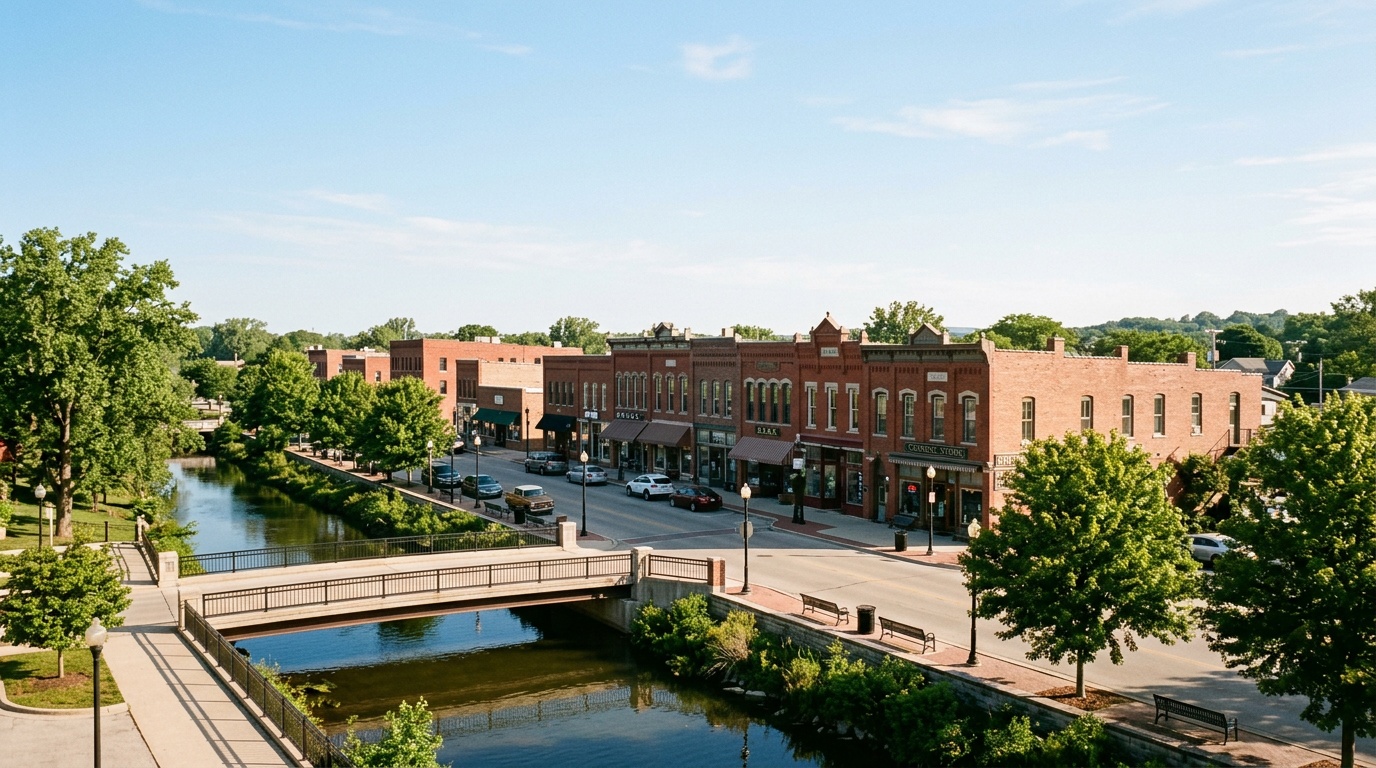
Plainfield, Illinois · K-12 Online Home School
School that grows with a Plainfield family.
An accredited, self-paced K-12 program for Plainfield families, built for commuters, growing households, and students who do better when the day fits them instead of a bell.
Every grade, one record
Start any week of the year
Placed by demonstrated skill
Self-paced, accredited
Start here
A fast-growing town, a school day that flexes
Plainfield is one of the fastest-growing towns in the region, full of newer neighborhoods, young families, and a long daily commute toward the city or the corporate corridor. A self-paced, accredited K-12 program sets the work for your student and lets the family own the hours, so the drive and the calendar never decide whether the school day happens.
The program serves families across Plainfield, Joliet, Naperville, and the southwest suburbs, with the same plan and the same accredited record behind every student. Start with how self-paced online high school works, or a plain look at online school versus homeschool versus public school. More about Plainfield.
Rural and long-commute families: the school comes to the house
A day that bends around two jobs
Learn more: the K-12 program
Placed by skill
One student, placed where they actually are
A child can sit above level in reading, on level in math, and still be building writing, all on the same day. The grid is a map, not a cage.
An example: one student, placed by skill the same day
Each subject starts where the student is, not where a birthday says.
Mid-year transfer panic: you don’t lose the year
The first month after a transfer
Week 1: enroll and place
Records reviewed, each subject placed by demonstrated skill.
Week 2: settle the routine
The family sets weekly targets and finds a rhythm.
Weeks 3-4: full stride
The student is working steadily, with no year lost in the move.
Learn more: what to know about a mid-year transfer
Why it fits here
A day that bends around a Plainfield commute
When the morning starts with a long drive and the evening fills with practice and work, a fixed bell fights the way families here live. Self-paced coursework lands in the hours you have, a strong student races ahead where ready, and a commuting parent can check the week from anywhere.
Two ways to run a school day
The deeper answer
Growth mindset, the honest version
Somewhere between the motivational poster and the actual science, “growth mindset” got a little lost. The original research never promised that believing harder would move you from struggling to thriving. It said that effort combined with the right strategy and useful feedback is what actually shifts a learner’s trajectory. Those three things together. Skip the strategy part, skip the honest feedback, and you just have a student who tries harder at the wrong approach and wonders why nothing changes. That is not growth. That is frustration with better posture.
What changes the equation is letting a student see, in real time, that their work is moving the needle. Mastery-based progress does exactly that. Instead of a calendar deciding when a unit closes, the work itself decides. A student who genuinely understands the material moves forward; one who needs another pass at a concept gets it, without penalty or embarrassment. Over weeks and months, that student builds something more durable than a grade: they build evidence, personal and undeniable, that effort plus the right approach actually produces results. That shift in self-perception is what the original research was pointing at all along. Our self-paced model is built on exactly this principle, because a student who watches their own progress accumulate learns to trust the process instead of fearing it. The poster can stay on the wall. The strategy has to be real.
Find your Plainfield family
Whatever brought you here, the model bends to it
Six of the most common reasons Plainfield families look at online K-12, and how a self-paced program answers each.
The commuter household
When the day starts with a long drive, the school day works around it, and either parent can open the record from anywhere.
Switching mid-year
You do not have to wait for fall. A counselor reviews the records and the student picks up at their real level on a clean record.
The student who is ahead
A strong student moves to the next course the moment a unit is mastered, with honors-level depth, instead of waiting on the middle of the room.
A day that actually sticks
A simple, repeatable rhythm anchored to real life, not a bell, is what makes a school week last past the first month.
Watching the budget
A home program removes much of the hidden spending around a daily commute. A counselor walks through what enrollment includes.
A family on the move
If life means another address, the accredited record is one continuous document that follows the family, with no gap to explain.
The deeper answer
Handing a teen the schedule, one week at a time
Handing a teenager the keys to their own schedule is less a single handoff and more a slow, deliberate climb. Start with the lowest rungs: let them choose when they attack each subject inside a window you still set. A student who decides “math happens right after breakfast” is already practicing planning, not just following orders. Once that holds for two or three weeks, release the window itself. Now they own the whole day, and the self-paced structure of their coursework becomes a genuine ally instead of a safety net you’re secretly holding. The real teaching moment, though, isn’t the smooth weeks. It’s the Tuesday they blew off an assignment and hit Friday staring down a pile. Resist the rescue. A missed target that carries a visible consequence writes a lesson no lecture can match. Your job shifts from scheduler to mirror: “Here’s what happened. What changes next week?” That question does more than any reminder ever could.
The checkpoints that keep momentum honest are simple and short. A Sunday five-minute review of the week ahead, a mid-week gut-check on pacing, and a Friday look-back that asks one question: did the plan serve you, or did you serve the plan? Students enrolled in a structured online high school already have curriculum timelines to anchor against, which makes those check-ins concrete rather than abstract. Ownership doesn’t arrive all at once. It accumulates, one well-held week at a time.
How it works
The whole model, in four moves
Talk
A fifteen-minute counselor call covers where your student is and what the year looks like.
Place
A counselor places each subject by demonstrated skill, not by birthday, so the work starts at the right level.
Plan
You get a written, subject-by-subject plan and a weekly target the student actually works toward.
Go
Start any week. Real teachers grade the work and answer questions on your student’s schedule.
The deeper answer
Handwriting and keyboarding both still matter
There is a reason surgeons still practice with their hands even though robots assist in the operating room, and that logic maps perfectly onto how students learn. Handwriting activates areas of the brain linked to letter recognition, memory encoding, and fine motor development in ways that typing simply does not replicate. Research from cognitive science suggests that students who write notes by hand retain information more deeply because the slower pace forces them to process and paraphrase rather than transcribe on autopilot. That is not nostalgia. That is neuroscience. At the same time, a student who cannot navigate a keyboard fluently in the modern academic world is working with one hand tied behind their back. Speed, formatting, research habits, digital communication, all of it lives on the keyboard, and fluency there is a genuine academic skill worth building deliberately.
So we do not pick a side. Pen-and-paper work lives alongside typed assignments because each one builds something the other cannot. Cursive and print train the hand-eye loop and reinforce phonemic awareness in younger learners. Keyboarding builds the automaticity that lets older students focus their mental energy on ideas rather than mechanics. Switching between the two is not inefficient. It is actually the kind of cognitive flexibility that sharpens a developing mind. Parents sometimes ask whether an online homeschool program can deliver real hands-on learning, and the honest answer is yes, because the smartest approach has always been to use every tool that works, not just the newest one on the shelf.
Learn more: the American curriculum
A week in practice
What a real week looks like
There is no homeroom and no bell, but there is a clear rhythm. On Monday the week’s targets are set. The student works in short, focused blocks, the heaviest subjects when they are freshest, and the record fills in as the work lands. A counselor watches that weekly target, so a slow stretch is caught early and a strong week is confirmed rather than wasted. Most students finish the academic core in fewer hours than a traditional day, because no one is waiting on a room of thirty to catch up.
A self-paced week, set by the family
- Targets set
- Math
- Reading
- Science
- Writing
- History
- Co-op
- Math
- Art
- Catch-up
- Review
The deeper answer
High school: the four-year sequence
High school hits different when the curriculum is actually built around the student rather than the other way around. Our online high school program covers all four years of core academics, which means language arts, mathematics, science, and social studies run as a connected sequence from ninth grade straight through to graduation, not a patchwork of disconnected courses stitched together each semester. Each course builds on the one before it, so a tenth-grader’s work in biology genuinely informs what they tackle in chemistry the following year. That kind of curricular scaffolding is what turns four years of seat time into four years of real intellectual growth.
The high school sequence also gives families something surprisingly rare: predictability with flexibility. Students know exactly which courses sit ahead of them, which credits they are earning, and how their cumulative record will look when they walk across that graduation stage. At the same time, the self-paced structure inside each course means a student who masters a unit quickly can keep moving, while a student who needs another pass at a concept gets that pass without penalty or embarrassment. Electives, fine arts, and practical-skills courses round out the sequence so the transcript reflects a full, well-balanced high school education, not just a survival checklist. Whether a family is switching from a traditional school, returning after a gap, or starting fresh, the four-year pathway is academically sound, fully accredited, and genuinely designed to carry students all the way to the finish line.
Ready when you are
See if it fits your family
A short conversation is the fastest way to know, with no pressure, just answers.
Kindergarten through senior year
One continuous record, every grade
The same program runs the whole way, and the level is set by what a student can do. Jump to any grade:
The deeper answer
Homeschool and online-school growth
The numbers do not lie, and they are moving in one direction. According to the online school vs. homeschool vs. public school lays out the differences without the spin. The growth figures are impressive on their own, but the more interesting story is why families keep choosing this path once they understand what it genuinely offers.
The course catalog
A full course load, online and self-paced
Elementary, K-5
Reading, writing, and number sense built carefully, one mastered step at a time.
Middle School, 6-8
The analytical turn: pre-algebra, real writing, and a student learning to own a plan.
High School, 9-12
A full accredited course load with honors-level depth inside the same self-paced structure.
The deeper answer
Honors and AP-equivalent coursework
Challenging coursework should not be reserved for students who can sit in a specific classroom at a specific hour. At our online high school, honors and AP-equivalent courses live inside the same self-paced structure that governs every other subject, which means a driven tenth-grader who has already mastered foundational algebra can move straight into advanced mathematics without waiting for a bell to ring or a new semester to start. No holding pattern, no artificially slowed lane, just the next logical challenge available the moment a student is genuinely ready for it.
The coursework itself carries real weight. Advanced sections go deeper into primary sources, laboratory reasoning, literary analysis, and theoretical frameworks than standard sections do, and the assessments are built to match that depth. Students build a cumulative record that reflects the actual level of work they completed, which matters when records are transferred, when families move between districts, or when a student transitions to a new school. Parents often worry that a self-directed format means academically ambitious students hit a ceiling early; the opposite is true here. The ceiling moves with the student, and the academic rigor travels right alongside the flexibility. Whether a student is working two grade levels ahead or simply wants to be pushed harder within their current year, advanced coursework is not a separate track students have to petition into. It is already there, waiting for anyone motivated enough to take it on.
The record that lasts
One accredited record, wherever life goes next
For a family that may move again, this is the part that matters most. The coursework is accredited, so the transcript is a professional document built to recognized standards and read cleanly by the next school. It is one continuous record across every grade and every move, with no gap to explain. A student who transfers in arrives at their real level, and a student who transfers out carries a transcript a registrar recognizes at face value.
What is on the accredited record
-
Course list and gradesEvery completed course, year by year
-
A cumulative GPACalculated and kept current
-
Descriptions a registrar readsStandards-aligned course descriptions
-
No gap across a moveOne continuous record, anywhere you go

A note from the Head of School
Do not wait for a semester to start. For a Plainfield family, the most useful first move is the fifteen-minute counselor call with your student’s most recent records in hand. We place by skill, subject by subject, and build the week around your real schedule.
Questions and answers
Plainfield online home school, in plain English
Is online home school legal in Illinois?
Yes. Illinois treats a home school as a private school. Families do not register with the state, seek approval, or sit state tests; you teach the same branches of education the public schools teach, in English. Authority: the Illinois State Board of Education.
Is the program accredited?
Yes. The coursework is accredited, so the transcript is a professional record built to recognized standards and read cleanly by the next school.
What about friends and activities?
A self-paced day frees up the hours a fixed schedule eats, which is why active families choose it. Co-ops, club sports, park-district programs, and city activities fill the daytime. Here is how online students build a social life.
Do you support an IEP or 504 plan?
Yes. The self-paced structure already provides extra time, a quiet space, and a flexible pace per subject. Bring the current plan to the counselor call and the routine is built around it.
How should we think about cost?
A home program removes much of the hidden spending around a daily commute and keeps the schedule open for a working parent. A counselor walks through what enrollment includes, and we are fully transparent about cost.
What if we try it and it is not working?
A struggling stretch gets caught by the weekly check and the counselor, the pace and support adjust, and the accredited record travels if a family decides to move on. No year is lost.
How much do I need to know to make this work?
Less than most parents fear. The school carries the instruction and the grading; the parent is a coach who keeps the rhythm, not a teacher who delivers the algebra. Not knowing the material yourself is fine, and on purpose.
What technology do we need to start?
A reliable laptop and a steady internet connection are the main requirements. Books and any hands-on materials are shipped to the house, so the day is a mix of on-screen and off-screen work.
How do I switch my child to online school mid-year in Illinois?
Yes, and you do not have to wait for fall. A counselor reviews the records, places your Plainfield student by demonstrated skill, and they pick up at their real level on a clean, accredited record. Here is what to know about a mid-year transfer.
How do I keep homeschool records in Illinois?
The coursework is accredited, so the transcript is a professional record built to recognized standards. Credits already earned transfer in after a counselor review, and the record reads cleanly for the next school or a college application. Here is how the record transfers.
Can an online homeschool student get a diploma in Illinois?
Students move through the accredited K-12 program and graduate on a record built to recognized standards. A counselor maps the path to graduation by demonstrated skill, so a student finishes when the work is done, not when a calendar says so.
How does a flexible online school schedule work for commuter families?
The school sets accredited coursework for your Plainfield student and the family owns the hours. Each subject is placed by demonstrated skill, a weekly check keeps the pace honest, and either parent can open the record from anywhere. Here is how self-paced works.
Is online homeschool a good option for gifted students in Plainfield IL?
Yes. A strong student moves to the next course the moment a unit is mastered, with honors-level depth, instead of waiting on the middle of a crowded room. Here is more on moving faster the right way.
The legal basics
In Illinois a home school is treated as a private school. Families are not required to register with the state, seek approval, give notice, or sit state tests; you teach the same branches of education the public schools teach, language arts, mathematics, the sciences, social studies, fine arts, and health, in English, and keep your own records. Compulsory attendance runs from age 6 to 17. Authority: the Illinois State Board of Education. Leaving a public school? A brief letter noting your child is enrolling in a private home school is the courteous step, and our accredited program keeps the cumulative record for you.
More Illinois cities we serve
Families across Illinois, one program
High School of America works with families all over the state. A few more cities we serve:
Get started in Plainfield
Whether your student is transferring mid-year or starting fresh, the first step is the same short conversation.
Get Your Enrollment Plan
Fill out the form below and an enrollment counselor will reach out within one business day.
Or call us: (888) 242-4262