Webb County, Texas · grades 9 to 12
Laredo Online High School
A change of school, not of story: every earned credit comes along toward an accredited diploma at 24 credits.

Laredo has a long habit of carrying on through a change of authority. The town was founded in 1755 as a crossing place on the Rio Grande, and in 1840 it was briefly the capital of the Republic of the Rio Grande, which is why locals count seven flags over Laredo instead of the six over the rest of Texas. The flag changed; the plaza, the families and the name stayed. A Laredo online high school record works on the same principle. The school your student answers to may change, and the credits already earned stay theirs. This page explains how that runs for a family in Laredo. It sits under our Texas online high school hub, which covers the whole state, inside our national online high school.
Saturday morning, every transcript on the kitchen table
Lay out every report card and transcript your student has, from every school, side by side. That pile is the starting point. A counselor reads all of it on the first call and turns it into one count toward 24 credits before any course is assigned.
Most families who call us from Laredo have a record that came from more than one place. Ninth grade at one campus, part of tenth at another, a semester somewhere else after a move. Nobody needs to apologize for that. A record with several letterheads on it is an ordinary record, and the job is to read it as one story rather than several.
That is the first piece of work, and it happens before anything else. The counselor matches each finished course to our catalog under our transferring credits rules, notes any course that was started and not finished, and writes down the number. Only then does a plan exist.
One record, three letterheads
- 1Transfer courses keep the term they were earned in.
- 2A half-finished course is entered as the half it is.
- 3Courses taken here follow, in order.
- 4The issuer is named at the foot.
Have the pile on the table already? Bring it to the call.
Online high school credits survive a change of school
Credit earned is credit kept. When a student moves to our online high school, the courses already passed are counted first and the plan begins from there, so nothing finished is assigned twice.
Families sometimes expect the opposite. They have heard about a student who changed schools and lost a semester, and they assume that is the price of moving. Here it is not how the process runs. The transcript is read before the first lesson opens, and the student starts on the course the count says comes next.
The flag over the plaza changed seven times. The plaza did not move. A transcript is the same: the school can change, and the record carries on.
There is a second half to the claim, and it matters just as much. Where a course on the old record carries a failing grade, it does not have to sink the plan. It can be taken again through credit recovery, which is built to close that one gap without repeating a whole year. Staying at a current school is often the right call, too, and we say so on the phone when it is.
Claim
Switching schools means starting the year over.
Reality
Finished courses are counted first, and the plan starts at the next open course.
Claim
A failing grade on the old record blocks the diploma.
Reality
That one course can be retaken through credit recovery without repeating the year.
Claim
Credits from years ago no longer count.
Reality
A finished course stays finished. The audit reads old records the same way as new ones.
A family-signed record, a school-issued diploma
A homeschool diploma is written and signed by the family. Our diploma is issued by an accredited school, on a transcript the school stands behind. Both are real routes; they hand the student a different kind of document.
Families searching for a home schooling diploma for Laredo often want to know what the family-run route involves before they choose. The guide on how to start homeschooling covers it plainly. If you are weighing online homeschool high school for Laredo, Texas, against the other routes, the page comparing online, homeschool, and public school sets the three side by side without a sales pitch.
| Question | Family-run homeschool | Our online high school |
|---|---|---|
| Who writes the transcript | The parent | The school |
| Who signs the diploma | The parent | The school |
| Who sets the courses | The family chooses everything | The student picks from a catalog, with a counselor |
| Who checks the work | The family | Graded in the course, with written feedback |
| Where earlier credit goes | Wherever the family records it | Counted first, onto one transcript |
The difference shows up later, when the student hands the record to someone outside the house. A school-issued record from an accredited online high school names its issuer at the foot, and that is the first thing an outside reader looks at. The full picture of the credential is on our online high school diploma page.
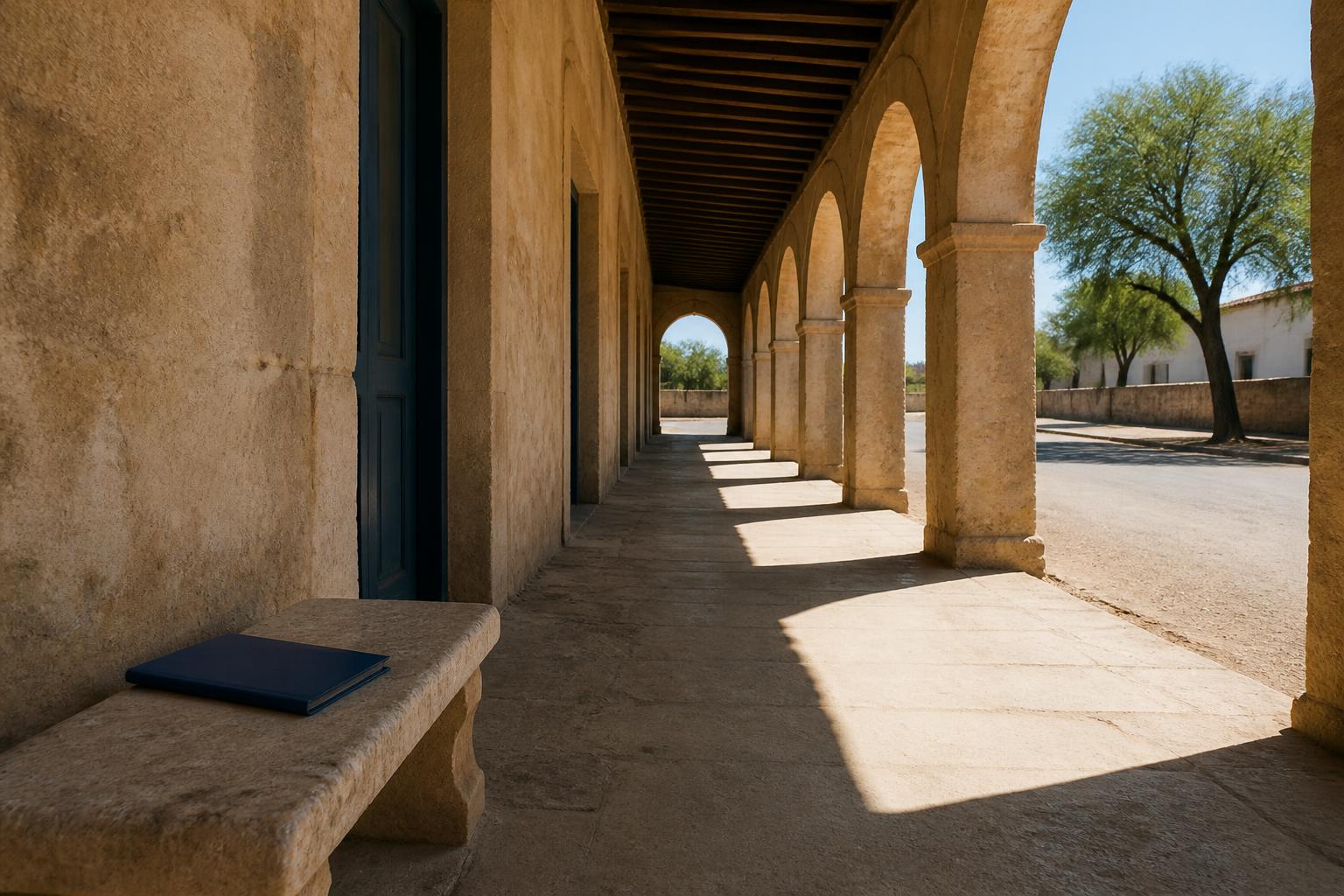
Old stone, new tenants, the same street. A record can carry on the same way.
If your student left high school before finishing
Whatever was earned before still counts. A student who left school a year ago, or several, starts with a credit audit like everyone else, and the plan picks up at the first course that is still open.
This is the most common call that begins with a pause. The student, or the parent, is not sure the old credits still mean anything. They do. Credit does not expire on a shelf. Our page on how to complete the diploma you started covers the questions that come up when the gap is measured in years, and anyone ready to finish high school online in Laredo, TX, follows the same three steps:
- Find the last record. Ask the last school attended for an official transcript, or sign a release on the first call and we request it.
- Let the counselor count it. Each course is matched, and the total toward 24 credits is written down for you.
- Open the next course. Work begins where the count says it should, not at the start of ninth grade.
Ready to see the count?
How do online high schools work near Laredo, TX?
A student logs in from home, opens a course, works through lessons that are already posted, and submits work for grading. Each finished course goes onto one transcript that the school issues, and 24 credits make the diploma.
That is the short answer to how do online high schools work near Laredo, TX, and our page on how does online high school work? walks a single course from the first login to the final grade. Nothing is broadcast at a set hour, so a missed morning is not a missed class. Every student has an assigned student services representative for questions about the account and the record, and a counselor on the very first call.
Geography does not change the mechanics. A family in the old San Agustín district downtown and one out past the edge of the city get the same courses, the same counselor process and the same diploma. The same program is described for students in San Antonio up the interstate and for families in Corpus Christi on the coast. One student’s four years might be drawn like this:
One student, four years, two schools
Laredo is a college town as well as a county seat, home to Texas A&M International University and Laredo College. A student who builds a working week around posted lessons is practicing the routine a campus asks for, which is a point about habits and not about admissions. County services for families are listed by Webb County, and the town’s longer history is told on Wikipedia’s Laredo article.
24 credits, counted in the order they were earned
Our diploma is earned at 24 credits. Credits from earlier schools are entered first, in the terms they were earned, and every course finished here is added after them, so the transcript reads as one history.
Families asking about a diploma for homeschoolers in Laredo, TX, often start with the number. For background on how credit totals work in general, see credits to graduate. For your student’s own count, the counselor reads the actual record. Here is what a receipt from that first read can look like:
The order matters because it is the order an outside reader expects. A transcript that lists transfer courses under their own terms, then our courses under theirs, tells the student’s story the way it happened. Nothing is hidden and nothing is double counted.
Each transfer course under its own term
Added as each one is finished
The school that awards the diploma
Open the next online high school course this week
Open the one course the plan says comes next, the week your student is ready. Courses here are self-paced, so a course does not wait for August or January and a student does not carry seven at once unless they want to.
Some students run five courses side by side; others take two, finish them and request two more. Both work for a self-paced online high school in Laredo, and the choice can change month to month. Here is part of the catalog of high school courses a request draws from:
- English
- English 1, English 2, English 3
- Mathematics
- Algebra 1, Geometry, Algebra 2
- Science
- Biology, Chemistry, Physics
- Social studies
- World History, United States History, U.S. Government
The full list, with electives, is in the course catalog, and the way those courses fit into four years is set out in our American curriculum. Online high school programs near Laredo often have to cover a whole household, and ours do: the same catalog sits behind our K-12 online homeschool programs, and the statewide picture for younger brothers and sisters is on our Texas online homeschool page.
Know which course comes next?
Late October, a tenth grader finishes ninth-grade English
It is a Tuesday in late October. The audit found English 1 still open, so your student is finishing it alongside tenth-grade work. Nobody is held back a year; the record simply catches up.
Grade labels matter less here than in a building, because the next course is chosen by the record, not by a birthday. A student can join at any grade from 9 to 12 and you can start any month, so a mid-year move is an ordinary start. Each grade has its own page:
- Ninth grade. The foundation year, usually English 1, Algebra 1, Biology and World History. See ninth grade online; a Laredo Texas online high school plan often begins here.
- Tenth grade. Geometry and English 2 tend to lead. See 10th grade online.
- Eleventh grade. Usually the fullest year of the four. See 11th grade online.
- Twelfth grade. Government, the last English course and whatever the audit says is still open. See 12th grade online.
Grades 9 through 12, any month
Cost is the other question on most lists, and how tuition works explains the structure; the counselor quotes the exact figure for your student’s grade on the call. If you want the whole school before you pick up the phone, start at our online school.
Start this month, from wherever the record stands.
Questions Laredo families ask before the first call
My student attended three different schools. Is that a problem?
No. Each record is read on its own terms and every finished course is counted. The result is one transcript that lists the earlier schools’ courses first and ours after them.
What if one of the old schools has closed?
Records from a closed school are usually held by a district office or another records keeper. Tell the counselor the school’s name and the years attended, and we will help you work out where to ask.
Does a course that was half finished count for anything?
Often, yes. A finished semester can count as a half credit in our count, and the student completes the remaining half here instead of starting the course over. The counselor confirms it course by course.
Will the diploma show the names of the earlier schools?
The diploma is issued by our school at 24 credits. The transcript behind it shows where each transfer course was earned, which keeps the record honest and easy for an outside reader to follow.
Who does my student talk to week to week?
Lesson questions go through the course, and graded work comes back with written feedback. Schedule and account questions go to the assigned student services representative, and planning questions go to the counselor.
Bring every report card you have. We will read them as one story.