Corona K-12 online home school, built around the commute, not the bell.
In a Circle City where a great many families spend two hours a day on the freeway, the school day should give those hours back, not pile on top of them.
Corona is a commuter town by design: a fast-growing Inland Empire city where a great many parents drive to Orange County or Los Angeles and back, leaving before the kids wake and getting home after dark. The fixed 8-to-3 bell adds a second rigid schedule on top of a brutal one, and something has to give.
A self-paced, accredited K-12 program runs on a different clock. Mastery moves the student up, not the calendar; the work is asynchronous and done in the windows the family has; progress is measured against the standard rather than the hour. Here is the complete guide to getting started.
It is not a lighter year, and it is not a parent turned teacher. The teachers are ours; the family keeps the rhythm, and a counselor keeps the year on track. Only the timeline flexes; the standards and checkpoints hold exactly where they belong.
The record stays one continuous document, the same one every student carries, and it moves with the student to any California school. The day finally runs on the family’s clock instead of fighting it.
What a year like this protects is the student’s relationship with learning. A child who spends years waiting through a pace set for someone else learns that school is something done to them on a clock. A child who moves at their real pace learns the opposite: that effort and curiosity actually move the needle, and that being stuck for a week is a normal, fixable part of the work rather than a verdict. In a Corona household with real demands on its hours, that is the difference worth building a childhood around.
How much school the week actually takes.
An honest look at focused hours per week by grade band, shipped-science time included. Self-paced trims the seat-time a fixed bell cannot, which is part of why the day fits a working Corona household.
Figure 1 · Typical focused hours per week, by grade band. Approximate; a counselor sets the real plan per student.
Online school that flexes around a working shift.
A great many Corona parents work hours that never lined up with a 3 p.m. pickup: warehouse and hospital rotations, early starts, swing shifts, a second job across town. The school day was built for a household that no longer exists.
Self-paced and asynchronous, the core work lands in the focused blocks the family actually has, early, midday, or evening, around the rotation. The schedule absorbs the shift instead of pretending it isn’t there.
A counselor reviews pacing on a regular cadence, so a heavy or overnight week is planned around and made up, not lost. The flexibility is engineered, not improvised, which is the difference between a self-paced school that works and one that quietly drifts.
One online school for every child in the house.
Plenty of Corona households run more than one student at once, often grades apart. The old model means a different campus, a different bell, and a different drive for each child. One accredited online homeschool holds all of them on one platform, with one counselor and one weekly rhythm.
Each child is still placed and paced independently, by skill rather than birthday. The third-grader works phonics while the ninth-grader works geometry, same morning, neither waiting on the other. The logistics relief is the part parents feel first: one login, no three-campus shuttle, one calendar the school bends around.
It also changes how the day feels. Siblings keep their own pace instead of one waiting on another, and the home runs on a rhythm the parents already manage rather than several school bells pulling in different directions. When one child races ahead and another needs a slower week, both happen on the same morning, each on their own record.
For the Corona student who is already ahead.
Not every student who is restless in class is struggling. Plenty are bored, finished with the chapter while the room is still on page one. A pace set for the middle of thirty students is the wrong pace for that child, and the fix is rarely more worksheets.
Mastery, not the calendar, decides when a student moves here. A child who is ahead keeps going into the next unit and the next course the moment the work is mastered, with honors and AP-equivalent options inside the same self-paced structure. They are not held to a grade-level average or made to wait for a room of thirty. It is a property of the model, not a separate gifted program.
What it protects is the student’s relationship with learning. A child who spends years waiting through a pace set for someone else learns that school is something done to them on a clock; one who moves at their real pace learns the opposite, that effort and curiosity actually move the needle, and that being stuck for a week is a normal, fixable part of the work rather than a verdict.
The parent’s real job: coach, not teacher.
The fear on nearly every first call is the same: “I work long hours and I never took calculus. How am I supposed to teach this?” The short answer is that you are not. The teaching is ours. The teachers plan the courses, grade the work, and answer the questions, on the student’s schedule rather than at a single bell.
The Corona parent’s job is rhythm, not instruction: keep the day on track, make sure the materials are out, and ask whether the work got done. If a child hits a wall, the teacher is the resource, not you. A counselor reviews pacing on a regular cadence, so a flexible week never quietly drifts into a gap.
It protects the relationship, too. A parent who is the encourager rather than the enforcer of algebra gets to stay on the child’s side of the work; the hard conversation about a missed concept happens with the teacher, where it belongs, and the parent stays the person who asks how the day went and means it.
The Corona online K-12 curriculum, grade by grade.
The full course of study, subject by subject across the four grade bands. A student is placed by skill, not birthday, so the grid is a map, not a cage. It is the American Curriculum framework underneath, with honors and AP-equivalent options where a student is ready. For families weighing the move, here is an honest comparison of online school, homeschool, and public school.
| Subject | K–2 | 3–5 | 6–8 | 9–12 |
|---|---|---|---|---|
| English | Phonics & fluency | Reading to learn, writing | Literature & argument | Composition, honors options |
| Mathematics | Number sense | Fractions & operations | Pre-algebra to Algebra I | Geometry, Algebra II, Precalculus, Calculus |
| Science | Observation & inquiry | Scientific method | Life & physical, shipped lab kits | Biology, Chemistry, Physics |
| Social Studies | Community & maps | US & world geography | World & US history, civics | US History, Government, Economics |
| Electives | Art & music | Intro languages | World languages, computer skills | Computer science, visual & performing arts |
Every grade has its own page, from kindergarten through elementary, middle school, and high school. New to this with a young child? The K-5 parent guide is the place to begin, and the counselor walks through placement in detail.
Every grade and class, kindergarten through twelfth.
The full K-12 catalog. Each grade has its own page, and the counselor places a student by demonstrated skill, subject by subject.
How a self-paced online home school actually teaches.
A self-paced day is a method, not a shortcut. Here is how each part of the K-12 day runs for a Corona student. New to all of this? Start with the complete guide to getting started.
Two rigid schedules were one too many. The school day is the one that can bend.
Two paces, one cumulative record.
We accommodate students with an active IEP or 504 plan and work with families on the specific accommodations the plan calls for. The starting point for any Corona family bringing an existing plan is a counselor call: the counselor reviews the plan, walks through how the accommodations land in the K-12 curriculum, and aligns the student’s pacing and supports to what it asks for.
Twice-exceptional learners are advanced in some subjects and need extra support in others. The self-paced mastery model runs both at once, on the same day, without either pace becoming the wrong one. What the school does not do is replace the clinical specialists a family already works with; it works alongside that ecosystem. For some students the calmer setting matters in its own right, and online learning can be a safer, more supportive environment.
The worry every parent raises first, whether a child online will have a social life, has its own answer too: here is how online students actually socialize, on their own schedule and often with more time for it than a seven-period day allows.

On a school day that bends around the drive.
Most first calls I take from a Corona family come down to the commute. Two parents on the freeway, a child whose school day starts before either of them is home, and a sense that the family is running two rigid schedules when it can only really keep one.
Self-paced is what fixes that. The core work lands in the blocks the family actually has, the standard never moves, and the counselor verifies the week so a flexible day never drifts into a gap. The student who is ahead keeps going; the one who needs a week takes it.
Bring the real week to the call: the drive, the hours, the kids at different grades. We build the year around the household you actually run, and we start there.
Sixty seconds with the Head of School.
What K-12 online home school in Corona costs.
The financial side is a real conversation, and the right place to have it is a one-to-one counselor call, not a table posted on a webpage.
For exact numbers and a written plan, schedule a counselor call. Fifteen minutes by phone. No pressure.
Corona online home school questions, answered.
Both parents commute and the day is already packed. How does self-paced help?
It removes the second rigid schedule. The work is asynchronous, so the core lands in the focused blocks the family actually has rather than at a fixed bell. A counselor reviews pacing so a heavy week is planned around, and the standard never moves.
Is “self-paced” watered down?
No. The coursework, standards, and checkpoints are fixed; only the timeline flexes. A counselor verifies pacing on a regular cadence so a fast pace never turns sloppy and a slow week never turns into a gap.
My child is years ahead. Can they move faster?
Yes. Mastery, not the calendar, decides when a student moves up, so a child who is ahead keeps going into the next unit and the next course the moment the work is mastered.
I work long hours. Do I have to teach the lessons myself?
No. The teachers are ours; they teach, grade, and answer questions. Your job is rhythm, not instruction. A counselor reviews pacing so a flexible week never drifts into a gap.
Can my student transfer back to the Corona-Norco Unified district later?
Yes. The accredited cumulative record transfers to any receiving California school. The counselor provides the transcript with completed work and standards-alignment notes for the district’s intake.
How does placement work, by age or by skill?
By demonstrated skill, subject by subject, not by birthday. A student can sit at different levels in different subjects on the same day. The counselor sets initial placement and adjusts as the student moves.
Can we start in the middle of the school year?
Yes. Enrollment is year-round, so a student can begin any day. The counselor reviews prior records first, so the student picks up at their real level rather than at the start of a term.
What does a K-8 student get at the end of 5th and 8th grade?
A promotion certificate at the end of 5th grade and another at the end of 8th. The cumulative record continues uninterrupted through high school.
How long is the counselor call, and what does it cost?
Fifteen minutes by phone. No commitment after. The counselor walks through where the student is in each subject, what the year would look like, and what enrollment would take.
Still have questions? See the complete online-school FAQ and the admissions requirements for an online K-12 school.
What the first call actually covers.
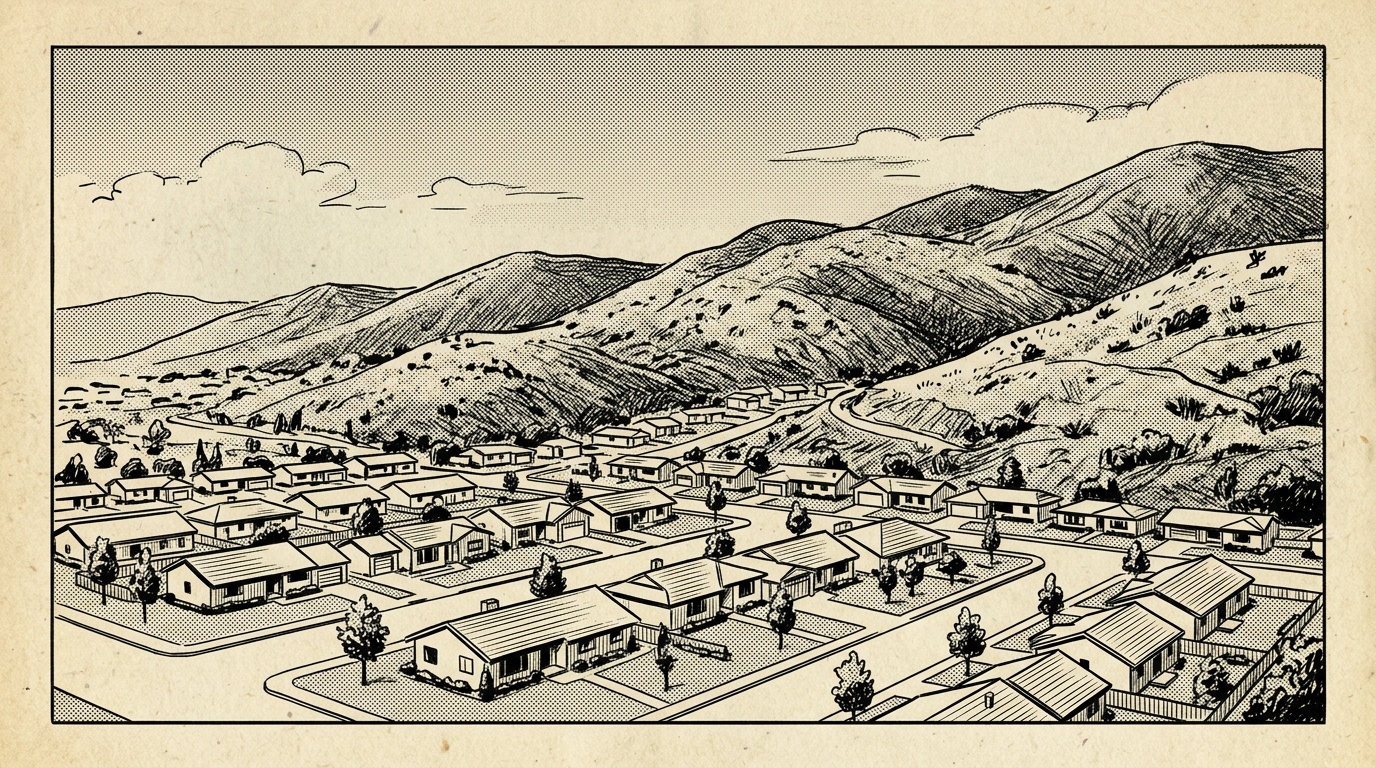
a Corona foothill neighborhood with the Santa Ana Mountains rising beyond.
The first step is a fifteen-minute phone call with a counselor. No commitment, no pressure, nothing to prepare. It covers where your student is now, their real level in each subject and any prior records; what the year would look like, how the self-paced day runs and where honors or acceleration fit; how it fits your family, the weekly rhythm around your real schedule and the parent’s coaching role; and what enrollment takes, the honest cost conversation and the few steps to start.
Corona, California.
A landmark for context. The school itself is online, available wherever a Corona family lives.
Sources & local references: Corona on Wikipedia · California Department of Education · Norco College
HSOA in nearby California cities.
Each city has its own page. The school is online, available wherever a family lives in California.
The door does not close in September.
Enroll any day of the year. Start with a fifteen-minute call and the counselor builds the year around your family.