Taylor County, where the stories stand on the sidewalk
Abilene Online High School
Grades 9 through 12, in lessons that stay on the page for a second read.
Begin an applicationBook a counselor callSend me the details
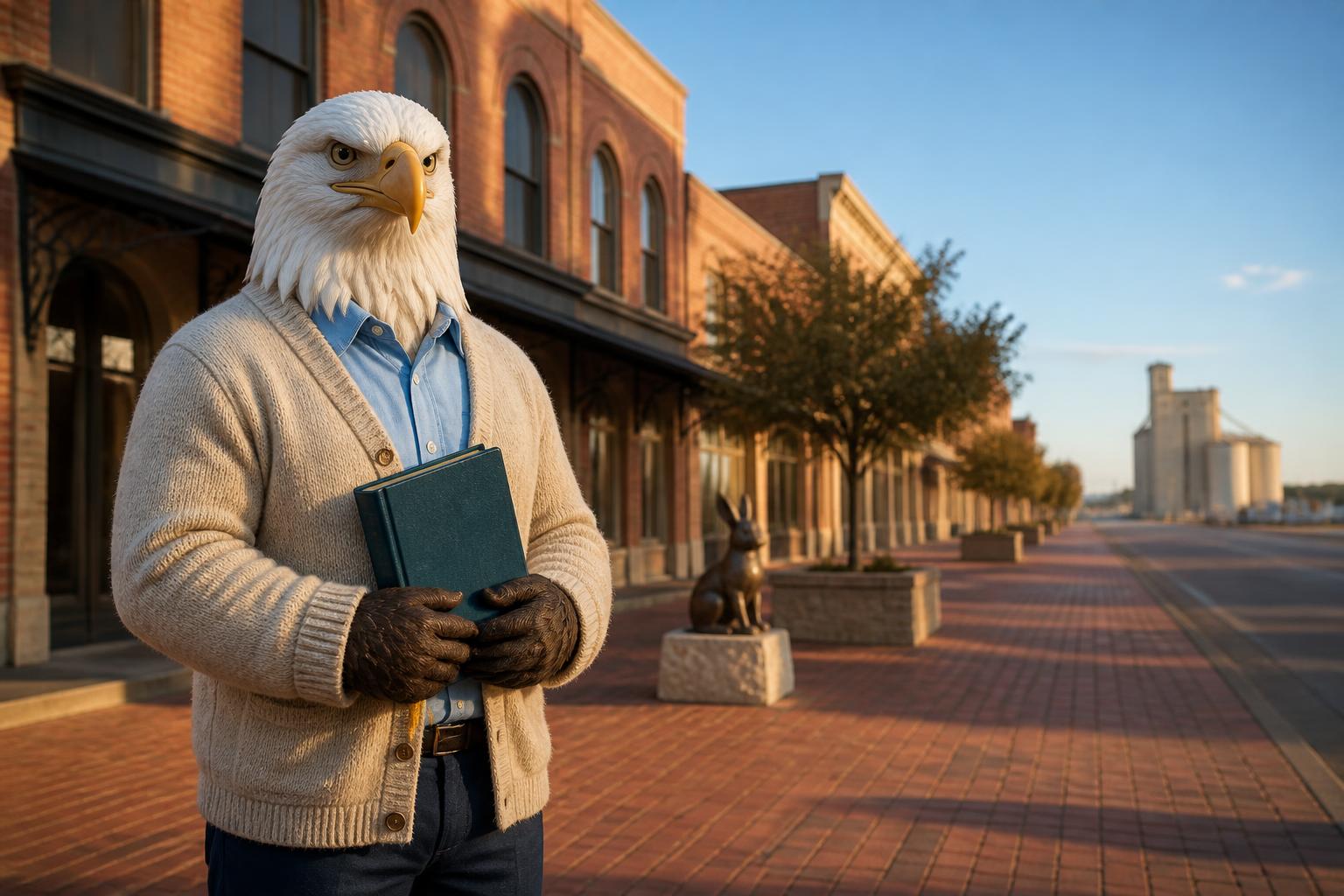
In Abilene, the stories stand on the street. In 2015 the Texas Legislature named the city the official Storybook Capital of Texas, pointing to the sculptures of picture-book characters set along the downtown sidewalks and to a museum, the National Center for Children’s Illustrated Literature, that collects the original art from those books. A sculpture on a corner is still there tomorrow. A reader can walk back, look again, and catch what slipped past the first time.
That habit, going back to the page, is the part of online high school almost nobody explains, and it is what this Abilene online high school page is about. We are an online high school for grades 9 through 12, and this is one city under our Texas online high school hub. The city began in 1881 as a stock shipping point on the Texas and Pacific Railway, named for the Kansas cattle town at the end of the trail, and it has been the Taylor County seat ever since. The families reading this live in a railroad town turned college town, and they mostly want to know one thing: how does a student learn from a screen?
Page one
Tuesday at nine, inside an online high school course
A student signs in, opens the next lesson in a course that is already built, reads it, does the practice, and turns in the graded work. Nothing is broadcast at a set hour, so the lesson reads the same at nine in the morning as it does at four in the afternoon.
Picture a Tuesday on the north side of town. A 10th grader sits down with a mug of coffee and opens Geometry exactly where yesterday stopped. There is no bell and no roll call. There is a lesson, written out in full, with worked examples and a short set of problems after it. The longer walk-through, with what a course screen looks like, is on our page answering how does online high school work? The short version is four moves:
- Read the lesson through once. All of it, start to finish, before touching a problem, to see where it is going.
- Work the practice. The ungraded problems are where a student finds out which paragraph did not land.
- Turn back to that paragraph. This is the step a classroom cannot offer twice. The explanation is still there, word for word.
- Submit the graded work. It is marked and returned with written feedback, and the next lesson opens.
A specimen week for one 10th grader, built for this page. The dark squares are the turn-backs: the lesson read a second time before graded work.
A week like that one is not a rule. It is what a steady pace tends to look like once a student has learned to treat rereading as part of the job rather than a sign of trouble.
Page two
Lecture heard once, high school lesson read twice
Self-paced means the lesson waits for the student. In a self-paced online high school course a student can read a unit as many times as it takes before the graded work, and nobody else’s speed turns the page for them.
A spoken explanation in a room goes by once. That is not a criticism of anyone who teaches that way; it is how speech works, and a good lecture is a fine thing. But the student who lost the thread halfway through has two choices: ask in front of thirty people, or carry the gap home and hope. A written lesson removes the choice. The step that was missed is on the screen, the same as it was an hour ago, and the student can go over it at the speed of their own attention. That is the practical heart of self-paced online high school, and it matters more to most students than the flexible hours do.
What families expect, and what the week is actually like
Claim
Online school means sitting through videos all day.
Reality
Expect a lot of reading. The lessons are written out, and a written lesson can be read again.
Claim
A slower reader will fall behind the class.
Reality
There is no class to fall behind. A unit takes as long as it takes, and the course waits.
Claim
Self-paced means nobody notices a stalled course.
Reality
An assigned student services representative follows the plan and reaches out when a course goes quiet.
Rereading is not remedial. It is how written material is meant to be learned.
Parents ask me whether their student reads well enough for online school. I ask whether the student will go back and read it twice. The second answer predicts more than the first.
None of this means a student is left alone with a stack of text. An assigned student services representative follows the plan, and a course that goes quiet for too long gets a message. The reading is the student’s; the watching is ours.
Page three
Can you finish high school where you left off?
Yes. Credits a student already earned stay earned, and the work to finish high school online starts at the first course still missing, not at the beginning of 9th grade.
A transcript works like a ribbon bookmark. Closing the book for a while does not lose the place; the ribbon is still in it. A student who stopped school in the middle of junior year, or after a hard semester, or because a family moved and the timing never came right again, has a record that says exactly which courses were passed. That record is the starting point, and the way back is laid out on our page about how to get back on track to a diploma.
Where the ribbon sits decides what comes next:
- Stopped partway through a semester
- Courses that were finished count. Courses that were open are usually started fresh, because a half-finished course carries no credit anywhere.
- One course failed, the rest passed
- Retake that one course on its own. Credit recovery means redoing the single class, not the year around it.
- Left after 11th grade
- Often a handful of courses from the end. A counselor names them on the first call, in writing.
- Records from more than one school
- Every transcript is read on its own and counted together, so nothing earned at an earlier school is lost in the shuffle.
Know where your student’s bookmark sits? Begin an application(888) 242-4262
Page four
Learn to read a course before high school begins
Spend the first weeks of 9th grade online learning how a course is laid out: where a unit begins, where the graded work sits, and how to find a lesson again before a quiz. That skill carries every course after it.
Most students arrive at high school knowing how to read a chapter. Fewer know how to read a course, which is a longer and more structured thing: a sequence of units, each with its own lessons, practice and graded work, building toward an exam. A 14-year-old who learns the shape of one course in September can find their way through the next twenty without help. Our page on ninth grade online covers that first year in full, and each later grade has its own:
- 9th grade onlineLearning the shape of a course, and starting the four-year sequences in English and math.
- 10th grade onlineLonger readings, more writing, and the first year a student paces a full load alone.
- 11th grade onlineThe densest lessons of the four years, and the year rereading pays most.
- 12th grade onlineOnly the courses still missing, ordered so the last term stays light.
Page five
Online high school programs written to be reread
Every course is built ahead of time, unit by unit, so the whole course is there from the first day and any lesson can be opened again weeks later, during review or right before an exam.
That design is deliberate. A student preparing for a final in Biology can go back to the October unit on cells and read it exactly as it was first taught, not as someone remembers teaching it. The lessons follow the American curriculum, and our K-12 online homeschool programs keep one structure from grade to grade, so a junior is not relearning how a course works. Here is the four-year spine most diplomas are built on:
The four-year spine
These are the online high school courses families ask about most, each with its own page listing the units. The full high school courses catalog holds the electives and the rest:
- English 1
- English 2
- English 3
- Algebra 1
- Geometry
- Algebra 2
- Biology
- Chemistry
- Physics
- World History
- United States History
- U.S. Government
English carries the heaviest reading, so it is the course where the turn-back habit shows first. Students who build it there tend to bring it into history and science without being asked.
Page six
If you homeschooled through eighth grade in Taylor County
Then your student already knows how to learn from a book at a kitchen table, which is most of what online high school asks. Bring a list of what 8th grade covered to the first call, and a counselor will place 9th grade from it.
Families who taught the middle grades at home often reach this point weighing a homeschool curriculum for 9th graders against handing high school to a school. The habits they built carry straight over: reading without a lecture first, working through a problem set alone, asking for help in writing. What changes is that the courses are graded by someone outside the family and recorded on a transcript we issue. If you are still deciding how the home years should run, how home education programs work sets out the options plainly.
| At home through 8th grade | In our 9th grade |
|---|---|
| A parent chose the books | The course is built and sequenced already |
| A parent checked the work | Graded work comes back with written feedback |
| Progress lived in a notebook | Every finished course goes on a transcript |
| The pace followed the family | The pace still follows the family |
The last row is the one most homeschooling parents ask about, and the answer is that it does not change. Self-paced was always how your student learned.
Page seven
24 credits, and the diploma a homeschooler can show
Our diploma takes 24 credits and is issued by an accredited school, so a student who homeschooled first finishes with a school-issued transcript and diploma rather than a family-issued one.
Twenty-four is our requirement, the same for every student. What the state of Texas or a district asks for is theirs to say, and we do not speak for it. A credit is one full-year course; a half credit is one semester. A student who homeschooled 9th and 10th grade and joins us for 11th has those years read course by course, and whatever counts is counted. The general picture of how many credits to graduate is on its own page, as is what our online high school diploma is and how it is issued. If the word accredited is the sticking point, we wrote out what accredited actually means in plain terms.
What the record shows
- 1The issuing school, named on every page.
- 2Each course with its own credit and grade.
- 3Homeschool years read in course by course, not as a lump.
The transcript is the document that travels. It lists each course with its credit and grade and names the school that issued it, which is what a reader on the other end looks at first.
Page eight
Sunday evening, two roads to a home school diploma
A family that keeps homeschooling through 12th grade writes the high school record itself; a family that enrolls hands the record to a school that issues it. Both are real choices, and the difference is whose name is on the transcript.
Picture the dishes done and two parents at the table with a rising 9th grader’s notebooks spread out, trying to decide. The home road keeps every choice in the family and puts the paperwork there too: the course descriptions, the grades, the transcript, the diploma. The school road gives that paperwork to someone else and keeps the kitchen table as the classroom. Families who want to look at the home road properly first should start with the homeschooling starter guide, and those weighing all three paths side by side can read our comparison of school options.
Three questions for the kitchen table
Do you want to write and sign the high school record yourselves?
Does your student learn well from written lessons?
Do you want the transcript issued by a school?
Closing this page and staying at home can be the right answer.
Either answer can be right. A counselor will say so if the honest advice is to keep going at home.
Page nine
Credits brought in, online high school courses still ahead
Send the records first. A counselor reads them on the first call, counts what transfers toward our 24, and only the courses still missing are assigned. Applications are open all year, so a student can start any month, mid-year included.
A family moving to Abilene for a job at a hospital or one of the three universities rarely moves in August. That does not matter to an Abilene online high school student, who starts when the family is ready. The steps are short: apply, send whatever transcripts exist, take the counselor’s call, and get the count in writing. Our transfer credit review explains how each course is read, and the admissions steps are laid out one at a time.
Every month is a start month
Cost is the other question on that call. Tuition is published, payment plans exist, and the figures are on our tuition and payment plans page, where a family can read them before anyone phones. Some of what a family spends on a building schedule, the midday drives and the shifts turned down, is set out under what families save.
Ready for the count? Book a counselor call(888) 242-4262
What do Taylor County families ask before they enroll?
Is this part of Abilene ISD or another district here?
No. We are a private online school that issues its own diploma, with no tie to Abilene ISD or any other district in Taylor County. Those schools serve a great many students well, and we speak only for our own.
My student reads slowly. Will online high school be too much?
Slow is not a problem in an Abilene online high school course, where there is no class to keep up with; a unit simply takes longer. What matters more is whether the student will go back over a lesson that did not land. Tell the counselor on the first call, and the course load can be set to fit.
Who reads my student’s work?
Graded work is marked and returned in writing. For everything else, pace, the plan, the next course, there is an assigned student services representative, one named person who knows the student’s file.
Are there colleges close to home for after the diploma?
Several. Abilene Christian University, Hardin-Simmons and McMurry are all in the city. We make no claim about what any college decides; our transcript is issued by an accredited school and read like any other.
Can a student start in the spring?
Yes. A course begins on the day the student opens it, so a February or April start is ordinary, and the credits already earned that year at another school are counted first.
What about the younger children in the house?
Our online K-12 school starts at kindergarten, and families with students below 9th grade can begin at the Texas K-12 online home school page.
Open the first online high school course this month
There is no fall deadline to wait for at this Abilene online high school. Apply, send what records you have, and let a counselor count them against the 24. The first lesson will be waiting, written out in full, and it will still be there the second time your student reads it.
Our other West Texas and Central Texas city pages are each written for their own families: Lubbock to the northwest, Killeen to the southeast, and Amarillo farther up on the plains.