Tarrant County, Texas
Arlington Online High School
Courses requested when your student is ready, delivered wherever they are, toward an accredited diploma at 24 credits.

Arlington made a decision about getting around that happens to describe this school. In December 2017 the city ended a fixed-route bus pilot and started an on-demand ride service instead: you ask for a ride when you need one, and it comes to where you are. Since August 2023 it has been called Arlington On-Demand, and it covers the whole city. An Arlington online high school works on that same idea. A course starts the week your student requests it, the lessons arrive wherever your student is, and each finished course is written onto one transcript. This page covers how that runs for a family in the city, and it sits under the Texas online high school hub, which covers the state as a whole, inside our national online high school.
Arlington online high school runs on demand
Your student requests a course, the course opens, and the work is done at whatever hour fits. Nothing leaves without them, and nothing waits at a stop for a bell. When a course is finished, its credit goes on the transcript, and 24 credits make the diploma.
A route is a promise about time and place: the bus will be at this corner at 7:12, and a rider who is there gets on. That works for a great many people, and a school building works the same way for a great many students. A route asks the rider to fit the schedule. On demand turns that around: the rider says when, and the service fits the ride to the person.
That is what self-paced means in practice here. There is no first-period start time, no lesson broadcast at a set hour that can be missed, and no semester calendar a course has to be squeezed into. Lessons are already posted when a course opens. Work is submitted when it is ready, graded, and returned with written feedback. A student who needs three weeks for a chapter takes three weeks; one who finishes a unit in four days moves on.
A route tells the rider when. On demand lets the rider say when. A course here starts on the same terms.
The support around the coursework is the part a family can count on. Every student has an assigned student services representative who answers questions about the account, the schedule and the record, and a counselor is on the very first call, before any coursework is assigned.
Want to talk it through before anything is decided?
24 credits to an accredited online high school diploma
Our diploma is earned at 24 credits. Each course is worth its own credit, credit from an earlier school is counted first, and the diploma is issued by the school, not assembled at home.
That last point matters for families weighing an online high school diploma against teaching high school themselves. A homeschool record is a document the family writes and signs. Our transcript and diploma are issued by an accredited online high school, so the record a student hands to an employer, a training program or a college admissions office is one the school stands behind. If you are looking into a home schooling diploma in Arlington, TX, and want to see what the family-run route involves, the guide to getting started with homeschooling lays it out plainly; the full picture of our own credential sits on the online high school diploma page.
Nine credits counted from the old transcript before any work was assigned. Fifteen courses to request, in whatever order the plan sets.
A number on its own is not much use, so here is the question families ask next: how many of the 24 are already done? The answer comes from a credit audit, which is the first piece of work a counselor does. For background on how credit totals work in general, see the credits you need; for our count, the counselor reads the actual transcript.
| On the first read of a transcript | What the counselor is checking |
|---|---|
| Course titles and terms | Which completed courses match courses in our catalog, and which are partial |
| Credit earned per course | Whether a semester counts as a half credit or a full one in our count |
| Grades | Which courses carry forward and which may be worth retaking through credit recovery |
| The issuing school | That the record came from the school itself, so it can be entered as transfer credit |
- 1Transfer courses are entered with the credit they earned, so the record shows one history, not two.
- 2Each course carries its own credit the moment it is finished, whatever month that is.
- 3A course still open is shown as in progress, never as a gap.
- 4The issuing school is named at the foot, which is what an outside reader checks first.
Fixed route or on demand: two high school shapes
Both shapes can end in a diploma. A fixed route runs on a shared timetable; on demand runs on the student’s. The right one depends on the student, and plenty of Arlington students are well served by the route they are on.
Families do not usually need persuading that online school exists. What they want is a straight description of the trade, so here it is in one table. If you want the wider picture, including teaching at home, our page on an honest comparison of the options covers all three without a sales pitch, and how does online high school work? walks through a course from the first login to the final grade.
The table leaves out one thing that is easy to miss. Online homeschool high school near Arlington is often described as if the student is alone with a screen. In our setup the student has a counselor, a student services representative and graded feedback on every piece of work; what they do not have is a timetable someone else wrote.
Request high school courses the week you are ready
Pick the course your student needs next and open it. Online high school courses here do not wait for August or January, and a student does not have to carry a full load of seven at once.
Some students take five or six courses side by side. Others take two, finish them, and request the next two. Both are on the table for Arlington TX self-paced online high school, and the choice can change from one month to the next. The asynchronous coursework is what makes that possible: the lessons are posted and waiting, so a course is never behind a timetable. Here is part of the catalog of high school courses, by subject, so you can see what a request looks like.
- English
- English 1, English 2, English 3
- Mathematics
- Algebra 1, Geometry, Algebra 2, Pre-Calculus
- Science
- Biology, Chemistry, Physics
- Social studies
- World History, United States History, U.S. Government
- Arts
- Art History and Criticism
The full list, with electives, lives in the course catalog, and the way the courses fit together is set out in our American curriculum. The same catalog sits behind our K-12 online homeschool programs, so a younger sibling in the house works inside the same system.
If your student arrives with credits from another school
Send the transcript first. Every transfer credit is counted before a single assignment is set, so your student never repeats a course they already passed, and the plan starts from what is done.
Many students who come to us are partway through high school somewhere else, and plenty arrive mid-year. That is an ordinary start, not an awkward one. Here is what happens, in order:
- Request the record. Ask the current school for an official transcript, or sign the release on the first call and we request it.
- The counselor audits it. Each course is matched to our catalog under our transferring credits rules, and the count toward 24 is written down.
- Gaps are named. A course with a failing grade can be taken again through credit recovery, so the gap closes without repeating a whole year.
- The first courses open. Only then does work begin, starting with whatever the audit says comes next.
A student who left school some time ago works the same way. Whatever credit is on record counts, and the plan picks up from there. If that is your situation, our page on how to finish your diploma online covers the questions that come up when the gap is measured in years rather than weeks.
Have a transcript in hand? Start with the audit.
Weeknight in Arlington, the high school lesson already posted
It is 7:40 on a Wednesday evening. The shift ended at six, dinner is done, and the chemistry lesson your student opened on Monday is right where they left it. Forty minutes now, an hour tomorrow morning.
Arlington sits between two downtowns, and a lot of households here are pulled in both directions at once: one parent working toward Fort Worth, one toward Dallas, a student with a part-time job somewhere along the way. A school day fixed from 8 to 3 has to be fit around all of that. An on-demand week is fit the other way round. This is one student’s week, drawn as a grid:
Dark cells are a part-time job. Every other cell is open, and the student chose which ones to fill.
Nothing in that grid is a requirement. It is one shape among many. A student who trains in a sport in the mornings would shade the grid differently; so would one who looks after a younger sibling after school. What stays the same is that the coursework is open at every hour of every day, so the student builds the week rather than being handed one.
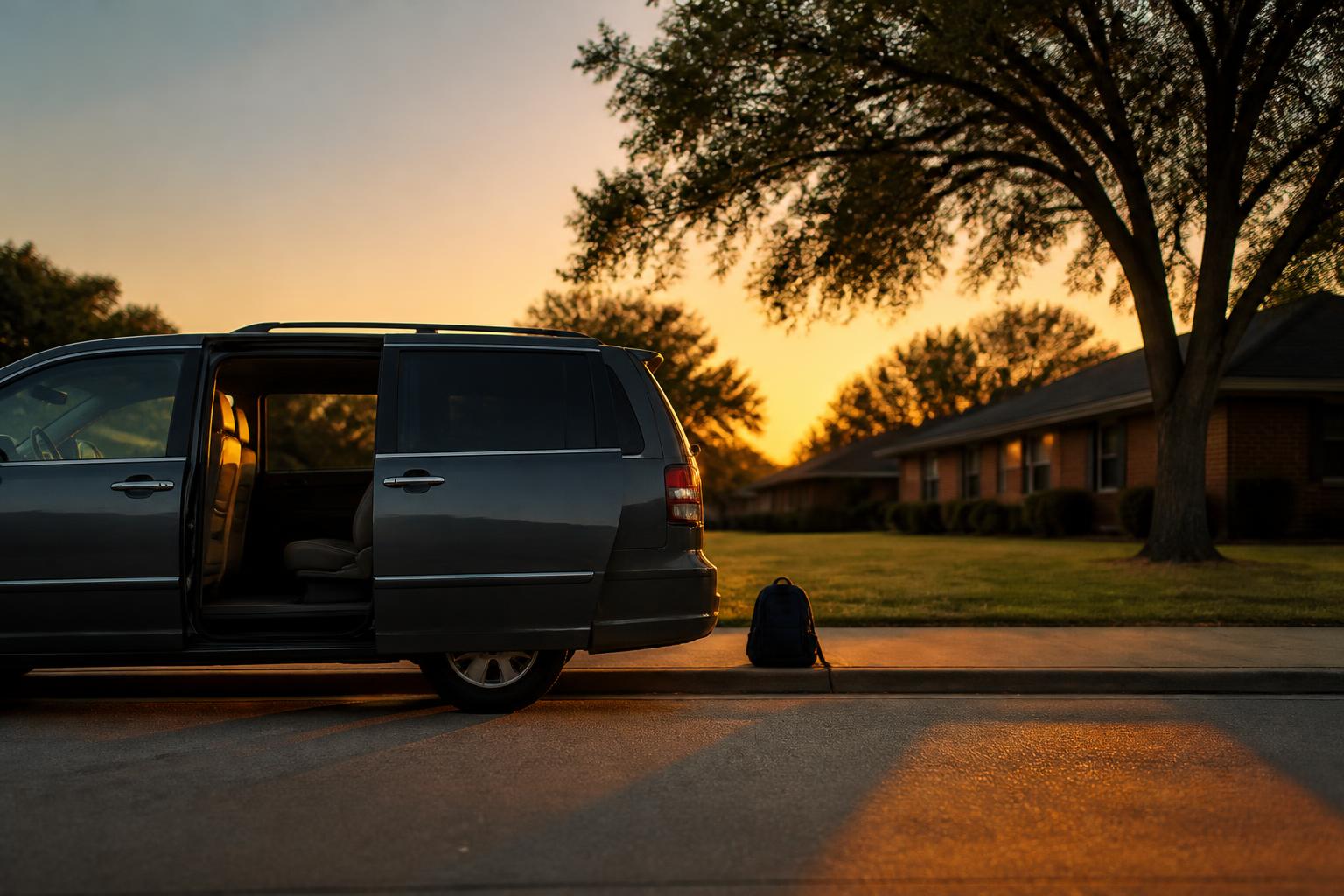
A ride that comes when it is asked for. The course works the same way.
How do online high schools work from Arlington, Texas?
A student logs in from home, or anywhere with a connection, opens a course, works through posted lessons, and submits work for grading. Credits are recorded as courses are finished, on a transcript the school issues.
The address does not change the mechanics. A family on the north side of the city, one near the southern city line, and one living 12 miles east of downtown Fort Worth all get the same courses, the same counselor process and the same diploma. That is the plain answer to how do online high schools work in Arlington, Texas: from the student’s side, the building is wherever they open the laptop. Families comparing nearby pages will find the same program described for Fort Worth students to the west and for families in Dallas to the east.
Is your student enrolled in a school right now?
Does the current schedule fit the household’s week?
Is there a course with a failing grade on the record?
A conversation, not a sales script. Some calls end with the student staying where they are.
Arlington is also a university city, home to UT Arlington, and a college campus runs on something close to the on-demand idea already: courses chosen each term, lectures posted, work done on the student’s own clock between classes. A high school student working this way is practicing the habits campus life asks for, a few years ahead of time. That is a point about routine, not a claim about admissions.
County services for families, from libraries to public health, are listed on the Tarrant County website. Younger brothers and sisters are covered too: the statewide picture for kindergarten through eighth grade sits on our Texas online homeschool page.
Grades 9 through 12 each have their own stop
A student can join at any grade from 9 to 12, at any point in the year. Grades 9 through 12 each have their own course set, and a student can be in two grades at once while a transcript catches up.
- 9th grade online. The foundation year: English 1, Algebra 1, Biology and World History are the usual first requests. See ninth grade online for the full year.
- 10th grade. Geometry and English 2 tend to lead, and this is often the year a transfer student joins. See 10th grade online.
- 11th grade. The heaviest year in most plans, with Algebra 2, Chemistry and United States History. See 11th grade online.
- 12th grade. Government, the last English course and whatever the audit says is still open. See 12th grade online.
The grade label matters less here than in a building. What decides a student’s next course is the transcript, not the year they were born, so a student who is a junior by age and a sophomore by credit simply works on both sets at once until the record lines up.
12 months, and every one open for enrollment
There is no enrollment window. You can start any month of the year, and a student who joins in October is on the same footing as one who joined in August.
This is the on-demand idea at its plainest. Families often call us mid-year because something changed: a move across the Metroplex, a job with new hours, a student who needs a different pace. Waiting for a semester to turn over is not part of the process. The counselor call can happen this week, the audit follows, and the first courses open after that. For anyone weighing a private online high school, cost is the other question on the list; how tuition works explains the structure, and the counselor quotes the exact figure for your student’s grade on the call.
If you want the whole sequence before you pick up the phone, the hub page for our online school and the steps below cover it.
- Book a counselor call, or call 888-242-4262.
- Send the current transcript for the credit audit.
- Open the first courses the audit names.
Ready to open the first course?
Online high school questions from Arlington families
Can my student switch from a district school in the middle of the year?
Yes. A mid-year move is an ordinary way to start. The transcript from the current school is audited first, partial courses are placed, and the next courses open from there. Nothing about the October or March calendar gets in the way.
Does my student have to log in at a set time each day?
No. Lessons are posted in advance and there is no live class to attend. Most students settle into a routine of their own, often a few hours a day, but the hours are theirs to choose.
Who does my student contact when they get stuck?
Questions about a lesson go through the course, and graded work comes back with written feedback. Questions about the schedule, the account or the record go to the assigned student services representative, and planning questions go to the counselor.
Is a diploma from an online school the same as one from a building?
Our diploma is issued by an accredited school on a transcript the school stands behind, at 24 credits. We do not make claims about how a particular employer or college reads it; families who need that answer for a specific program should ask that program directly, and the counselor can tell you what the transcript shows.
What does my student need at home to get started?
A computer with a dependable internet connection, a regular place to work and a routine the household agrees on. Course materials are inside each course. The counselor will talk through the first few weeks with you so the routine is set before the first course opens.
Request the first course when your student is ready. We will be there when you ask.