Dallas County, Texas
Grand Prairie Online High School
Grades 9 through 12 that a student learns to run alone, with support on the line the whole way.
Start the first courseBook the counselor callEmail me the details

Grand Prairie started out in 1863 as Dechman, a townsite Alexander McRae Dechman took in trade for a broken-down wagon and his team of oxen, and it was incorporated as a city in 1909. Its aviation chapter began on September 28, 1940, when North American Aviation broke ground on a plant beside Hensley Field. A year later the company moved production of the T-6 Texan here, and the T-6 was a trainer: the airplane a pilot learned in on the way to flying alone, with an instructor aboard until the student was ready. That is the right picture for a Grand Prairie online high school. The work is done solo. The support is not. This page explains how that works for a family in the city, and it sits under the Texas online high school hub, which covers the whole state, inside our national online high school.
If your teen asks to run high school solo
Then an online high school is a sensible next step, provided the running is handed over gradually. Your student does the coursework alone, at home or anywhere quiet, and a counselor, support and an assigned student services representative stay reachable the whole time.
Families usually reach this page when a teenager has started asking for more control. Sometimes it is a student who finishes classwork fast and wants to move on. Sometimes it is one who works best in the early morning, or one who has a job, a sport or a sibling to help with and wants the school day to fit around it. A classroom with a teacher in the room suits a great many students, and staying where you are can be the right call. This page is for the household where the question has become: could my student run this on their own?
Nobody learns to fly by being handed the airplane on the first morning. You fly with someone in the back seat until they can stop talking. School works the same way, and needing the back seat for a while is no insult.
The Eagle
Here is what we look for on the first call, before any course is chosen. None of these is a test to pass. Each one tells the counselor how much of the week to hand over at the start.
- Sustained focus. Can the student sit with one task for forty-five minutes and come out with something finished?
- Asking for help. Will they send a question when they are stuck, or quietly stop?
- A place. Is there a desk, a corner or a library table that is theirs for school?
- A reason. Do they know why they want this, in their own words?
Three questions before the first call
Can your student work for an hour with the door closed and come out with something done?
Is there a quiet place at home, at a library or at a relative’s that is theirs for school?
Would your student rather talk the plan through with a counselor before choosing a course?
Closing this page and staying where you are can be the right answer too.
Online high school is flown solo, never alone
Independent study does not mean an unsupervised student. In our accredited online high school the student does the work, and a named set of people keeps the work on course.
The difference matters, because the fear most parents bring to the first call is that working alone means drifting alone. It does not have to. A self-paced course still has finished lessons, recorded grades and a plan with dates on it. What changes is who holds the controls on a given week, and that is a decision the family makes with us rather than something that happens by accident.
| Who | What they hold | When you reach them |
|---|---|---|
| The student | The daily work, the pace inside the plan, and the first try at every question | Every day |
| The counselor | The course plan, built on the first call from what the student has already earned | At the start, and when the plan needs to change |
| Support | Help with the course material and the platform when a student is stuck | When the student asks |
| Student services representative | An assigned person for the family’s questions about records, scheduling and next steps | Whenever the family needs one person to call |
| The parent | The household rules, the quiet place, and the say on how much freedom to hand over | At the kitchen table |
Read the table from top to bottom and it is a crew, not a classroom. The student is in the front seat. The others are the instructor in the back, the tower and the ground crew. For the full mechanics of how lessons, grades and courses connect, read how does online high school work?, which covers the parts every family asks about.
Claim
Working alone means nobody is watching the progress.
Reality
Finished work and grades are recorded in each course, and the student has support and an assigned student services representative to contact.
Claim
A self-paced course has no deadline, so it never ends.
Reality
Self-paced means the student sets the speed inside a plan the family agrees on, and that plan has finish dates written into it.
Claim
Independence is something a teen either has or does not.
Reality
It is learned, a little at a time, the same way any skill with a checklist is learned.
Want the counselor to judge how much of the week your student is ready to run?
Hand the high school week over in stages
Do not hand a fourteen-year-old the whole week on the first Monday. Hand over one piece at a time, and let the student earn the next piece by keeping the last one.
That is the practical shape of a self-paced online high school. Self-paced describes the speed, and the speed is the student’s. The plan around it is a family decision, and the sequence below is one that suits many Grand Prairie households new to it. It is an example, not a rule; some students move through it in three weeks and some take a semester.
- Stage one: the parent plans, the student works. A parent sets which lessons happen on which days, and the student’s only job is to finish them.
- Stage two: plan together. A few minutes at the table at the start of the week, the student choosing the order.
- Stage three: the student plans, the parent checks. The student sets the week and a parent looks at the grades each week.
- Stage four: the student runs it. Plans, pace and questions to support all belong to the student, and the parent reads the progress when they choose.
One way a family might hand the week over across a term, not a fixed schedule. Dark cells are where a parent leads. Support is reachable in every column.
The thing that moves a student to the next stage is not age and not a grade point. It is a record of kept promises: a week planned and a week done. Students who skip a stage usually come back to it, and that is ordinary. The counselor can help you decide when to move, and the assigned student services representative is the person to call when the week stops working and you want to know why.
How does a Grand Prairie online high school run?
A student opens the course, works through lessons and assignments in order, and each finished piece is graded and recorded. When every unit is done, the credit goes onto the transcript.
That is all of it, and it is why the family question is less about technology than about routine. For a family searching for an online high school in Grand Prairie, Texas, these are the terms that come up on almost every call, defined the way we use them.
- Course
- One subject, such as English or chemistry, worked from first lesson to last. Our high school courses are listed by subject, and the content follows our American curriculum.
- Credit
- What a finished course is worth on the record. Our diploma takes 24 credits.
- Self-paced
- The student sets the speed. A course can take a few weeks or a full term, inside a plan the family agrees on.
- Transcript
- The school-issued record of every course and grade, the document a college, employer or training program reads.
- Transfer credit
- Credit earned at another school. It is counted on the first call, before any new work is assigned, and the details are on transferring credits.
- Start any month
- Enrollment is open all year, so a student can begin mid-year or in summer without waiting for a new term.
One rule of thumb: if a term on this list is unclear after the first call, ask again. Nobody expects a family to know the vocabulary on day one.
None of these depends on where in the city a family lives, which matters in a place that crosses Dallas, Tarrant and Ellis counties, as the city’s Wikipedia entry lays out. A Grand Prairie TX online high school student works from the same courses whatever the address.
Homeschool transcript versus a school-issued diploma
A homeschool transcript is written and signed by the parent. Ours is issued by the school. Both are legitimate routes, and they suit different families.
Parents researching a home schooling diploma for Grand Prairie TX sometimes come to us halfway through deciding. If the family wants to choose every book and write the record itself, read how to start homeschooling before anything else. If the family wants the teen to work independently but wants a school to keep and issue the record, an online homeschool high school in Grand Prairie Texas usually means something like what we do. The page on how the options compare sets out all three routes side by side.
Family-issued record
The parent chooses the curriculum, keeps the grades and signs the transcript. Freedom is complete, and so is the responsibility for the paperwork.
School-issued record
The student still works independently, at home. The school keeps the grades, issues the transcript and awards the online high school diploma.
Some families choose a middle path, using an accredited home education program for a younger child and moving to a school-issued record in ninth grade. The point is that independence and a school-issued record are not opposites. A private online high school can give a student both.
Tuesday, 7:40 a.m., and a ninth grader logs in
The first week of ninth grade online looks like this: a short list of lessons, one subject at a time, and a parent nearby for the first few mornings.
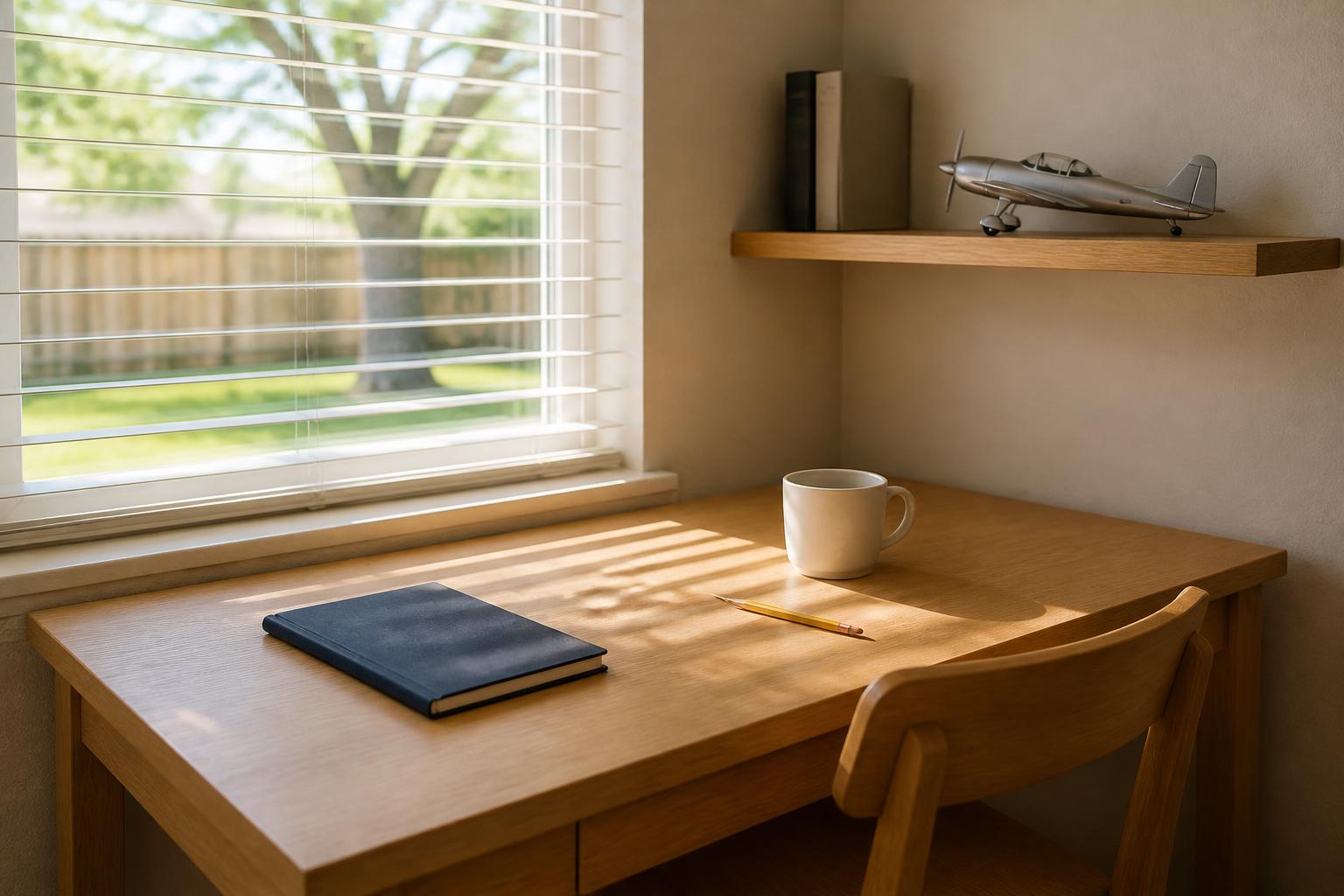
The kitchen still smells of breakfast. The student has the English lesson open first because that was the agreement on Sunday, and the parent is two rooms away with coffee and a laptop of their own. By nine the reading is done and a short response is submitted. Biology is next. There is a question about cell membranes that the textbook did not answer, and for the first time the student writes it down and sends it to support instead of skipping it. That one message is the most important thing that happens all week.
On the first mornings a parent is close by, not hovering: near enough to answer, far enough that the student has to try first.
Families looking for Grand Prairie Texas homeschool curriculum for 9th graders often expect a box of books. What actually arrives is a schedule and a set of courses. The 9th grade online page shows what a first year usually holds. A student who starts here and keeps going will meet 10th grade online, 11th grade online and 12th grade online the same way, with more of the week in their own hands each year.
24 credits, logged like flight hours
Our diploma is earned at 24 credits, recorded one finished course at a time. Every credit stays on the transcript once it is logged, the way hours stay in a pilot’s logbook.
A student pilot does not earn a license in one flight. The hours add up, each one written down, and nobody takes an hour away after it is logged. A Grand Prairie Texas high school diploma from us works the same way. If you want to understand how the count works in general, read how many credits to graduate; for us, the number is 24, across grades 9 through 12. Here is a sample of the online high school courses a student logs along the way.
- EnglishEnglish 1, English 2, English 3
- MathAlgebra 1, Geometry, Algebra 2, Pre-calculus
- ScienceBiology, Chemistry, Physics
- Social studiesWorld History, U.S. History, U.S. Government
- ElectivesArt History and Criticism, with more electives in the full course list
The order is the counselor’s suggestion and the pace is the student’s. A student who likes math can log Algebra 2 in a few weeks and spend longer on English 3. Physics can be the course a student and a parent agree to take more slowly, with more check-ins, because it is where self-teaching is hardest. That is how a self-paced plan stays honest: independence where the student is strong, more support where the subject is steep.
Ready to log the first credit? Enrollment is open this month, like every month.
If your student left high school partway through
Then the credits already earned count first, and only the missing courses are assigned. A student who stopped is not starting over.
This is where independence matters most, because a student coming back after time away is often the one who most needs the work to fit around a job or a family. To finish high school online for Grand Prairie households in that position, the first call is a credit audit: the counselor reads the old transcript, counts what transfers, and builds a plan from there. The route is laid out on the page about how to complete the diploma you started.
A student who left with eleven credits
Thirteen to go is not a restart. The finished courses are counted first and only the missing ones are assigned.
Where a grade did not go well, credit recovery lets a student retake the course and replace the result rather than repeat a whole year. The student works it alone, at their own pace, with the same support as any other course. A transcript from another state or another country is read the same way. Bring whatever record exists, even an unofficial copy, to the first call, and the counselor will tell you what it is worth before anything is assigned.
Returning after time away is common. The plan is built around the job or the family, not the other way round.
Every month is a start month for enrollment
There is no fall deadline. A student can enroll in any month and begin with the courses the counselor plans on the first call.
Twelve months, twelve start dates
That openness is what makes a mid-year start possible, and it is why a start in October or February is as ordinary as one in August. Nearby, families read our pages for online high school in Arlington to the west, Irving’s online high school page to the north and the Dallas online high school to the east; the method on each is the same and the courses are shared. Families with younger children can see our Texas K-12 online home school page, which covers the earlier grades, and our online school home page has the wider picture.
Wherever in the metro the family lives, the courses, the counselor and the record are the same.
Cost questions are answered on the tuition page and on the first call, once the counselor knows how many credits the student needs. Families can also call 888-242-4262 and ask a counselor directly.
Ask the online high school questions first
These are the questions Grand Prairie parents put to our counselors about independence, support and the record, answered plainly.
How much of the day will my teen spend working alone?
Most of it, once the routine is set. In the first weeks a parent is usually nearby, and the plan is to step back as the student keeps their promises. Support is a message away throughout.
Who does my student ask when a lesson makes no sense?
Support, for questions about the course material and the platform. Questions about records, scheduling or the plan go to the family’s assigned student services representative.
What if my student is not ready to plan their own week yet?
Start at stage one, with a parent setting the week. Readiness is built, not required on day one, and a student who needs more check-ins is doing nothing wrong.
Is the diploma issued by the school or by the family?
By the school. The transcript and the diploma are school-issued, and the school is accredited. That is the difference from a family-issued homeschool record.
Can credits from a Grand Prairie high school count toward the 24?
Yes, where they transfer. The counselor reviews the transcript on the first call and counts what applies before any new course is assigned.
Can a student start in the middle of the semester?
Yes. Enrollment is open in every month, so a mid-year start is ordinary, and the counselor plans the first courses around where the student already is.
The first call hands over the controls slowly
Bring the old transcript if there is one, and an honest sense of how much of the week your student can run today. The counselor will count the credits, suggest a first course and a starting stage, and you will leave the call knowing who your student calls when they are stuck.